A shopper no longer needs to sit at a desktop, open a browser, and deliberately search for a product before making a purchase. A product can appear in a short video, a recommendation can come from an AI assistant, a question can be answered on WhatsApp, and the purchase can happen within minutes. This shift is one reason the mobile commerce market continues to expand. The global mobile commerce market was valued at USD 2.42 trillion in 2026 and is projected to reach USD 5.01 trillion by 2034, growing at a CAGR of 9.5%.
What makes this growth interesting is not simply the number of people shopping on smartphones. The bigger change is how mobile shopping is becoming more intelligent, visual, social, personalized, and almost invisible. This blog explores the Mobile Commerce Trends shaping that shift, from AI-powered discovery and social commerce to mobile payments, AR, conversational shopping, faster checkout, and agentic commerce. It also looks at the technologies businesses need to turn these mobile shopping trends into practical growth opportunities.
What Is Mobile Commerce and Why Is It Growing?
Mobile commerce, or m-commerce, refers to buying and selling products or services through smartphones and tablets. It includes purchases made through mobile websites, shopping apps, social platforms, digital wallets, messaging applications, and other mobile-enabled channels. The important distinction is that mobile commerce is no longer simply a smaller version of desktop eCommerce. Consumers behave differently on mobile. They browse while commuting, compare products while standing inside stores, respond to social content, use voice or AI to find recommendations, and expect payment to take seconds.
This behavior is pushing businesses to rethink their mobile commerce strategy. A mobile storefront now needs to support the entire customer journey, starting with product discovery through social content, creator recommendations, or AI-powered suggestions. During research, shoppers expect detailed product information, reviews, comparison tools, videos, and increasingly, AR experiences. At the decision stage, personalized recommendations and relevant offers can influence the purchase, while a fast and secure checkout helps prevent customers from dropping off at the final step. The experience does not end after payment either. Real-time delivery updates, simple returns, responsive customer support, loyalty programs, and personalized recommendations all contribute to whether a customer comes back.
The result is a broader shift in mobile commerce growth, where convenience alone is no longer enough. The experience needs to feel relevant at every interaction.
What Are the 7 Mobile Commerce Trends Shaping the Next Generation of Shopping?
From AI-powered recommendations to faster payments and social shopping, these m-commerce trends are changing how customers discover, evaluate, and purchase products on mobile.
1. AI Is Becoming the New Shopping Assistant
AI is shifting mobile shopping from keyword searches to conversational discovery. It can understand customer intent, recommend products, personalize offers, and simplify product research. Generative AI in eCommerce is also enabling smarter search, automated support, and personalized experiences.
2. Social Commerce Is Turning Scrolling Into Shopping
Social platforms are becoming product discovery and purchase channels. Shoppable posts, creator content, live shopping, and user-generated content can shorten the journey from discovering a product to buying it.
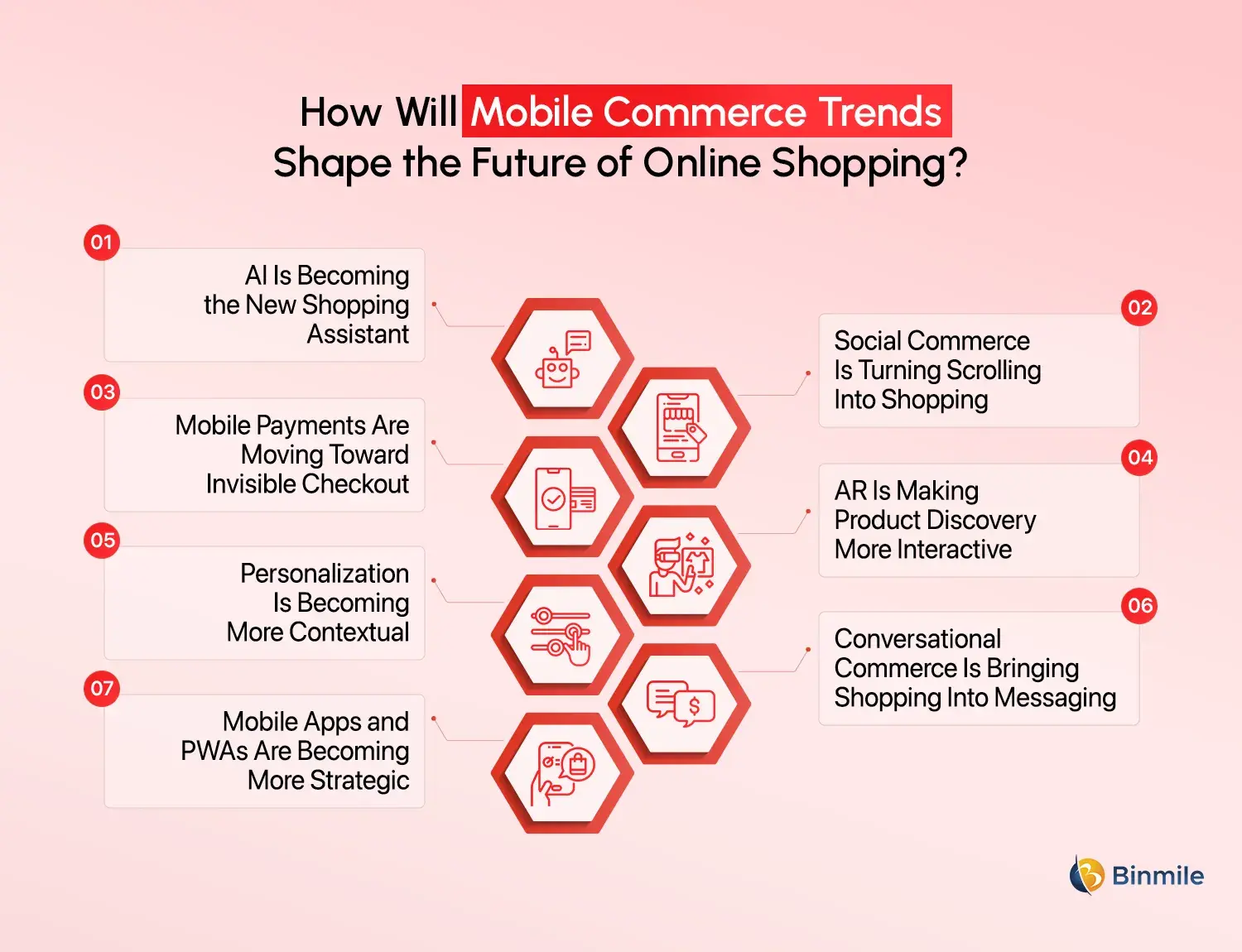
3. Mobile Payments Are Moving Toward Invisible Checkout
Customers expect faster, simpler payments. Digital wallets, UPI, saved cards, one-click checkout, biometrics, and tokenization are helping businesses create smoother mobile checkout experiences while maintaining security.
4. AR Is Making Product Discovery More Interactive
AR allows customers to visualize products before buying, from trying on eyewear to placing furniture in their homes. These AR mobile commerce trends can make online purchases more interactive and reduce uncertainty.
5. Personalization Is Becoming More Contextual
Mobile personalization is moving beyond purchase history. Businesses can use browsing behavior, preferences, location, timing, and real-time activity to deliver more relevant recommendations and offers.
6. Conversational Commerce Is Bringing Shopping Into Messaging
Customers can discover products, ask questions, check availability, and track orders through messaging platforms. AI chatbots combined with human support can make these interactions faster and more convenient.
7. Mobile Apps and PWAs Are Becoming More Strategic
Businesses are choosing between apps, responsive websites, and PWAs based on customer behavior and goals. Apps can support loyalty and personalization, while websites offer broader reach and easier discovery. The right mobile app development technologies help deliver scalable experiences.
Mobile Commerce Technology: What Businesses Need Behind the Experience
A polished mobile storefront is only the visible layer. Behind it sits a technology ecosystem connecting the frontend with product catalogs, inventory, payment systems, customer data, order management, analytics, logistics, and customer support.
A scalable mobile commerce technology stack can include mobile applications or responsive web experiences, APIs and microservices, cloud infrastructure, headless commerce architecture, product information management, customer data platforms, payment services, AI and machine learning, analytics and personalization engines, CRM and marketing automation, and order and inventory management.
This integration is important because fragmented systems quickly create fragmented customer experiences. A customer may see a product as available online while the store inventory says otherwise. A promotion may work on the website but not inside the app, or a payment may succeed while the order system fails to update.
These are not just technical problems. They directly affect customer trust, conversion rates, and the overall mobile shopping experience.
Want to turn emerging mobile commerce trends into a scalable digital shopping experience?

Mobile Commerce Applications Are Expanding Beyond Retail
The term m-commerce often makes people think about online shopping, but m-commerce Applications extend much further.
Mobile commerce can support a wide range of activities, including retail purchases, food ordering, travel bookings, event ticketing, banking and financial services, subscription services, digital goods, grocery delivery, healthcare appointments, and on-demand services.
This expansion is one reason mobile commerce solutions need to be designed around specific customer journeys rather than generic mobile eCommerce templates.
A grocery application, for example, has very different requirements from a luxury fashion platform. One may prioritize speed, repeat purchases, and location-aware delivery. The other may focus more heavily on visual discovery, personalization, storytelling, and AR.
Mobile App or Responsive Website: Which Should Businesses Choose?
There is no universal answer.
A business should first understand how frequently customers purchase, where discovery happens, how much personalization is required, and whether customers will benefit from app-specific functionality. For businesses with frequent repeat purchases, loyalty programs, personalized experiences, and high customer engagement, an app can provide significant advantages.
For businesses focused on organic discovery, broad reach, or occasional purchases, a mobile-optimized website may be the better starting point. Many mature businesses ultimately use both. The important thing is to ensure that customers can move between channels without losing context. A shopper should be able to browse on a website, continue on an app, ask a question through messaging, and still see the same cart, account, order information, and preferences.
How Businesses Can Prepare for the Next Phase of Mobile Commerce
Following every new technology trend is not a strategy. Businesses should first identify where customers experience friction and then determine which technologies can solve those problems.
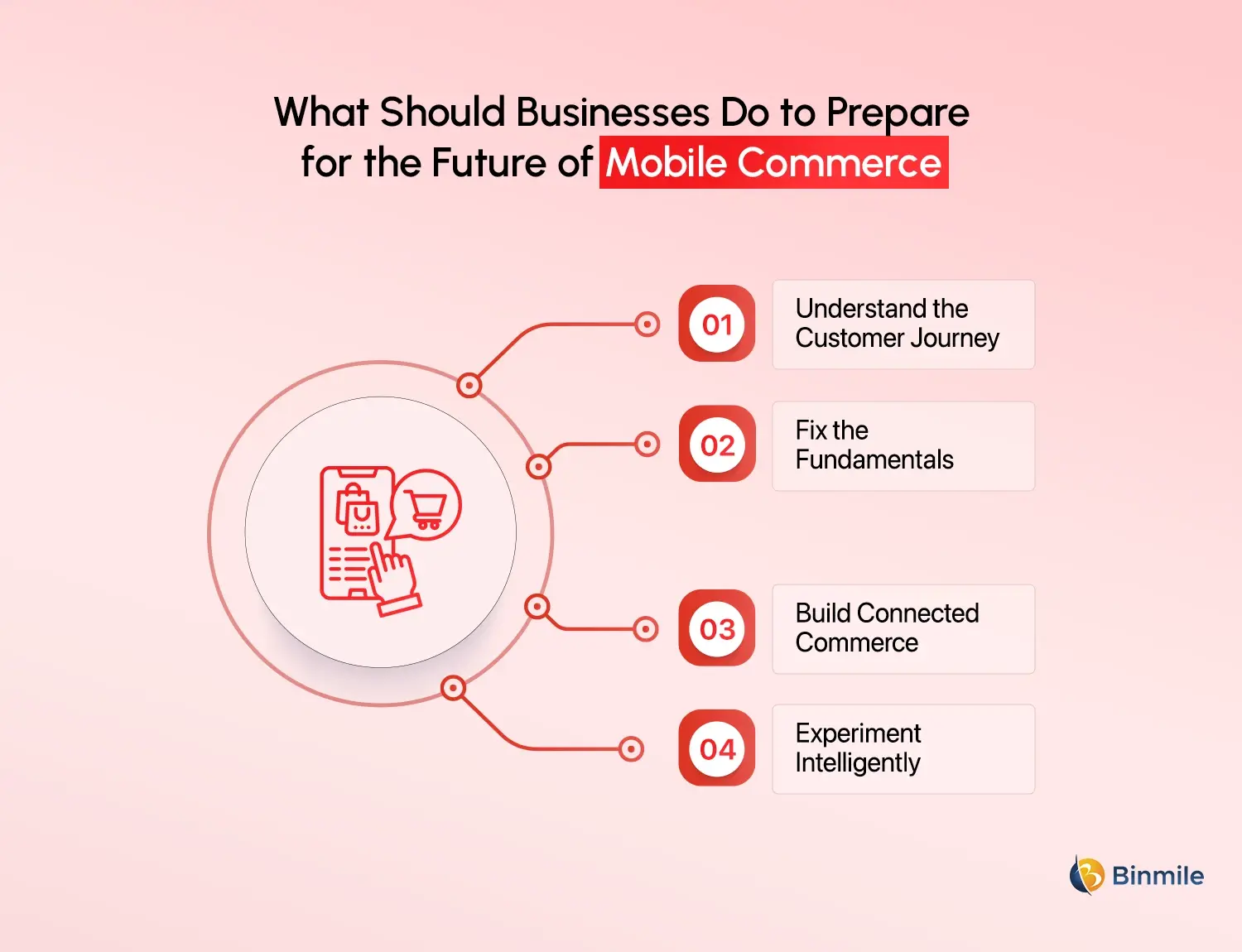
A practical approach starts with four areas:
-
Understand the Customer Journey
Map where customers discover products, compare options, abandon carts, make payments, seek support, and return to purchase.
-
Fix the Fundamentals
Improve mobile performance, navigation, search, product information, accessibility, checkout, and payment reliability before adding complex features.
-
Build Connected Commerce
Integrate mobile experiences with inventory, CRM, payment, order management, analytics, and customer support.
-
Experiment Intelligently
Test AI recommendations, AR, social commerce, conversational experiences, loyalty features, and new payment methods based on measurable business outcomes.
The strongest mobile commerce strategy is therefore not about adding the most technology. It is about using technology where it removes friction or creates a meaningful reason for customers to stay, purchase, and return.
Ready to build a faster, smarter mobile shopping experience that keeps pace with changing customer expectations?

How a Technology Partner Can Help Businesses Capitalize on Mobile Commerce Trends
Turning emerging trends into a working commerce ecosystem requires more than building another shopping app. Businesses often need to modernize existing systems, connect fragmented platforms, integrate payments, introduce AI, improve mobile performance, and create consistent experiences across web, app, social, and messaging channels.
This is where a technology partner such as Binmile can contribute across the broader digital commerce lifecycle. From Mobile eCommerce and Mobile App Development to eCommerce Website Development, payment integration, AI-enabled experiences, and modern commerce architecture, the focus can remain on connecting technology decisions with actual customer and business requirements.
The right implementation approach also leaves room for future changes. As AI shopping assistants, agentic commerce, social selling, new payment methods, and immersive experiences mature, businesses should not have to rebuild their commerce foundation every time the market changes. A flexible architecture, strong payment gateway integrations, reliable data, and a mobile-first customer experience provide the foundation for adapting to what comes next.
Frequently Asked Questions
Businesses should watch AI-powered shopping, social commerce, conversational shopping, faster mobile checkout, digital wallets, AR product visualization, contextual personalization, and agentic commerce. Together, these trends are making mobile shopping more interactive, personalized, and frictionless.
AI is improving product discovery, recommendations, search, customer support, personalization, and marketing automation. It can understand shopper intent and provide more relevant suggestions, while emerging agentic systems can increasingly assist with product selection and purchasing.
Mobile payments reduce checkout friction and let customers complete purchases quickly from their phones. Digital wallets, UPI, tokenization, biometrics, and other payment methods also help businesses support different customer preferences while improving convenience and security.
Businesses can combine short-form video, creator content, shoppable posts, live shopping, and messaging to shorten the journey from discovery to purchase. Connecting social channels with product catalogs, payments, inventory, and customer data can make the experience more seamless.
The choice depends on customer behavior and business goals. Responsive websites work well for discovery and broad reach, while apps are valuable for frequent purchases, loyalty, personalization, and engagement. Many established businesses benefit from offering both connected experiences.
A technology partner can help assess the existing commerce ecosystem, design mobile experiences, integrate payment and backend systems, implement AI and personalization, modernize applications, and build scalable m-commerce solutions that can adapt as customer expectations and technologies evolve.