A threat intelligence platform is quickly becoming a core part of enterprise security operations as organizations deal with growing volumes of threat data, fragmented security tools, and increasingly targeted attacks. The market reflects that shift. The global threat intelligence market was valued at USD 6.87 billion in 2025 and is projected to reach USD 31.58 billion by 2034, growing at a CAGR of 18.30%. For enterprises, however, the challenge is not simply adopting another security tool. The real value comes from turning scattered intelligence into useful context, faster decisions, and coordinated action.
That makes implementation just as important as platform selection. This blog explores what enterprises should consider before threat intelligence platform implementation, how a cyber threat intelligence platform fits into the wider security ecosystem, the essential components of its architecture, the implementation process, common challenges, and a practical checklist for evaluating whether the platform is ready to support long-term security operations.
What Is a Threat Intelligence Platform?
A threat intelligence platform is a security solution that collects, analyzes, enriches, and manages threat data from multiple sources to help organizations identify, assess, and respond to cyber threats. It turns raw data such as malicious IP addresses, domains, malware indicators, vulnerabilities, and threat actor information into actionable intelligence for security teams.
Threat intelligence can come from commercial feeds, open-source intelligence, internal security logs, vulnerability databases, incident investigations, malware research, and other sources. A platform brings these inputs together, normalizes and enriches them, and helps security teams understand which threats actually matter to their environment.
A modern cyber threat intelligence software solution can connect this intelligence with security operations tools such as SIEM, SOAR, EDR, firewalls, vulnerability scanners, and ticketing systems, particularly when threat intelligence also supports threat modeling with DevOps and broader security workflows.
Instead of asking analysts to manually move information between systems, the platform can help automate enrichment, prioritization, investigation, and selected response actions.
What Are the Benefits of a Threat Intelligence Platform for Enterprises?
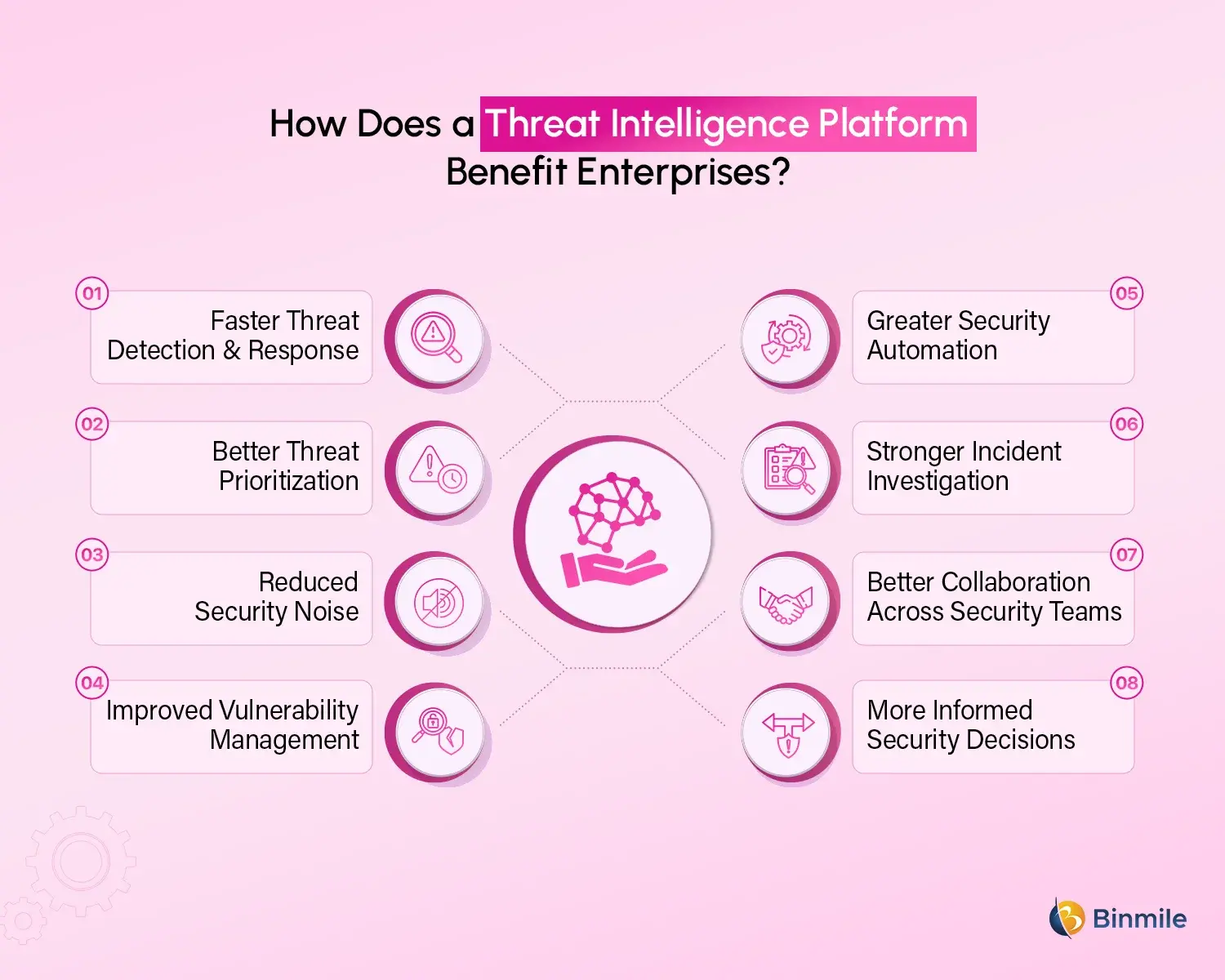
A threat intelligence platform helps enterprises convert scattered threat data into actionable insights, enabling faster detection, better prioritization, and more informed cybersecurity decisions.
-
Faster Threat Detection and Response
Connects threat intelligence with security tools to identify relevant threats faster, reduce investigation time, and enable security teams to respond before threats escalate.
-
Better Threat Prioritization
Enriches threat indicators with relevant context, helping analysts distinguish critical risks from low-priority alerts and focus resources on threats with greater business impact.
-
Reduced Security Noise
Filters duplicate, outdated, and irrelevant intelligence from multiple sources, reducing unnecessary alerts and helping security analysts focus on genuinely actionable threats.
-
Improved Vulnerability Management
Combines vulnerability information with threat intelligence to identify actively exploited weaknesses, helping enterprises prioritize remediation based on real-world risk and potential business impact.
-
Greater Security Automation
Automates repetitive activities such as threat feed processing, indicator enrichment, alert correlation, and ticket creation, allowing security teams to focus on complex investigations.
-
Stronger Incident Investigation
Provides historical threat context, related indicators, and threat actor information, helping analysts understand attack patterns and investigate incidents more thoroughly and efficiently.
-
Better Collaboration Across Security Teams
Creates a centralized intelligence layer that enables SOC analysts, incident responders, threat researchers, and security teams to share relevant information and coordinate responses.
-
More Informed Security Decisions
Transforms raw security data into contextual intelligence. The intelligence it produces can support risk management, security planning, threat modeling, and broader cybersecurity practices.
What Should Enterprises Consider Before Implementation?
Implementation should begin with business and security requirements, not with a list of platform features.
An enterprise operating in financial services, healthcare, retail, manufacturing, or government may have very different threat profiles and compliance requirements. Similarly, a large organization with multiple SOCs and thousands of endpoints will have different integration and scalability needs than a smaller security team.
Before selecting a platform, security leaders should define:
- Intelligence Requirements: Identify the threats, actors, vulnerabilities, industries, regions, and assets that matter most.
- Data Sources: Determine which commercial, open-source, internal, and third-party feeds need to be integrated.
- Existing Security Stack: Map the SIEM, SOAR, EDR, firewall, vulnerability management, identity, ticketing systems, and modern application security tools already in use.
- Automation Requirements: Decide which activities can be automated and where human approval should remain mandatory.
- Users and Stakeholders: Define what SOC analysts, threat researchers, incident responders, vulnerability teams, and executives need from the platform.
- Governance Requirements: Establish access controls, data retention, auditability, privacy, and regulatory requirements.
Starting with these questions prevents a common implementation mistake: collecting as much intelligence as possible without knowing what the organization actually needs.
What Should a Threat Intelligence Platform Architecture Include?
A well-designed threat intelligence platform architecture should create a connected flow from data collection to analysis and response.
A typical architecture includes the following layers:
| Layer | Purpose |
|---|---|
| Data Ingestion | Collects intelligence from feeds, APIs, OSINT, internal systems, and security tools. |
| Normalization | Converts data from different formats into a consistent structure. |
| Enrichment | Adds context around indicators, vulnerabilities, malware, actors, and campaigns. |
| Correlation | Connects related indicators, assets, vulnerabilities, and threat actors. |
| Analysis | Identifies patterns, relationships, risk levels, and potential threats. |
| Intelligence Management | Stores, organizes, searches, and manages intelligence throughout its lifecycle. |
| Integration | Connects intelligence with SIEM, SOAR, EDR, ticketing, and other security tools. |
| Automation | Triggers predefined workflows, alerts, investigations, or response actions. |
| Reporting | Converts intelligence into dashboards, reports, and decision-ready insights. |
The architecture should also support structured threat intelligence standards and secure APIs. More importantly, it should allow intelligence to move in both directions. Security tools should feed relevant information into the platform, while enriched intelligence should flow back into operational systems.
This creates a security ecosystem where intelligence becomes part of everyday workflows rather than remaining isolated within a specialist team.
What Is the Threat Intelligence Platform Development Process?
For enterprises building or heavily customizing a platform, the threat intelligence platform development process should follow a phased approach.
1. Define Intelligence Requirements
Start by identifying what the organization wants the platform to accomplish. This could include threat detection, threat hunting, vulnerability prioritization, incident response, fraud detection, third-party risk monitoring, or executive reporting.
2. Design the Data Strategy
Identify the sources that will provide useful intelligence. This includes commercial feeds, OSINT, internal telemetry, vulnerability databases, malware repositories, incident data, and industry-specific intelligence.
The goal should not be maximum data volume. It should be of maximum relevance.
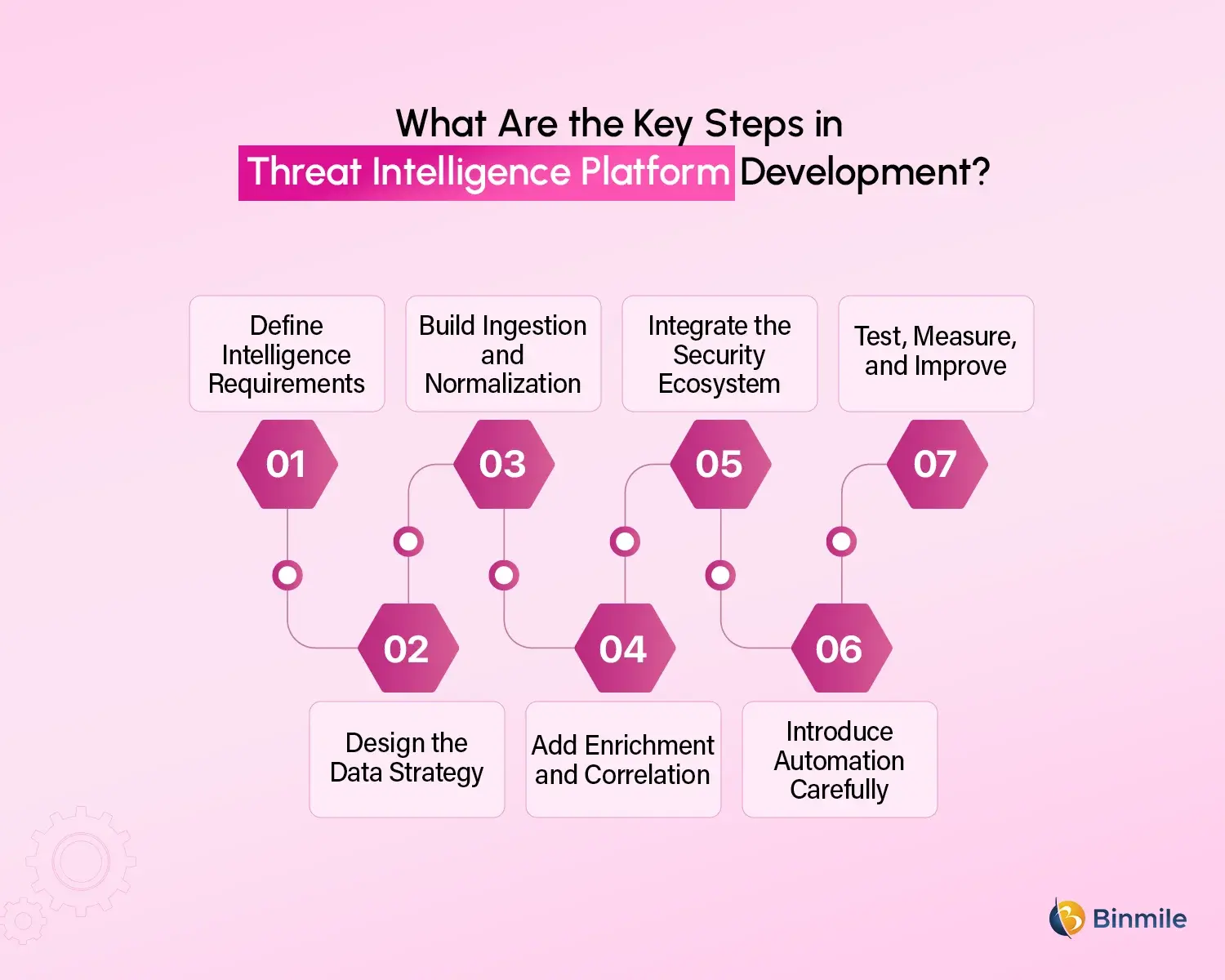
3. Build Ingestion and Normalization
Threat data arrives in different formats and levels of quality. The platform needs reliable ingestion pipelines that can parse, normalize, validate, deduplicate, and organize incoming information.
This stage is particularly important because poor-quality or duplicated data can quickly reduce analyst confidence in the platform.
4. Add Enrichment and Correlation
Raw indicators become more useful when connected with context. An IP address, domain, file hash, CVE, or malware family should ideally be linked with related actors, campaigns, vulnerabilities, assets, and historical observations.
This enables analysts to investigate relationships instead of reviewing isolated indicators.
5. Integrate the Security Ecosystem
The platform should connect with existing security infrastructure through APIs, connectors, or standardized interfaces. Integrations with SIEM, SOAR, EDR, vulnerability management, firewalls, and ticketing platforms are particularly valuable.
6. Introduce Automation Carefully
Not every security action should happen automatically. High-confidence, low-risk activities may be automated, while sensitive actions can require analyst approval.
For example, the platform might automatically enrich an alert or create a ticket but require human approval before blocking an IP address across critical systems.
7. Test, Measure, and Improve
Before enterprise-wide deployment, test data quality, integrations, workflows, scalability, access controls, and response automation. After deployment, monitor metrics such as false-positive rates, analyst workload, response times, intelligence utilization, and the percentage of actionable intelligence reaching security operations.
Looking to build a threat intelligence capability that fits your enterprise security ecosystem?

What Should Be on a Threat Intelligence Platform Checklist?
A practical threat intelligence platform checklist can help security leaders compare solutions against actual operational requirements.
| Evaluation Area | Questions to Ask |
|---|---|
| Data Ingestion | Can the platform support the required internal and external sources? |
| Data Quality | Does it normalize, validate, deduplicate, and enrich intelligence? |
| Threat Context | Can it connect indicators with actors, campaigns, vulnerabilities, and assets? |
| Integrations | Does it integrate with the existing SIEM, SOAR, EDR, and ticketing stack? |
| Automation | Can repetitive intelligence and response workflows be automated safely? |
| Scalability | Can it handle growing data volumes, users, sources, and security events? |
| API Support | Are APIs available for custom integrations and future expansion? |
| Access Control | Can access and permissions be managed according to organizational roles? |
| Reporting | Can technical intelligence be converted into useful reports for different stakeholders? |
| Auditability | Can teams track intelligence sources, changes, decisions, and response actions? |
| Usability | Can analysts find and understand relevant intelligence without excessive manual effort? |
A platform that performs well in a product demonstration may still fail in production if it does not fit the organization’s workflows. Evaluation should therefore include real use cases, sample data, integration testing, and analyst feedback.
What Are the Common Challenges in Threat Intelligence Platform Implementation?
Even a capable platform can underperform when implementation is poorly planned.
-
Too Many Feeds, Too Little Relevance
Connecting every available intelligence feed may look impressive, but it can overwhelm analysts with low-value indicators. Organizations should begin with sources aligned with their intelligence requirements and expand gradually.
-
Poor Data Quality
Duplicate, outdated, or unreliable intelligence can increase false positives and waste analyst time. Data validation, confidence scoring, expiration rules, and lifecycle management should be established early.
-
Limited Integration
A platform operating separately from the SOC creates another dashboard for analysts to monitor. Integration should be considered a core implementation requirement rather than an optional feature.
-
Over-Automation
Automation can reduce repetitive work, but poorly designed automation can also amplify mistakes. Organizations should establish confidence thresholds, approval workflows, rollback mechanisms, and audit trails before automating sensitive actions.
-
Lack of Ownership
Threat intelligence touches multiple teams. Without clear ownership across security operations, threat intelligence, vulnerability management, incident response, and IT, intelligence may be generated but not acted upon.
-
Measuring Activity Instead of Impact
Counting feeds, indicators, or reports does not necessarily demonstrate value. Better metrics include faster incident response, improved detection accuracy, reduced false positives, better vulnerability prioritization, and measurable reductions in manual work.
How Can a Global Threat Intelligence Platform Support Enterprise Security?
For multinational organizations, a Global Threat Intelligence Platform needs to account for more than geographic scale.
Threat activity varies across regions, industries, technologies, and regulatory environments. Enterprises may need localized intelligence while maintaining a centralized view of global threats.
A scalable platform should therefore support multiple teams, regional security operations, different intelligence requirements, multilingual data sources where necessary, and role-based access. It should also provide a common intelligence layer so teams can share relevant information without losing control over sensitive data.
This becomes especially valuable for organizations operating distributed cloud environments, global supply chains, and multiple business units.
How Much Does Threat Intelligence Platform Development Cost?
The threat intelligence platform development cost depends heavily on the scope and level of customization.
A basic implementation that focuses on feed aggregation, normalization, dashboards, and selected integrations will require less investment than an enterprise-grade platform with advanced analytics, automated response, AI-assisted enrichment, extensive integrations, multi-tenant capabilities, and high-availability infrastructure.
The major cost factors usually include the number and complexity of integrations, intelligence sources and licensing requirements, data storage and processing volume, custom analytics and scoring models, automation and response workflows, user roles and access controls, cloud or on-premises deployment, compliance and audit requirements, AI in risk management and machine learning capabilities, and ongoing maintenance and platform enhancements.
For this reason, enterprises should avoid relying on a generic development-cost estimate. A more reliable approach is to define the required capabilities, prioritize an MVP, and estimate subsequent phases based on integration complexity and operational requirements.
Need to turn threat intelligence into faster, smarter security decisions?
How Can Binmile Help With Threat Intelligence Platform Implementation?
A threat intelligence platform delivers value when intelligence reaches the right system, the right team, and the right decision at the right time. That requires more than platform configuration. It requires an understanding of security workflows, integrations, data architecture, automation, and the organization’s wider technology environment.
Binmile can support enterprises in planning and implementing threat intelligence capabilities around their existing security ecosystem, from defining requirements and designing the architecture to integrating security tools, developing workflows, and improving operational visibility. Its broader expertise across Cyber Threat Intelligence, AI in Risk Management, Threat Modeling With DevOps, Modern Applications Security, Cybersecurity Practices, and ServiceNow SecOps can also help organizations connect threat intelligence with wider security and risk processes.
The objective is not simply to add another cybersecurity platform. It is to create a threat-informed security operation where intelligence can support faster detection, better prioritization, and more confident response as the enterprise threat landscape continues to change.
Frequently Asked Questions
A threat intelligence platform collects, organizes, enriches, and analyzes threat data from multiple sources. It helps enterprises identify relevant risks, reduce security noise, prioritize threats, and connect intelligence with detection, investigation, and response workflows.
Start with clear intelligence requirements, select relevant data sources, prioritize data quality, integrate existing security tools, automate carefully, establish governance, and continuously measure performance. A phased implementation usually reduces operational disruption and improves adoption.
It turns fragmented threat data into actionable intelligence by adding context around indicators, vulnerabilities, actors, and campaigns. Integration with security tools can also accelerate detection, improve investigation, prioritize vulnerabilities, and automate selected response activities.
Common challenges include excessive data feeds, poor-quality intelligence, integration gaps, weak governance, over-automation, and unclear ownership. Without defined requirements and workflows, organizations may end up with more security data without achieving better security outcomes.
A cybersecurity partner can help define requirements, design the platform architecture, integrate security systems, configure intelligence workflows, implement automation, and establish governance. This can reduce implementation risks while helping the platform align with existing enterprise security operations.