AI adoption is moving from isolated experiments to an expanding network of agents, models, workflows, and AI-powered applications. This shift is significant. According to IDC, AI solutions and services are expected to generate a cumulative global impact of $22.3 trillion by 2030, making the ability to manage AI investments almost as important as making them. This is why ServiceNow AI Control Tower is becoming relevant for enterprises managing increasingly complex AI environments. The problem that arises is that enterprises are no longer dealing with one AI system. They may have dozens or hundreds of agents working across IT, customer service, HR, security, operations, and business workflows, often across multiple platforms.
That is where an AI Control Tower becomes relevant. Instead of managing AI agents as disconnected projects, enterprises can establish a centralized AI Control Tower layer for discovering, governing, monitoring, securing, and measuring their AI ecosystem. This guide explains what an AI Control Tower is, why agent sprawl is becoming a serious enterprise challenge, its core components and AI Control Tower architecture, how ServiceNow approaches AI governance, practical AI Control Tower use cases, and what organizations should consider before implementation.
What Is a ServiceNow AI Control Tower?
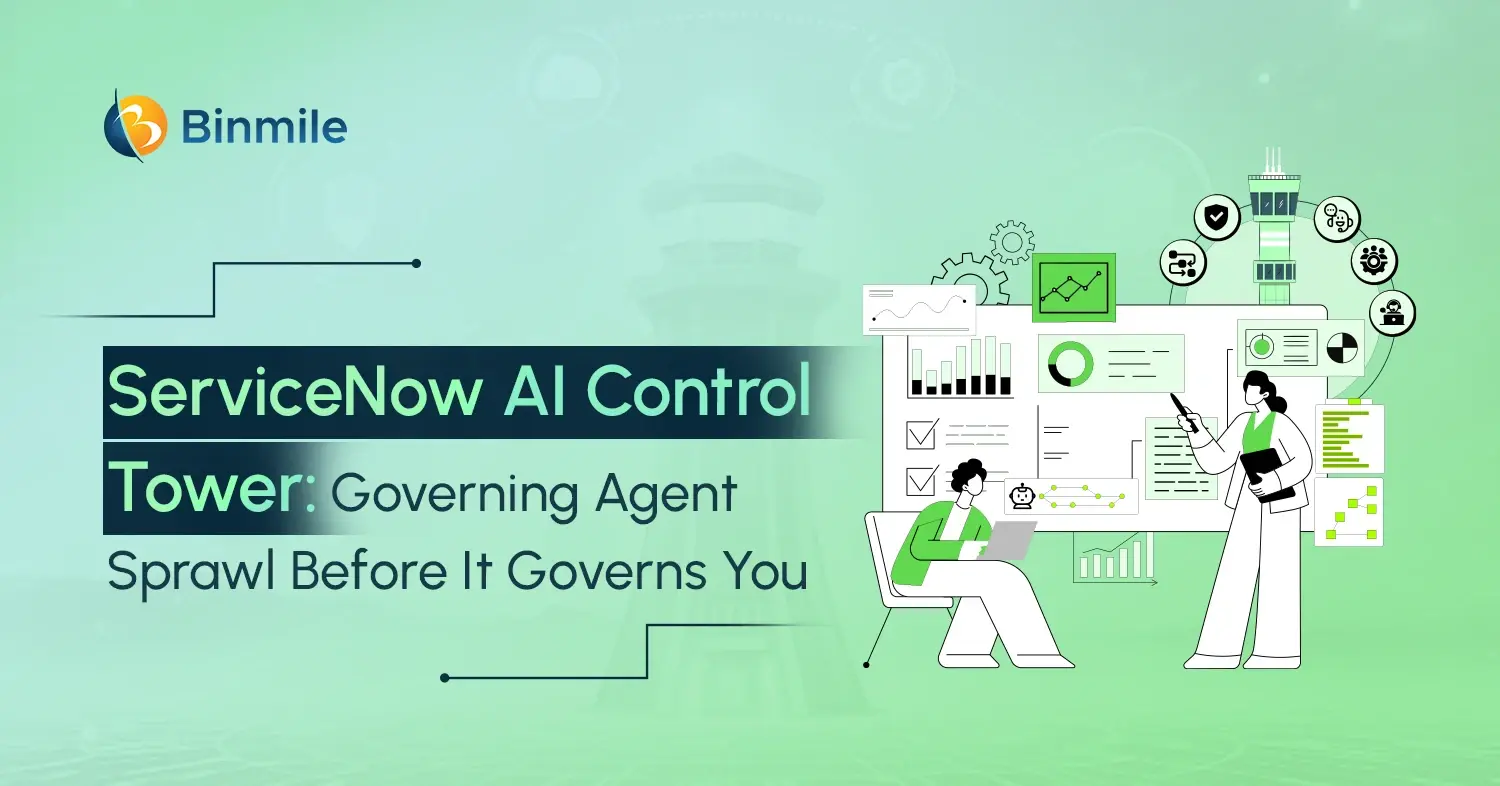
An AI Control Tower is a centralized management and governance layer that gives enterprises visibility and control over their AI ecosystem. Instead of managing agents, models, and workflows separately, it provides a unified view of their ownership, dependencies, risks, performance, and business value.
Think of it as an operational command center for enterprise AI. As organizations deploy more agents across IT, customer service, security, and business operations, managing them individually becomes difficult. An AI Control Tower Workspace can provide a more structured way to view and manage these assets.
ServiceNow’s AI Control Tower brings together AI asset inventory, value, health, risk and compliance, security and privacy, and AI cases. The goal is not just to track AI assets, but to ensure they remain safe, compliant, effective, and aligned with business objectives through stronger AI Control Tower governance.
Why Is Agent Sprawl Becoming an Enterprise Problem
AI agent sprawl happens when organizations deploy multiple AI agents without centralized visibility, ownership, governance, or lifecycle controls.
It often starts with useful initiatives: a service desk agent for ticket classification, an HR assistant for employee queries, or a security agent for investigations. Individually, these systems may work well, but collectively, they can create a complex ecosystem that becomes difficult to manage.
| Without Centralized Control | With Centralized AI Management |
|---|---|
| Unknown AI assets | Centralized AI inventory |
| Unclear ownership | Defined ownership and accountability |
| Duplicate agents | Identification of overlapping assets |
| Inconsistent policies | Standardized governance controls |
| Limited risk visibility | Risk and compliance monitoring |
| Isolated performance data | Portfolio-level analytics |
| Difficult lifecycle management | Structured onboarding and retirement |
| Unclear business value | Value and outcome tracking |
The bigger concern is that AI agents can act on enterprise systems rather than simply provide information. An agent may access data, trigger workflows, communicate with another agent, or execute an action.
That makes uncontrolled growth more than an IT management problem. It can become a security, compliance, operational, and financial issue, making AI Risk Management an important part of enterprise AI oversight.
AI Governance vs. AI Control Tower: What Is the Difference?
AI governance defines the policies, roles, controls, and accountability needed to manage AI responsibly. An AI Control Tower puts those principles into practice by providing centralized visibility, risk monitoring, approvals, and lifecycle management.
Simply put, an AI Governance Framework defines the rules, while an AI Control Tower helps operationalize and monitor them at scale.
This distinction becomes important as organizations move from managing a few AI systems to overseeing hundreds of agents and assets.
What Are the Components of a ServiceNow AI Control Tower?
The exact capabilities can vary by platform and implementation, but the components of a ServiceNow AI Control Tower generally need several interconnected capabilities.
1. AI Asset Discovery and Inventory
A reliable inventory provides visibility into AI agents, models, prompts, datasets, integrations, and dependencies. ServiceNow’s AI Control Tower helps bring these assets into a structured view across ServiceNow and external AI environments.
2. AI Risk and Compliance
Different AI systems possess different levels of risk. An AI Control Tower helps organizations assess risk, monitor compliance, and apply appropriate controls based on each asset’s purpose and access.
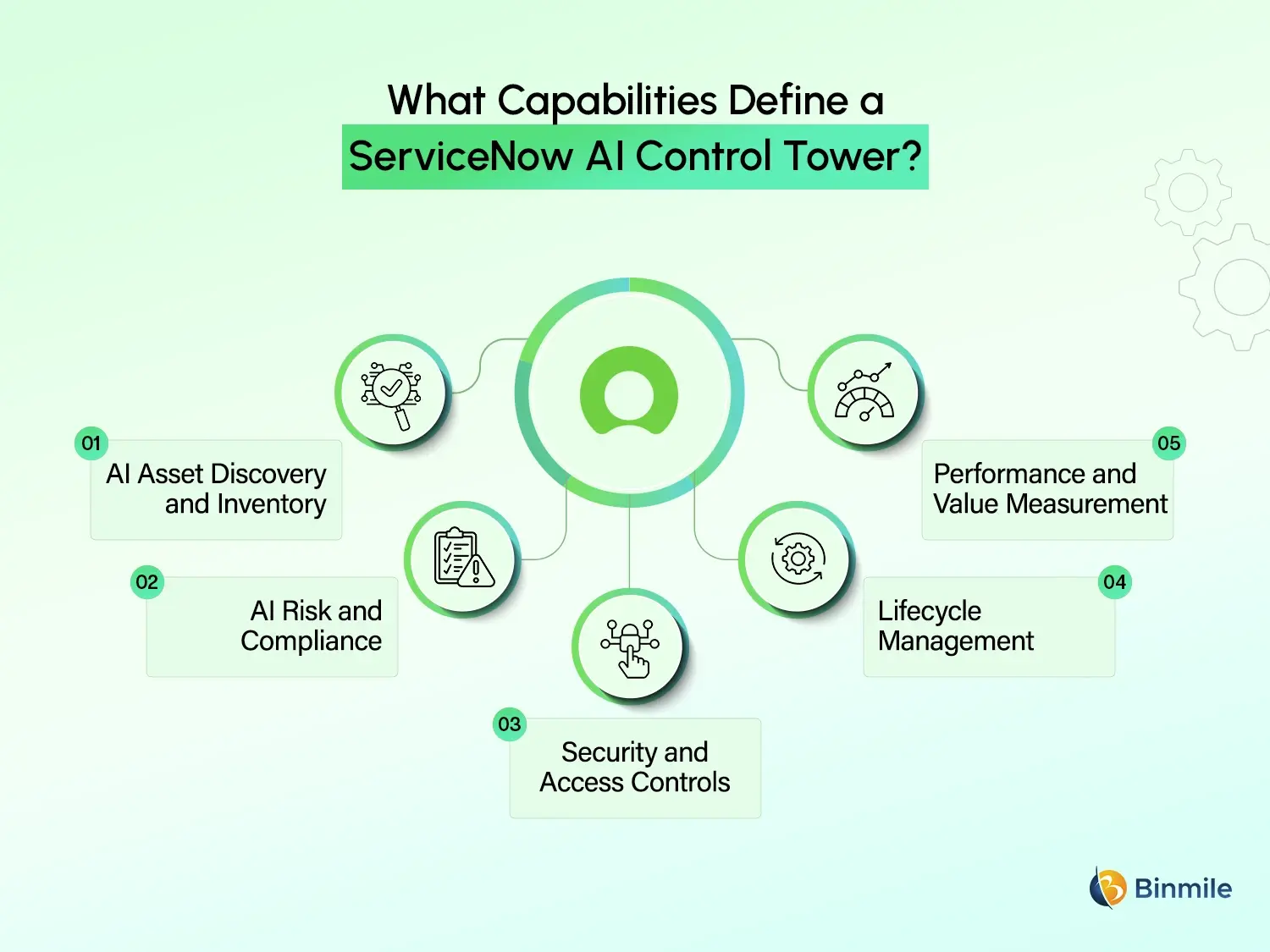
3. Security and Access Controls
AI agents have access to enterprise systems and data, which makes permissions critical. An AI Control Tower provides visibility into access, actions, users, and potential security risks, supporting broader AI Control Tower governance.
4. Lifecycle Management
AI assets require ongoing oversight as models, data, permissions, and business requirements change. An AI Control Tower supports management from onboarding and deployment through monitoring, updates, and retirement.
5. Performance and Value Measurement
AI Control Tower analytics helps organizations track adoption, health, costs, risks, and business outcomes, making it easier to identify which AI initiatives are delivering meaningful value.
Build the visibility, governance, and lifecycle controls needed to scale AI with confidence.
What Are the Advantages of ServiceNow AI Control Tower for Enterprises?
The biggest advantages of an AI Control Tower appear when organizations move beyond experimentation and begin operating AI as an enterprise capability.
-
Better Visibility
Teams get a centralized view of AI agents, models, and workflows, making it easier to understand what exists and where each asset operates.
-
Reduced Duplication
Centralized discovery helps identify overlapping agents and capabilities across departments, preventing teams from investing time and resources in solving the same problem twice.
-
Stronger Governance
Organizations can apply consistent policies, approval processes, and controls across AI systems instead of leaving governance decisions to individual teams.
-
Faster Risk Identification
Centralized risk and security data helps teams quickly identify high-risk AI assets that require additional review, remediation, or stronger controls.
-
Better Lifecycle Management
AI assets can be monitored throughout their lifecycle, from development and deployment to performance reviews, updates, changes, and eventual retirement.
-
Clearer AI Value
Value and performance tracking helps decision-makers identify which AI initiatives are delivering measurable business outcomes and where investments may need adjustment.
What Are the ServiceNow AI Control Tower Use Cases?
An AI Control Tower becomes most valuable when enterprises need to manage multiple AI systems while keeping operations, governance, security, and business value connected.
-
Managing a Multi-Agent IT Environment
Organizations using AI across ITSM, operations, employee support, and security can use a control tower to monitor agent relationships, performance, ownership, and risk, particularly across ServiceNow ITOM workflows.
-
Controlling AI Agent Sprawl
A control tower helps organizations assess, approve, monitor, and retire agents systematically while identifying duplicate capabilities, unclear ownership, unnecessary access, and agents that no longer deliver sufficient value.
-
Governing Third-Party AI
Enterprises often combine ServiceNow with cloud AI services, copilots, custom models, and other applications. An AI Control Tower Solution provides visibility across this mixed ecosystem instead of managing each platform separately.
-
Measuring AI Investment
AI Control Tower analytics helps compare AI initiatives based on adoption, performance, cost, health, and business outcomes, helping leaders identify which investments are creating measurable value.
How to Implement ServiceNow AI Control Tower Effectively
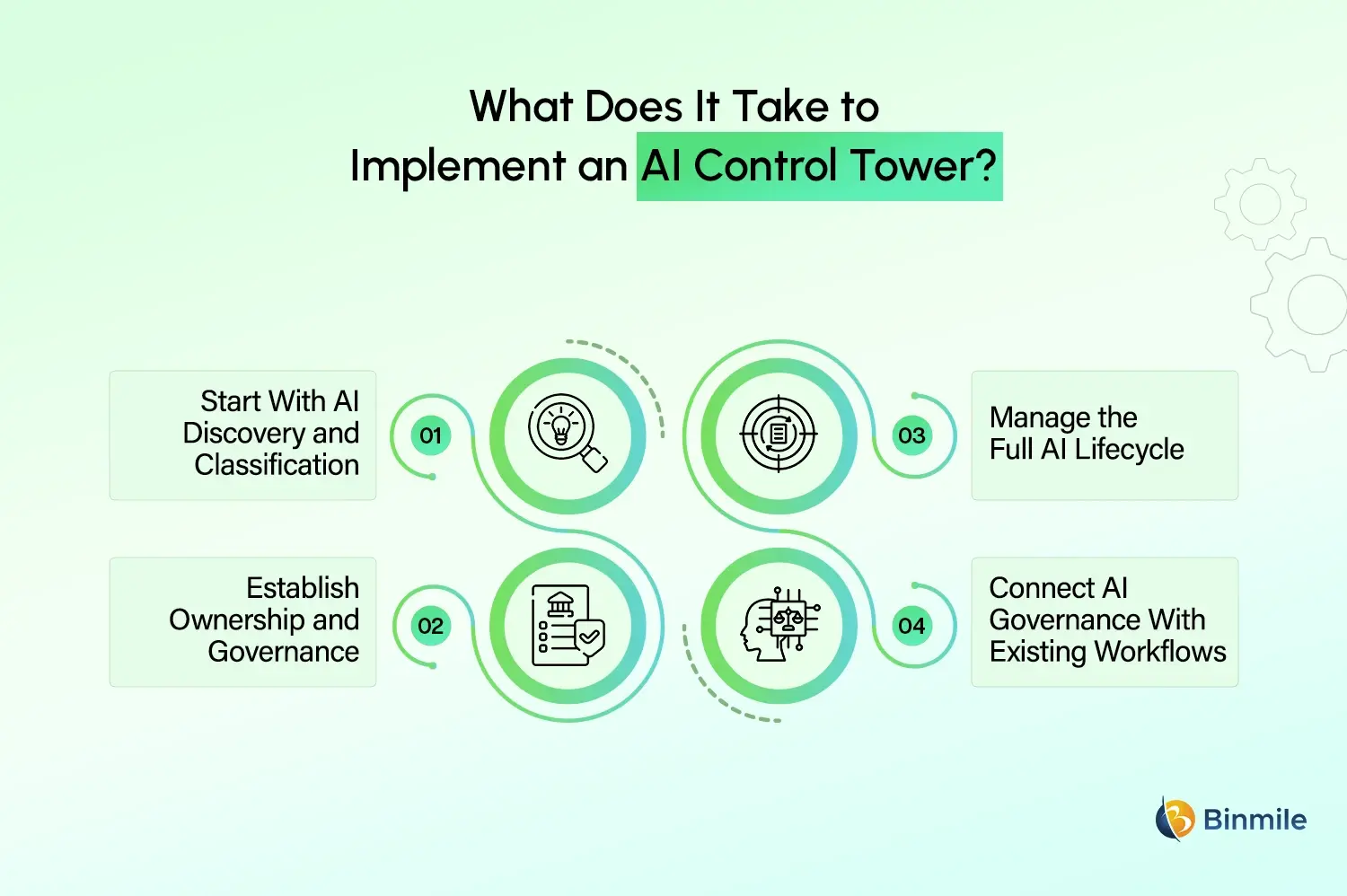
Implementing an AI Control Tower is not simply a technology deployment. It requires a clear understanding of the existing AI environment, defined governance processes, and integration with the workflows already used across the enterprise.
-
Start With AI Discovery and Classification
Begin by identifying existing AI agents, models, applications, integrations, data dependencies, owners, and known risks. Classify these assets based on factors such as business impact, data access, autonomy, and risk so that controls can match the level of exposure.
-
Establish Ownership and Governance
Every AI asset should have a clear owner and defined responsibilities. Establish policies for approval, access, risk assessment, compliance, and monitoring so governance does not stop once an agent reaches production.
-
Manage the Full AI Lifecycle
AI governance needs to continue throughout an asset’s lifecycle. This helps organizations continuously review whether an AI system remains secure, compliant, effective, and relevant to business needs.
-
Connect AI Governance With Existing Workflows
AI management should not become another disconnected process. Organizations using ServiceNow ITSM, ITOM, or SecOps can integrate AI governance into existing workflows, making approvals, risk reviews, monitoring, and remediation easier to manage. A ServiceNow Implementation Partner can also help align these processes with the organization’s existing platform environment.
How ServiceNow Supports AI Agent Governance
ServiceNow’s AI Control Tower brings AI strategy, asset management, governance, security, monitoring, and value measurement into a connected environment. It supports AI asset discovery, duplicate asset identification, risk and compliance management, security monitoring, and AI value tracking.
This approach is particularly useful when AI agents operate across enterprise workflows. For example, an agent supporting IT operations should remain connected to the operational processes, permissions, and controls surrounding those workflows. The same applies to agents involved in security, employee services, or other business functions.
Capabilities across ServiceNow ITSM in 2026, ServiceNow ITOM, SecOps, and enterprise governance can therefore form part of a broader AI management strategy rather than operating as isolated systems. A ServiceNow ITOM guide can help teams understand the operational side of these workflows, while SecOps implementation can extend governance into security-focused environments.
A structured AI Control Tower approach can help you keep growing AI ecosystems secure and accountable.

How Binmile Can Help Build a Governed ServiceNow AI Ecosystem
Moving from AI experimentation to controlled enterprise adoption requires more than enabling a platform feature. It requires an operating model that connects AI discovery, governance, risk management, security, workflows, and measurable business outcomes.
Binmile can bring these pieces together through its ServiceNow implementation and AI capabilities, helping organizations assess their current AI landscape, establish governance workflows, integrate relevant ServiceNow capabilities, and create a practical approach to managing AI agents throughout their lifecycle. The emphasis is on fitting AI governance into the enterprise’s existing operating model rather than creating another isolated layer of technology.
For enterprises dealing with growing numbers of agents, the objective is not to slow AI adoption. It is to make that adoption more controlled, measurable, and sustainable so teams can continue adding new AI capabilities without losing visibility over the systems already in production.
Frequently Asked Questions
An AI Control Tower is a centralized environment for discovering, governing, monitoring, securing, and measuring AI agents, models, workflows, and related assets across an enterprise. It helps organizations manage AI as a coordinated ecosystem rather than isolated deployments.
Enterprises need an AI Control Tower because AI adoption can quickly create fragmented agents, models, integrations, and workflows. Centralized visibility helps organizations manage ownership, security, compliance, performance, lifecycle, costs, and business value more consistently.
AI agent sprawl occurs when organizations accumulate large numbers of AI agents across departments and platforms without sufficient visibility, ownership, governance, or lifecycle management. This can create duplicate capabilities, security gaps, compliance risks, and unnecessary operational costs.
An AI Control Tower helps manage agent sprawl by creating a centralized inventory of AI assets, identifying relationships and duplicates, tracking ownership, monitoring risk and performance, applying governance controls, and supporting lifecycle management from onboarding through retirement.
AI governance defines the policies, principles, responsibilities, and controls for responsible AI use. An AI Control Tower operationalizes those practices by providing centralized visibility, workflows, monitoring, risk management, lifecycle controls, and analytics across AI assets.
ServiceNow supports AI agent governance through AI Control Tower capabilities for AI asset discovery, inventory, risk and compliance, security, monitoring, evaluation, lifecycle management, value measurement, and AI ecosystem integrations. This provides a centralized view of enterprise AI operations.
Yes. Binmile can support ServiceNow AI agent implementation and governance by assessing existing AI environments, defining governance workflows, integrating ServiceNow capabilities, establishing lifecycle controls, and aligning AI operations with enterprise security, compliance, and business objectives.