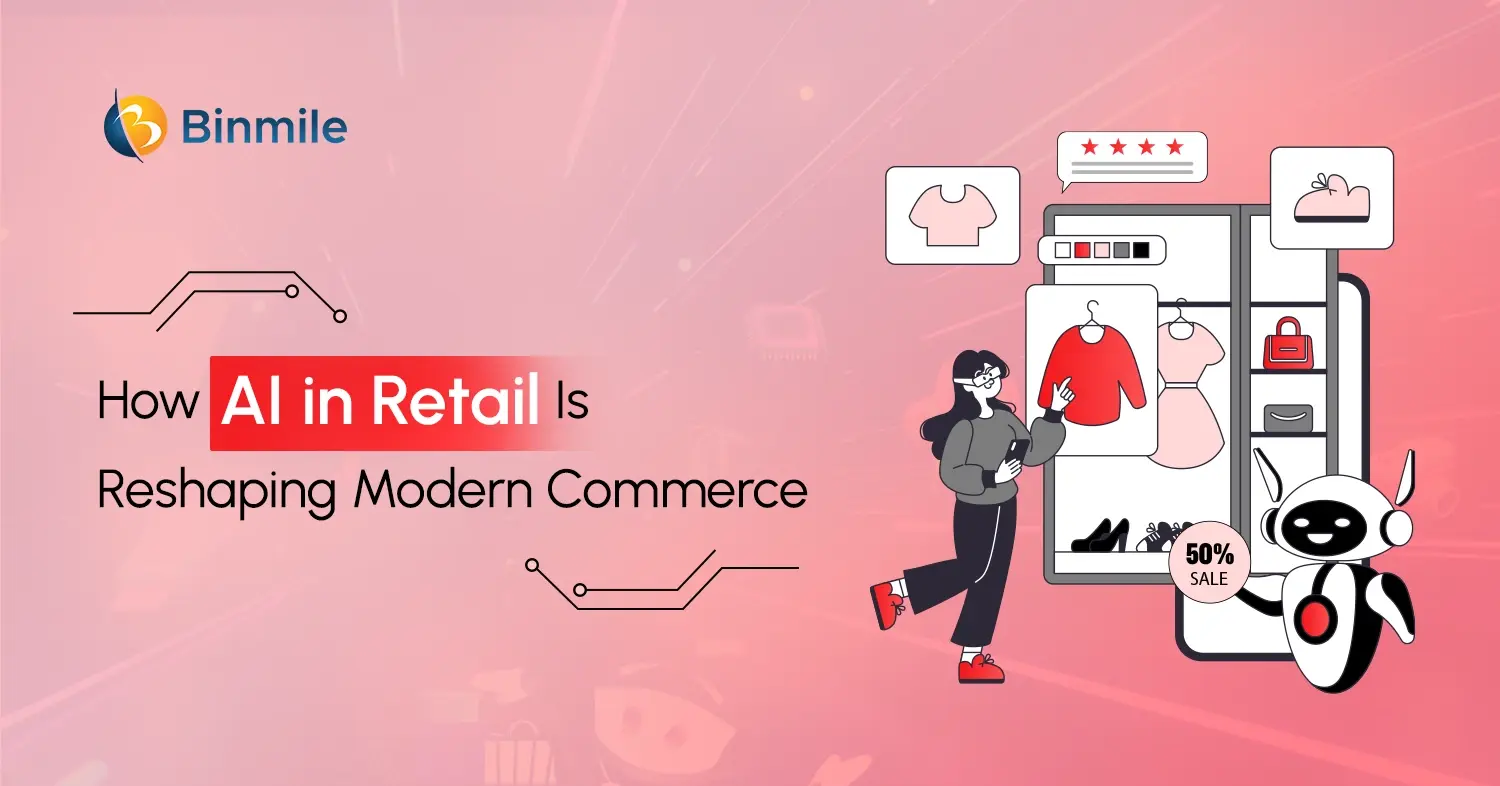
Retailers have access to more data than ever before, but many still find it difficult to use those insights for profit. Consumers today expect tailored suggestions, speedy help, accurate inventory information, and a smooth purchase process across all points of engagement with retailers. According to Statista, the global AI retail market is projected to grow rapidly over the coming years as businesses adopt intelligent automation, predictive analytics, and personalized commerce technologies to improve customer experiences and operational efficiency.
Retailers are no longer viewing artificial intelligence as a technology to be experimented with. Rather, it has evolved into an organization-wide strategic asset that enables businesses to improve their customer retention rates, enhance their supply chain operations, lower their operational costs, and ultimately increase their bottom lines. In this blog, we will discuss the current AI applications being developed that will change how retail operates; implementation roadblocks preventing retailers from implementing AI; potential return on investment realized by retailers; and the initial construction of scalable, AI-enabled networks by retailers for continued success over time.
What Is AI in Retail and Why Enterprises Are Investing in It
Artificial intelligence in retail refers to the use of technologies like machine learning, predictive analytics, and automation to improve customer experiences and retail operations. Retailers implement artificial intelligence (AI) into their business operations to improve personalization of each consumer’s shopping experience, better predict future sales and demand, automate routine tasks, and speed up how quickly companies make key decisions.
With customers having higher expectations of the retailers they shop from, retailers are investing in AI solutions in retail to address key challenges in relation to: how they manage inventory efficiently; retain customers; increase operational efficiency; and provide seamless shopping experiences for their consumers. Additionally, many retailers are using AI to support their more extensive digital transformation in the retail industry initiatives by building smarter, more scalable, and data-driven ecosystems.
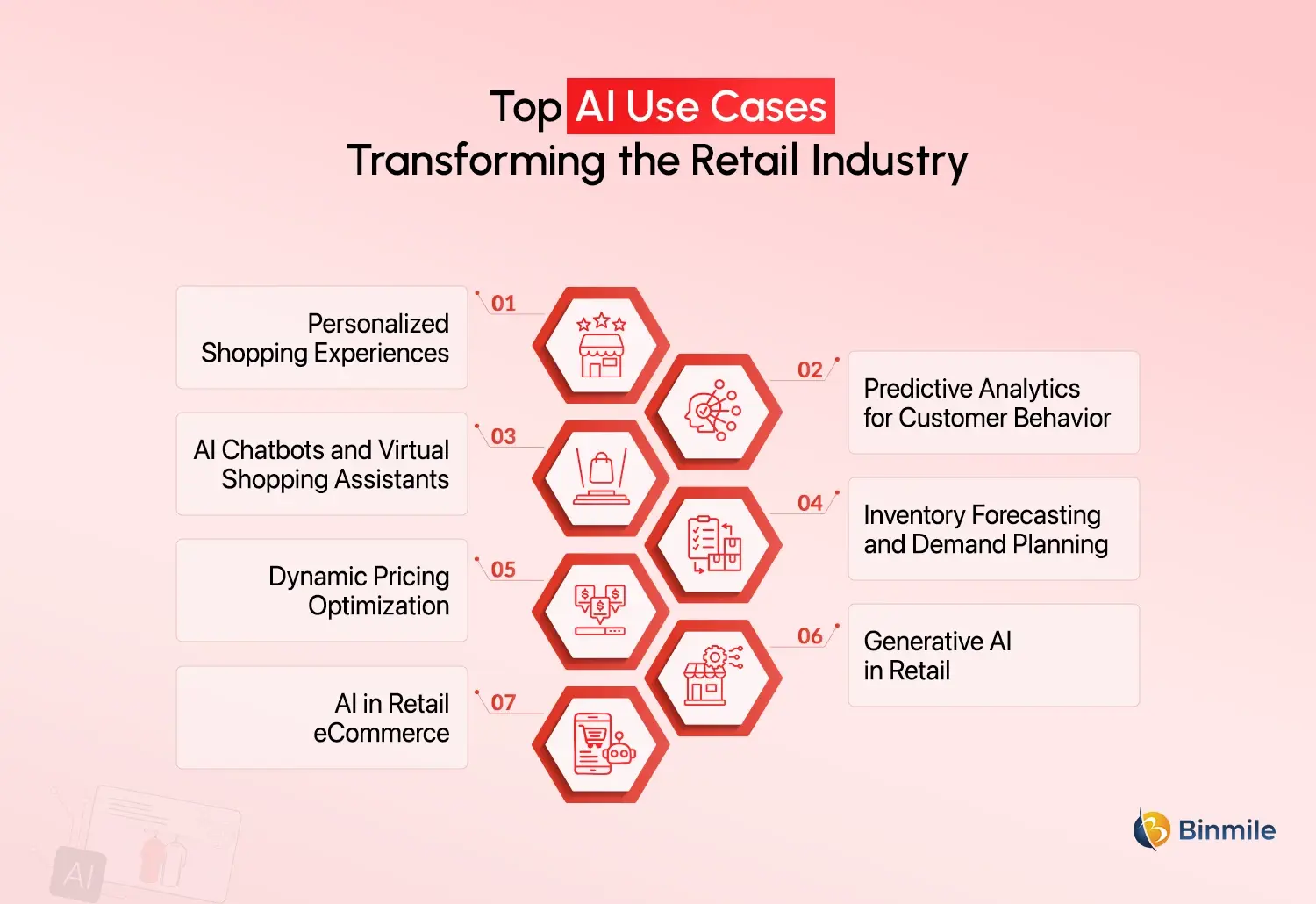
Top AI Applications in Retail That Drive Revenue Growth
AI applications in retail help businesses improve customer experiences, automate operations, and increase revenue through smarter decision-making and personalization.
-
Personalized Shopping Experiences
Customer behavior and preferences can be tracked with the aid of AI to provide tailored recommendations to the client, ultimately leading to increased engagement, conversion rates, and brand loyalty.
-
Predictive Analytics for Customer Behavior
Retailers can use predictive analytics to discover common patterns that indicate when a customer may be ready to make a purchase, and then develop a retention retail strategy or marketing campaign targeted toward that specific behaviour.
-
AI Chatbots and Virtual Shopping Assistants
AI chatbots provide immediate assistance to customers regarding inquiries, product recommendations, and resolving issues; this, in turn, will help to free up employee time and lower overall operational costs.
-
Inventory Forecasting and Demand Planning
By utilizing AI forecasting systems, retailers can better predict the demand for specific products based on previous demand as well as AI in retail market trends to improve their inventory management processes and eliminate waste and inefficiency associated with overstock and stockouts.
-
Dynamic Pricing Optimization
Dynamic pricing using AI assists retailers in determining the optimal price point at which to sell their products based on current demand, competition, customer behaviour, etc., resulting in maximized gross margins and increased sales.
-
Generative AI in Retail
Generative AI in retail can automate the processes that occur within retail by producing product descriptions, marketing material, responding to customer inquiries, and creating personalized shopping experiences; thus, it allows the retailer to scale their implementation more easily and at less expense.
-
AI in Retail eCommerce
Implementing AI technology into your retail eCommerce platform can provide retailers with an improved eCommerce experience through easier product discovery. Additionally, improved customer targeting, enhanced fraud detection, and increased cart recovery rate.
Real-World Examples of AI in Retail
Many global retailers are already using AI to improve customer engagement and operational efficiency.
-
Amazon
Amazon’s recommendation engine is one example of how to use artificial intelligence in retail. The recommendation engine uses a variety of algorithms and machine learning models to analyze customer browsing patterns, purchase history, and personal preferences. By fully utilizing these data points, Amazon delivers highly personalized recommendations to its customers, leading to a large increase in conversion rates and more cross-selling opportunities.
-
Walmart
Walmart’s AI-based inventory and forecasting systems directly enhance its stock control management in stores and warehouses. This increase in visibility in the supply chain and the reduction of inefficiencies in the inventory enable Walmart to better serve its customers.
-
Sephora
Sephora takes advantage of AI-based personalization algorithms and virtual-simulation technologies to enhance the online shopping experience of its customers. Additionally, by providing personalized beauty recommendations and allowing customers to “try on” items virtually before purchasing them, Sephora is enhancing its customers’ overall shopping experience.
-
Zara
Zara uses artificial intelligence and predictive analytics to analyze customer behavior and develop the best way to distribute inventory. This enables Zara to react quickly to changes in fashion.
-
Starbucks
Using predictive analytics and AI-based personalization functions in its mobile app, Starbucks recommends products, makes targeted promotional offers to customers, and enhances the in-store experience of customers.
These examples show how the use of AI in the retail industry is moving beyond experimentation and becoming a core business strategy.
How AI in Retail Drives Business Growth
AI helps retailers improve revenue generation, operational efficiency, and customer engagement through data-driven decision-making and automation.
-
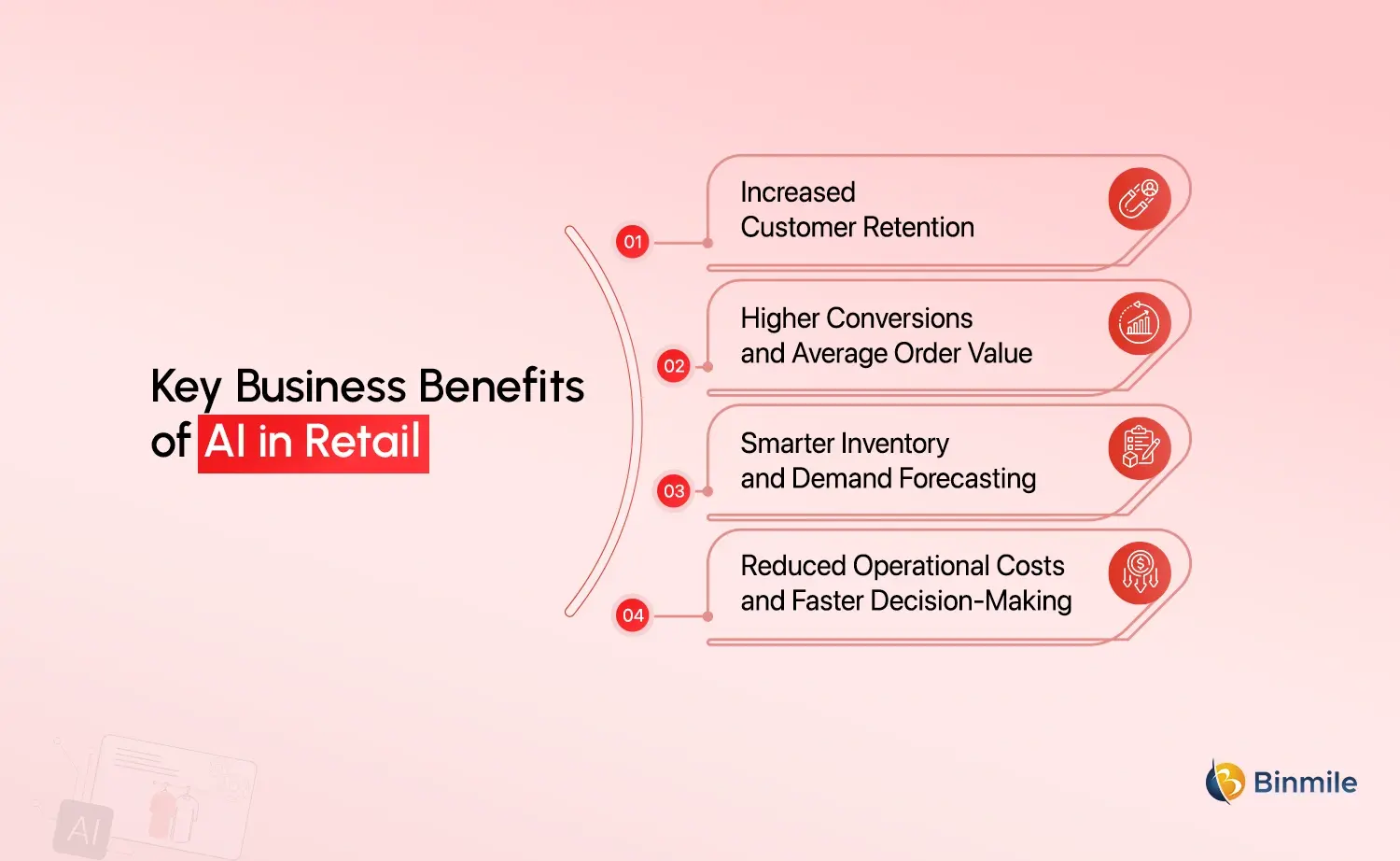
Increased Customer Retention
Through Artificial Intelligence-driven personalization and predictive analytics, retailers can create loyalty. Additionally, encouraging repeat purchases by providing targeted engagement.
-
Higher Conversions and Average Order Value
AI recommendation engines and intelligent product suggestions can increase conversion rates as well as provide opportunities to sell a greater number of items to existing customers.
-
Smarter Inventory and Demand Forecasting
AI greatly enhances inventory management capabilities by providing retailers with much more detailed analysis of demand patterns, customer behavior, and market trends.
-
Reduced Operational Costs and Faster Decision-Making
Additionally, AI takes care of repetitive tasks; reduces the operational load on the business; and makes it faster and more efficient for companies to make decisions.
ROI of AI in Retail
The ROI of AI depends on implementation quality, business goals, and operational scale. Businesses adopting AI often see measurable returns across multiple operational areas.
-
Reduced Inventory Losses
Using AI to forecast demand and manage inventory allows retailers to keep accurate inventory on hand. Additionally, this will decrease instances of over-ordering or not having enough inventory on hand to meet customer needs.
-
Lower Customer Support Costs
Retailers can lower their costs associated with customer service by using AI chatbots and virtual assistants to handle customer inquiries quickly and effectively, rather than employing large numbers of customer service representatives.
-
Increased eCommerce Conversions
AI-based personalized recommendations for consumers, through predictive targeting and intelligent search capabilities, improve conversion rates on eCommerce sites. Thus, lowering eCommerce shopping cart abandonment rates.
-
Better Pricing Optimization
Dynamic pricing systems allow retailers to increase revenue by adjusting pricing using AI-based on customer buying behavior and fluctuations in demand. Additionally, AI in retail trends in their respective markets.
-
Improved Customer Lifetime Value
Using AI-based strategies for customer engagement allows retailers to better engage their customers in a personalized manner. Additionally, this can lead to greater retention and loyalty among their customers.
Ready to modernize your retail ecosystem with predictive analytics, intelligent automation, and AI-driven commerce experiences?

Cost of AI Implementation in Retail
The cost of implementing AI in the retail sector depends on factors such as business size and infrastructure complexity. Additionally, customization requirements, integration needs, data readiness, and AI model sophistication.
| AI Retail Solutions | Estimated Cost Range |
|---|---|
| AI chatbot implementation | $5,000–$25,000 |
| Recommendation engine | $20,000–$100,000+ |
| Predictive analytics system | $30,000–$150,000+ |
| AI-powered inventory management | $50,000–$200,000+ |
| Enterprise retail AI ecosystem | $250,000–$1M+ |
Typically, smaller retailers start their bot automation or predictive analytics tools, while large enterprises usually invest in a more extensive AI ecosystem, which includes personalized engines for customer experiences, smart supply chains, and advanced ML models.
Custom anchored AI development projects are typically more expensive, but they can be expanded more readily, be more flexible than off-the-shelf products, and produce greater business value over an extended period than do the off-the-shelf alternatives. Additionally, even though implementations can vary greatly in price, long-term operational savings and revenue growth potential usually offset any initial outlay.
Challenges Retailers Face While Implementing AI
Although AI offers substantial opportunities, implementation comes with challenges that retailers must address carefully.
-
Data Quality and Availability
Artificial Intelligence (AI) systems use data that has been both structured and of good quality. Additionally, the poorer the quality of the data, the lower the level of accurate predictions made from that data, and the less successful an AI application will be.
-
Legacy Infrastructure
There are still many retail companies that are running on old, outdated computer systems that are hard to connect to newer AI technologies.
-
Privacy and Security Concerns
It has become critical to retailers that AI systems have mechanisms to allow secure and compliant use of customer data since retailers must collect and store it. Additionally, manage such vast amounts of customer information.
-
AI Skill Gaps
The skill set required to build, operate, and maintain an AI-based solution requires knowledge. Additionally, an understanding of multiple areas of Data Science, Analytics, Engineering, and AI Development.
-
Scalability Challenges
Many retailers do not successfully scale AI initiatives beyond the pilot phase due to the challenges associated with the complexity of operating a business in the retail industry. Additionally, due to limitations in their current infrastructures.
How Retail Businesses Can Build a Scalable AI Strategy
Retailers looking to scale AI successfully should focus on business-driven implementation and long-term scalability.
-
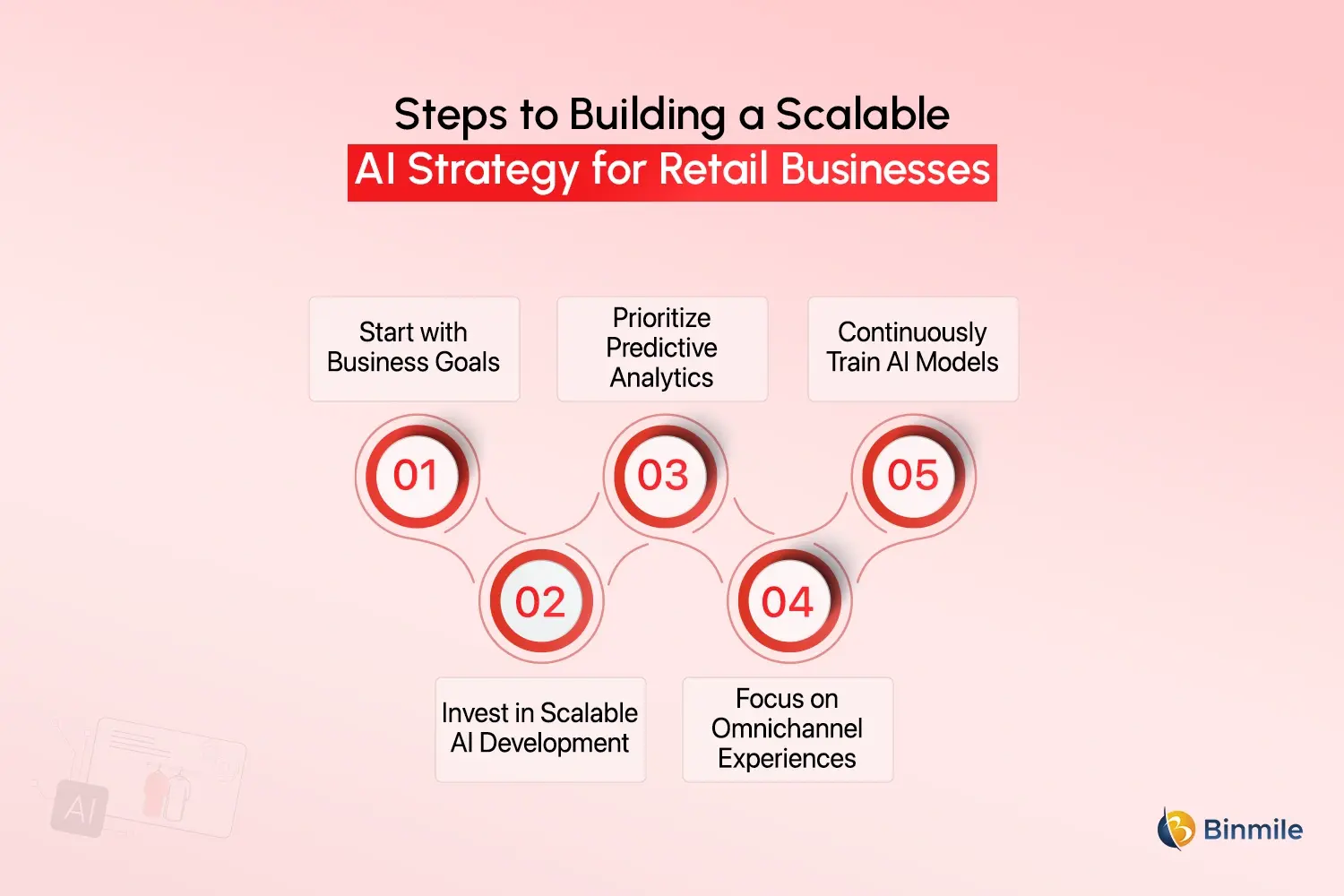
Start With Clear Business Goals
Identify the specific operational or consumer-related issues you want to resolve with AI before entering into AI adoption.
-
Build a Strong Data and Technology Foundation
Have access to structured data, scalable storage systems/technologies, and interconnected systems like digital twins in retail, all imperative for the successful implementation of AI.
-
Prioritize High-Impact AI Applications
Target high-value use cases first: predictive analytics, personalization, and demand forecasting.
-
Integrate AI Across the Retail Ecosystem
Technologies like AR in Retail, predictive analytics, and generative AI are also shaping the future of AI in retail. Additionally, by creating more immersive, personalized, and data-driven shopping experiences.
-
Continuously Optimize AI Models
Always test AI models, datasets, and use case scenarios on an ongoing basis to assure performance and deliver optimal long-range business results.
Looking to build AI-powered retail experiences that improve customer engagement, increase conversions, and optimize operations?

How Binmile Helps Retail Enterprises Scale AI
Retail enterprises today need more than isolated automation tools. They require intelligent ecosystems capable of connecting customer experiences, operational workflows, analytics, and business intelligence into one scalable infrastructure.
Binmile supports retail businesses through scalable AI development, predictive analytics implementation, enterprise modernization, and retail eCommerce software development solutions designed to improve operational efficiency and customer engagement. Additionally, businesses aim to implement machine learning in retail models for demand forecasting, modernize legacy infrastructure, or optimize omnichannel customer experiences. Further, the focus remains on delivering measurable business outcomes aligned with long-term growth strategies.
As technologies like generative AI, predictive analytics, immersive commerce, and intelligent automation continue evolving, retailers investing early in scalable AI ecosystems will likely gain stronger competitive advantages in customer retention, operational efficiency, and revenue growth.
Frequently Asked Questions
AI improves customer experience through personalization, predictive recommendations, faster support, intelligent search, and targeted engagement strategies. It helps retailers deliver more relevant shopping experiences across both eCommerce and physical retail channels.
AI analyzes customer behavior during checkout and identifies friction points. Retailers use AI-powered reminders, personalized offers, and predictive engagement campaigns to encourage customers to complete purchases.
AI uses predictive forecasting to analyze demand patterns, sales history, and customer behavior. This helps retailers maintain optimal stock levels, reduce inventory waste, and improve warehouse efficiency.
AI analyzes browsing patterns, purchase history, demographics, and engagement behavior to identify the future of AI in retail buying intent, churn risk, and customer preferences more accurately.
AI-powered pricing systems monitor demand fluctuations, competitor pricing, and customer behavior in real time to recommend optimal pricing strategies that improve conversions and profitability.
Yes. AI improves retention by enabling personalized communication, predictive recommendations, targeted loyalty campaigns, and proactive customer engagement based on behavioral insights.