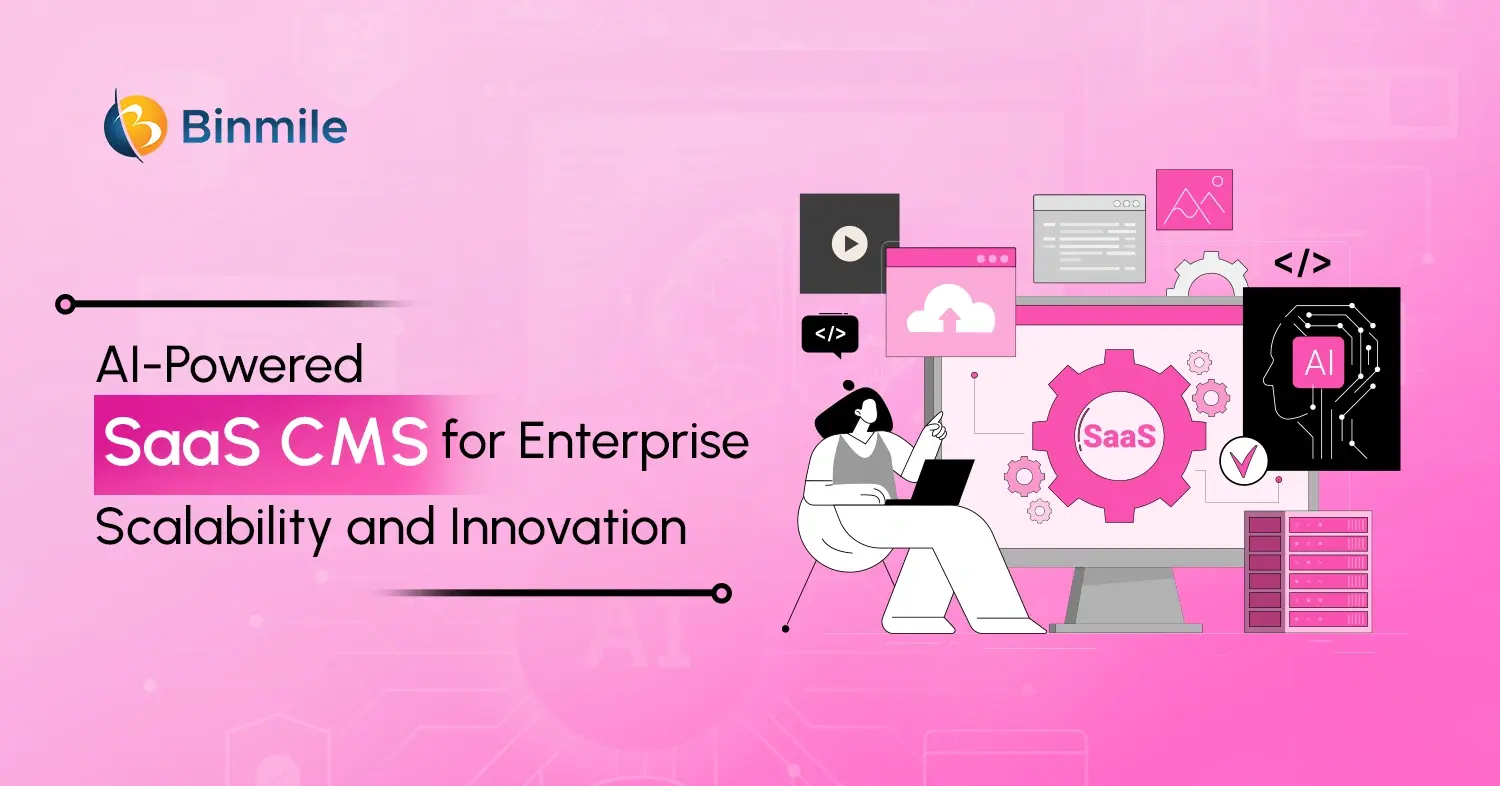
Content today moves faster than ever. Businesses are managing websites, mobile apps, ecommerce stores, customer portals, digital campaigns, and AI-driven experiences simultaneously. According to Statista, the global SaaS market is projected to exceed hundreds of billions in value over the next few years as enterprises continue shifting toward cloud-native operations. This rapid growth is pushing companies to rethink how they manage digital content, customer experiences, scalability, and automation. Traditional content systems are struggling to keep up with modern business expectations, making SaaS CMS platforms central to digital transformation strategies.
This blog explores how a SaaS CMS helps businesses scale digital operations, support AI-driven workflows, improve content management efficiency, and build future-ready customer experiences. We will also cover SaaS CMS architecture, headless CMS adoption, enterprise features, pricing models, implementation challenges, and platform selection strategies.
What Is a SaaS CMS and Why Are Businesses Adopting It?
A SaaS CMS is a cloud-based content management platform delivered through a subscription model. Rather than having to maintain their own infrastructure, companies use the SaaS CMS provided by the vendor and run their business applications through a third-party company. The vendor also supports the application by providing maintenance, updates, scalability, and security of the underlying infrastructure.
A SaaS-based CMS has generally been found to provide enterprises with faster time to market, lower total cost of ownership and operation, improved scalability, and increased ease of managing omnichannel content when compared with traditional CMS solutions. Companies can manage their websites, e-commerce sites, apps, portals for customers, and digital experiences from one central point of management.
Increased demand for digital agility is motivating enterprises to adopt SaaS CMS solutions. With a modern SaaS content management system, companies are able to deliver content more quickly, integrate with more advanced technologies such as artificial intelligence and analytics, increase collaboration among business teams, and create a consistent experience across all digital channels.
CEOs and CTOs who adopt SaaS-based content management systems experience the greatest benefits of operational efficiencies, scalability, and lower reliance on infrastructure.
Understanding SaaS CMS Architecture
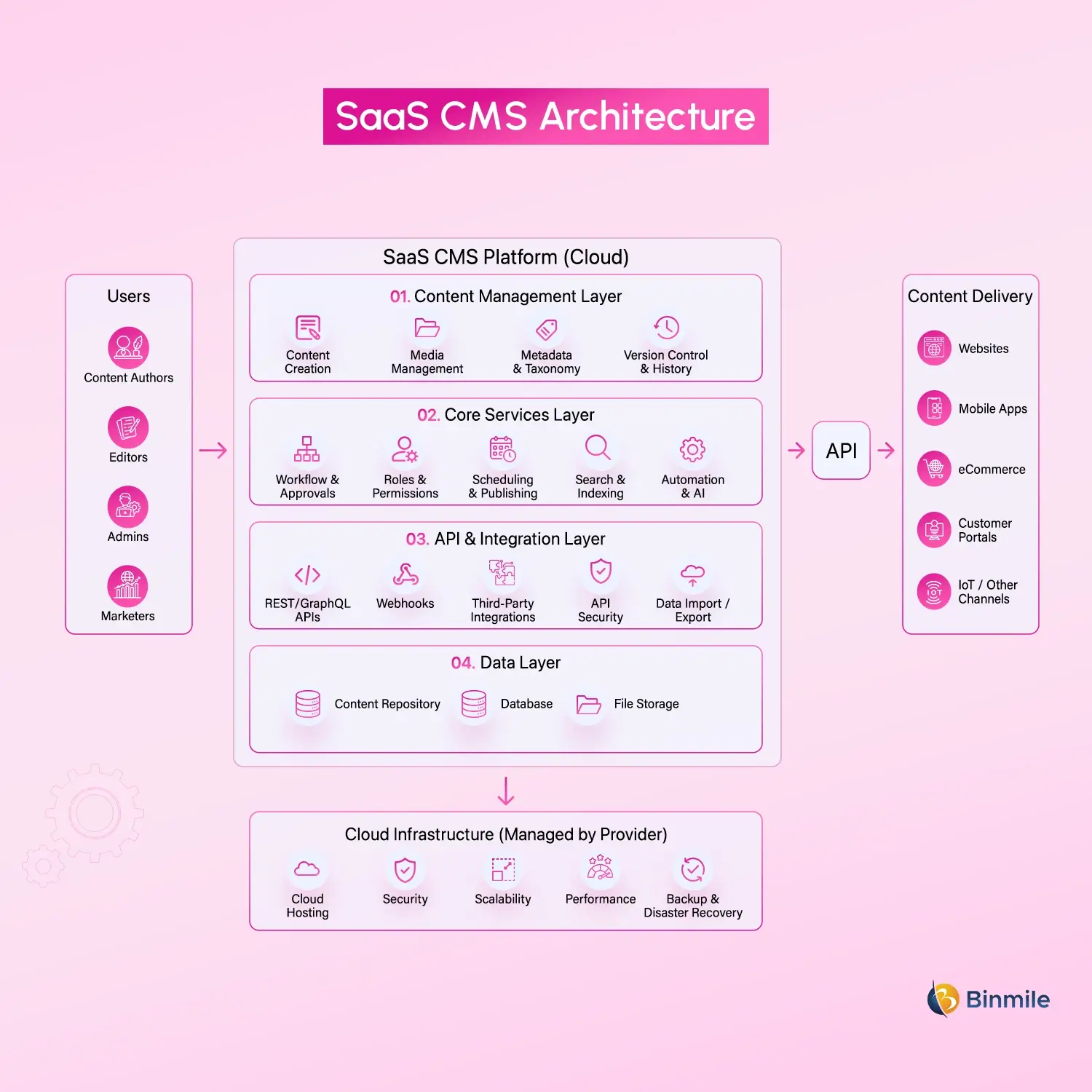
The foundation of every scalable SaaS CMS lies in its architecture. Unlike traditional monolithic systems, modern SaaS CMS architecture uses APIs and cloud-native services to separate backend content management from frontend delivery.
-
Cloud Infrastructure
Cloud infrastructure is a way to manage physical infrastructure, i.e., hosting, uptime/scalability, security, and backups, without businesses having to create physical infrastructure.
-
API Layer
The API layer connects the front end of SaaS applications to the back end of content repositories so all omni-channel content can be delivered on websites, applications, eCommerce platforms, and across all digital touchpoints.
-
Content Repository
A content repository contains all blogs, media files, products, landing pages, and all digital assets in one central place.
-
AI and Automation Engine
AI and automation engines are used for personalization, predictive analytics, workflow automation, intelligent tagging, and content optimization.
-
Frontend Delivery Layer
The Frontend Delivery Layer is what powers websites, mobile applications, eCommerce stores, customer portals, and user-facing digital experiences.
-
Analytics and Monitoring
Analytics tools provide information to measure engagement, operational performance, customer behavior, and traffic patterns in order to support continuous optimization.
Why Headless SaaS CMS Is Becoming the Preferred Enterprise Model
One of the biggest changes in digital content management is the growing adoption of headless SaaS CMS platforms.
In a headless SaaS CMS, the backend content repository is separated from the frontend presentation layer. Content is delivered through APIs, giving businesses more flexibility, scalability, and development freedom.
-
Faster Omnichannel Delivery
Companies are able to publish their content to various channels, including websites, applications, e-commerce platforms for purchase, smart devices, kiosks, and customer portals from one centralized system.
-
Better Developer Flexibility
Besides giving developers the ability to use any of the various front-end frameworks, such as React or Angular, the headless CMS provides a developer-friendly environment free of CMS restrictions.
-
Improved Scalability
By allowing for the independent scaling of both the front-end and back-end, the headless CMS provides businesses with operational flexibility for improved management of their overall traffic.
-
Easier AI Integration
A headless CMS architecture can simplify the integration of AI SaaS solutions using API and workflow automation processes.
How AI Is Transforming SaaS CMS Platforms
AI has quickly become one of the core functions that are part of any modern-day SaaS application. Because of this, utilizing an AI-powered SaaS solution can also help companies automate, personalize, run more efficiently, and engage more effectively with customers.
-
Intelligent Content Creation
AI solutions provide assistance to content teams with summary creation, metadata generation, tagging, recommendations, translation into many languages, and many types of optimization during the content lifecycle.
-
Personalized User Experiences
By analyzing user behaviour, AI engines can dynamically serve personalized content to their users based on preference, geographical location, purchasing habits or other characteristics.
-
Smart Search and Recommendations
By being able to understand the context rather than just key terms, advanced AI search will help find content for customers and internal teams.
-
Workflow Automation
AI can automate approval, publish dates, categorising/categorising content, moderation, customer interactions, and other tasks in company workflows.
-
Predictive Analytics
AI-based insights can help companies identify their most successful pieces of content, predict future trends in content in the marketplace, and help optimize engagement with other types of content over time.
The rise of Agentic CMS models is further expanding AI-driven automation in modern SaaS content management systems.
SaaS CMS Features That Matter Most for Enterprises
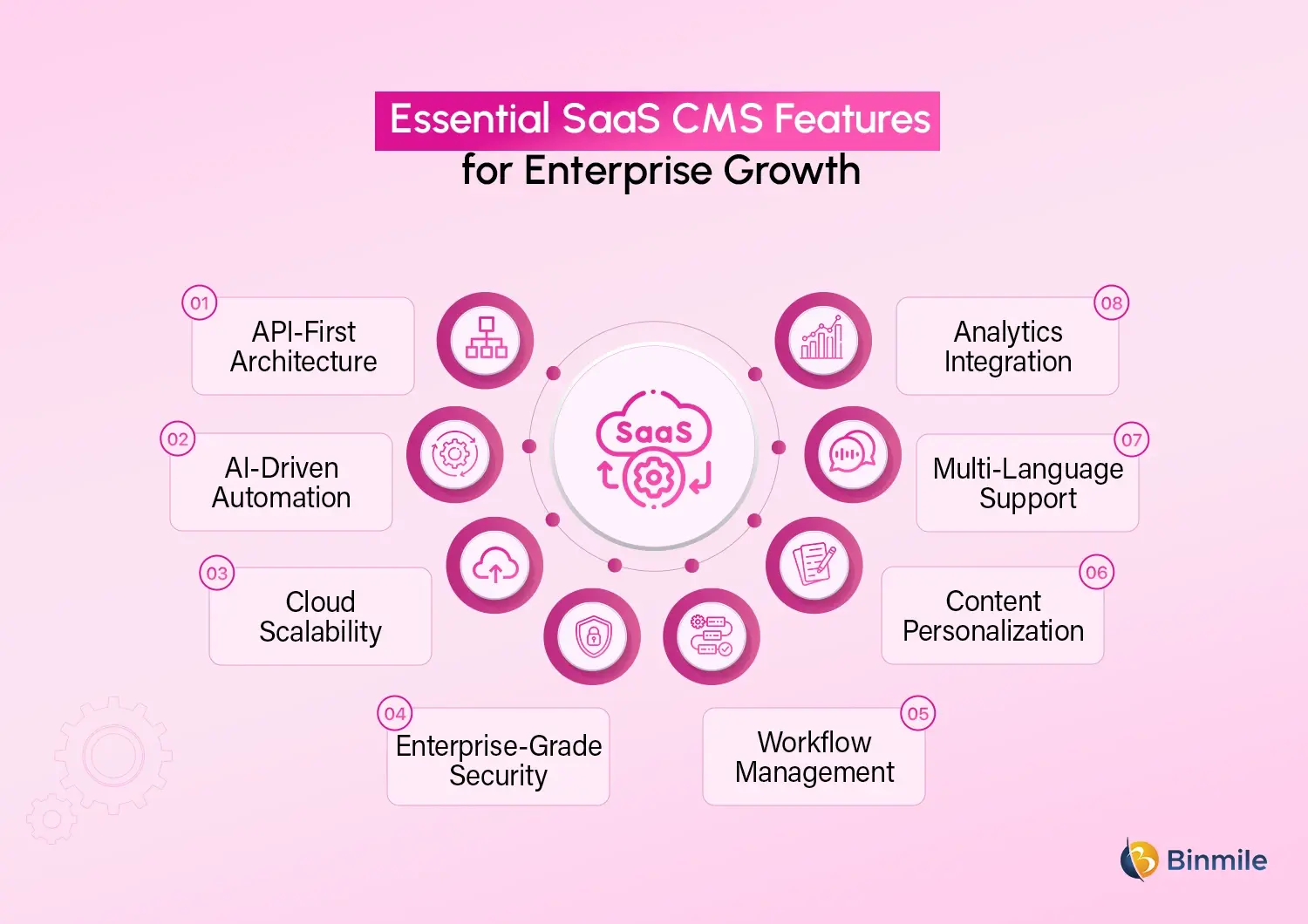
Enterprise decision-makers should evaluate SaaS CMS platforms beyond publishing capabilities. The right SaaS CMS features directly impact scalability, operational efficiency, security, and digital growth.
-
API-First Architecture
API first SaaS architecture helps organizations share content using multiple distribution methods from the same source. Examples include websites, mobile applications, ecommerce platforms, and digital products.
-
AI-Driven Automation
Automation features increase productivity by reducing human intervention through automated tagging, approving, personalizing, and optimizing content.
-
Cloud Scalability
Cloud scalability allows businesses to manage growing traffic and operational demands without infrastructure expansion.
-
Enterprise-Grade Security
Enterprise-level security helps protect mission-critical data through encryption, auditing, compliance, and access control.
-
Workflow Management
Workflow management improves collaboration between marketing, development, operations, and content teams.
-
Content Personalization
Personalization capabilities improve customer engagement by delivering targeted digital experiences.
-
Multi-Language Support
Multi-language capability allows for scaling internationally while providing localized customer experiences.
-
Analytics Integration
Analytics provide insight into customer usage and enable data-driven decisions by tracking usage behavior and content performance.
SaaS CMS for eCommerce Web Development
The eCommerce industry is rapidly adopting SaaS CMS platforms and CMS for eCommerce web development solutions to improve agility, scalability, and customer experience.
-
Dynamic Product Catalogs
Many businesses can successfully handle big, ever-changing product catalogs in different places where consumers make purchases.
-
Personalized Shopping Experiences
By incorporating AI-powered personalization into their buying processes, many businesses can provide customers with a tailored shopping experience along with relevant product recommendations and targeted offers.
-
Multi-Channel Commerce
Modern-day online businesses operate on multiple platforms, e.g., websites, marketplaces, app stores, and provide a consistent shopping experience across all those platforms.
-
Real-Time Inventory Integration
Synchronizing inventory levels with ecommerce platforms in real-time increases operational accuracy and enhances customer’s confidence in doing business with your company.
Need a flexible SaaS CMS architecture that supports AI integration, omnichannel delivery, and enterprise scalability?
Common SaaS CMS Challenges Businesses Must Address
Despite its advantages, implementing a SaaS CMS also comes with operational and technical challenges.
-
Integration Complexity
Organizations will need capable API management and migration action plans to connect legacy technologies with modern SaaS cloud-based content management platforms.
-
Data Migration Risks
Content migration could potentially disrupt an organization’s existing SEO architecture, metadata, formatting consistency, and operational workflows.
-
Customization Limitations
Depending on the SaaS provider, some CMS for business platforms limit back-end customizations compared to traditionally hosted solutions.
-
Security and Compliance
Enterprises that do business in regulated industries should confirm their compliance with the applicable security and governance regulations.
-
Cost Management
Enterprises can incur increased costs from SaaS CMS platforms based on traffic, storage usage, API usage, AI functionality, and enterprise growth needs.
Legacy CMS vs SaaS CMS
Many organizations are still running legacy CMS environments that create operational inefficiencies and scalability limitations.
| Legacy CMS | SaaS CMS |
|---|---|
| High maintenance burden | Managed cloud infrastructure |
| Limited scalability | Elastic cloud scaling |
| Slower updates | Continuous updates |
| Infrastructure dependency | Faster deployment |
| Difficult omnichannel delivery | API-first flexibility |
| Manual workflows | AI-driven automation |
Businesses undergoing digital transformation increasingly prefer SaaS Application Development strategies aligned with cloud-native architectures.
Understanding SaaS CMS Pricing Models
Different SaaS CMS providers use different pricing structures depending on operational complexity and scalability needs.
- User-based pricing charges businesses based on the number of users or administrators.
- Usage-based pricing depends on API requests, bandwidth, traffic, or storage consumption.
- Tiered subscription models offer varying features and scalability levels.
- Enterprise licensing provides customized pricing for large organizations.
- Add-on pricing applies to advanced AI features, integrations, and analytics capabilities.
Enterprises should evaluate long-term scalability costs instead of focusing only on initial pricing.
Choosing the Right SaaS CMS Approach
There is no universal SaaS CMS solution for every business. The right approach depends on operational goals, scalability requirements, and digital transformation priorities.
-
Business Growth Projections
Companies ought to consider whether the business will be capable of handling an increase in website visits from both local and international prospects and greater demand for new content.
-
AI Readiness
Companies that have invested in Artificial Intelligence-based workflow automation should be focusing on how to automate processes, provide predictive analysis capabilities, and build intelligent integration solutions for internal systems.
-
Omnichannel Content Needs
An effective SaaS-based content management system should support delivery channels of web content, mobile device delivery channels, e-commerce delivery channels, portal delivery channels, and connected digital experience delivery channels.
-
Integration Requirements
Companies need to evaluate what integration capabilities exist between their CRM System, ERP System, Analytics System, Payment System, and Marketing System.
-
Security Expectations
Businesses need to evaluate the encryption standards being used, governing body standards for compliance, access control standards for internal users, and the governance capabilities to apply proper security measures.
-
Development Flexibility
Choosing the Right SaaS Tech Stacks is equally important for businesses looking to build scalable, AI-driven, and future-ready SaaS CMS ecosystems.
-
Global Scalability
Businesses want to operate worldwide and will require localizing their products, having multiple data centers set up globally, as well as multi-language support.
-
Total Cost of Ownership
Companies need to evaluate the total cost of ownership for their infrastructure, integration, scalability, licensing costs, and long-term operating costs as one total cost.
Looking to modernize your digital ecosystem with a scalable AI-powered Saas CMS solution tailored to enterprise growth?
Building Future-Ready Digital Experiences
The need for digital experiences will continue its drive toward becoming more intelligent, personalized, and interconnected. Companies will need content systems that can support ongoing rapid innovation while maintaining their overall business operations.
A SaaS CMS represents more than just a publishing tool; it represents the foundation of how an organization interacts with its customers and uses AI-driven automation to create scalable ecommerce and innovate through digital transformation. During the migration to modernizing an organization’s digital ecosystem, many organizations will require a combination of Scalability & Performance i.e SaaS App Development, scalable SaaS Architecture, as well as Integrated Content Operations.
As experts in Custom Software Development Services, scalable SaaS Applications, Enterprise modernization, and AI-Powered Digital Ecosystems, Binmile can assist your organization in developing platforms that are future-proofed in order to foster a closer alignment of technology and business growth. From exploring a headless SaaS CMS to planning a legacy migration or simply the continued scaling of their existing modern SaaS Applications, organizations should always keep flexibility, operational efficiency, and sustainable innovation as their key focus.
Frequently Asked Questions
A SaaS CMS is a cloud-based content management system delivered through a subscription model. It allows businesses to manage, publish, and scale digital content without maintaining on-premise infrastructure or handling software updates manually.
AI improves a SaaS CMS by automating workflows, personalizing customer experiences, optimizing content delivery, generating recommendations, and improving search capabilities. It also helps businesses reduce manual effort and improve operational efficiency.
Yes, modern SaaS CMS platforms are designed for enterprise scalability. They support cloud-native infrastructure, omnichannel content delivery, API integrations, and a flexible architecture that can handle growing traffic and operational complexity.
Businesses can migrate from legacy CMS systems to a SaaS CMS through structured migration planning, API integration, content restructuring, and workflow mapping. Proper implementation minimizes downtime and preserves SEO and operational continuity.
A SaaS CMS improves scalability, operational efficiency, AI integration, omnichannel delivery, workflow automation, and customer experience management, making it a strong foundation for enterprise digital transformation initiatives.
A SaaS CMS centralizes workflows, automates repetitive tasks, simplifies collaboration, and enables faster publishing across multiple digital channels, helping teams manage content operations more efficiently at scale.