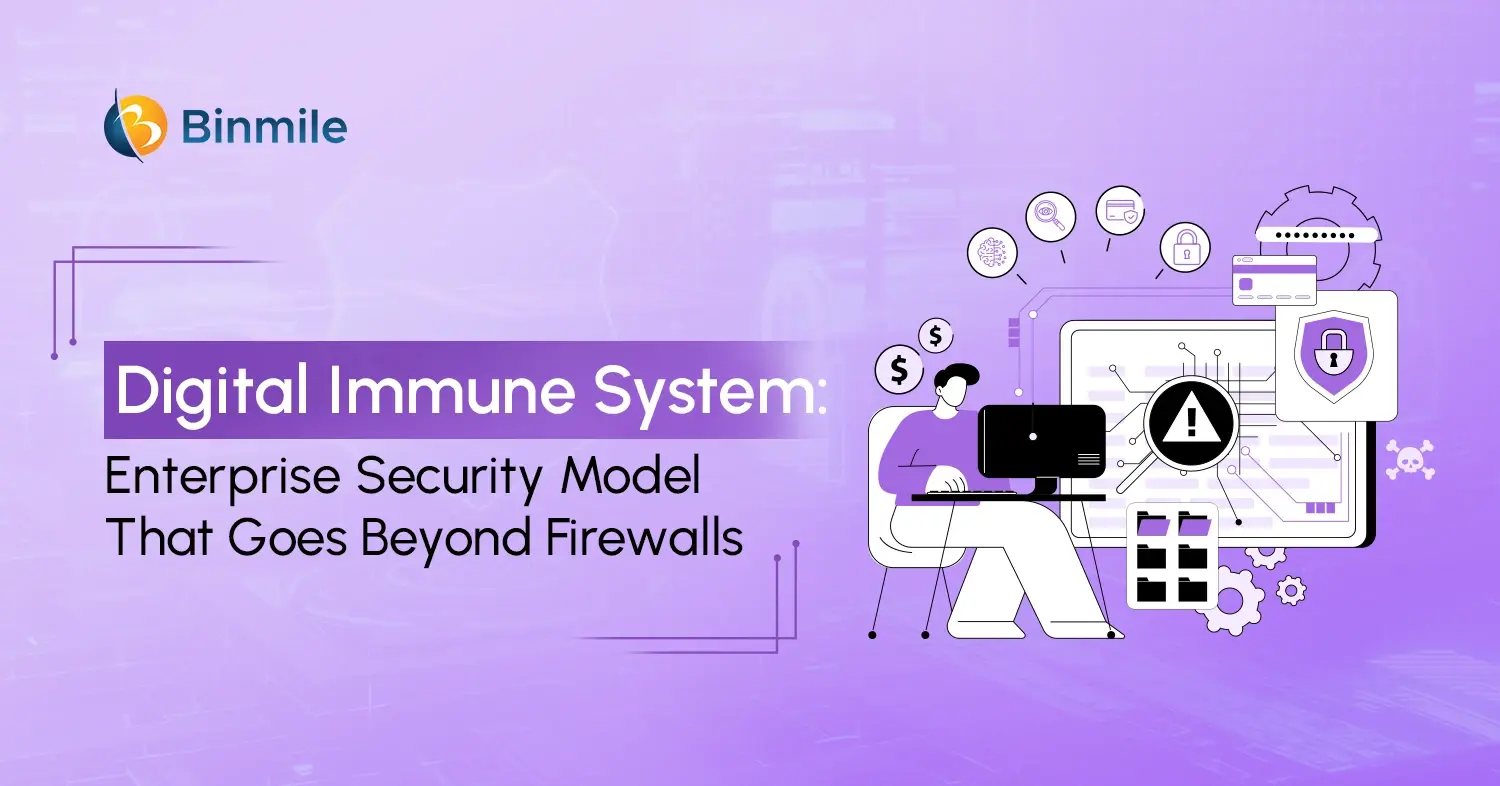
A firewall can block suspicious traffic, but it cannot protect every application, API, cloud workload, user journey, software release, or business process from failure. That is why the digital immune system is becoming a serious enterprise priority. Gartner predicted that organizations investing in digital immunity could reduce downtime by up to 80%, which makes it more than a cybersecurity trend. It is becoming a business resilience model for enterprises that cannot afford outages, security incidents, customer disruption, or weak digital experiences.
This blog explains what a digital immune system means, why it matters, how it works, and how enterprises can build digital immunity across applications, cloud environments, software pipelines, IoT ecosystems, and cybersecurity operations. We will also cover digital immune system examples, core technologies, market relevance, challenges, solutions, and how businesses can move beyond firewall-based protection toward a smarter security model.
What Is a Digital Immune System and Why Are Firewalls Not Enough?
A digital immune system is an enterprise security and resilience model that combines cybersecurity, observability, automation, AI, DevSecOps, and continuous testing to protect digital systems from threats and failures. Like the human immune system, it detects harmful activity, responds quickly, learns from incidents, and becomes stronger over time. This helps enterprises identify risks early, recover faster, and improve system resilience continuously.
Even though firewalls, antivirus programs, and access controls are still very important, they no longer provide the completely secure solution that today’s businesses need. Today’s businesses operate across cloud environments, APIs, SaaS applications, mobile apps, internet of things (IoT) devices, and third-party integrations, creating more entry points for attackers than ever before. Firewalls may be able to deny access to users; however, they are unable to find and fix problems with bad releases, misconfigured cloud services, abused APIs, misused identities, and underlying performance issues. That is the reason that a digital immune system in cybersecurity helps organizations move from reacting to threats to becoming resilient to threats.
The Digital Immune System Framework for Enterprise Security
A digital immune system connects monitoring, security, automation, recovery, and learning to help enterprises detect risks early and respond faster.
1. Continuous Visibility
Teams can see applications, APIs, cloud systems, users, and workloads in real-time and quickly identify anomalous behavior; therefore, they can identify suspicious behaviors early in the process.
2. Intelligent Detection
AI practitioners use AI and analytics, along with cyber threat intelligence, to help identify the true risks and to reduce the level of noise associated with alerts.
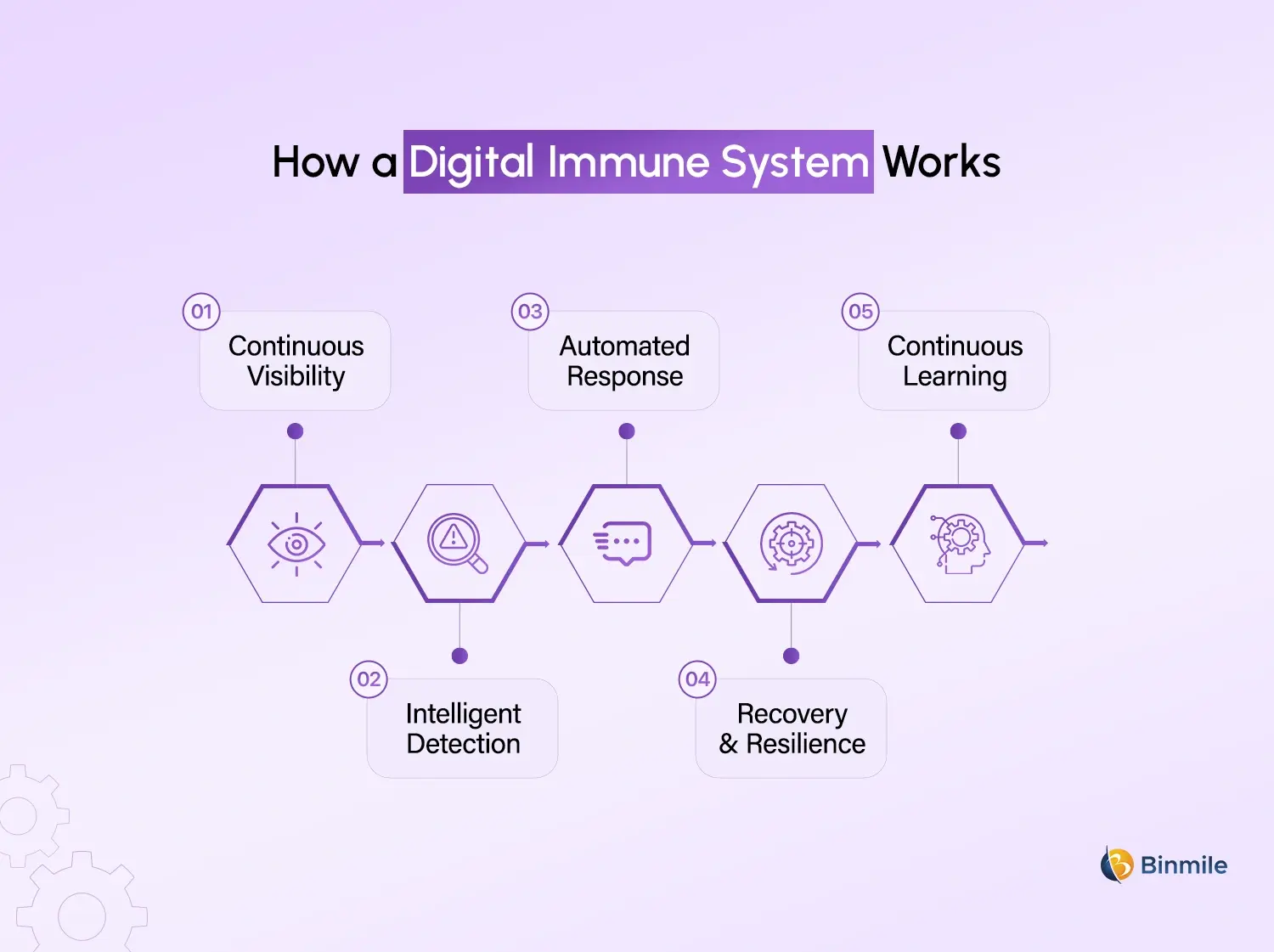
3. Automated Response
Automation allows for quick actions to be taken, such as blocking threats, isolating workloads, rolling back releases, and routing alerts for further investigation.
4. Recovery and Resilience
Having a backup strategy, a failover plan, a rollback strategy, and conducting resilience testing helps to reduce downtime when there is an incident.
5. Continuous Learning
Each incident provides an opportunity for both the quality of monitoring and the quality of code to be improved, as well as the quality of response workflows to be improved, and ultimately, to develop improved security controls in the future.
What Are the Core Technologies Behind a Digital Immune System
A digital immune system technology stack combines tools and practices that help enterprises detect, defend, respond, and recover.
| Technology | Role in Digital Immunity |
|---|---|
| Observability | Tracks system behavior, performance, logs, traces, and user journeys. |
| AI and Machine Learning | Detects anomalies, predicts risks, and prioritizes incidents. |
| Cyber Threat Intelligence | Adds context around new threats, vulnerabilities, and attacker behavior. |
| DevSecOps | Embeds security into software development and deployment. |
| Automation | Speeds up response, remediation, rollback, and recovery. |
| Chaos Engineering | Test system resilience under controlled failure conditions. |
| Zero Trust Access | Continuously verifies users, devices, workloads, and permissions. |
Digital Immune System Examples
These digital immune system examples show how digital immunity works across industries.
1. Banking and Fintech
Regulates transactions, identifies fraud, safeguards APIs, and shields online payment systems.
2. Healthcare
Secures patient portals, EHR systems, telehealth services, and connected medical devices.
3. Retail and eCommerce
Secures user accounts, payment systems, inventory tracking, and mobile apps.
4. Manufacturing and Logistics
Secures IoT devices, connected equipment, warehouses, and supply chain systems.
5. SaaS Platforms
Secures continuous integration and development (CI/CD) pipelines, monitors system performance, and enhances system availability.
How to Build Digital Immunity in Enterprise Systems
To build digital immunity, enterprises need a roadmap that connects security, software quality, performance, and business continuity.
1. Identify Business-Critical Systems
Determine which systems are important for revenue, customer service, legal compliance, and business operations.
2. Improve System-Wide Visibility
Continuously monitor application services, APIs, infrastructure, cloud platforms, database servers, and all users in real time.
3. Embed Security into Development
Utilize DevSecOps methodology by scanning code, testing dependencies, detecting secrets, and addressing issues as early in the development lifecycle as possible.
4. Use Automation for Faster Response
Automate routing alerts, modifying user access, rolling back actions taken by users, patching software errors, and recovering lost files or databases.
5. Apply AI with Governance
Leverage artificial intelligence as a service technologies to identify risks and prioritize vulnerabilities while ensuring data transparency and decision-making authority remain intact.
6. Test Resilience Regularly
Utilize chaos engineering/chaos testing, load testing, failover tests, and recovery drills to identify potential points of failure in terms of resiliency.
7. Create Feedback Loops
After each incident, update security policies and procedures and/or create new ones based on lessons learned from the incident.
Want to build secure applications that can detect, adapt, and recover faster?

Key Digital Immune System Strategies for Enterprises
The best digital immune system strategies are practical, measurable, and aligned with business priorities. Enterprises should focus on strengthening security, improving resilience, and reducing the business impact of digital failures.
1. Map Critical Business Systems
Determine the applications, workflows, data assets, and infrastructure that have a direct impact on revenue generation, compliance, and customer satisfaction.
2. Connect Cybersecurity with Software Engineering
Implement cybersecurity practices at every stage of the design and development lifecycle rather than conducting a final review of completed products.
3. Use Cyber Threat Intelligence
Leverage cyber threat intelligence to identify emerging threat patterns or behaviors, assess vulnerabilities, identify potential attack vectors, and assess risks based on the industry in which your organization operates.
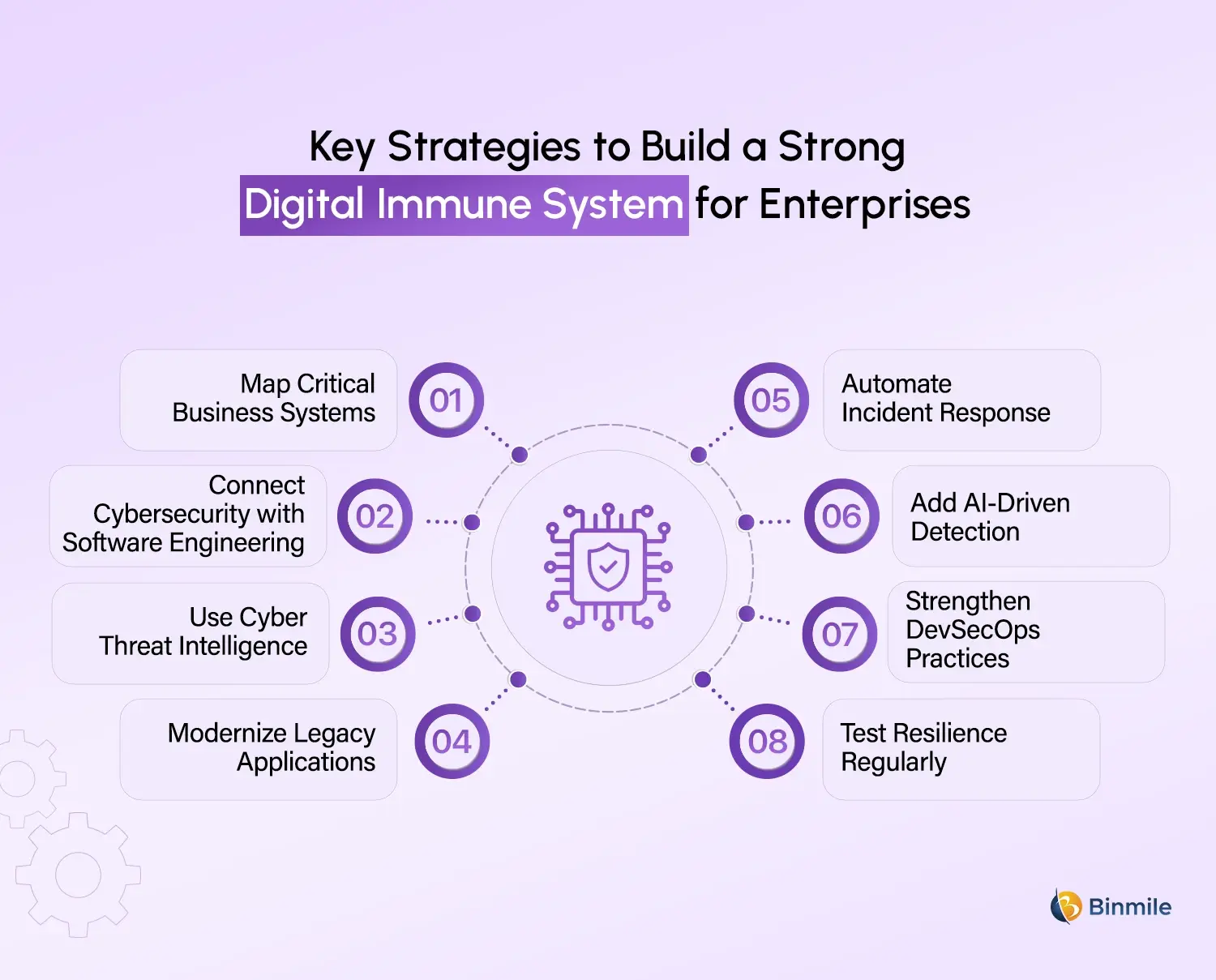
4. Modernize Legacy Applications
Replace outdated systems with newer systems that provide better visibility, API security, automated testing, and recovery capabilities.
5. Automate Incident Response
Automate the process of routing alerts, isolating workloads, rolling back system changes, patching systems, restricting access, and recovering operational systems.
6. Add AI-Driven Detection
Utilize artificial intelligence to detect anomalous behavior; identify potential risks; prioritize vulnerable components; and reduce the volume of alerts.
7. Strengthen DevSecOps Practices
Integrate security testing into a CI/CD pipeline by implementing code scans, dependency analysis, secret discovery, and pre-deployment testing.
8. Test Resilience Regularly
Perform chaos testing, load testing, failover testing, and disaster recovery exercises to identify weaknesses in your organization’s resilience strategy.
Digital Immune System Market: Why Enterprises Are Paying Attention
The digital immune system market is growing because businesses are facing three major pressures: rising cyber threats, complex digital systems, and higher customer expectations.
As companies continue to launch new Applications, leverage additional cloud platforms, use additional tools to integrate disparate applications, and depend upon real-Time data, the levels of Security risk and Operational risk increase.
In addition, Customers expect that applications will always operate seamlessly. A short blip in uptime can negatively impact revenue, increase support costs, and damage brand reputation. This is why more and more companies with customer-facing platforms, Finance Systems, Healthcare Applications, Enterprise Applications, and connected operations are looking to invest in solutions that provide a Digital Immune System.
The rise of artificial Intelligence adoption is another factor that is driving companies’ interest in this area of investment. As companies deploy AI in customer service, Operations, decision-making, and Automation, they will need stronger controls around Data Security, System Reliability, Behavior of Models, and Governance.
Common Challenges in Building a Digital Immune System and Their Solutions
Building a digital immune system can be difficult when tools, teams, and systems are disconnected.
Challenge 1: Fragmented Security and IT Tools
Utilizing different solutions often creates blind spots that hinder the decision-making process.
Solution:
Integrate security, DevOps, observability, and incident response tools with shared dashboards and automated workflows.
Challenge 2: Legacy Applications
Typically, older applications do not have the level of visibility needed, API security, testing, and recovery capabilities.
Solution:
Gradually modernize your solutions to become more observability-enabled, with better access controls, API security, and a cloud-ready architecture.
Challenge 3: Too Many Alerts
Excess alerts of low-risk status create alert fatigue and therefore do not reflect actual risks.
Solution:
Prioritize alerts using artificial intelligence and cyber threat intelligence according to level of risk, context, and impact to the business.
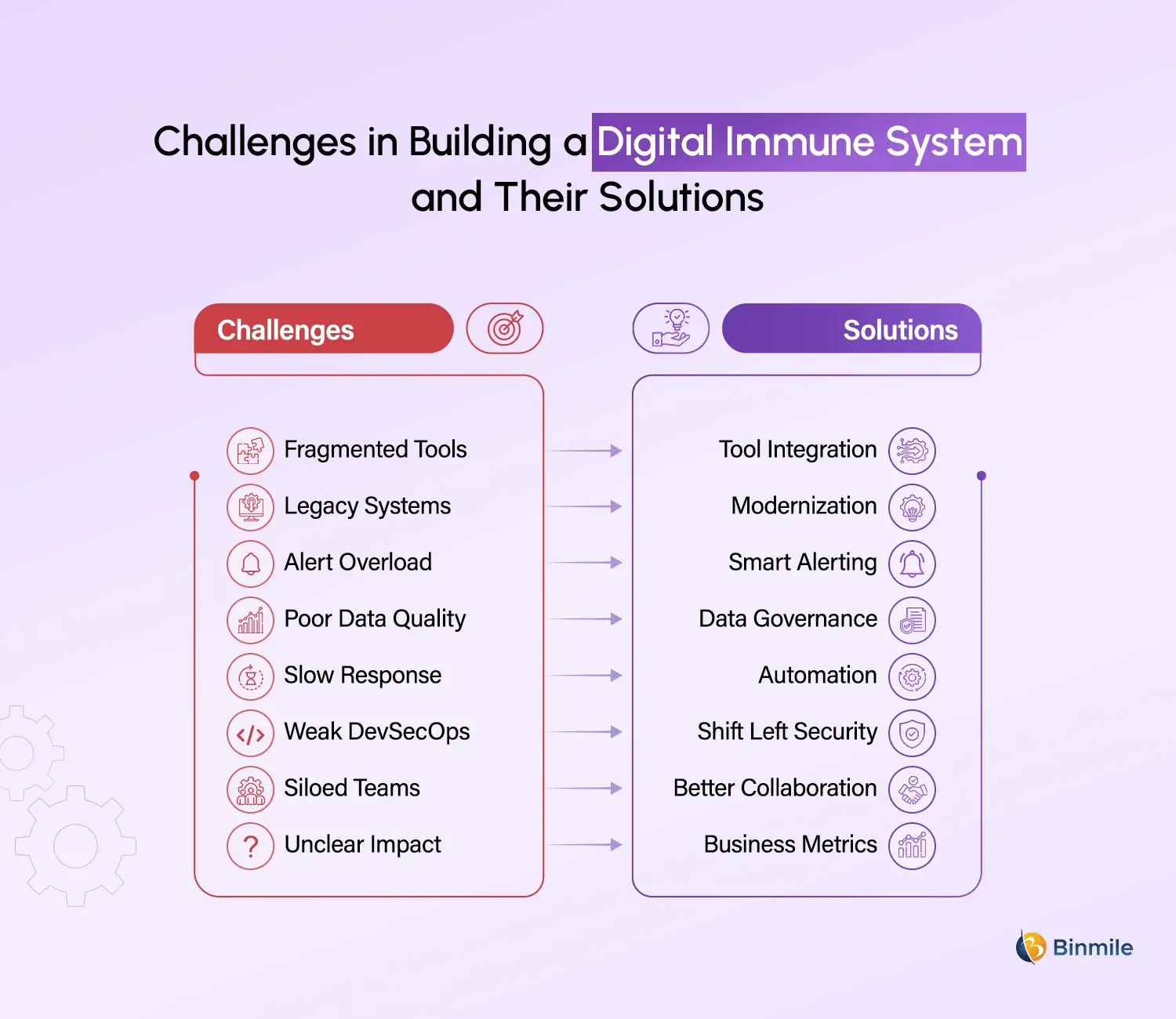
Challenge 4: Poor Data Quality
Due to incomplete logging and inconsistent data across different systems, organizations struggle to detect threats.
Solution:
Improve log management, telemetry collection, monitoring standards, and data governance practices.
Challenge 5: Slow Manual Response
Using manual processes in a crisis situation extends the time it takes to respond to incidents, outages, or failures.
Solution:
Automate repetitive tasks such as isolating workload, rollbacks, restricting access, patch alerts, and recovery alerts.
Challenge 6: Weak DevSecOps Maturity
Performing security checks at the end of development allows high-risk vulnerabilities to reach production.
Solution:
Incorporate scanning of code, checking dependencies, finding secrets, and performing security testing into the CI/CD Pipeline to build security into your code early.
Challenge 7: Poor Team Collaboration
Working in silos reduces an organization’s ability to effectively respond and remain resilient.
Solution:
Establish shared goals, standardized playbooks, ownership for team members, and conduct cross-functional reviews.
Challenge 8: Unclear Business Impact
Without technical metrics to show business value, a company can not properly connect the security, DevOps, observability, and incident response via the use of shared dashboards and automated workflows.
Solution:
Track downtime reduction, faster response, recovery time, fewer production issues, and customer experience improvement.
Ready to strengthen enterprise security with intelligent, resilient, and future-ready digital systems?

How Binmile Can Help Enterprises Build Digital Immunity
Building a digital immune system requires more than adding new cybersecurity tools. It needs secure software architecture, cloud resilience, DevSecOps maturity, AI-powered intelligence, automation, and continuous improvement across the enterprise technology ecosystem.
Binmile helps businesses strengthen this foundation through digital transformation in business, custom software engineering, cybersecurity consulting, AI-driven solutions, IoT development, DevOps enablement, and CI/CD implementation. The focus is on helping enterprises design systems that are secure, scalable, observable, and resilient from the start.
For organizations modernizing legacy applications, launching new digital products, or improving their security posture, the right approach is to connect cybersecurity with software quality and business continuity. A digital immune system guides enterprises by helping them prevent failures, respond faster, and build technology environments that continually improve with every incident, release, and risk signal.
Frequently Asked Questions
A digital immune system is a security and resilience model that combines observability, AI, automation, DevSecOps, testing, and threat intelligence to detect risks early, respond faster, reduce downtime, and improve enterprise technology performance.
A digital immune system in cybersecurity helps businesses move beyond reactive protection. It continuously monitors systems, detects anomalies, automates response, and strengthens applications, APIs, cloud environments, and software pipelines against evolving cyber threats.
Businesses can build digital immunity by identifying critical systems, improving visibility, embedding DevSecOps, using AI-driven detection, automating response workflows, testing resilience, and creating feedback loops after incidents, outages, and failed deployments.
Examples include fraud detection in banking, secure patient portals in healthcare, resilient checkout systems in eCommerce, protected IoT environments in manufacturing, and automated rollback systems in SaaS platforms using CI/CD pipelines.
No. Large enterprises need it because of complex systems, but growing businesses can also benefit. Any company running customer-facing apps, cloud platforms, sensitive data workflows, or digital operations can use digital immunity principles.