Personal data has quietly become one of the most valuable assets a business owns. It sits inside CRMs, HR tools, cloud platforms, payment systems, mobile apps, website forms, support tickets, analytics dashboards, and even AI-powered chatbots. But the same data can also become a serious business risk when it is collected without clarity, stored without control, or shared without accountability.
This blog explains why DPDP compliance matters more than most businesses assume. We will cover what the Digital Personal Data Protection Act means for enterprises, why DPDP rules are important, how businesses can prepare a practical DPDP compliance checklist, what DPDP Readiness should include, and how organizations can use the right mix of data governance, security, cloud protection, consent management, and technology support to reduce privacy risk.
What Is DPDP Compliance?
DPDP compliance means following the requirements of the Digital Personal Data Protection Act while collecting, processing, storing, sharing, retaining, and deleting digital personal data. In simple words, it means businesses must handle people’s personal information with more clarity, control, and accountability.
This data may include names, phone numbers, email addresses, employee records, financial details, health information, customer queries, purchase history, and data collected through apps, websites, or digital platforms.
The DPDP Act applies to organizations that process digital personal data in India. It can also apply to businesses outside India if they process personal data of individuals in India while offering goods or services. For businesses, this means privacy can no longer be limited to legal documents. It must become part of daily operations, product design, technology systems, and customer experience.
Why DPDP Compliance Matters More Than You Think
Here are the reasons why DPDP compliance matters for enterprises:
1. Protects Customer Trust
Consumers want to know how the company collects, processes, and protects an individual’s data. By using clear consent, transparent notice, and responsible data use, businesses can establish higher levels of customer confidence.
2. Reduces Business And Financial Risk
If companies have weak privacy practices, they may suffer from data breaches, legal issues, regulatory action, and loss of reputation. By remaining compliant with DPDP standards, businesses can identify and remediate any privacy issues before they become bigger problems.
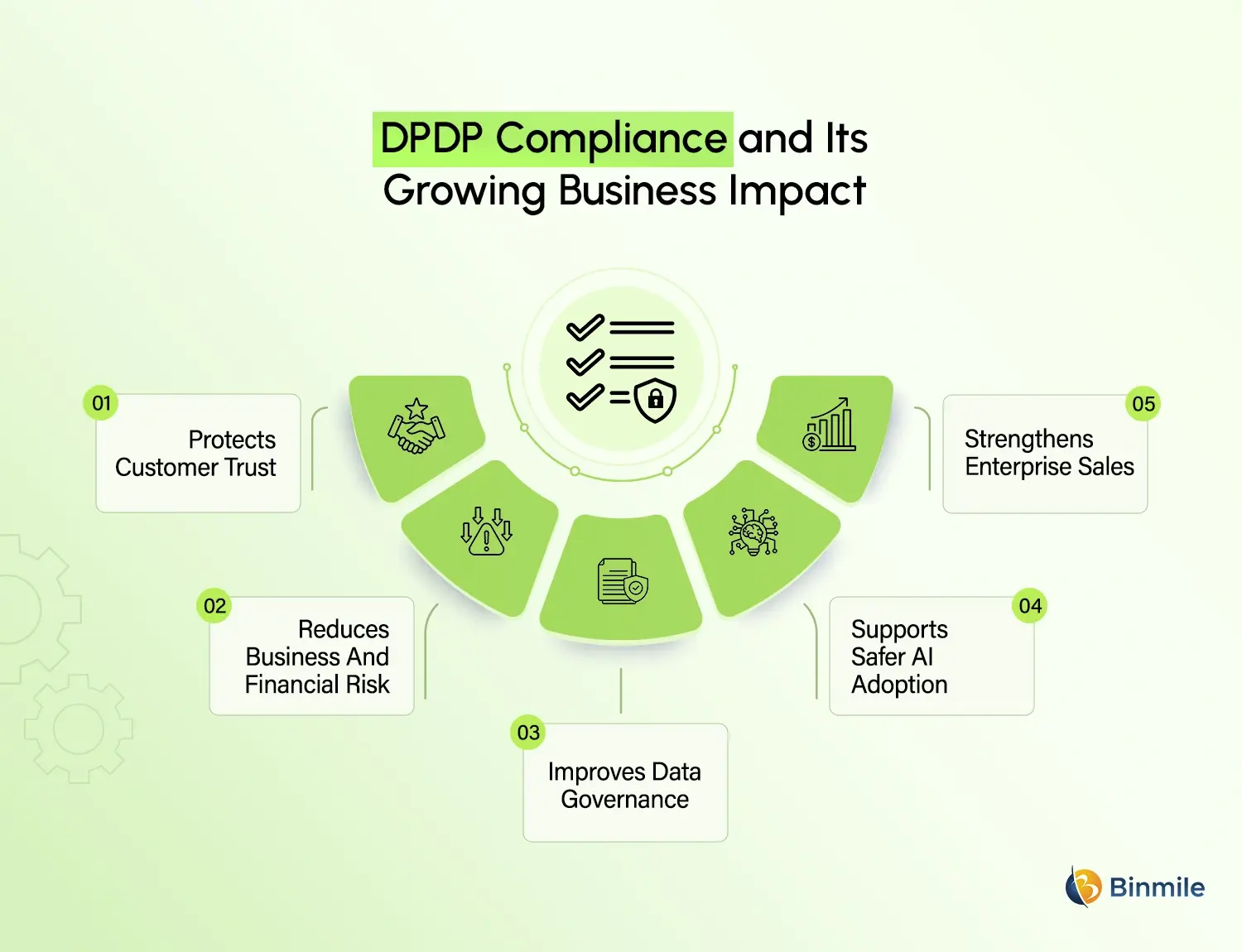
3. Improves Data Governance
With DPDP compliance, businesses have an increased ability to see where personal data is being stored, who has ownership of the data, how many people can access the data, and when the data should be destroyed.
4. Supports Safer AI Adoption
Personal data is used frequently by AI chatbots, automated tools, and analytic systems. With DPDP compliance in place, organizations have the ability to clearly define what data AI technologies can use and how the data should be secured.
5. Strengthens Enterprise Sales
Enterprise customers are now using privacy as a determining factor for purchasing decisions. DPDP compliance increases an organization’s credibility when going through audits, RFPs, partnerships, and vendor evaluations.
What Businesses Need to Know About DPDP Rules
The DPDP regulations will provide a clearer understanding of how companies must handle their privacy responsibilities in real-world situations. There are several critical areas addressed by these rules, including: notice; consent; data subject’s rights; security safeguards; responses to breaches; children’s data; consent managers; and roles and responsibilities of data custodians.
Companies will need more than just a privacy policy to be compliant with the DPDP regulations. Likewise, having a consent checkbox will not be sufficient for compliance either. Likewise, keeping the compliance paperwork in a binder will not be sufficient either.
In order to be compliant with the DPDP regulations, companies must develop and implement clear workflows, enforce system-level controls, establish and document processes, and have an audit-ready trail for all aspects of compliance. Companies must be able to demonstrate how they collected consent, how they protected the data they received, how they responded to user requests, how they responded to data breaches, etc.
Key Business Areas Impacted by DPDP Rules
DPDP rules affect multiple teams, not just legal or compliance departments. Any team that collects, stores, accesses, or uses personal data has a role to play.
| Business Area | How Does DPDP Impact It? |
|---|---|
| Marketing | Lead forms, newsletters, campaigns, landing pages, remarketing tools, and CRM usage need clearer consent and purpose mapping. |
| Product and Engineering | Apps, portals, dashboards, AI tools, and customer journeys need privacy-first design and limited data collection. |
| HR | Employee records, identity documents, payroll data, and background verification details need secure handling and retention controls. |
| IT and Security | Access control, encryption, monitoring, breach response, cloud security, and identity management become critical. |
| Legal and Compliance | Policies, notices, vendor contracts, grievance processes, and audit evidence need to align with DPDP rules. |
| Sales and Partnerships | Enterprise buyers may assess DPDP readiness before closing deals or onboarding vendors. |
DPDP Compliance Checklist for Enterprises
A practical DPDP compliance checklist helps businesses move from awareness to execution. It gives teams a clear structure to review what is working, what is missing, and what needs to be improved.
1. Identify All Personal Data
Create a mapping of how the personal information from customers, employees, vendors, partners, and visitors to the website and/or app is collected and stored in CRM’s, HRMs, cloud, support tools, and third-party systems.
2. Define The Purpose
Each piece of data should be collected for a defined business purpose, and if you do not need the data, you should not collect it.
3. Review Consent Mechanisms
Consent should be clear, specific, informed, and easy to withdraw across all apps, websites, AI-powered chatbots, support tools, and marketing campaigns.
4. Update Privacy Notices
The privacy notices should describe what data is collected, why it will be used, how long it will be stored, and how the user can exercise their rights.
5. Create Data Principal Rights Workflows
The business needs to be able to track the workflows for the handling of access requests, correction requests, deletion requests, grievance requests, and requests for withdrawal of consent without relying on only a manual email.
6. Strengthen Access Control
Access to personal data should only be granted to those who have a legitimate need/purpose to access the data. Role-based access controls, MFA, periodic access reviews, and activity logs are all ways to reduce the abuse of personal data.
7. Review Vendor Data Sharing
Vendors (i.e., SaaS tools, payroll providers, cloud platforms, marketing tools, support partners, etc.) should be reviewed for their privacy and security practices.
8. Build Breach Response Readiness
The teams should have a plan to detect, investigate, report, and respond to incidents involving personal data breaches, including identifying roles for each part of the process.
DPDP Readiness Implementation Roadmap
A strong DPDP readiness implementation roadmap should be practical and phased. Businesses should avoid trying to fix everything randomly.
| Phase | What It Includes | Business Outcome |
|---|---|---|
| Phase 1 | Data discovery and system mapping | Clear visibility into where personal data exists |
| Phase 2 | Gap assessment against DPDP requirements | Understanding of current privacy risks |
| Phase 3 | Consent and notice redesign | Better transparency and user control |
| Phase 4 | Access, security, and retention improvements | Reduced misuse, leakage, and over-retention risk |
| Phase 5 | Vendor and third-party review | Stronger accountability across the data ecosystem |
| Phase 6 | Automation and compliance monitoring | Scalable DPDP compliance management |
This roadmap helps enterprises move from confusion to clarity. It also ensures DPDP implementation services focus on real business systems, not just policy updates.
Need scalable DPDP Act Compliance Solutions to protect personal data and reduce regulatory risk?

How DPDP Act Compliance Solutions Help Businesses
Here is how DPDP Act compliance solutions can help businesses in keeping up with data protection:
1. Consent Management
Businesses have the ability to track when they collected consent, why they collected consent, and if consent was withdrawn afterwards.
2. Data Principal Request Handling
Compliance solutions provide businesses with the tools needed to route requests for access, corrections, deletions, grievances, and withdrawal of consent to the proper teams.
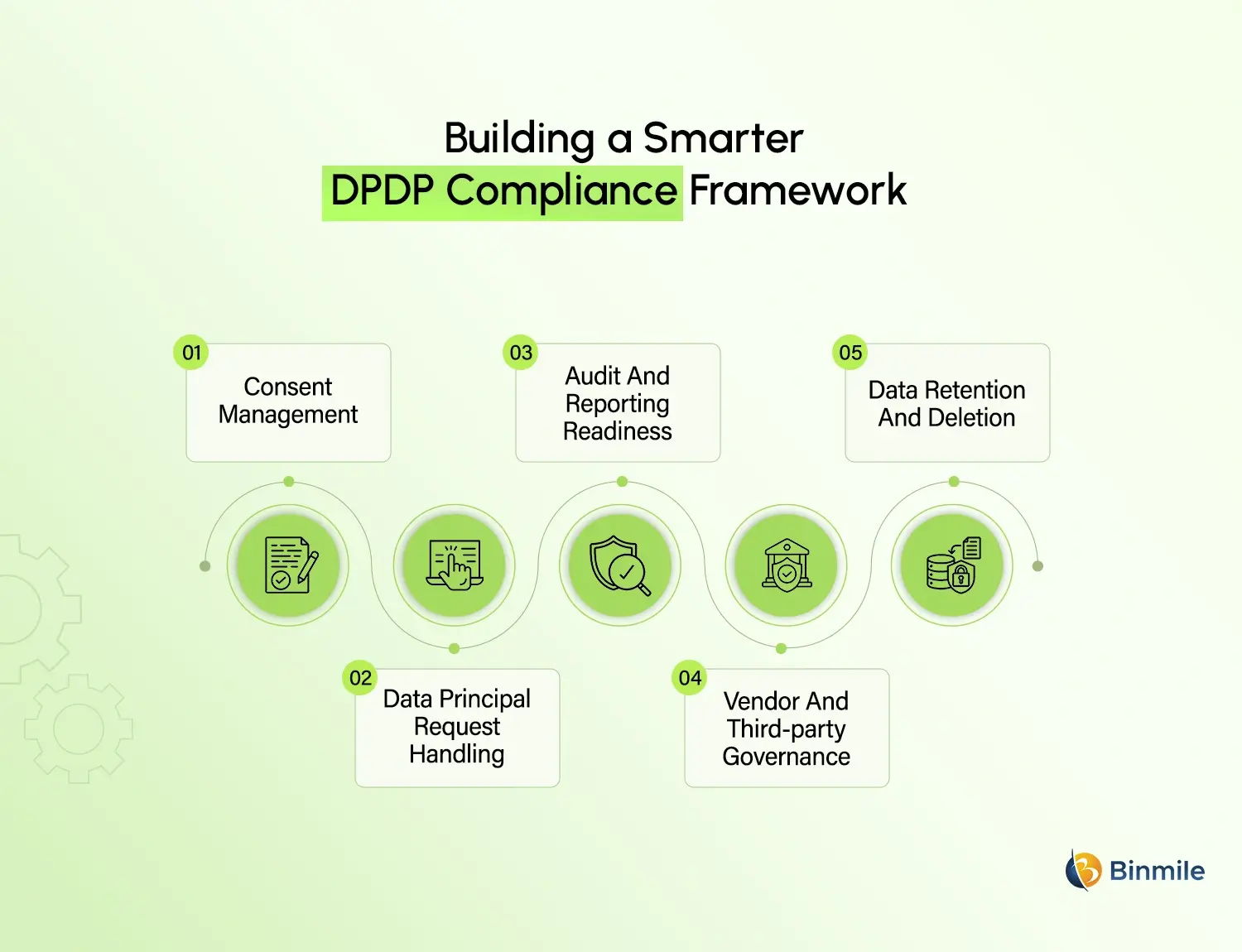
3. Audit And Reporting Readiness
The DPDP Act Compliance Solutions can provide businesses with access to audit logs, compliance reports, privacy dashboards, and documentation.
4. Vendor And Third-party Governance
Solutions can be used to monitor the accountability of vendors for data sharing, their risk, and the privacy standards outlined in their contracts.
5. Data Retention And Deletion
Businesses can create automated workflows to delete, archive, or anonymize personal data when it is no longer needed.
Why DPDP and Data Governance Strategy Must Work Together
Collaboration between the DPDP and the overarching data governance strategy is vital to achieving DPDP compliance. To protect data correctly, a business must have at least an understanding of its data, specifically, the types of data it has, the physical locations of that data, who owns the data, and how that data flows through the organization.
A robust data governance strategy creates definitions around the items above (ownership, classification, access, quality, lineage, retention, and accountability), thus simplifying how organizations can manage their personal data in a responsible manner.
Data governance also supports organizations in reducing duplicate data, deleting obsolete records, creating better reports, and reducing unnecessary data collection. This is important because the DPDP is not just about protecting data, but also about collecting and utilizing data in a way that will satisfy the requirements of the DPDP.
When an organization is investing in AI, analytics, automation, or cloud modernization, data governance becomes essential to supporting compliance as well as innovation. Clean, controlled, properly classified data are the basis for all successful initiatives related to compliance, innovation, and overall success.
DPDP vs GDPR Compliance
Here is the difference between DPDP and GDPR compliance:
| Area | GDPR Compliance | DPDP Compliance |
|---|---|---|
| Region | Mainly applies to EU-related personal data processing. | Applies to digital personal data covered under India’s DPDP Act. |
| Focus | Broader personal data protection framework. | Digital personal data protection and fiduciary accountability. |
| User Control | Strong rights framework with multiple lawful bases. | Consent-led framework with specific obligations and legitimate uses. |
| Business Relevance | Important for global and EU-facing businesses. | Critical for businesses handling digital personal data in India. |
| Readiness Approach | Mature privacy governance, documentation, and rights management. | India-specific compliance mapping, consent workflows, and DPDP readiness. |
Common DPDP Compliance Mistakes Businesses Should Avoid
Many organizations start DPDP compliance with good intent, but still miss important areas. These mistakes can weaken the entire privacy program.
1. Treating It Only As a Legal Task
Legal teams may assist in guiding the process. However, IT, Security, Data, HR, Marketing, Products, and Operations teams are all required to be part of the effort.
2. Ignoring Legacy Systems
Older systems, such as databases, spreadsheets, archived folders, and disconnected tools, may still retain personal data that could present unforeseen compliance risks.
3. Collecting More Data Than Needed
Many organizations collect more data than is needed due to the fact that their forms/workflows were not sufficiently reviewed. By complying with the DPDP, organizations can enhance their processes regarding the collection of purposeful data.
4. Not Maintaining Consent Records
Consent must be trackable. Organizations must be able to document when and why they have obtained consent and if any consent has been revoked.
5. Forgetting Third-party Tools
Third-party tools used by organizations to perform marketing, analytics, human resources, cloud services, payment processing, and support may be storing personal data. Each of these should be examined thoroughly.
What DPDP Implementation Services Should Include
DPDP implementation services should help businesses convert legal requirements into practical processes, system changes, and technology controls.
A strong implementation approach should include data mapping, gap assessment, consent review, privacy notice updates, data rights workflows, vendor assessment, access control improvements, retention planning, breach response design, audit evidence preparation, and employee training.
For technology-led businesses, implementation may also include updating signup forms, improving chatbot data handling, adding audit logs, configuring access controls, and integrating privacy workflows with existing enterprise systems.
The right DPDP implementation services should connect privacy, legal, security, engineering, data, and business teams so compliance does not remain scattered across departments.
Ready to strengthen DPDP compliance and build a privacy-ready digital ecosystem for your enterprise?
How the Right Technology Partner Can Support DPDP Readiness
DPDP compliance needs legal clarity, but it also needs strong technical execution. Many businesses already understand that they need to comply, but they struggle with where to begin, how to assess data flows, how to redesign systems, and how to make compliance scalable.
Binmile can support organizations with DPDP compliance services that combine consulting, implementation, data governance, cloud security, automation, and enterprise application expertise. The focus is not only on helping businesses understand the DPDP Act but also on helping them operationalize privacy across platforms, workflows, cloud environments, and digital products.
For enterprises preparing for DPDP compliance and readiness, the right partner can help assess current gaps, design consent and data rights workflows, improve enterprise cloud data protection, strengthen data governance solutions, and support DPDP Act Compliance Management Software implementation where needed. This makes compliance more practical, measurable, and easier to manage as the business grows.
Frequently Asked Questions
DPDP compliance means following the Digital Personal Data Protection Act while collecting, processing, storing, sharing, and deleting digital personal data. It helps businesses manage consent, protect user data, support rights, and maintain accountability.
Any organization processing digital personal data in India may need to follow the DPDP Act. This includes enterprises, startups, SaaS firms, healthcare platforms, fintech companies, eCommerce brands, HR teams, and foreign businesses serving Indian users.
A DPDP compliance checklist should include data discovery, consent management, privacy notices, user rights workflows, vendor reviews, access controls, retention policies, breach response planning, audit logs, and employee awareness across relevant business teams.
No, DPDP compliance is also a business, technology, security, and customer trust responsibility. Legal teams can guide interpretation, but IT, security, product, data, HR, marketing, and leadership teams must help implement it.
GDPR compliance applies mainly to EU-related data processing, while DPDP compliance focuses on digital personal data under India’s privacy law. Both protect individuals, but requirements, terminology, rights, and operational obligations differ.
Enterprises need DPDP implementation services because compliance involves more than policy writing. It requires data mapping, consent workflows, system changes, vendor governance, security safeguards, breach response processes, and audit-ready documentation.