AI-generated content is becoming harder to separate from everything else published online. Businesses now use AI for customer support, documentation, marketing, software development, research, and countless other tasks. The World Economic Forum notes that experts estimate AI-generated content could account for as much as 90% of information on the internet in the coming years. Research published in Nature has also shown that repeatedly training models on recursively generated data can cause them to lose information from the original data distribution.
That leads to an uncomfortable question: What happens when AI starts learning too much from AI itself?
This is where AI model collapse becomes relevant. The issue is not simply that AI produces inaccurate content. The bigger concern is what can happen when generated content repeatedly enters the training pipeline and gradually replaces diverse, real-world information. For businesses building generative AI models, that makes model collapse an important part of AI risk management.
What Is AI Model Collapse?
AI model collapse is a form of model degradation that can occur when AI systems are repeatedly trained on data generated by other AI models. A single round of synthetic data does not automatically cause a problem. The concern grows when generated information is continuously reused and begins to replace original, human-generated data.
Real-world datasets contain plenty of information that does not occur frequently. They include unusual customer requests, rare fraud patterns, unexpected behaviors, mistakes, and edge cases. Synthetic datasets may not preserve that same range. Over time, repeated training on generated content can make common patterns stronger while less frequent information becomes harder for the model to learn. Synthetic data itself is not bad. Businesses use it for testing, simulations, data augmentation, privacy-sensitive applications, and situations where collecting enough real-world information is difficult.
The problem is dependence.
Think of making a photocopy of a photocopy. The first copy may look almost exactly like the original. Keep repeating the process, and small details begin to disappear. AI systems can experience a similar effect when generated content keeps becoming training material for the next generation of models. Eventually, outputs may become less diverse, and the model may move further away from the original data distribution. For organizations that depend on reliable AI model performance, that gradual shift can become a serious issue.
How Does AI Model Collapse Happen?
The model development process is easier to understand as a cycle.
An AI model learns from a dataset and produces new content. That content is collected and later included in another training dataset. The next model learns from the original information as well as the previous model’s interpretation of it.
Do this repeatedly, and the training data can become increasingly removed from the original source.
Common patterns tend to survive because they appear frequently. Rare information has fewer opportunities to make it through each cycle. Errors can survive in much the same way.
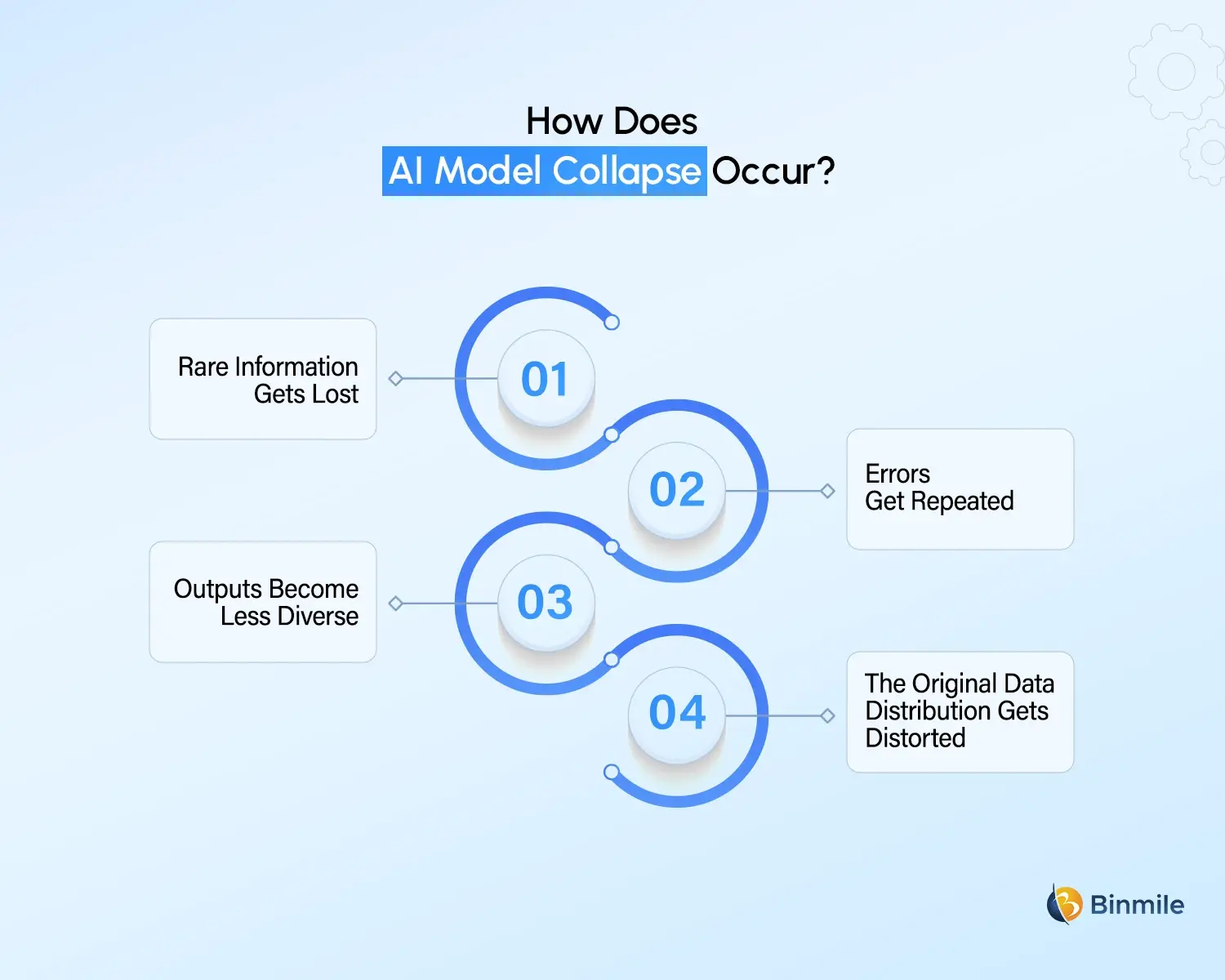
1. Rare Information Gets Lost
Real-world data is not neat. It contains unusual cases that may seem insignificant because they represent only a small percentage of the dataset. For an enterprise AI system, those examples can be some of the most valuable ones.
Consider fraud detection. Most transactions are legitimate, so normal behavior naturally dominates the training data. Unusual transactions are much less common, but they are exactly what a fraud detection system needs to recognize.
If repeated synthetic training reduces exposure to those uncommon patterns, the model can remain accurate on ordinary transactions while becoming less effective at spotting unusual fraud.
2. Errors Get Repeated
AI-generated data can contain factual mistakes, flawed assumptions, and incorrect interpretations. If that content is used to train another model, the original error does not necessarily disappear.
It can be learned again. After several training cycles, the same error may appear more frequently and become harder to distinguish from a legitimate pattern.
Error → Repeated exposure → Reinforced pattern → Harder correction
That is why model collapse is an AI model risk, not simply another data-quality problem.
3. Outputs Become Less Diverse
Repeated exposure to synthetic data can also affect the variety of AI outputs.
Certain phrases, recommendations, structures, or visual patterns may appear more frequently than others. As these patterns become dominant in training data, newer models can become increasingly inclined to reproduce them. The same concern applies to Multimodal AI. If text, images, audio, or other generated data become less diverse, the resulting systems may have a narrower range of patterns to draw from.
4. The Original Data Distribution Gets Distorted
Synthetic data reflects the model that created it. It contains that model’s learned patterns and limitations rather than the full complexity of the real world. When generated content is repeatedly fed into new training cycles, some patterns can become exaggerated while others gradually disappear. The resulting model may therefore move further away from the original data distribution.
That gradual shift is one of the central concerns behind AI model degradation.
What Are the Types of Model Collapse Businesses Should Understand?
Model collapse does not necessarily mean a model suddenly stops working. In many cases, the deterioration is gradual and easy to miss if teams look only at overall accuracy.
| Type | What Happens | Business Impact |
|---|---|---|
| Early Model Collapse | Rare events and less frequent patterns begin disappearing | Reduced ability to handle edge cases |
| Late Model Collapse | Broader patterns become distorted, and outputs move further from the original distribution | Significant loss of accuracy and reliability |
| Distributional Collapse | Generated data becomes concentrated around common patterns | Less diverse and representative outputs |
| Error Amplification | Existing errors or biases are repeatedly reproduced | Higher risk of incorrect or biased decisions |
The distinction matters because a model can continue performing well on familiar benchmark data while becoming weaker in situations that are less common but more important in production.
Why Is AI Model Collapse a Business Risk?
The implication of model collapse becomes a business problem when a change in the quality of an AI system starts affecting the work built around it. A model does not have to completely fail for the impact to show up. It might still produce convincing answers most of the time while becoming less dependable in situations that are harder to predict.
That matters when AI in risk management is being used for customer interactions, fraud detection, forecasting, recommendations, document processing, or other decisions that influence day-to-day operations. In these situations, even a gradual drop in AI model performance can have consequences.
-
Reduced AI Model Performance
A model can continue to score well on standard tests and still struggle with inputs it has seen less often.
For example, a customer service assistant might handle routine questions without any issue but give weaker answers when a customer describes an unusual situation. A fraud detection system could face a similar problem if it becomes less familiar with uncommon transaction patterns.
The problem is easy to overlook when teams focus only on average accuracy.
-
Increased Bias and Reduced Representation
When uncommon patterns disappear from training data, the model’s understanding of certain users or situations can become narrower.
This can matter for systems serving different customer groups. A model may work perfectly well for the majority while producing less accurate or less appropriate results for groups that are not represented as strongly in its training data.
Over time, that gap can become both a performance and fairness concern.
-
Higher Hallucination and Reliability Risks
A degraded model may have a harder time producing consistently reliable outputs. That does not mean every response will be wrong. In fact, the more difficult cases are often the ones that reveal the problem.
Businesses could see inaccurate recommendations, fabricated information, incorrect summaries, or responses that sound confident but do not hold up when checked. The consequences are greater when those outputs feed into business decisions.
-
Loss of Competitive Advantage
Most organizations do not invest in AI simply to have an AI system in place. They expect it to improve something, whether that means faster decisions, better personalization, lower operating costs, or more efficient workflows.
If model quality starts slipping, those improvements can gradually lose their value. The company may continue spending on infrastructure, data, and AI operations while getting less from the system than it did before.
-
Compliance and Governance Concerns
There is also a governance side to the problem.
Businesses need to know what data was used to train a model, how that data changed, and whether the model continues to perform as expected. This becomes particularly important in regulated industries, where organizations may need to explain how an AI system reaches or supports certain decisions.
That is why model provenance and continuous AI model evaluation matter. Without a clear record of the data and model changes, figuring out why performance has declined can become much harder.
Want to make your enterprise AI systems more reliable to build stronger data, evaluation, monitoring, and governance practices.

How Does Synthetic Data Contribute to AI Model Collapse?
Synthetic data has become useful in modern AI development. It can help create rare scenarios, support testing, expand datasets, and protect sensitive information.
The problem starts when organizations use it as a substitute for too much real-world data.
Generated content carries the characteristics of the model that produced it. If another model learns heavily from that content, its limitations can be carried forward as well. Repeating the process can reinforce errors, biases, and common patterns.
The answer is not to eliminate synthetic data. Instead, businesses need to maintain a healthy mix of synthetic and real-world information.
Teams should know where their training data came from, how much of it is synthetic, and how it was processed. Human review and continuous AI model evaluation can also help identify problems before they become part of another training cycle.
What Are the AI Model Collapse Prevention Strategies for Enterprises?
Preventing model collapse requires controls across the AI model development lifecycle. These practices also support the development of Ethical AI Models by improving transparency, fairness, and accountability across the AI lifecycle.
1. Maintain a Strong Supply of Real-World Data
Keep diverse, human-generated data at the core of the training ecosystem. Refresh datasets regularly instead of relying heavily on recycled AI-generated content.
2. Track Data Provenance
Record where training data comes from and whether it is real or synthetic. This makes it easier to identify possible contamination and understand why model behavior may have changed.
3. Separate Synthetic and Real Data
Clearly classify synthetic and real-world data within training pipelines. Monitoring the proportion of generated content can prevent accidental overdependence on it.
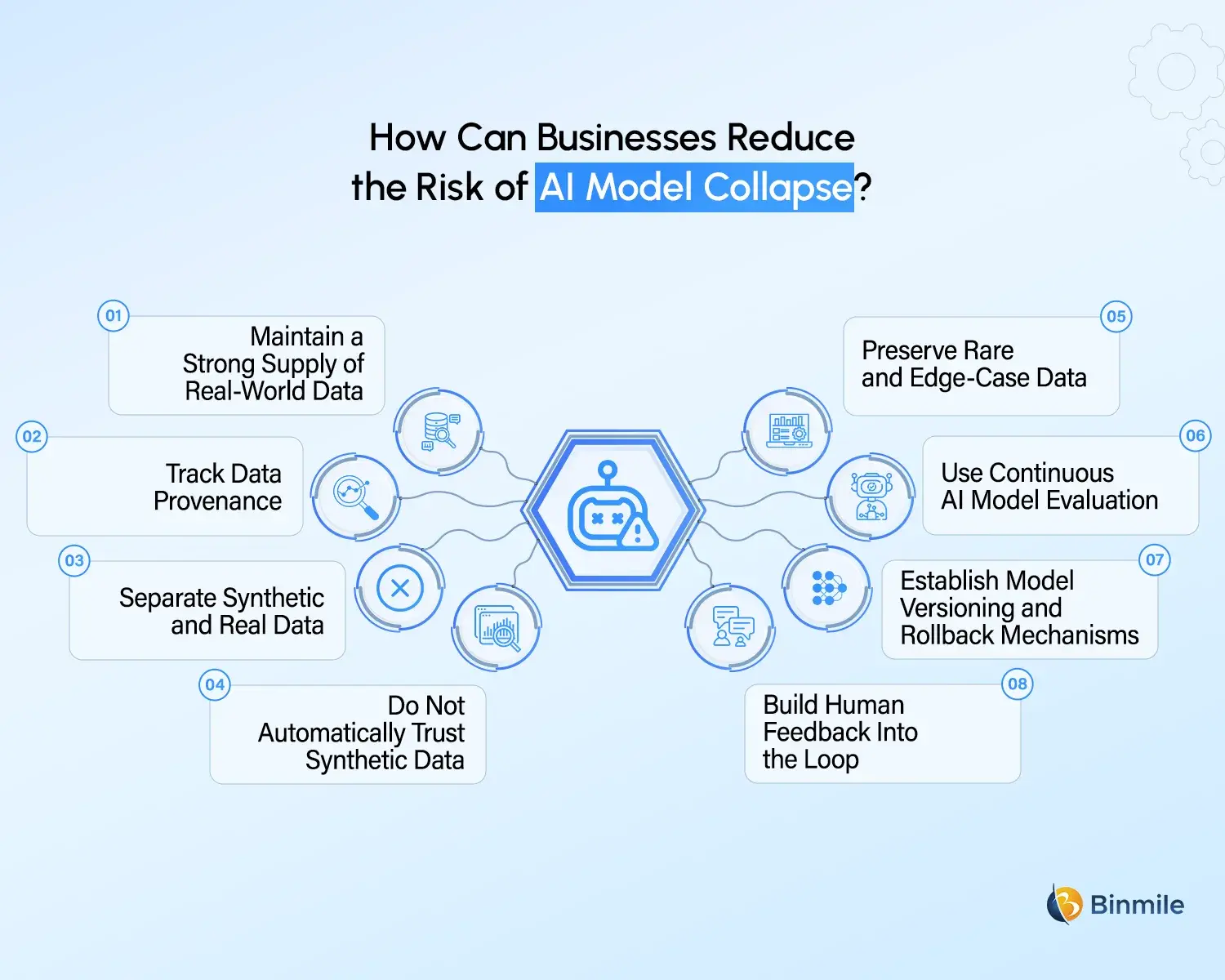
4. Do Not Automatically Trust Synthetic Data
Synthetic data still needs quality checks. Validate it for accuracy, duplication, bias, diversity, and relevance before using it for training.
5. Preserve Rare and Edge-Case Data
Do not throw away unusual examples simply because they are uncommon. Rare fraud patterns, cybersecurity anomalies, and unusual customer queries can be essential to reliable enterprise AI.
6. Use Continuous AI Model Evaluation
Monitor accuracy, hallucinations, bias, output diversity, edge-case performance, and distribution drift after deployment. Looking at these indicators over time can reveal gradual degradation.
7. Establish Model Versioning and Rollback Mechanisms
Track major model changes and compare new versions against established benchmarks. If performance drops, teams should have a clear path to investigate and roll back the change.
8. Build Human Feedback Into the Loop
Human reviewers can catch repetitive outputs, missing perspectives, and subtle quality problems that automated metrics may overlook. Their input provides another useful layer of AI model collapse prevention.
How Can Enterprises Monitor AI Models for Early Signs of Collapse?
Early detection gives teams more options. Instead of trying to repair a severely degraded model, they can investigate changes while they are still manageable.
A useful monitoring process should compare model versions against consistent benchmarks containing common scenarios as well as rare and real-world edge cases.
-
Declining Output Diversity
If responses become increasingly similar even when inputs vary, the model may be relying too heavily on familiar patterns.
-
Poor Performance on Rare Cases
A decline in performance on unusual inputs can be easy to miss when average accuracy remains strong. These cases should therefore be monitored separately.
-
Distribution Drift
Large differences between model outputs and trusted real-world data may indicate that the model is moving away from its original distribution.
-
Increasing Repetition
Repeated phrases are one obvious example, but the same issue can appear in recommendations, summaries, structures, and generated visuals.
-
Concentration of Errors
If unrelated outputs begin containing the same mistakes, teams should investigate whether those errors are being reinforced somewhere in the data or training pipeline.
-
Performance Gaps
Average metrics can hide weaknesses in specific domains, user groups, or edge cases. Breaking performance down into these areas gives teams a clearer picture.
These indicators can become part of an AI risk management framework and MLOps monitoring process, helping teams address degradation before it affects production.
AI Model Collapse Solutions: A Practical Enterprise Framework
For organizations already using generative AI at scale, model collapse prevention should be part of the broader AI risk management strategy.
A practical framework can be divided into five stages:
| Stage | Focus | Key Action |
|---|---|---|
| Discover | Understand data sources | Map real and synthetic data |
| Assess | Identify collapse risk | Evaluate diversity, provenance, bias, and distribution |
| Control | Reduce contamination | Set data-quality and synthetic-data controls |
| Monitor | Detect degradation | Continuously evaluate model behavior |
| Improve | Restore performance | Refresh data, fine-tune, retrain, or roll back |
This approach turns model collapse from an abstract AI concern into something teams can monitor and manage. It also fits into broader risk management in software development, where risks are identified and addressed throughout the development lifecycle instead of after a problem reaches production.
Want to make AI risk management part of your development lifecycle by building stronger data, evaluation, monitoring, and governance practices for enterprise AI?

How Can an AI Development Company Help With AI Model Collapse Prevention?
Preventing model collapse involves more than choosing the right AI model. Data quality, training practices, evaluation, monitoring, governance, and deployment all have a role to play. This becomes even more relevant for organizations using Artificial Intelligence as a Service, where AI capabilities may depend on external platforms, managed infrastructure, or third-party models.
An experienced AI Development Company can help businesses establish data provenance, control synthetic-data usage, build continuous evaluation pipelines, and monitor models for early signs of degradation. This becomes especially useful when an organization operates multiple AI systems with different datasets and model versions. Without proper controls, keeping track of how each system was trained and how its performance has changed can quickly become difficult.
The goal is not to stop using synthetic data. It is to make sure AI systems continue learning from sources that are diverse, relevant, and reliable. Binmile supports enterprises with AI model development, data engineering, model evaluation, monitoring, and governance, helping organizations build AI systems that can remain reliable as their data, models, and business requirements evolve.
Frequently Asked Questions
AI model collapse occurs when models repeatedly learn from AI-generated data and gradually lose diversity, rare information, or accuracy. Businesses risk unreliable outputs, biased decisions, weaker edge-case performance, and declining value from AI investments.
Businesses can reduce collapse risk by maintaining diverse real-world datasets, tracking data provenance, controlling synthetic-data usage, preserving rare examples, continuously evaluating models, monitoring performance changes, and introducing human feedback throughout the AI lifecycle.
Synthetic data can contribute to model collapse when AI-generated outputs repeatedly replace real-world training data. Errors, biases, and common patterns may become amplified across generations, gradually reducing diversity and moving model behavior away from the original data distribution.
Enterprises should combine real and carefully validated synthetic data, maintain data lineage, preserve edge cases, evaluate models against stable benchmarks, monitor distribution drift, conduct fairness testing, and establish clear retraining, rollback, and governance procedures.
Yes. An AI development company can help assess training pipelines, implement data provenance, establish model evaluation frameworks, monitor performance, control synthetic-data exposure, improve model governance, and build continuous testing processes designed to identify degradation before it affects production systems.
Enterprises can monitor output diversity, accuracy, repetition, distribution drift, rare-case performance, hallucination rates, bias, and changes across model versions. Comparing these metrics against trusted baselines helps teams identify gradual degradation before it becomes a major failure.