Artificial Intelligence is transforming the manufacturing industry with its deep learning capabilities. Many manufacturing businesses are leveraging the maximum potential of artificial intelligence to improve accuracy, efficiency, and productivity across various processes. Manufacturers adopting AI clearly demonstrate a strategic shift toward modernizing their operations. They also aim to stay ahead of the competition in an increasingly evolving industry. In fact, according to a recent survey conducted by a leading technology news website, 26% of organizations actively use AI to improve their decision-making processes. The question now is: how can your business leverage AI in manufacturing to improve decision-making, increase efficiency, and move toward smart manufacturing? In this blog, we will answer that question and explore real-world use cases and examples of how manufacturers are using artificial intelligence to transform their operations. Let’s start.
What is AI in Manufacturing?
AI in manufacturing operates across information technology (IT) and operational technology (OT) environments. It uses AI-powered tools based on machine learning and deep learning to improve industrial workflows and production processes. Artificial intelligence enhances various aspects of manufacturing, from daily operations to new product development (NPD). It also helps accelerate time to market and build a sustainable competitive advantage.

With the advent of IoT, edge computing, cloud networks, and machine learning, manufacturers now have access to more data than ever before. They can also derive meaningful insights from the captured data. This enables them to make smarter decisions and improve operational efficiency, such as:
- Equipment Maintenance
- Supply Chain Monitoring
- Production Process Optimization
- Quicker Product Creation
- Accelerated New Product Development
Top 7 Ways AI in Manufacturing is Revolutionizing Industrial Production
The incorporation of AI in manufacturing is driving a significant shift, pushing the industry towards significant advancements and efficiencies. Below you can take a look at 7 key use cases in manufacturing with real-world examples.
1. Supply Chain Management
Supply chain management plays a key role in the manufacturing industry. Artificial intelligence has emerged as a major contributor to this area. By combining AI with manufacturing, businesses can transform their supply chain processes. This helps improve accuracy, operational efficiency, and cost-effectiveness.
Using AI in the supply chain allows leveraging predictive analytics, enhancing inventory management, improving demand forecasting, and streamlining logistics. Machine learning algorithms can analyze historical data and identify meaningful patterns. They also accurately forecast fluctuations in customer demand. For example, an automotive parts manufacturer can use machine learning models to predict demand for spare parts. This helps optimize inventory levels while reducing operational costs.
A globally recognized retail giant, Walmart, uses artificial intelligence to optimize its supply chain operations. The company leverages AI to improve productivity and enhance customer satisfaction. Walmart relies on machine learning algorithms to forecast customer demand, analyze historical sales data, and manage inventory levels efficiently.
2. Warehouse Management
Innovations in AI are also reshaping the warehouse management sector of manufacturing. The rise of AI-driven manufacturing solutions and machine learning has revolutionized the way warehouses operate, resulting in improved efficiency, precision, and cost savings. One of the main AI manufacturing use cases for warehouses is inventory management.
The algorithms based on artificial intelligence for manufacturing can analyze historical sales data, existing stock levels, and market trends to forecast demand patterns precisely. This allows warehouses to enhance their inventory levels, mitigating carrying costs while ensuring product availability. For example, BMW counts on AI-powered automated guided vehicles (AGVs) in its manufacturing warehouses to streamline internal logistics operations.
AI in transportation powers these automated guided vehicles that follow predetermined paths, automating the transfer of supplies and finished products, thus optimizing inventory management and visibility for the company.
3. Cobots
Cobots in manufacturing are also known as collaborative robots that come in handy to boost productivity by partnering with human operators. Such robots are deployed in fulfillment centers to assist in picking and packing. These cobots work simultaneously with human workers, navigating complicated areas and recognizing objects with the help of AI systems.
A case in point here is that Amazon’s cobots utilize ML to accelerate order fulfillment, streamline logistics, and enhance operations. These AI-driven robots can carry out intricate tasks accurately and adaptably. Cobots can take care of complex assembly processes and quality control inspections and smoothly tie-up with human workers. This proactive approach established by a leading manufacturing software development company reduces downtime, decreases maintenance costs, and ensures optimum equipment performance.
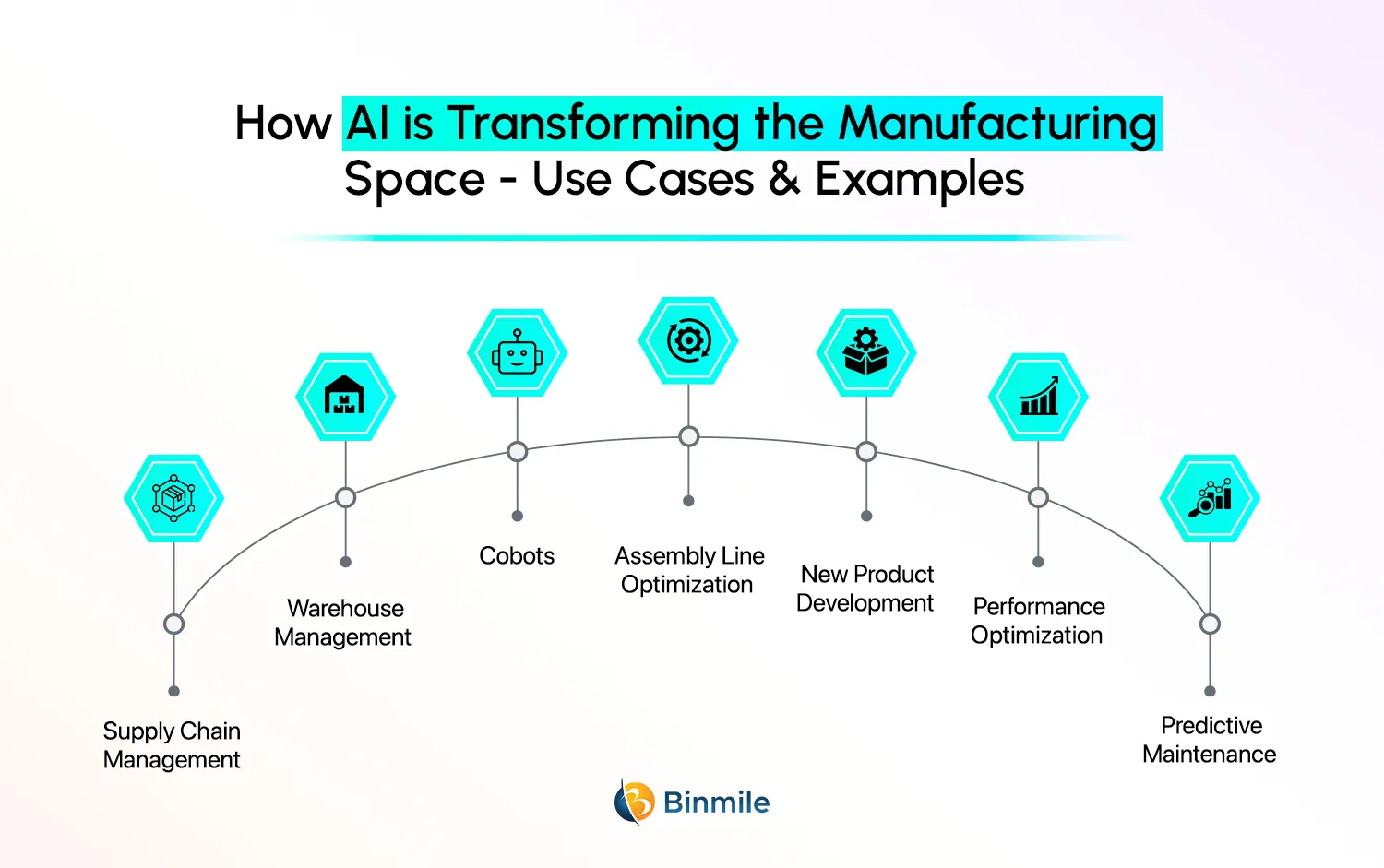
4. Assembly Line Optimization
Artificial Intelligence is employed in assembly line optimization to optimize the accuracy, efficiency, and flexibility of production processes. By analyzing previous performance metrics along with real-time sensor data, ML algorithms enhance workflow, drive down downtime, and allow predictive maintenance. To ensure the best possible product quality, AI-powered computer vision systems in manufacturing can discover flaws easily.
By changing production parameters due to variations in demand, intelligent automation reduces waste and enhances resource utilization. The use of AI in manufacturing transforms assembly lines into data-driven and flexible environments. It enables continuous learning and adaptation across manufacturing processes. As a result, manufacturers can increase production output while maintaining high quality standards.
Volkswagen is one of the most relevant examples of a business using AI in the manufacturing industry to improve assembly lines. They enhance the effectiveness and ability of their production operations by leveraging AI-backed solutions. This automotive company analyzes sensor data from the assembly line with the help of ML algorithms to predict maintenance requirements and streamline operations.
5. New Product Development
The fabrication of new products in the manufacturing industry has witnessed a significant revolution with the advent of AI. The integration of GenAI in product development has brought innovative approaches and streamlined processes that are transforming the way organizations develop and introduce new products to the market.
One of the main benefits of AI in manufacturing for new product development is the potential to analyze a huge amount of data swiftly and efficiently. Manufacturers can collect insights from market trends, consumer preferences, and competitor analysis by making the most of ML algorithms. This allows them to make data-driven decisions and create products that gel well with market trends.
An excellent example you can learn here is that semiconductor businesses can uncover component failures, forecast potential issues in new designs, and propose outstanding layouts to improve outcomes in IC design by utilizing the full potential of machine learning in manufacturing.
6. Performance Optimization
Performance optimization is a significant aspect of manufacturing, and AI turns out to be useful in that area. Aligning with emerging AI business trends, AI algorithms can find patterns, identify anomalies, and perform data-driven predictions by analyzing historical data, real-time sensor data, and the rest of the relevant variables. This allows manufacturing businesses to improve operations, reduce downtime, and increase overall equipment effectiveness.
General Electric (GE) is one of the artificial intelligence use cases in manufacturing where this technology modifies factory performance optimization. This company has incorporated AI algorithms into its manufacturing processes to analyze a sizeable amount of data from sensors as well as historical records. They can detect trends, foresee possible equipment issues, and streamline processes using AI. By implementing this approach, GE can also minimize equipment downtime, augment overall equipment effectiveness, and enhance manufacturing operations efficiency.
7. Predictive Maintenance
Predictive maintenance has popped up as a fruitful application in the manufacturing industry due to the use of artificial intelligence. By tapping advanced predictive analytics and ML algorithms, AI in the manufacturing industry allows organizations to proactively track and estimate equipment failures, reducing downtime and improving maintenance schedules.
One crucial concept in predictive maintenance is the digital twin. A digital twin is a virtual copy of a physical asset that captures real-time data and imitates its behavior in a virtual ecosystem. By linking the digital twin with sensor data from machinery, AI development services for the manufacturing industry can analyze patterns, discover any abnormalities, and forecast possible failures.
One of the finest AI in manufacturing examples is the application of digital twin technology in the automotive company Ford. For every vehicle model it manufactures, Ford develops different digital twins, and each twin deals with a different production area, from ideation to development to operation. They also leverage digital models for manufacturing procedures, production facilities, and consumer experiences. The digital twin of their manufacturing facilities can accurately recognize energy losses and highlight places where energy can be saved, and overall production line performance can be tweaked.
Want to leverage the power of AI in manufacturing? Our AI development services can help you optimize processes, boost efficiency, and stay ahead of the competition.

How Can Binmile’s Custom AI Solutions Help You Excel in the Manufacturing Sector?
Now that you have perused the whole content, you must have become familiar with the significant role of AI in transforming various aspects of the manufacturing industry. Right from supply chain management to predictive maintenance, incorporating AI in manufacturing processes has significantly optimized accuracy, efficiency, and cost-effectiveness for various business owners. To experience the maximum impact of artificial intelligence in manufacturing, you will need to hire software developer having expertise in AI development services. Binmile’s specialization in developing state-of-the-art AI and ML products especially customized for manufacturing businesses has positioned the company as a leader in the IT industry. And if you want to avail AI-driven services of the top manufacturing software development firm, please get in touch with their service executives immediately.
Frequently Asked Questions
AI in Manufacturing uses artificial intelligence technologies such as machine learning, computer vision, and predictive analytics to automate processes, improve production efficiency, optimize quality control, and support data-driven decision-making.
AI helps manufacturers reduce downtime, improve product quality, optimize inventory, enhance predictive maintenance, lower operational costs, and increase overall production efficiency.
AI can improve predictive maintenance, production planning, quality inspection, supply chain management, inventory optimization, robotics, energy management, and demand forecasting.
Organizations should evaluate data quality, system integration, workforce readiness, cybersecurity, implementation costs, scalability, and long-term maintenance before deploying AI solutions.
An experienced AI development partner helps identify high-impact use cases, build customized AI solutions, integrate them with existing manufacturing systems, and ensure successful implementation with measurable business outcomes.