As IT environments expand to include cloud, on-premises, and hybrid models, disconnected service desks and legacy ITSM tools are having a tough time keeping pace. This reality is driving the move to ServiceNow ITSM as a more streamlined, enterprise-grade option. According to Gartner, global IT spending is expected to surpass $6.5 trillion, highlighting how central technology operations have become to business performance.
This blog delves into ITSM in ServiceNow, breaking down the ServiceNow ITSM modules, ITSM ServiceNow in 2026, and why it will be different, the main benefits of adopting it, the do’s and don’ts of implementation, and the future of ServiceNow ITSM for enterprises.
What is ITSM in ServiceNow
ServiceNow ITSM is the platform’s ability to enable structured management of IT services. IT service management is the designing, delivering, managing, and continually improving of IT services within an organization. This framework shifts from reactive to proactive by aligning operational activities with business objectives.
ServiceNow IT Service Management centralizes workflows, automation, advanced reporting, and asset visibility in the ServiceNow environment. It provides teams with the capability to manage incidents, service requests, problems, changes, and assets all within a unified system, removing the silos of traditional IT structures.
ITSM and ServiceNow stand out from legacy tools primarily due to their unified, cloud-native architecture. Reframing what is ITSM as a discipline rather than a tool choice helps leaders set realistic benchmarks before committing to a multi-year platform migration. With all modules in the same ecosystem, a higher degree of data consistency and integration is achieved. Enterprises leveraging ServiceNow ITSM enterprise capabilities realize service performance, asset dependency, and operational risk visibility, especially in diverse hybrid and multi-vendor environments.
What are the ServiceNow ITSM Modules
ServiceNow ITSM modules are designed to function as an integrated suite within the ServiceNow ITSM platform, enabling users to manage IT services using connected workflows as opposed to managing services through disconnected tools.
ServiceNow Incident Management treats service interruptions as service disruptions by logging, prioritizing, and resolving issues. It also integrates with the ServiceNow CMDB to provide context. Problem Management works to identify the root cause to avoid recurrence. Change Management works to control system updates by managing change requests, approvals, impact analyses, and system downtime.
Request Management allows and tracks service requests through an integrated service catalog, and users can track requests to ensure consistency. Knowledge Management creates a repository of information to assist both agents and users in problem resolution.
ServiceNow ITSM asset management allows tracking of hardware, software, and cloud resources throughout their lifecycle so organizations can manage costs and compliance. In addition, ServiceNow Now Assist improves the performance of the ServiceNow ITSM applications by providing AI-based recommendations, automated summary writing, and intelligent routing to improve usefulness within the ServiceNow environment.
What Makes ServiceNow ITSM Different in 2026
The shift to ServiceNow ITSM is not just about replacing legacy tools. It is about adopting a scalable, intelligent platform that continuously evolves with enterprise demands. In 2026, organizations expect ITSM to deliver automation, visibility, resilience, and measurable business value. ServiceNow ITSM stands out because it addresses all of these expectations within a unified ecosystem.
1. Comprehensive and Deeply Integrated ServiceNow ITSM Modules
ServiceNow ITSM modules are strong because of the deep integration and seamless modular capabilities. Enterprises are not implementing standalone features. They are implementing the entire suite of ServiceNow ITSM applications, including Incident Management, Problem Management, Change Management, Request Management, Knowledge Management, and Service Catalog.
These modules operate on the same ServiceNow ITSM platform and share a common data model. For instance, ServiceNow Incident Management directly integrates with the ServiceNow CMDB for contextual configuration data during ticket resolutions. This context helps to improve accuracy and reduce downtime while enhancing root cause analysis.
ServiceNow differs from legacy systems because instead of having modules that operate independently, every service interaction is integrated with and in real-time connected to assets, changes, and configuration items.
2. Integrated Asset and Configuration Management
Starting in 2026, ServiceNow ITSM asset management is anticipated to be a game-changer. There is no question that enterprises continue to require complete visibility into the utilization of hardware, software, cloud infrastructure, and licenses.
Utilizing ServiceNow CMDB in a larger ServiceNow context, organizations can avoid cascading failures by breaking dependencies mapped across systems and applications.
With asset management integrating directly into your incident, change, and problem workflows, IT leaders are able to make impact, cost, and compliance decisions before action is taken.
3. AI-Powered Productivity with ServiceNow Now Assist
Unlike workflows based on rules, automation in 2026 is expected to be extremely advanced. ServiceNow Now Assist AI offers unprecedented capabilities, now for the first time in ServiceNow, that offer search history and related context to service agents, as well as summaries of service desk tickets, and recommendations to intelligently route service desk tickets.
This will greatly improve the development of service organization knowledge articles and overall service delivery. AI will improve the generation of knowledge articles and sustain long-term improved service delivery across the organization.
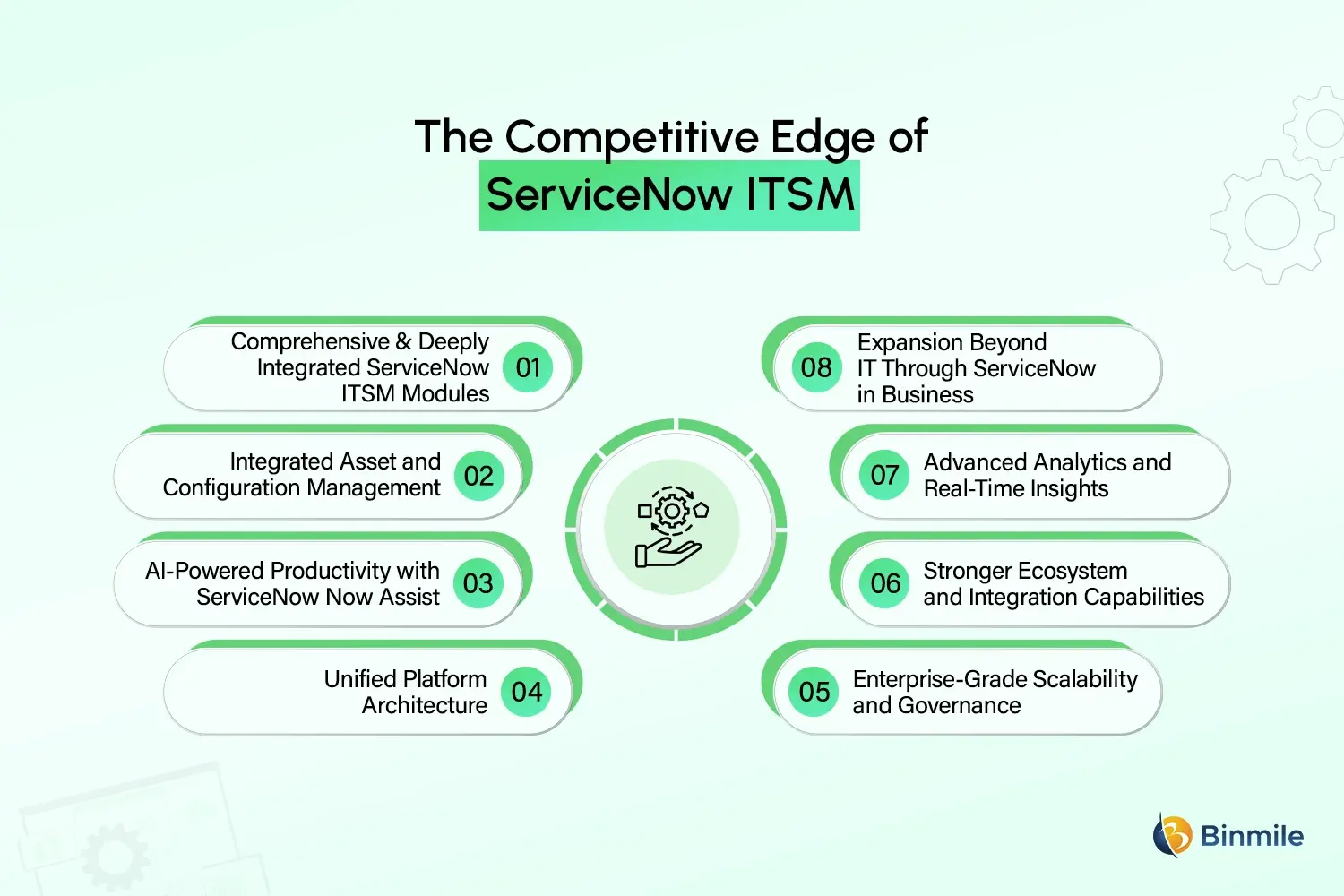
4. Unified Platform Architecture
ServiceNow ITSM Platform has its own single cloud-native architecture, meaning there are no multiple, disconnected tools and no complicated integrations.
Enterprises can stay within the ecosystem to create custom workflows and applications or even extend capabilities to build new applications. This is important for long-term scalability as business needs change.
Centralized data consistency is improved with a unified architecture. Reporting, dashboards, and analytics can pull from a single source.
5. Enterprise-Grade Scalability and Governance
ServiceNow ITSM enterprise deployments are designed for global operations. Large enterprises have unique needs, such as role-based access controls, integrated multi-language support, compliance with regional and national frameworks, and standardized workflows across multiple geographies.
ServiceNow ITSM solutions meet these needs by offering built-in governance controls, allowing enterprises to achieve flexibility while maintaining consistency. This is particularly important for organizations that cross-integrate hybrid cloud and multi-vendor environments.
6. Stronger Ecosystem and Integration Capabilities
Integration depth is a key differentiator for all enterprise customers evaluating ServiceNow vs Ivanti. ServiceNow has deeper ecosystem partnerships with more marketplaces and pre-built connectors for integrations with ERP, HR, monitoring, and security tools.
With more ecosystem maturity, ServiceNow enables organizations to seamlessly integrate ITSM with critical business systems. Rather than operating as a separate service desk, ServiceNow acts as the primary workflow engine for the enterprise.
7. Advanced Analytics and Real-Time Insights
IT leaders need accurate and quantifiable results to be deemed successful. ServiceNow ITSM is equipped with sophisticated analytics, tracking, and reporting on key performance indicators (KPIs), service level agreement (SLA) compliance, incidents, and successful change execution.
Operational improvements and reduction of costs justify ServiceNow ITSM pricing. Enterprises gain ROI from reduced downtime, quicker resolution, and heightened compliance.
8. Expansion Beyond IT Through ServiceNow in Business
In 2026, IT Service Management is not restricted to IT departments. ServiceNow in Business allows HR, facilities, finance, and operations to use the same ServiceNow platform for case and service request management.
Ready to replace fragmented IT tools with unified ServiceNow ITSM solutions that drive measurable results?

How to Implement ServiceNow ITSM in Your Enterprise
Successful ServiceNow implementation requires strategic planning, not just technical setup.
-
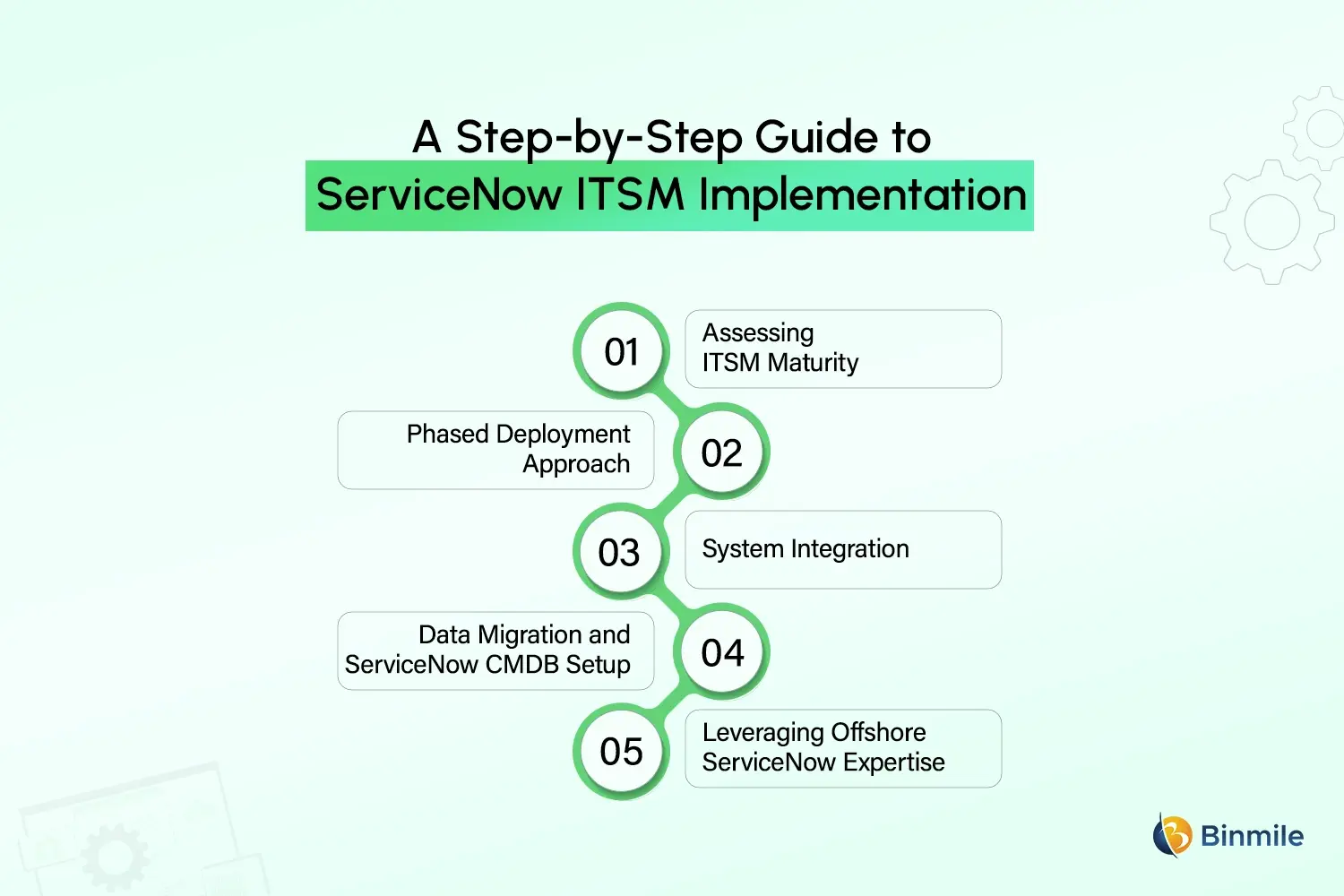
Assessing ITSM Maturity
Before deployment, organizations need to assess current processes, determine inefficiencies, and define operational goals with platform functionality in order to align processes with capabilities to be accurate.
-
Phased Deployment Approach
Enterprise ServiceNow Platform Implementation Levels provides a set of modules that allow for gradual implementation. This leads to a more streamlined adoption, making phased implementations less disruptive to other phases.
-
System Integration
When ServiceNow ITSM integrates with ERP, HR, monitoring, and security, it enhances the value of ITSM in ServiceNow and expands end-to-end visibility of workflows.
-
Data Migration and ServiceNow CMDB Setup
Accurate configuration data is essential. Proper CMDB planning ensures effective incident, problem, and change management.
-
Leveraging Offshore ServiceNow Expertise
Offshore ServiceNow models are widely adopted by enterprises to tap into specialized skills while exercising cost control. However, governance and long-term oversight are essential to success.
After deployment, maintaining a stable ServiceNow environment is essential. Continuous optimization, updates, and AI refinement through ServiceNow Now Assist ensure sustained performance and measurable outcomes.
The Future of ServiceNow ITSM: From AI Assistance to Autonomous Service Desks
The evolution of ServiceNow ITSM is moving beyond traditional workflow automation and AI-assisted operations toward more autonomous service delivery. ServiceNow’s Autonomous Workforce vision introduces specialized AI agents that can perform defined service operations with less manual intervention while escalating issues that require human expertise.
One example is the L1 Service Desk AI Specialist, which ServiceNow describes as an AI specialist capable of self-assigning tickets, resolving IT issues end-to-end, and escalating issues with relevant context. This changes the traditional Level 1 service desk model from manually processing routine tickets to supervising and managing AI-driven resolution workflows.
For enterprises, the value is not simply about replacing manual ticket handling. An autonomous service desk can help organizations automate repetitive requests, accelerate resolution of common issues, and allow human service desk teams to focus on incidents and problems that require judgment, investigation, or specialized knowledge.
How an L1 Service Desk AI Specialist Can Transform ITSM
An autonomous L1 service desk can support several stages of the service workflow:
-
Ticket Intake and Assignment
AI can identify incoming requests and determine the appropriate workflow or ownership.
-
Issue Analysis
AI can use available service and configuration context to understand the issue and identify potential resolutions.
-
Routine Resolution
Common, well-defined issues can be handled through automated workflows.
-
Knowledge Utilization
AI can use organizational knowledge and service information to support resolution activities.
-
Intelligent Escalation
Issues that require human expertise can be escalated with relevant context instead of simply being placed back into a queue.
-
Continuous Service Improvement
Resolution patterns and service data can help organizations identify recurring issues and opportunities for automation.
The effectiveness of this model depends on the quality of the underlying service data, workflows, knowledge base, integrations, governance, and CMDB. Autonomous ITSM therefore should not be viewed as an isolated AI capability; it is an evolution of a connected ServiceNow environment.
From Human-First to Human + AI Service Management
The rise of autonomous service capabilities does not eliminate the need for IT professionals. Instead, it changes how service desk teams can allocate their time. AI can handle repetitive and predictable service interactions while human specialists concentrate on complex incidents, exceptions, business-critical changes, and situations requiring judgment.
This makes the combination of ServiceNow ITSM, CMDB, workflow automation, knowledge management, and AI increasingly important for enterprises looking to modernize service operations.
Looking to modernize your IT operations with a scalable ServiceNow ITSM platform tailored for enterprise growth?

How the Right Partner Makes the Difference
ServiceNow transformation requires more than technical setup. It requires strategic alignment, deep platform knowledge, and experience across industries.
This is where systematic ServiceNow Platform Implementation, process optimization, and enterprise-level customization become crucial. Binmile’s knowledge of ServiceNow IT Service Management, ServiceNow Incident Management, ServiceNow CMDB, and enterprise workflow automation allows Binmile to assist clients in building scalable ServiceNow solutions in alignment with their operational goals. Starting from the first assessment to configuration, and from phased deployment to iterative optimization, the services are focused primarily on delivering value and improving operations as opposed to the mere configuration of the systems.
Enterprises looking to transition from fragmented systems to unified ServiceNow ITSM solutions benefit from guided implementation strategies that minimize disruption and maximize ROI.
Frequently Asked Questions
ServiceNow ITSM is a comprehensive IT service management platform that automates and manages incidents, changes, requests, and assets. It is important because it centralizes IT operations, improves efficiency, and supports enterprise-wide digital transformation.
ServiceNow ITSM pricing typically depends on selected modules, the number of users, and enterprise scale. Large organizations evaluate it based on total cost of ownership, automation benefits, and long-term ROI rather than upfront licensing alone.
Enterprises commonly use incident, problem, change, request, and knowledge management modules. Many also integrate ServiceNow ITSM asset management and ServiceNow CMDB for better visibility and governance.
A ServiceNow implementation timeline depends on scope and complexity. Mid-sized deployments may take a few months, while large enterprise transformations with integrations and custom workflows can extend longer.
In ServiceNow vs Ivanti comparisons, ServiceNow often stands out for platform scalability, AI capabilities, and enterprise integration. However, the best choice depends on organizational needs and long-term digital strategy.