With the advent of advanced technologies such as Artificial intelligence and machine learning, business leaders are transforming their operations and enriching customer experiences. At the heart of this AI revolution is ChatGPT, OpenAI’s sophisticated language model. There’s nothing that this generative AI tool cannot do. From automating customer support inquiries to generating marketing content and analyzing data patterns. AI programs offer a powerful tool for digital transformation. Yet many organizations face a critical challenge: how to effectively integrate ChatGPT into their existing technological ecosystem.
The complexity is not just technical; it also involves balancing automation with human oversight, ensuring data security, and training staff to work alongside AI systems. Businesses shouldn’t rush to implement ChatGPT without proper planning. This leads to integration issues, security vulnerabilities, and even underutilized potential. Therefore, in this blog, we’ll focus on seamlessly incorporating ChatGPT into business applications. We’ll also further explore the value of this tool for businesses and provide a comprehensive guide to successful integration.
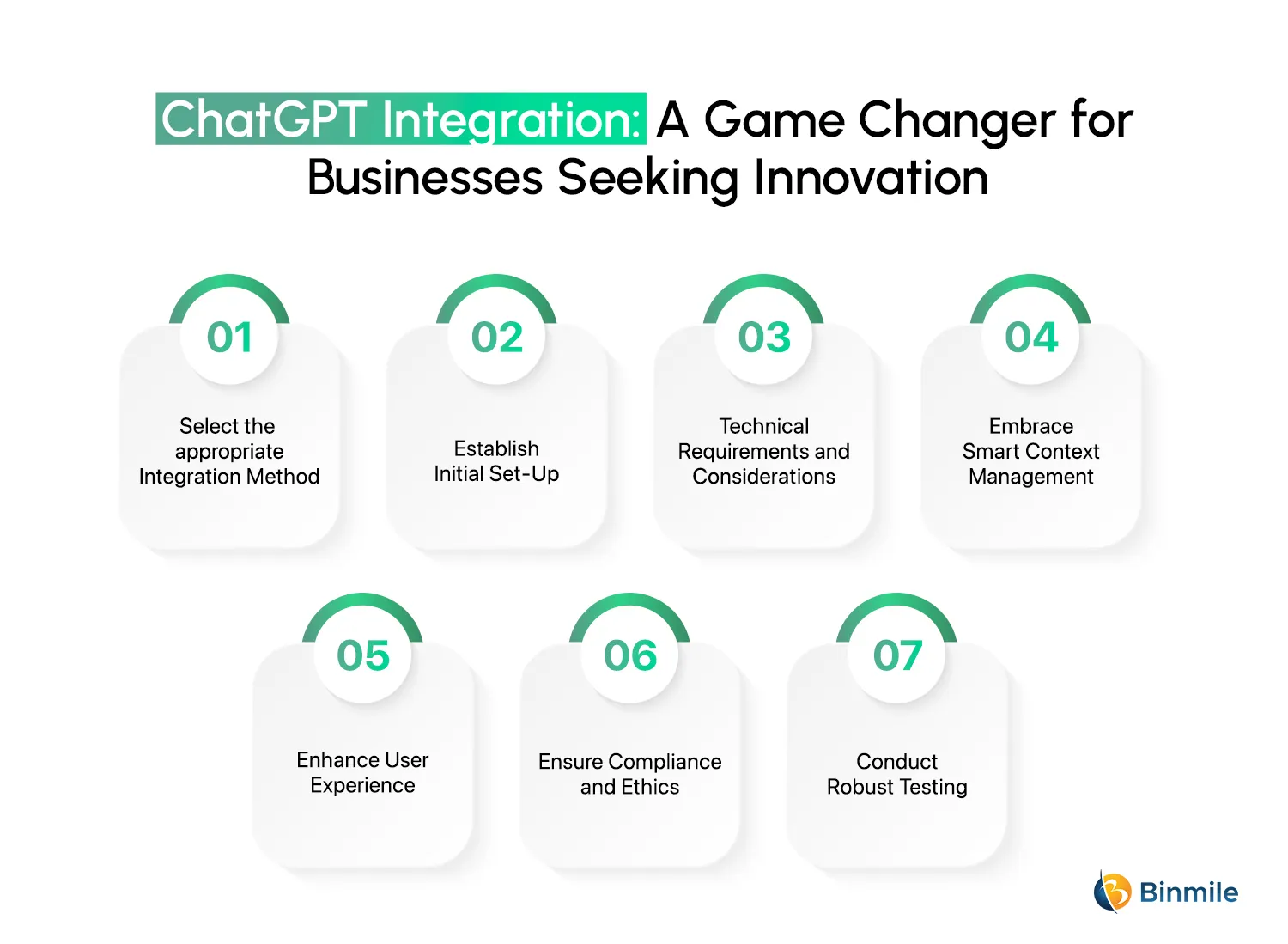
ChatGPT Integration: A Game Changer for Businesses Seeking Innovation
We’ll explain in the blog later on how ChatGPT promises to revolutionize the way your users engage with your apps or website by providing around-the-clock support and personalized responses. But to successfully leverage ChatGPT for improved business operations or enhanced customer experiences, you must figure out how to add a ChatGPT integration to software or apps.
1. Select Appropriate Integration Method
There are several API services that can be used for ChatGPT through OpenAI. The two primary ones that are frequently used are the Chat Completion API and the more general Completions API. The Chat Completion API is preferred if you deal with a conversation-based request, while the Completions API is more versatile for various tasks. Thus, assess your application’s use case to determine which API to use.
2. Establish Initial Set-Up
When running fine-tuning of ChatGPT or when using some specific training data, make sure the data is clean. This process involves cleaning and preprocessing the data to remove noise, inconsistencies, and irrelevant information that may trip up analysis for negative results. The quality of data decides how well your model will perform, so make sure you’re training your data efficiently.
Before using the ChatGPT, you must go through API keys to be able to access the programs. This key needs to be accessed from OpenAI and then implemented into the application without being tainted. This will allow you to authenticate your requests and prevent unauthorized access.
3. Technical Requirements and Considerations
It’s essential to understand the tech part of the integration to establish a solid backend for your website or website. Integrating an AI chatbot like ChatGPT requires server-side integration with languages like Node.js or Python, secure data transmission via HTTPS, and a user-friendly frontend using HTML, CSS, and JavaScript. Ensuring user privacy by informing them about bot interactions and data usage policies is also crucial.
For a comprehensive app, consider the following tech stack:
- Frontend: React.js or Angular for dynamic user interfaces.
- Backend: Node.js, Express.js, or Django for robust server-side operations.
- Database: MongoDB or PostgreSQL for efficient data management.
- Authentication: OAuth or JWT for secure user authentication.
- Hosting: AWS, Azure, or Google Cloud for scalable and reliable hosting solutions.
- DevOps: Docker and Kubernetes for containerization and orchestration.
4. Embrace Smart-Context-Management
To ensure that the interaction doesn’t jump from topic to topic, context awareness should be provided. Your users should be able to store the session data and previous interactions to enable them to come up with the best response for the next interaction. It’s also important that your app responds to conversation resets and timeouts and remembers user preference/ settings.
Devise possible subroutines that would be implemented when ChatGPT can’t generate an output for the input fed into the model. It should include rerouting of users to FAQ, support, or offering user suggestions to keep them occupied.
5. Enhance User Experience
The effectiveness of the ChatGPT integration depends mainly on how well it serves your target users. Therefore, build a responsive design to make it possible to have an interface that can work on a given device. Further, put strong measures on error control to avoid substantially losing users’ trust. It will also help you include ways to capture user feedback and work on it accordingly.
6. Ensure Compliance and Ethics
To avoid unintended consequences such as potential corporate secrets being leaked, providing non-factual statements, or even generating biased or discriminatory outputs. Thus, ensure compliance with data protection regulations (like GDPR), use right and clean data and ethical standards to clearly inform users about data usage, provide options for managing their data to offer credible, unbiased, and reliable data.
7. Conduct Robust Testing
Thoroughly test the integration to ensure that the chatbot functions as expected. You should prepare various user scenarios and edge cases to identify and address any issues in the testing process. By actively seeking and incorporating user feedback, you can gather valuable insights to iterate and refine the implementation.
Transform your business processes with seamless AI integration solutions tailored to your unique needs.
What is GPT?
GPT, or Generative Pre-trained Transformer, is a series of language models developed by OpenAI. These models are trained on vast text data for specific language tasks; however, they can be refined and fine-tuned to deliver desired results. They excel in generating coherent text by predicting subsequent words. ChatGPT, a conversational AI based on these models, interacts in natural language and is trained to be safe, reliable, and informative, with knowledge updated until April 2023.
OpenAI has several conversational AI models such as GPT-4, GPT-4 turbo, and GPT-3, among others. These AI models can create interesting functionality and features in your applications that are useful for your users. This may include:
- Building chatbots and virtual assistants
- Automating customer support workflows
- Generating content like emails, reports, and more
- Answering domain-specific questions
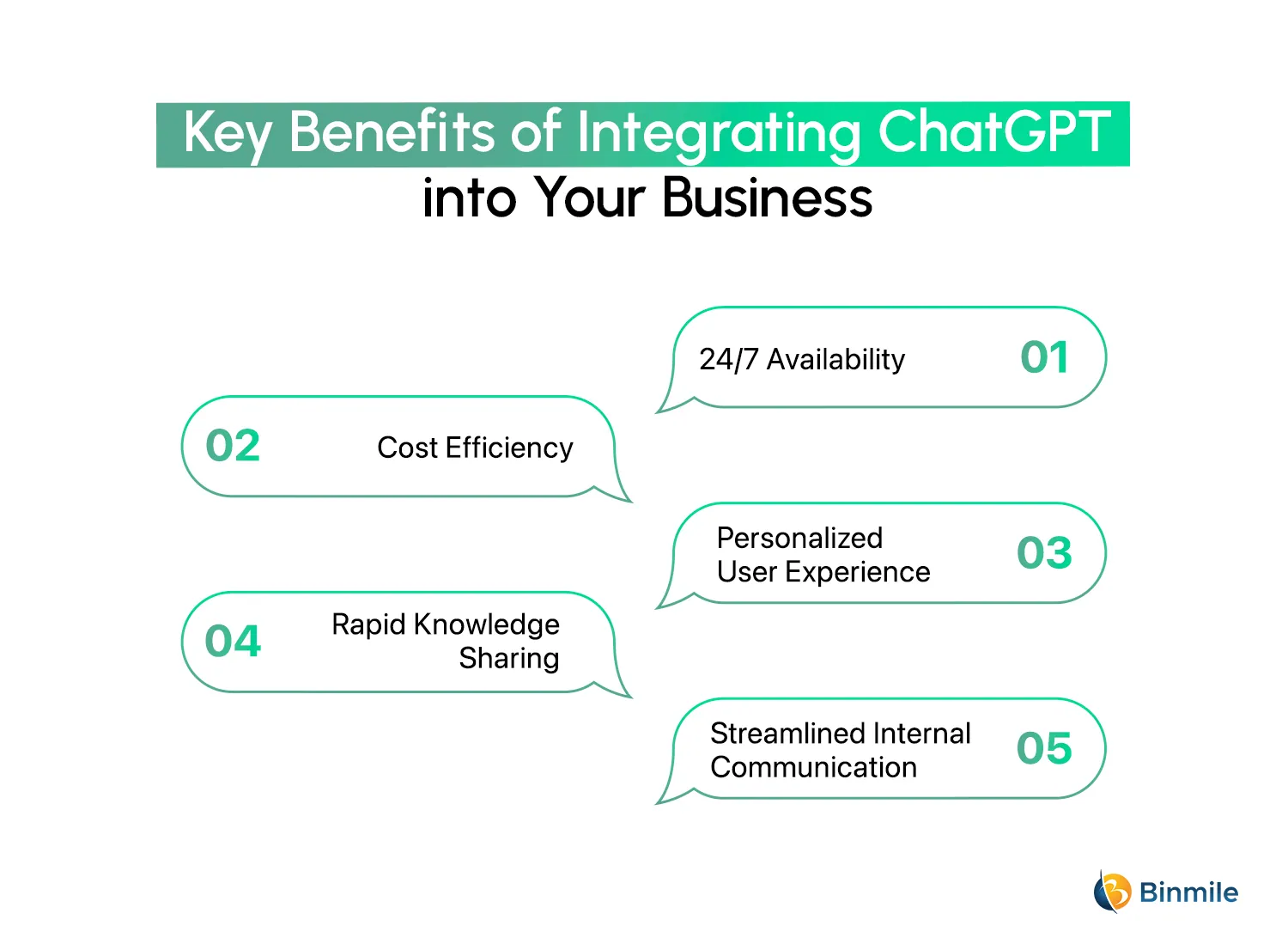
Key Benefits of Integrating ChatGPT into Your Business
As businesses continue to leverage artificial intelligence technologies to optimize their operations. Without a doubt, ChatGPT has emerged as a powerful tool for its various use cases, such as content creation, translation, web scraping, etc. Thus, as a generative AI tool that ChatGPT brings to help businesses, let’s understand that in detail.
-
24/7 Availability
With ChatGPT, your business can offer round-the-clock support, ensuring customers receive assistance anytime, leading to higher engagement and loyalty.
-
Cost Efficiency
Automating interactions with ChatGPT reduces the need for extensive customer service staff, leading to significant cost savings while maintaining high service quality.
-
Personalized User Experience
ChatGPT can analyze user data and preferences to deliver tailored recommendations and responses, enhancing customer satisfaction and retention.
-
Rapid Knowledge Sharing
With its ability to access and summarize vast amounts of information quickly, ChatGPT can assist employees in finding the information they need, improving productivity and decision-making.
-
Streamlined Internal Communication
ChatGPT can facilitate better communication within teams by acting as a knowledge repository and answering common queries, enhancing collaboration.
Build the future: Collaborate with us for innovative, custom AI solutions that drive results!
Wrapping It Up
The integration of ChatGPT into business systems represents more than just a technological upgrade, it is a strategic investment in your company’s future. By following best practices for implementation, addressing potential challenges proactively, and maintaining a balanced approach to automation and human oversight, organizations can harness ChatGPT’s capabilities to drive innovation and competitive advantage. As AI technology continues to evolve, businesses that successfully integrate these tools today will be better positioned to adapt and thrive tomorrow.
We recommend you start small, measure results, and scale gradually based on your organization’s specific needs and goals. With careful planning and execution, ChatGPT can become a valuable asset in your business ecosystem, enhancing both operational efficiency and customer experience.
Frequently Asked Questions
ChatGPT integration refers to embedding OpenAI’s language model into business systems, applications, or workflows to automate conversations, improve customer support, and enhance decision-making through AI-powered interactions.
ChatGPT integration helps enterprises improve customer engagement, automate repetitive tasks, reduce operational costs, enhance productivity, and deliver personalized user experiences across multiple channels.
Common use cases include AI chatbots for customer support, content generation, email automation, virtual assistants, HR support systems, knowledge base management, and sales enablement tools.
Yes, ChatGPT integration can be secure when implemented with proper data encryption, API security practices, access controls, and compliance with industry regulations such as GDPR and SOC standards.
Implementation time depends on complexity, use case, and system architecture. Simple integrations can take weeks, while enterprise-grade AI solutions may require phased development and longer deployment cycles.
Partnering with experienced AI developers ensures seamless integration, better scalability, secure deployment, optimized performance, and faster ROI through well-structured AI implementation strategies.