
A product catalog can look perfectly organized to a customer while being a complete mess behind the scenes. Product names may live in spreadsheets, specifications in an ERP, images in a DAM, descriptions in documents, and marketplace information in yet another system. As product ranges and sales channels grow, keeping everything accurate becomes increasingly difficult. That is one reason the global Product Information Management market is expanding rapidly. Fortune Business Insights estimates the market was valued at USD 5.48 billion in 2025 and is projected to reach USD 20.66 billion by 2034, growing at a CAGR of 15%.
But buying a PIM platform is not the same as a successful Product Information Management implementation. The real work involves understanding existing product data, defining ownership, cleaning and standardizing information, integrating business systems, establishing workflows, and deciding how data should reach every customer-facing channel. This guide explains how Product Information Management works, when a business needs it, how to plan an implementation, what a PIM System should include, common implementation challenges, and how to measure whether the investment is delivering value.
What Is Product Information Management and Why Do Businesses Need It?
Product Information Management is the process of collecting, organizing, enriching, governing, and distributing product information from a centralized environment. A PIM System brings details such as product descriptions, SKUs, specifications, variants, images, categories, certifications, and channel-specific content into one controlled environment.
As product catalogs and sales channels grow, managing this information through spreadsheets and disconnected systems quickly becomes difficult. A single product may need to appear consistently across eCommerce websites, marketplaces, mobile apps, distributor portals, and regional stores. Product Information Management Software helps businesses centralize this information, improve data quality, streamline product catalog management, and distribute accurate product content across channels.
How Does PIM Work?
A typical PIM environment sits between the systems that generate or store product data and the channels where customers or business partners consume that information.
The flow generally looks like this:
Data sources → PIM → Validation and enrichment → Approval → Channel distribution
Data may originate from an ERP, supplier files, spreadsheets, PLM systems, CRM platforms, existing databases, or external data providers.
The PIM solution then brings this information together, standardizes it, identifies missing attributes, supports enrichment workflows, and prepares the information for publication.
The final stage involves distributing approved product information to websites, marketplaces, mobile apps, sales portals, print catalogs, or other channels.
The important point is that PIM does not necessarily replace every existing system. Instead, it creates a reliable layer for managing the information required to describe and sell products.
PIM vs ERP: What Is the Difference?
This is one of the most important questions to resolve before a Product Information Management Implementation.
An ERP primarily supports business operations such as finance, procurement, inventory, orders, supply chain, and other transactional processes. A PIM focuses on the information required to describe, market, sell, and distribute products.
They can work together rather than compete.
| ERP | PIM |
|---|---|
| Manages operational and transactional data | Manages product information and content |
| Focuses on business processes | Focuses on product experience and information |
| Supports inventory and order processes | Supports catalog enrichment and distribution |
| Often contains core product attributes | Handles richer, customer-facing product information |
| Used heavily by internal operations | Connects product teams with sales channels |
For many enterprises, the right approach is not to choose between ERP and PIM. It is creating reliable product data integration between them.
PIM vs MDM: Are They the Same?
PIM and Master Data Management are related but serve different purposes.
MDM establishes governance and consistency around critical business entities such as customers, suppliers, locations, and products. PIM focuses specifically on product information and the content required to sell products across channels.
An enterprise may therefore use MDM as part of its broader data strategy while using PIM for detailed product information, enrichment, catalog management, and omnichannel publishing.
The distinction becomes particularly important when designing an enterprise-wide data management framework.
Ready to turn scattered product data into a reliable digital commerce engine?

How to Implement a Product Information Management System Step by Step
Successful PIM implementation starts with business requirements, not software selection.
1. Define the Business Problem First
Start by identifying why the organization needs PIM.
Is the primary problem inconsistent product information? Slow catalog updates? Marketplace expansion? Poor data quality? Multiple regional websites? A new eCommerce platform? Manual catalog management?
The answer determines the type of PIM architecture and functionality required.
A useful implementation goal should connect the technology to a measurable business outcome, such as reducing product onboarding time, improving catalog completeness, reducing manual work, or accelerating new-market launches.
2. Audit Your Existing Product Data
Before moving anything into a new PIM System, understand what already exists.
Map where product information currently lives and identify data sources, product attributes, duplicate records, missing information, inconsistent naming, different units of measurement, outdated descriptions, unstructured product content, conflicting ownership, and channel-specific requirements.
This stage is often underestimated. Moving poor-quality data into a new system does not solve the underlying problem. It simply gives the problem a more sophisticated home.
3. Create a Product Data Model
Next, determine what information each product should contain.
Define categories, attributes, relationships, variants, mandatory fields, optional fields, units, formats, taxonomies, and validation rules.
For example, a laptop may require attributes such as processor, RAM, storage, screen size, operating system, battery capacity, and dimensions. A cosmetics company would need an entirely different structure covering ingredients, skin type, usage instructions, certifications, and packaging information.
The data model should reflect the business rather than forcing every product into the same structure.
4. Establish Product Data Governance
PIM works best when everyone knows who is responsible for the data. Define who creates and validates product information, who approves changes, who owns specific attributes, who can publish content, and how errors and updates are handled.
Establishing clear quality standards and accountability is where product data governance becomes essential. A strong governance model keeps the PIM from becoming another uncontrolled repository and ensures product information remains accurate, consistent, and trustworthy.
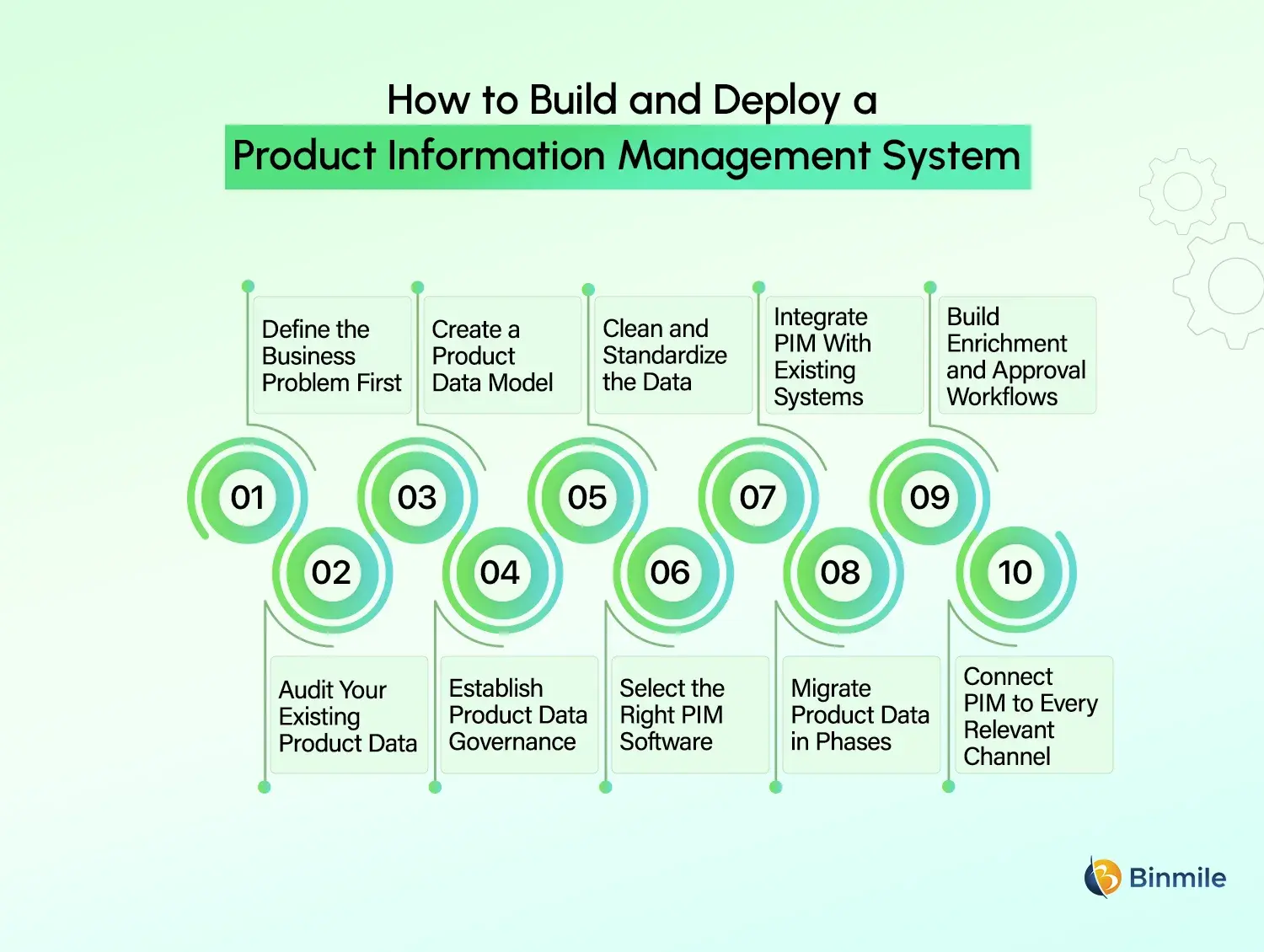
5. Clean and Standardize the Data
Data cleansing should happen before or during migration.
Standardization may include consistent product naming, standard measurement units, common attribute structures, duplicate removal, category normalization, consistent terminology, missing-value identification, formatting rules, and validation of product identifiers.
The objective is to create trustworthy centralized product information, not simply move existing files into a new platform.
6. Select the Right PIM Software
Once requirements and data structures are clear, evaluate PIM software against actual business needs.
Important capabilities may include flexible data modeling, workflow management, role-based access, data validation, bulk editing, version control, localization, product relationships, taxonomy management, API support, integration capabilities, channel syndication, analytics and reporting, search and filtering, and scalability.
Do not select a PIM simply because it has the longest feature list.
The better question is whether the platform can support your product model, existing technology ecosystem, business workflows, and future growth.
7. Integrate PIM With Existing Systems
A PIM system rarely works in isolation, particularly when it needs to connect with an organization’s existing applications and Software Product Development Services initiatives.
Depending on the business, integrations may be required with ERP software development, PIM in eCommerce platforms, CRM, DAM, marketplaces, PLM systems, supplier systems, analytics platforms, and other applications.
The architecture should clearly define which system owns which data and how information moves between systems.
For example, an ERP may remain the source for inventory-related information while PIM manages customer-facing product content. An eCommerce platform can then consume approved product information from PIM.
This reduces duplicate data entry and creates a more reliable product information system.
8. Migrate Product Data in Phases
Avoid moving the entire catalog at once unless there is a strong reason to do so.
A phased migration allows teams to test data mapping, attribute structures, validation rules, integrations, workflows, user permissions, and publishing processes
Start with a representative product category or a manageable product group. Resolve issues there before expanding the migration.
This approach also makes it easier to identify unexpected dependencies in legacy systems.
9. Build Enrichment and Approval Workflows
Raw product data is rarely ready for publication.
A PIM implementation should define how information moves from incomplete data to approved content.
For example:
Product created → Data completed → Validation → Enrichment → Review → Approval → Publication
Different teams can own different stages.
This becomes particularly useful for large organizations where product managers, marketing teams, technical teams, legal teams, regional teams, and eCommerce teams all contribute to product information.
10. Connect PIM to Every Relevant Channel
The final objective is not simply to maintain a clean internal catalog. It is to make reliable information available wherever customers interact with the product.
Depending on the business, that may include eCommerce websites, mobile applications, marketplaces, dealer portals, distributor platforms, social commerce channels, print catalogs, in-store systems, and B2B portals.
This is where omnichannel product management becomes valuable. Teams can manage product information centrally while adapting it to the requirements of individual channels.
What Are the Biggest PIM Implementation Challenges?
PIM implementation is more likely to struggle because of poor planning than because of the technology itself.
Common challenges include:
| Challenge | Why it Happens | What Helps |
|---|---|---|
| Poor Data Quality | Legacy systems contain inconsistent information | Data profiling and cleansing |
| Unclear Ownership | Multiple teams edit product information | Defined data ownership |
| Complex Integrations | Several systems exchange product data | Clear integration architecture |
| Resistance to Change | Teams are comfortable with spreadsheets | Training and workflow adoption |
| Over-Customization | Business processes are replicated unnecessarily | Standardize before customizing |
| Incomplete Requirements | PIM is selected before understanding business needs | Detailed discovery and data audit |
| Migration Issues | Legacy data does not match the new model | Phased migration and validation |
| Channel Complexity | Each channel has different requirements | Channel-specific rules and workflows |
How to Measure the Success of a PIM Implementation
A PIM project should not be considered successful simply because the platform has gone live. Measure what changed after implementation.
Useful metrics include:
1. Product Onboarding Time
Measure how long it takes to collect, enrich, validate, approve, and publish information for a new product. A shorter onboarding cycle indicates that teams can bring products to market more efficiently.
2. Data Completeness
Track the percentage of required product attributes that are populated and ready for use. Higher completeness means customers and sales channels are less likely to encounter missing product information.
3. Data Accuracy
Monitor how often product information contains errors, outdated specifications, duplicate entries, or inconsistencies. Improving accuracy helps reduce rework and supports more reliable customer experiences.
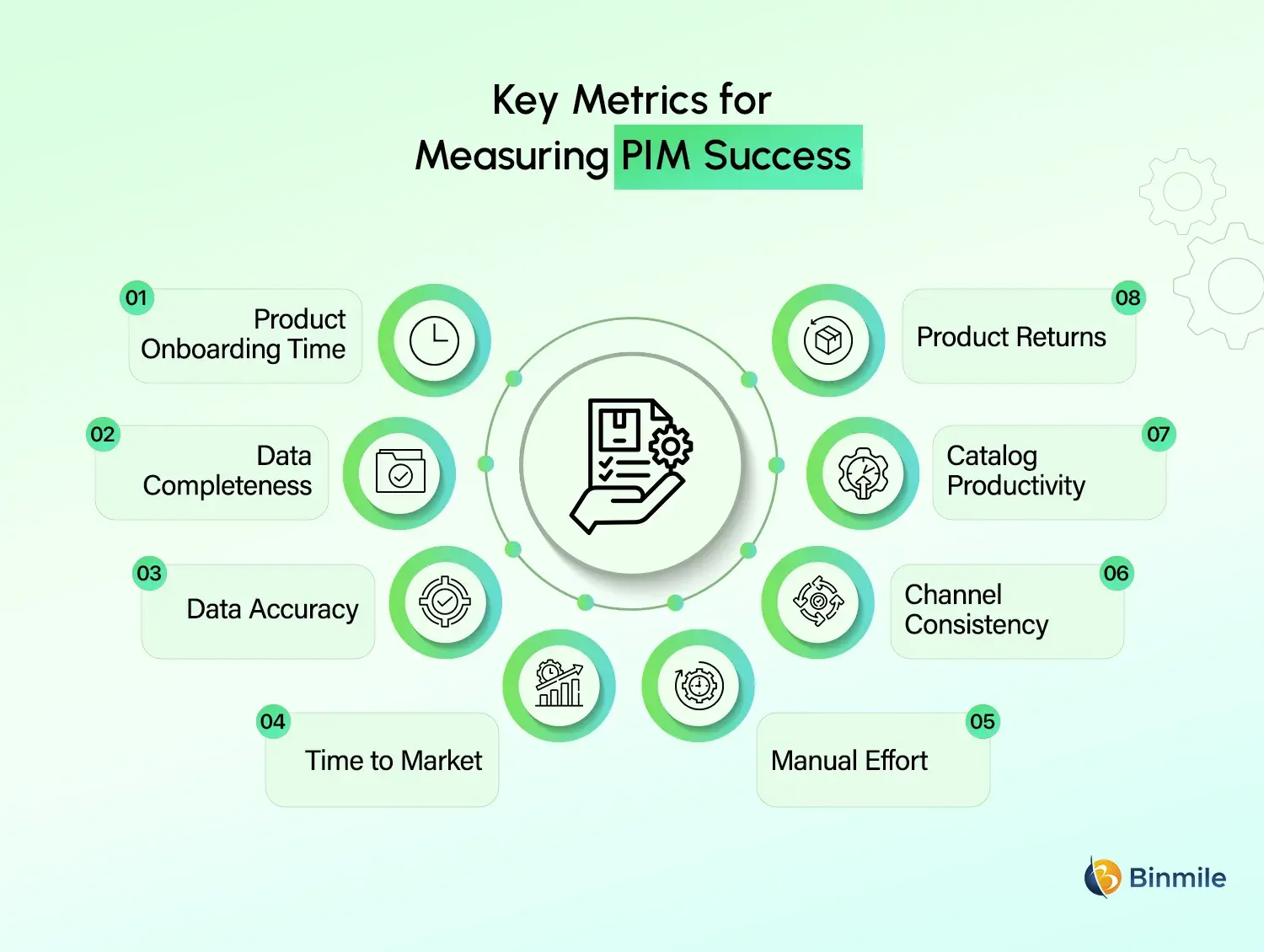
4. Time To Market
Measure how quickly a new product moves from initial data entry to being available across relevant sales channels. A faster time to market can help businesses respond more quickly to launches, seasonal demand, and market opportunities.
5. Manual Effort
Track the amount of time teams spend collecting, updating, correcting, and distributing product information. A successful PIM implementation should reduce repetitive manual work and allow teams to focus on higher-value activities.
6. Channel Consistency
Measure how often product information differs across websites, marketplaces, mobile apps, catalogs, and other channels. Better consistency indicates that the PIM is effectively serving as a reliable source of product information.
7. Catalog Productivity
Evaluate how many products teams can manage within the same operational capacity. If the catalog grows without requiring a proportional increase in staff, it indicates that PIM is improving productivity and scalability.
8. Product Returns
Analyze whether inaccurate, incomplete, or misleading product information is contributing to avoidable returns. Improvements in product content can help customers make more informed purchasing decisions and potentially reduce returns.
What Does a Future-Ready PIM Architecture Look Like?
A modern PIM should not be treated as a standalone application. It should fit into the wider enterprise technology ecosystem and support digital product development across eCommerce platforms, mobile applications, customer portals, and other digital experiences.
A future-ready architecture typically emphasizes APIs, scalable integrations, flexible data models, cloud deployment where appropriate, automation, strong governance, and the ability to support new sales channels without redesigning the entire product data structure.
This is particularly relevant for enterprises adopting SaaS cloud migration and modern cloud architectures. A PIM platform that cannot integrate cleanly with the rest of the ecosystem can eventually become another data silo.
The goal should be straightforward: create product information once, improve it through controlled workflows, and make trusted information available wherever the business needs it.
Is fragmented product data slowing down your eCommerce growth?

How Binmile Can Help With Product Information Management
Implementing PIM successfully requires more than configuring software. It requires an understanding of data, applications, integrations, business processes, and the customer journey. Binmile can help organizations approach PIM as part of a broader technology modernization strategy, starting with product data assessment and architecture planning before moving into integration, migration, implementation, and optimization.
For organizations already working with complex ERP or eCommerce environments, the focus can extend to building reliable connections between systems, establishing product data governance, and creating workflows that reduce manual intervention. The result is a more structured foundation for product catalog management, faster channel updates, and consistent product experiences as the business scales.
Frequently Asked Questions
Product Information Management (PIM) is a centralized approach to managing, enriching, governing, and distributing product information. It helps businesses maintain accurate, consistent product data across eCommerce websites, marketplaces, mobile apps, and other sales channels.
A typical PIM implementation involves defining business requirements, auditing existing product data, creating a data model, establishing governance, cleansing data, selecting the right PIM software, integrating systems, migrating data, building workflows, and connecting relevant sales channels.
PIM is particularly valuable for businesses with large or complex product catalogs, multiple sales channels, frequent product updates, or operations across different markets. Retailers, manufacturers, distributors, wholesalers, and eCommerce businesses can benefit significantly from centralized product information.
Common challenges include poor-quality legacy data, unclear data ownership, complex system integrations, migration issues, inconsistent product attributes, user adoption, and excessive customization. Proper planning, data governance, and phased implementation can help organizations manage these challenges.
PIM can reduce manual data management tasks, improve product data accuracy, accelerate product launches, strengthen channel consistency, and make catalog management more efficient. These improvements can help businesses scale their product operations while delivering more reliable product experiences.
A technology partner can support the entire PIM journey, from data assessment and solution architecture to software implementation, data migration, system integration, workflow development, testing, and optimization. The right partner can also align PIM with the organization’s broader data and eCommerce strategy.