A recent report by Statista highlights that the global eCommerce market is projected to surpass $3.88 trillion by 2026, reflecting not just growth in online transactions but a deeper shift toward enterprise-grade digital ecosystems.
Businesses today are not just competing on products or pricing. They are competing on how well their systems scale, adapt, and deliver consistent experiences across markets. As organizations expand, the limitations of traditional eCommerce platforms start becoming visible. If you are already exploring how AI in eCommerce is reshaping customer journeys and operational efficiency, the bigger question is whether your current commerce setup is built to support that shift.
This blog breaks down what enterprise commerce really means today, the challenges businesses face, the features that define modern platforms, and how enterprises can build a future-ready commerce strategy.
What is Enterprise Commerce and Why It Matters in 2026
Enterprise commerce refers to large-scale digital commerce systems intended for high-volume businesses with complex systems. Advanced eCommerce systems differ from basic eCommerce setups by offering support for multi-region operations, advanced integrations, and complex analytics.
For CEOs and CTOs, implementing enterprise eCommerce systems is no longer about “going digital.” Rather, they still view control and advantage from the use of digital technologies. The systems integrate inventory, customers, payments, logistics, and all analytics into one ecosystem.
Enterprise eCommerce systems are now required to be adaptive in a multi-store, multi-currency, multi-tax, multi-segment customer environment, and also multi-time zones. Moreover, non-adaptive systems were static and are no longer acceptable.
How to Choose the Right Enterprise Commerce Platform
Implementing the right enterprise commerce platform is a must. This can be a game-changer in the ways that your eCommerce can scale. Below are the must-have features for enterprise commerce software.
1. Scalable Architecture
Most enterprise eCommerce platforms today support cloud-native and microservices-based architecture. This enables businesses to scale and avoid disruptions to their operations.
2. Advanced Integration Capabilities
An effective platform provides seamless integration with ERP, CRM, payment gateways, and other third-party services. This is where eCommerce architecture plays a crucial role.
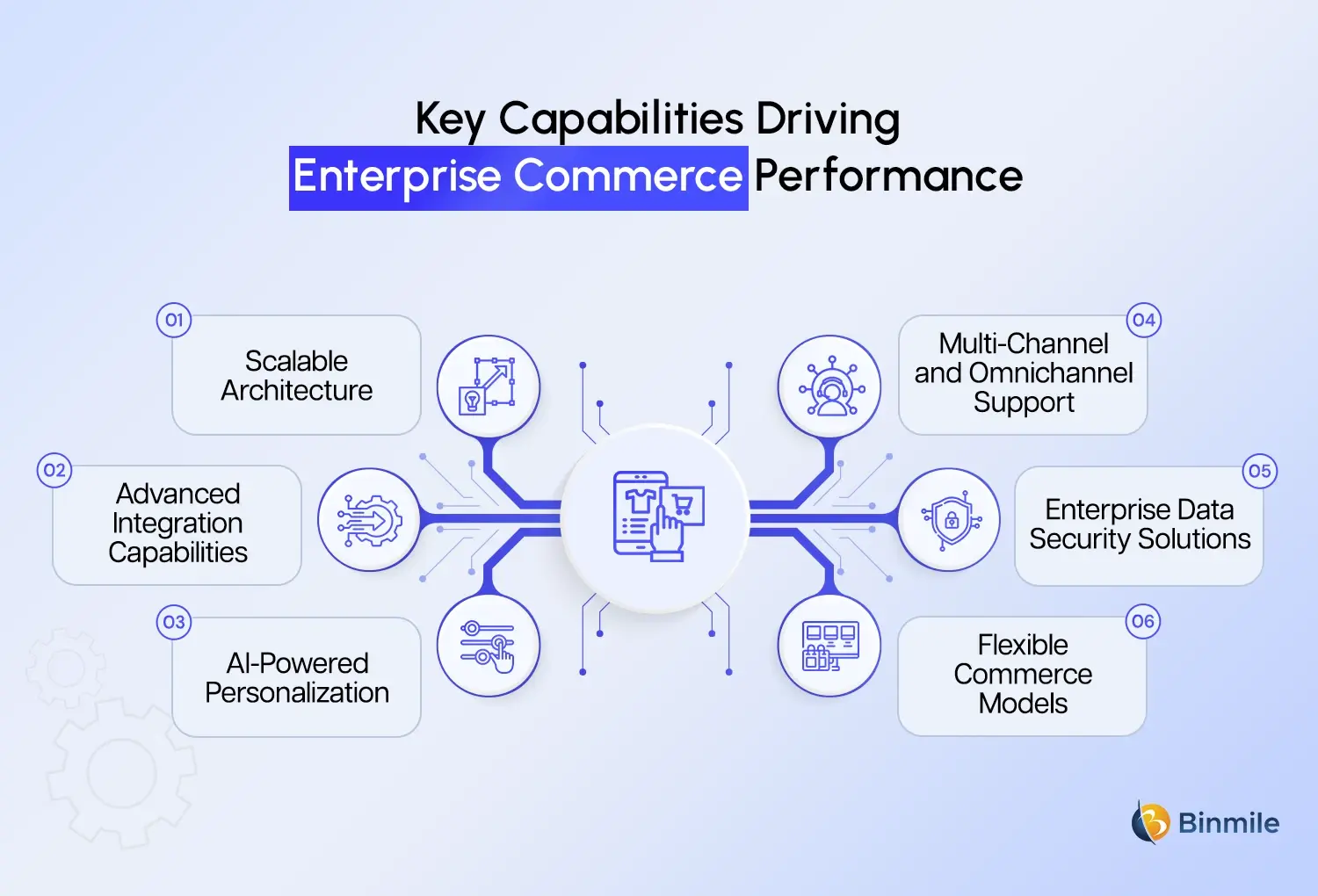
3. AI-Powered Personalization
AI in eCommerce means real-time product recommendations, optimal pricing, and target marketing. This enhances conversion rates.
4. Multi-Channel and Omnichannel Support
Enterprise commerce platforms should offer the same level of integration across web, mobile, marketplace, and offline channels.
5. Enterprise Data Security Solutions
An enterprise commerce platform must include enterprise data security solutions such as encryption, compliance monitoring, fraud detection, and access controls.
6. Flexible Commerce Models
Enterprise commerce solutions should support all models, including B2B, B2C, and D2C.
How Enterprise Commerce Supports Scalable Growth
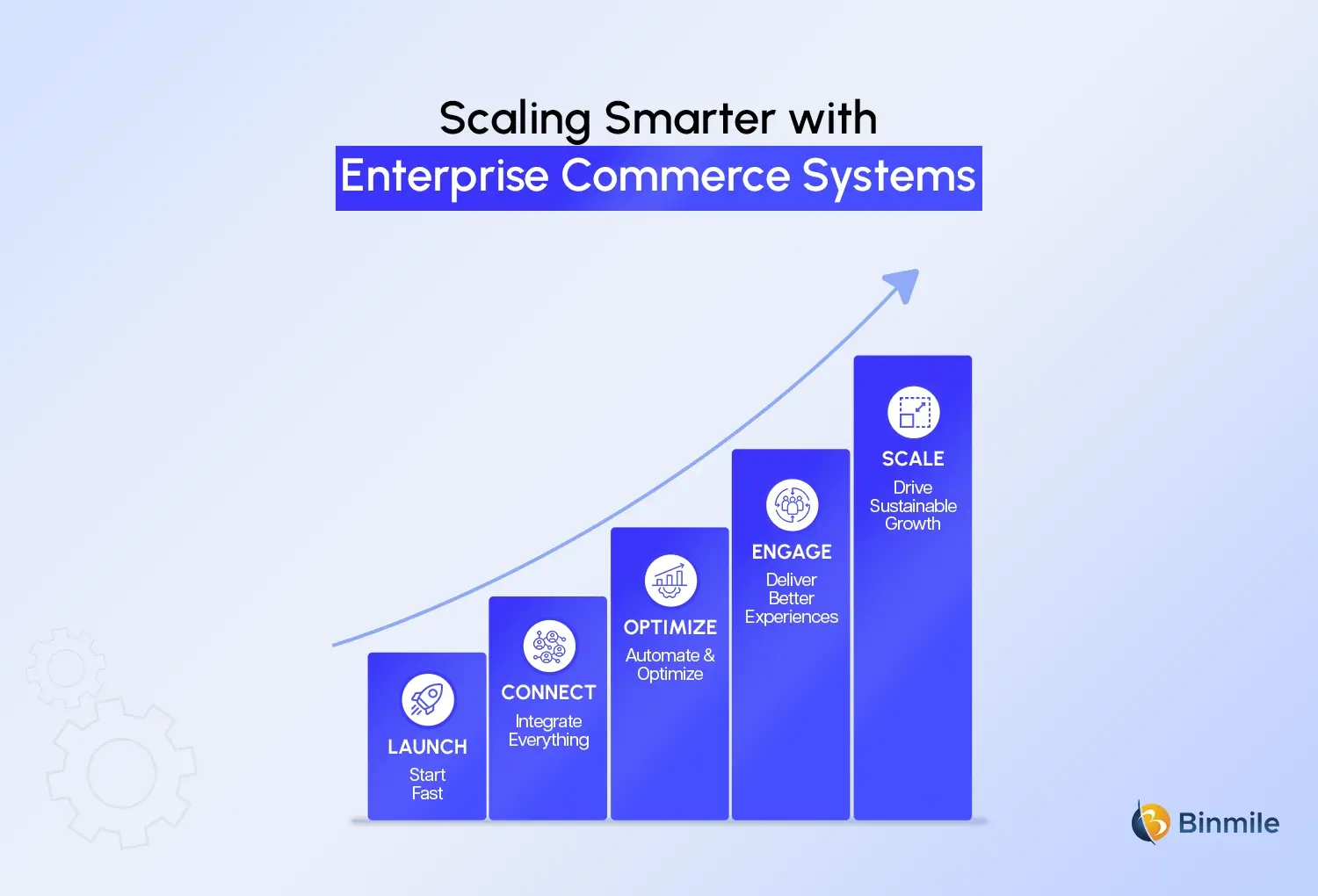
Enterprise commerce supports scalable growth in various ways. Scalability is not just about handling more users. It is about handling complexity without losing efficiency. Below are some of the ways:
-
Market Expansion Without Rebuilding Systems
Expand to new markets, currencies, and regions without the expense of rebuilding systems and the time/complexity of integration.
-
High Performance During Peak Demand
No downtime for continuous performance and zero revenue loss, even during the busiest sales or campaigns.
-
Operational Automation with AI
AI agents in commerce automate support, inventory, orders, and marketing. This minimizes the need for human intervention to boost operational efficiency.
-
Centralized Control with Distributed Execution
Execute commerce autonomously across multiple channels, regions, and teams to have control and visibility in all locations.
-
Faster Decision-Making with Real-Time Data
Unified, real-time commerce data allows executives to make business decisions quickly and optimally.
-
Reduced Dependency on Manual Processes
Automated workflows and less error dependence allow teams to focus on more strategic work and business development.
Enterprise Commerce Strategy: What Actually Works
Building a successful enterprise commerce strategy requires more than choosing the right platform. It involves aligning technology with business goals.
-
Define Clear Objectives
Determine what achieving your business goals looks like, be it financial growth, broadening your target market, or providing your customers with top-notch service.
-
Choose the Right Tech Stack
An ideal eCommerce Tech Stack will assist your business in scaling, be adaptable, and will enable seamless integrations.
-
Invest in Custom Development
By funding a Custom Development project, you can be confident that your specialized eCommerce Developer will skillfully craft a platform with the ideal features to serve your business.
-
Focus on Security First
Incorporating the appropriate level of defense at the heart of the ecosystem is imperative for safety against enterprise commerce threats.
-
Leverage AI and Automation
The intersection of Artificial Intelligence and the automation of not only enterprise commerce, but commerce in general, can greatly assist in revolutionizing the efficiency and capability of your business.
-
Continuous Optimization
The application of enterprise commerce is to evolve and graduate into a more complex, augmented subsisting system, which necessitates constant vigilance and development.
Looking to build a scalable enterprise commerce ecosystem that grows with your business?

What Is the Role of Enterprise Commerce in Customer Experience with AI
Customer experience with AI is where enterprise commerce creates real differentiation.
-
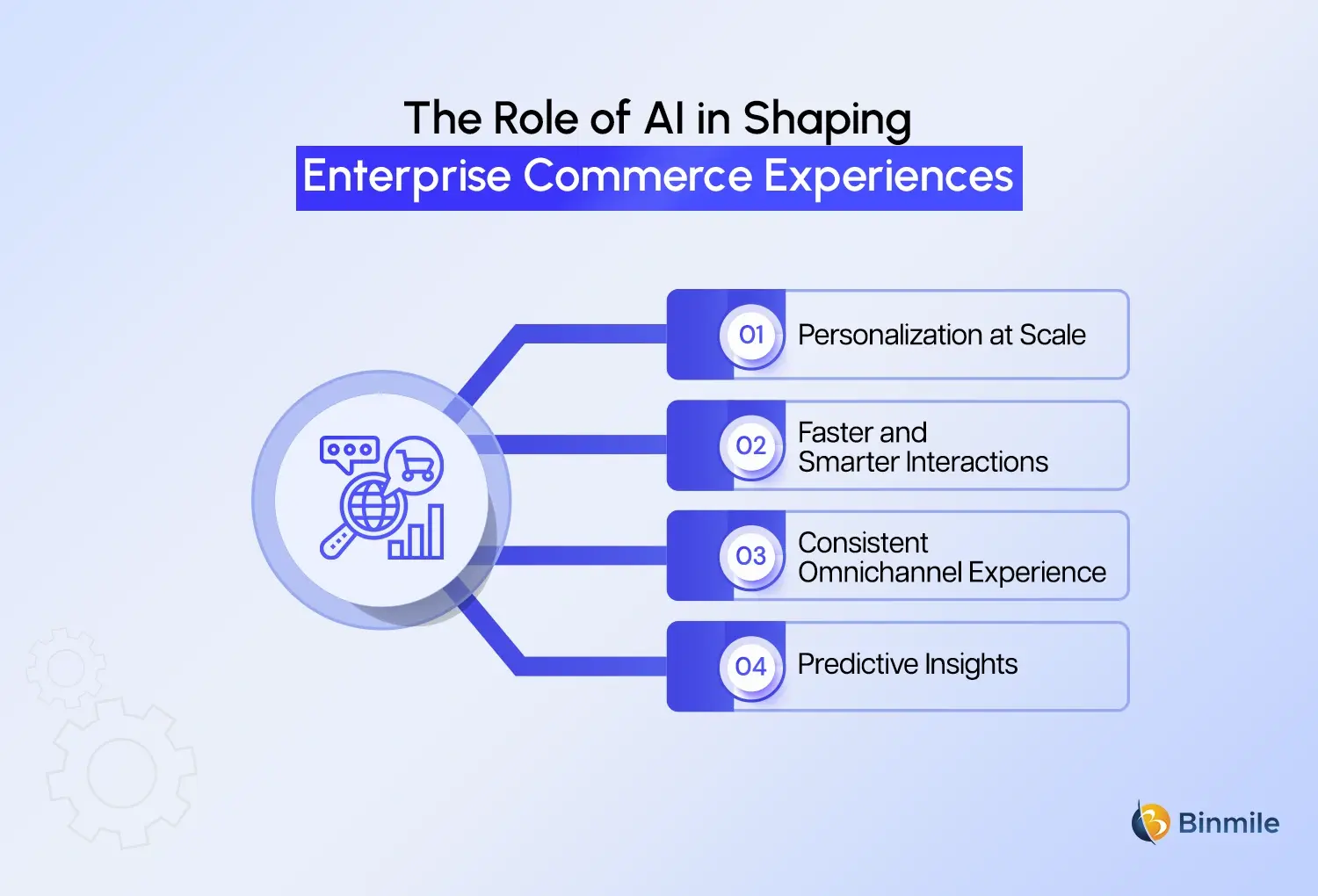
Personalization at Scale
Generative AI in eCommerce allows companies to construct custom product listings, articulate emails, and provide tailored suggestions in an instantaneous fashion.
-
Faster and Smarter Interactions
AI assistants help eCommerce businesses respond to customer inquiries in no time, facilitating better customer engagement.
-
Consistent Omnichannel Experience
No matter if a customer shops online, in a store, or through an App, an integrated enterprise commerce platform takes care of a cohesive and excellent shopping experience.
-
Predictive Insights
AI examines customer patterns to gain insight into their future behaviors. This better informs businesses to set prices, control inventory, and devise optimal marketing.
What Are the Types of Enterprise Commerce Solutions
Different businesses require different types of enterprise eCommerce solutions. Understanding these types helps in choosing the right approach.
| Type | Description |
|---|---|
| B2C Enterprise Platforms | Focused on direct consumer sales with high traffic and eCommerce personalization needs |
| B2B Enterprise Platforms | Designed for bulk transactions, pricing tiers, and complex workflows |
| Headless Commerce Platforms | Separate frontend and backend for greater flexibility |
| Composable Commerce | Modular approach where businesses choose best-in-class components |
| Marketplace Platforms | Multi-vendor systems that support multiple sellers |
Each type serves a specific purpose, and the choice depends on business goals and operational complexity.
What is the Future of Enterprise eCommerce: Trends Shaping 2026 and Beyond
The future of enterprise eCommerce is being shaped by rapid technological advancements and changing customer expectations.
-
Rise of AI Agents in Commerce
AI agents will replace manual jobs with AI-driven support, inventory management, operations, and decisions; they will also reduce costs and enhance speed, precision, and productivity.
-
Composable and Headless Architectures Becoming Standard
Businesses adopt flexible architectures where components evolve independently, enabling faster innovation without disrupting the entire system.
-
Hyper-Personalization at Every Touchpoint
AI-driven insights enable real-time personalized pricing, content, and recommendations, improving conversions and strengthening customer loyalty.
-
Enterprise Commerce Security as a Competitive Advantage
Strong enterprise commerce security helps customers build trust and helps business leaders prevent breaches and, most importantly, protects business leaders on a regional and regulatory basis.
-
Integration of Emerging Technologies
Across enterprise eCommerce apps, augmented reality, virtual reality, and blockchain are changing the landscape of digital commerce, enabling businesses to offer unrivaled customer experience, build trust, and enhance the security and transparency of their transactions.
What Are the Key Business Challenges Enterprises Face Without Enterprise Commerce Systems
Many organizations still operate on fragmented systems. This creates inefficiencies that directly impact revenue and growth.
1. Disconnected Systems and Data Silos
Adding, integrating, and modifying commerce systems when implemented in CRM and ERP systems results in long decision-making. Enterprise commerce systems provide a single integrated data management system.
2. Poor Scalability During Demand Spikes
Legacy commerce systems become faulty and inoperable during high traffic spikes. This causes a reputation hit and lost revenue.
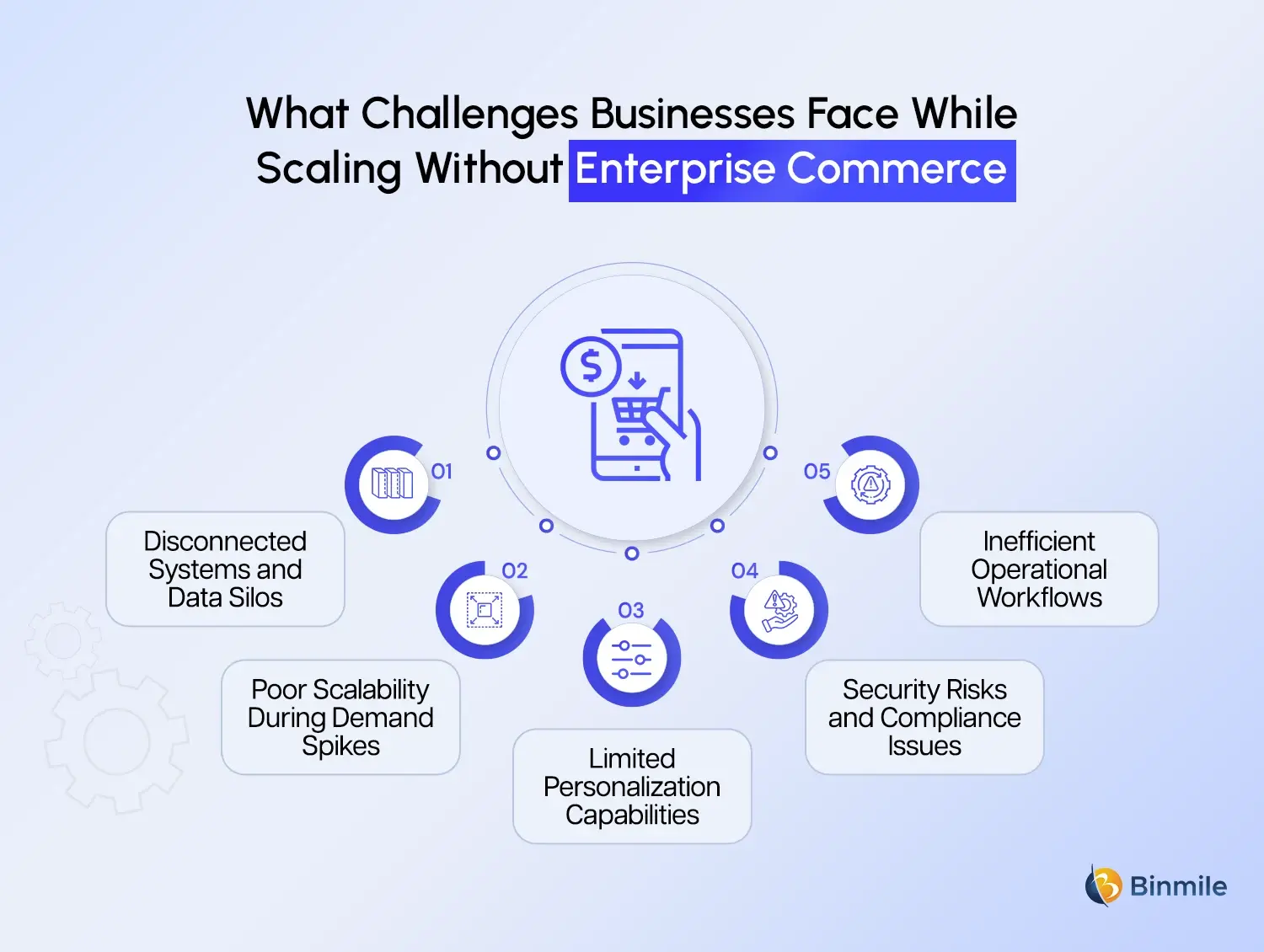
3. Limited Personalization Capabilities
Personalization through AI offers solutions to building a virtual storefront that engages customers and increases customer retention.
4. Security Risks and Compliance Issues
Enterprise systems that use commerce tools expose a wide margin of custody for commerce. Financial losses occur from compliance and system breaches.
5. Inefficient Operational Workflows
The lack of efficiency in controlling inventory, processing orders, and customer relations is still a concern.
Planning to upgrade your eCommerce enterprise platform with AI and advanced architecture?

How the Right Technology Partner Makes the Difference
When selecting technology partners for enterprise commerce projects, the choice of partner has a significant impact on the overall success of these types of projects. In addition to selecting the best platform and tools for use in building enterprise commerce solutions, proper implementation and integration will provide the best results.
Companies such as Binmile will assist enterprises in bridging the gap between business strategy and execution, including aligning their business objectives with scalable digital solutions. The enterprise services offered by Binmile include everything from robust eCommerce Architecture development, implementation of AI-driven personalized experiences, and secure enterprise eCommerce software creation, all while keeping a focus on developing future-ready systems.
The primary strength of a company such as Binmile is its ability to combine technical capability and experience with knowledge of the business side of the equation. Because of this unique combination, Binmile helps ensure that enterprise commerce platforms are being developed not just for current needs, but that they also provide the flexibility to grow and change along with market requirements, customer expectations, and technology trends.
Frequently Asked Questions
Enterprise commerce refers to large-scale eCommerce systems designed for businesses with complex operations, high transaction volumes, and multi-channel presence. These platforms integrate various business functions into a unified system to improve efficiency and scalability.
Traditional eCommerce focuses on basic online selling, while enterprise commerce supports complex operations like multi-region sales, advanced integrations, and AI-driven personalization. It is designed for scalability, flexibility, and enterprise-level performance.
Key features include scalable architecture, advanced integrations, AI-powered personalization, multi-channel support, strong security, and flexible commerce models. These features ensure performance, efficiency, and adaptability.
Yes, growing businesses can benefit from enterprise commerce solutions as they provide scalability and flexibility. However, the investment should align with the business size, goals, and long-term growth strategy.
Popular enterprise commerce platforms include headless, composable, and marketplace-based systems. The choice depends on business needs, complexity, and desired level of customization.
eCommerce is a broader term for online selling, while enterprise commerce focuses on large-scale, complex systems designed for high-growth businesses. It includes advanced features like AI, integrations, and enterprise-level security.