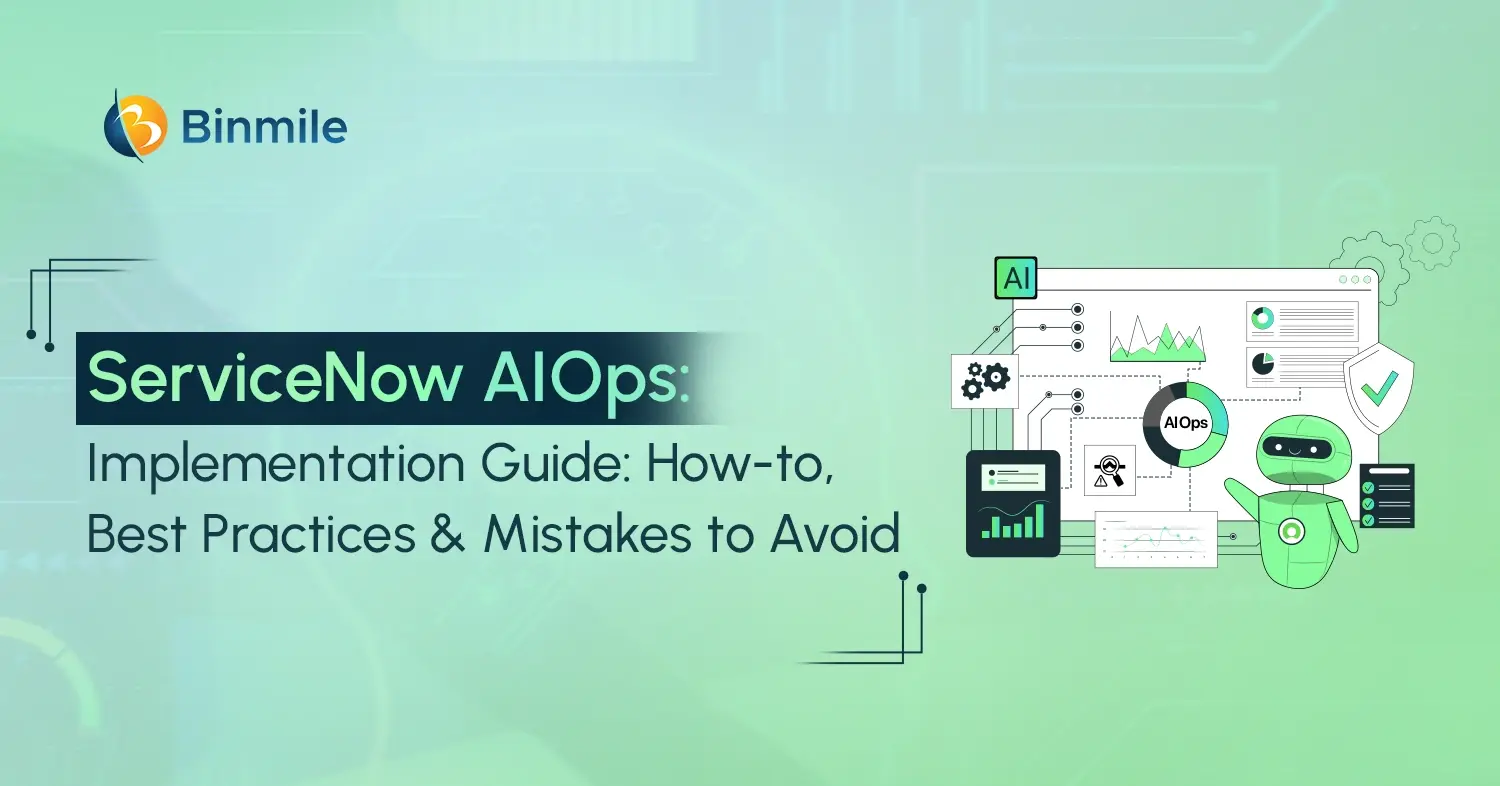
Modern IT environments generate massive amounts of data, events, alerts, logs, and performance signals. ServiceNow AIOps helps organizations make sense of this complexity by detecting anomalies, correlating events, identifying root causes, and automating remediation. With AI-driven and agentic capabilities, AIOps is increasingly helping IT teams move beyond simply responding to alerts toward proactive, self-healing operations.
However, to truly harness the benefits of the ServiceNow AIOPS implementation, you need a well-planned, well-executed implementation. Without the right approach, the platform’s capabilities can be underused, leaving critical opportunities for automation and optimization untapped. In this blog, we will explore step-by-step phases of ServiceNow AIOps implementation and discuss how it keeps digital services running 24/7 with improved operational efficiency and reliability. In addition, we will share a few key mistakes to avoid so your rollout is smooth and impactful.
What is ServiceNow AIOps?
Modern ServiceNow AIOps goes beyond alert and event management. It combines telemetry, AI-driven analysis, service context, and automation to detect potential issues, understand their impact, identify likely root causes, and initiate remediation workflows. This enables IT teams to move toward proactive and self-healing operations, where known issues can be addressed automatically rather than waiting for manual intervention.
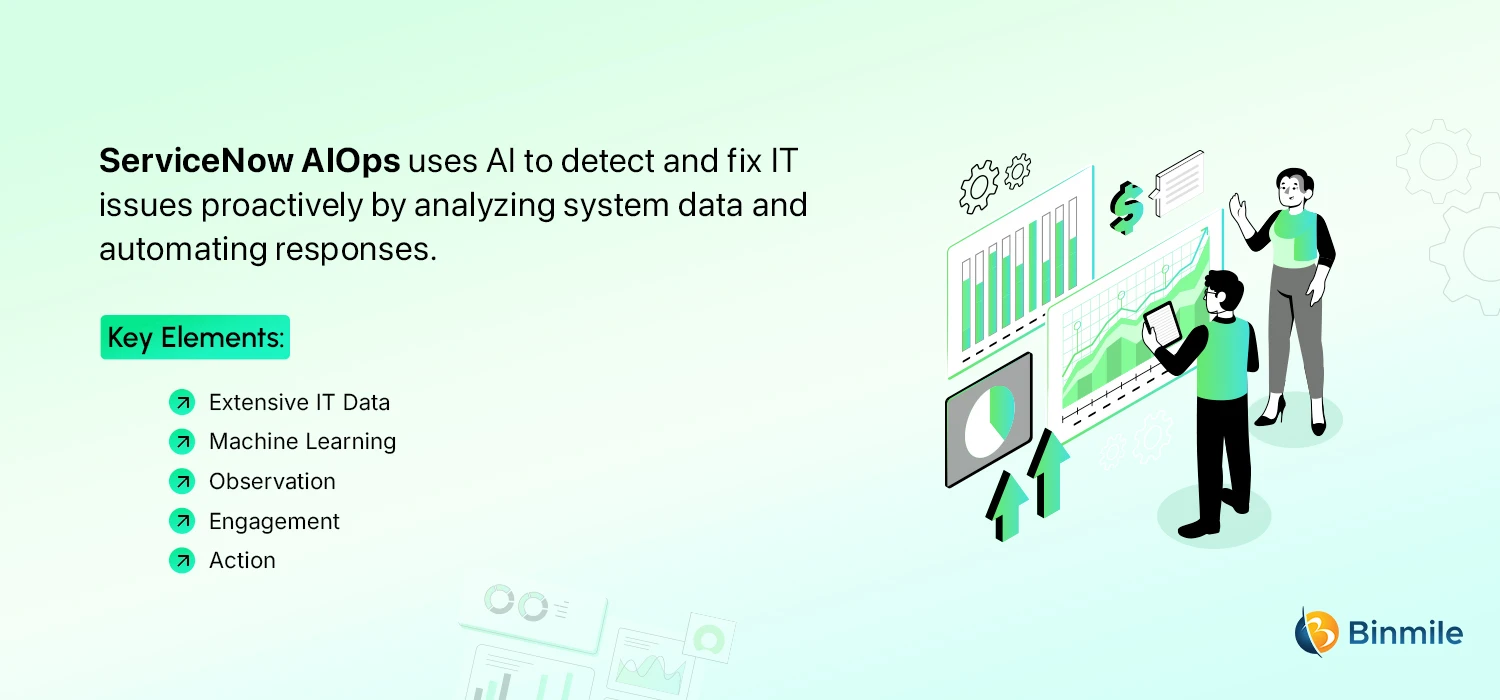
In other words, utilizing AI and other advanced technologies like predictive analytics, machine learning, and automation to identify and resolve issues before they happen. This allows IT teams to visualize the health of services and their digital products in real-time, detect anomalies, and automate remediation without manual intervention.
What Are the Key Elements of ServiceNow AIOps
To better understand the capacity and responsibility of AIOps with ServiceNow, let’s take a look at its core elements and the factors that drive it:
-
Extensive IT Data
It breaks down the data into silos by aggregating diverse data from IT service management and IT operations management, enabling faster identification of root causes and automation.
-
Machine Learning
Utilizing advanced ML capabilities, AIOps automates analytics and uncovers connections and insights, and scales with speed and accuracy that would otherwise be impossible.
-
Observation
This is done to collect data from different IT domains and sources, such as containers, cloud, or virtualized environments, as well as legacy infrastructure. However, data must be collected in real-time to provide the most up-to-date foundation.
-
Engagement
The platforms offer interconnectedness across multiple IT domains, including ServiceNow ITSM. Through configuration, coordination, and management of computer systems and software, AIOps analytics provide more reliable and relevant data, seamlessly incorporating information about the environment and enabling automation.
-
Action
With its capabilities, the ServiceNow AIOps platform can handle both simple and complex jobs and create systems that fully automate operations, thus entirely freeing up IT operations teams to take on other tasks.
What Are the Common Challenges of ServiceNow AIOps Implementation
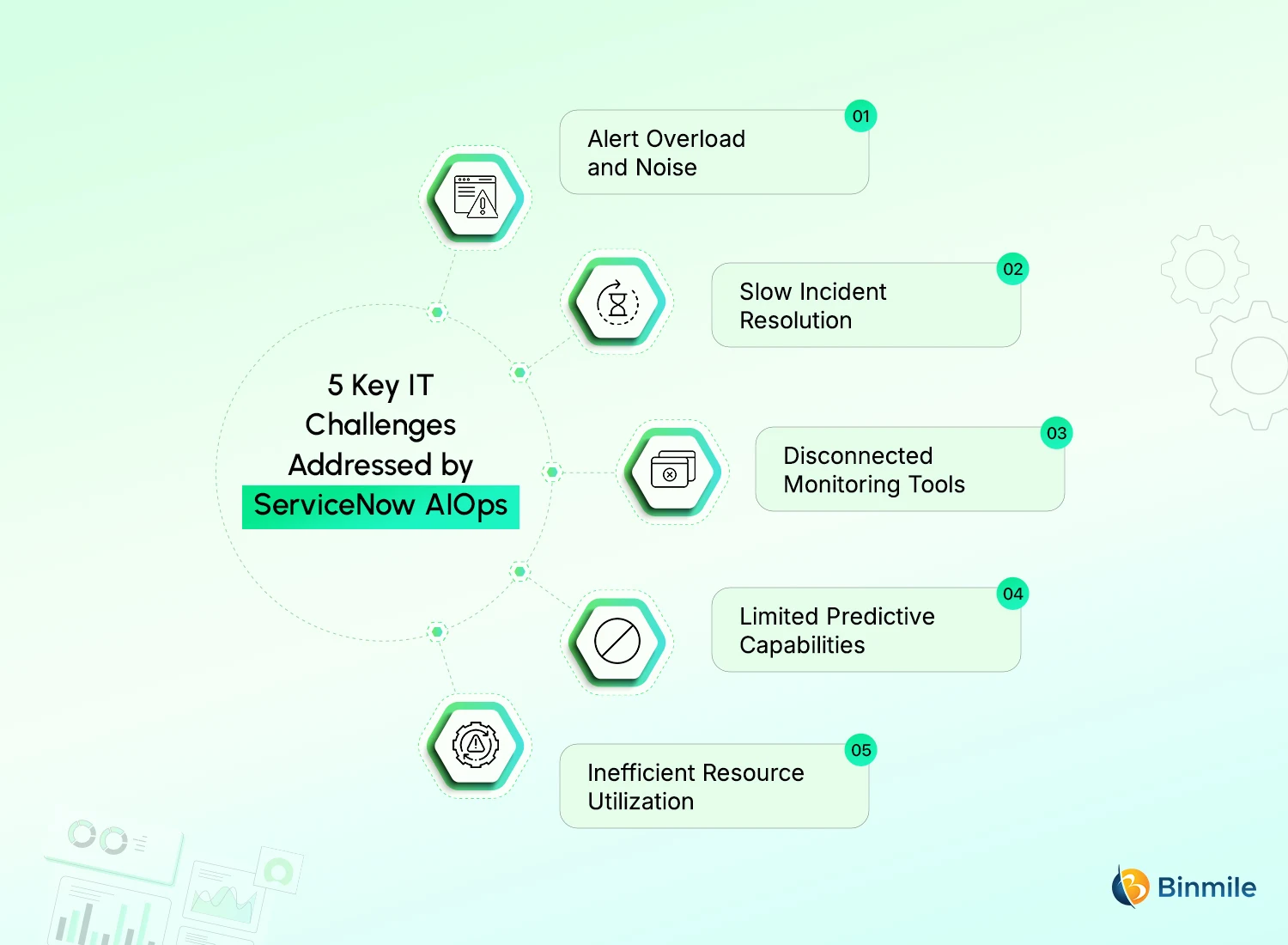
ServiceNow AIOps platform is a game-changer for IT teams that struggle with visibility, alert fatigue, and slow response times. Here are 5 common challenges it addresses:
-
Alert Overload and Noise
IT teams often face thousands of alerts daily, many of which are duplicates or low priority. ServiceNow AIOps platform uses AI-powered event correlation to cut through the noise and focus only on what matters.
-
Slow Incident Resolution
Traditional reactive approaches delay service restoration. AIOps speeds up root cause analysis using machine learning, helping resolve incidents in minutes instead of hours.
-
Disconnected Monitoring Tools
Data scattered across multiple monitoring systems leads to blind spots. ServiceNow consolidates data from various sources into one operational view.
-
Limited Predictive Capabilities
Without forecasting, IT teams remain reactive. AIOps, driving ServiceNow’s role in digital transformation, predicts failures and recommends preventive actions.
-
Inefficient Resource Utilization
Manual remediation drains IT resources. ServiceNow automates common resolutions, freeing up teams for higher-value tasks.
What Is the Process of ServiceNow AIOps Implementation
Implementing the ServiceNow AIOPS dashboard isn’t just about developing a strategy; you must create a structured rollout plan, ensure data quality, and embed automation into operational workflows. Here’s how to do it right:
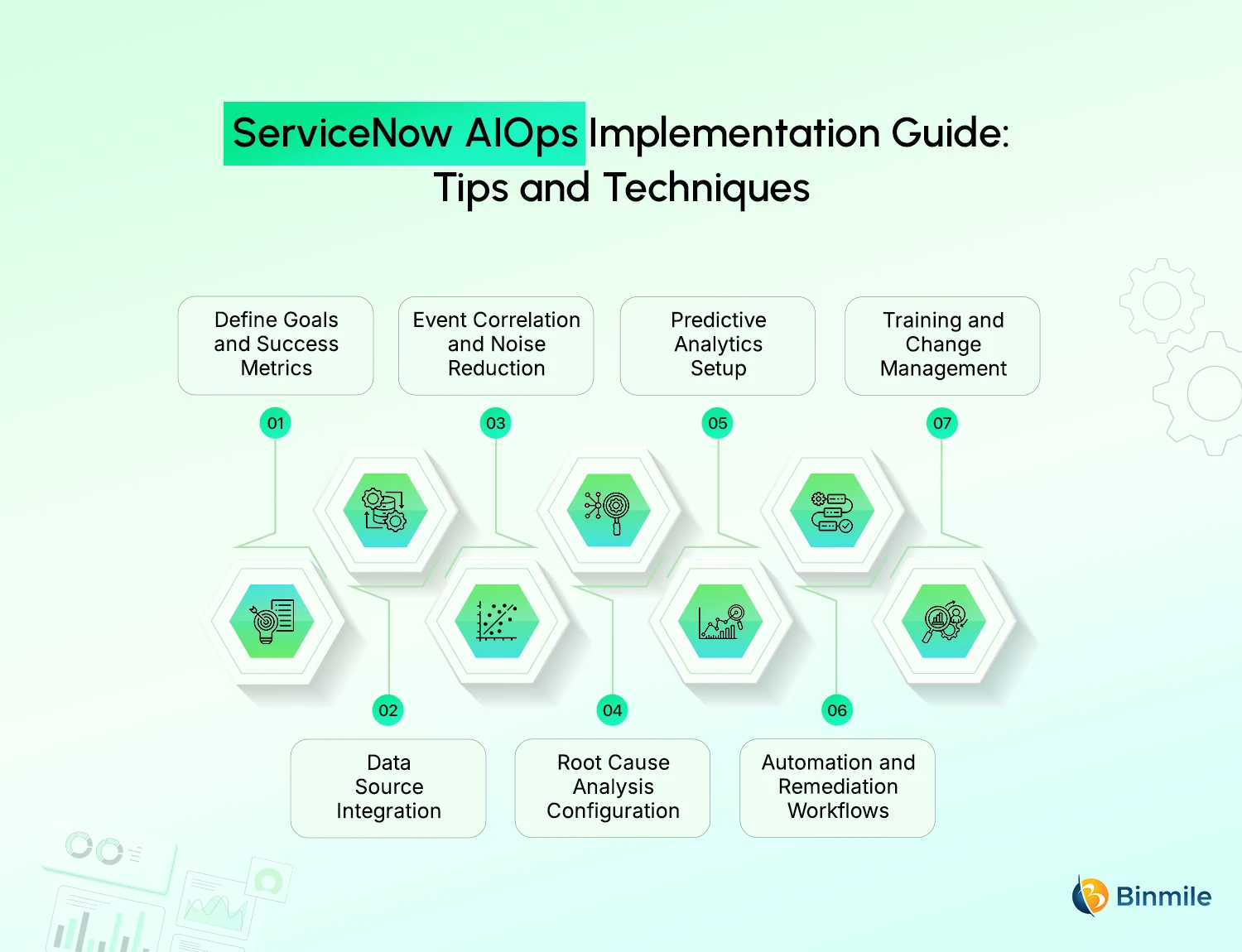
1. Define Goals and Success Metrics
Before implementing the ServiceNow AIOps platform, clearly identify the operational challenges you aim to solve, whether it’s reducing alert fatigue, improving uptime, or speeding resolution times. Incorporate observability in DevOps to gain deeper insights into system behavior and performance trends. Set measurable KPIs like mean time to resolution (MTTR) or percentage of incidents resolved automatically. This clarity ensures the deployment aligns with business objectives and provides a framework for evaluating impact over time, keeping all stakeholders focused on shared, quantifiable outcomes.
2. Event Correlation and Noise Reduction
Configure the ServiceNow AIOps dashboard to consolidate duplicate alerts, filter non-actionable events, and prioritize incidents based on business impact. Train its machine learning models with historical data to improve correlation accuracy over time. Reducing alert noise allows IT teams to focus on critical issues rather than sifting through thousands of low-priority notifications. This phase is key to improving responsiveness, reducing fatigue, and ensuring that operational attention is directed toward incidents with the most significant potential impact.
ServiceNow’s current AIOps AI Specialist, for example, analyzes alerts in context, identifies likely root causes, recommends next actions, and can autonomously handle known operational issues through approved remediation.
3. Data Source Integration
Connect all relevant monitoring tools, application logs, event streams, performance metrics, and the organization’s ServiceNow CMDB into the ServiceNow AIOps platform using APIs or connectors. Verify that the data is accurate, complete, and consistent before ingestion, as poor-quality information will undermine AI-driven insights. Establish governance policies for ongoing updates and access control. A clean, comprehensive data foundation ensures the platform delivers relevant, actionable recommendations and creates a unified operational view for your IT teams to make informed, timely decisions.
4. Root Cause Analysis Configuration
Set up service dependency mapping and topology views to enable the platform to visualize how infrastructure components interact. Train AI models to identify likely root causes by analyzing historical incident patterns. Integrating RCA directly into incident workflows speeds diagnosis and enables targeted, effective remediation. For recurring issues, develop automated playbooks that execute fixes immediately, reducing downtime and keeping essential services running smoothly without repetitive manual intervention from your IT operations teams.
5. Predictive Analytics Setup
Enable anomaly detection and forecasting models to identify deviations before they escalate into outages. Predictive AI vs prescriptive AI brings in a critical evolution in IT operations: predictive AI forecasts potential issues, while prescriptive AI suggests specific actions to resolve them. By linking predictive alerts to automated preventive workflows, teams can reduce disruptions and shift from reactive to proactive service assurance. Therefore, regular model retraining ensures continued accuracy and relevance.
6. Automation and Remediation Workflows
Develop automated workflows to resolve common incidents, like restarting services or reallocating resources, without manual input. Test each workflow thoroughly before production to ensure safety and prevent unintended consequences. Embed these automations into the incident lifecycle so they trigger immediately when conditions are met. Maintain documentation for all workflows to ensure repeatability and scalability, and periodically review them to adapt to evolving operational needs or changes in your IT infrastructure and business priorities.
7. Training and Change Management
Provide tailored training for different user roles, from operators to managers, ensuring everyone can leverage the ServiceNow AIOps dashboard in daily workflows. Use scenario-based exercises to build confidence, maintain an internal knowledge base, and tap into the benefits of offshore support services for scalable, round-the-clock assistance. Engage stakeholders, communicate changes, and collect feedback to refine processes. Strong change management ensures smooth adoption and long-term value beyond initial deployment.
5 Common Mistakes to Avoid in ServiceNow AIOps Implementation
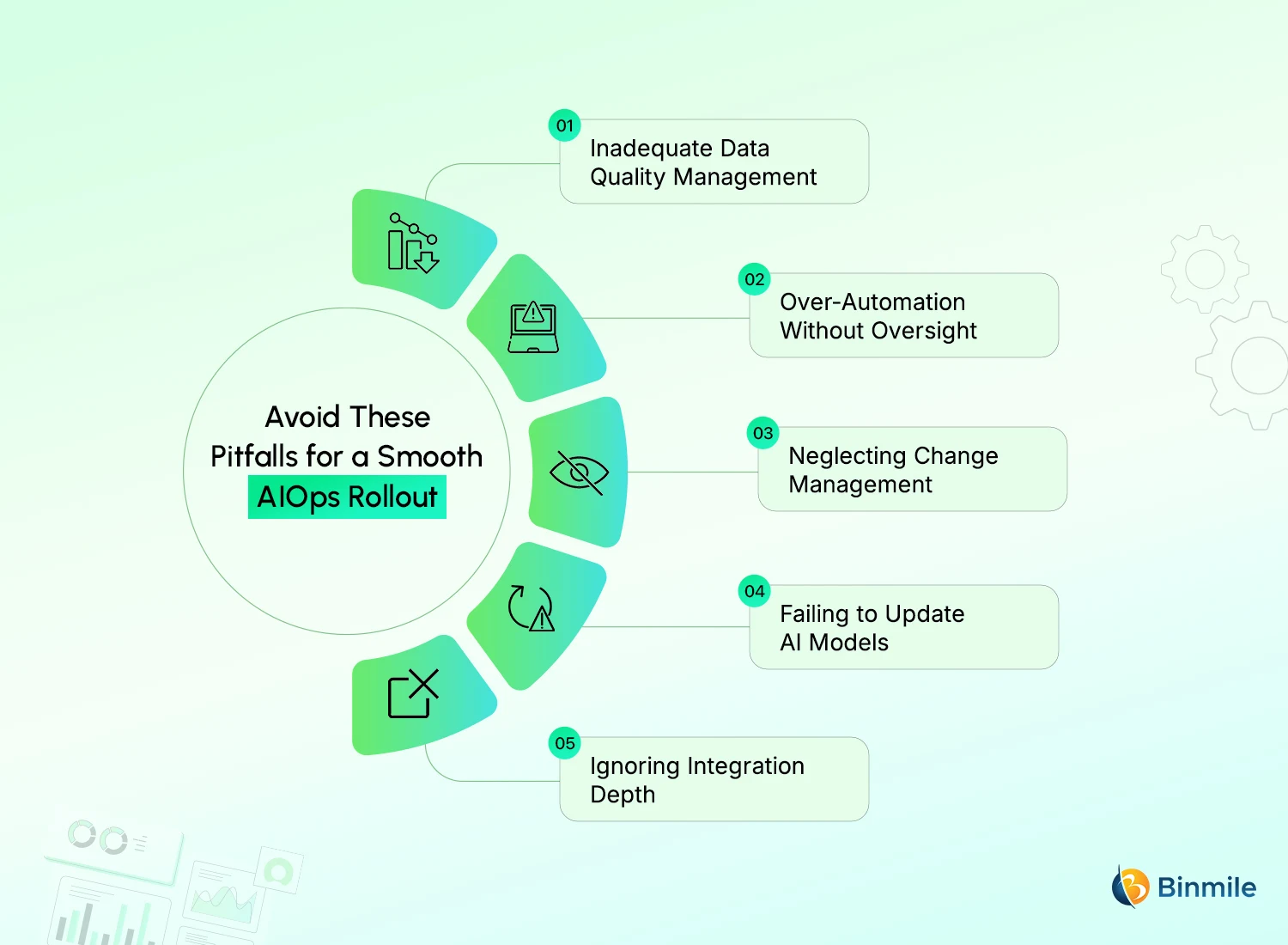
Even powerful tools fail without proper execution. Here is what to watch out for:
-
Inadequate Data Quality Management
Feeding incomplete or inaccurate data undermines predictions and correlations. Always start with clean, governed datasets.
-
Over-Automation Without Oversight
Automating without safeguards can lead to cascading failures. Always include review points for high-impact actions.
-
Neglecting GenAI Updates in ServiceNow
Without retraining, GenAI accuracy declines. Schedule regular model refreshes with fresh data during implementation.
-
Neglecting Change Management
Rolling out the ServiceNow AIOPS platform without preparing your team creates resistance. Engage stakeholders early and offer role-based training.
-
Ignoring Integration Depth
Surface-level integration with monitoring tools limits the platform’s capabilities. Aim for deep, bidirectional data sharing when you opt for the ServiceNow platform implementation.
Binmile’s ServiceNow Implementation: A Blueprint for ITSM Success
Cover-More is the leading travel insurance provider who were struggling with managing its IT Service Management (ITSM) processes. The core issue was an unorganized system for reporting and resolving incidents and requests, with no clear segregation between incidents and service requests, making it cumbersome to track, monitor, and manage these events efficiently. Due to this, inefficiencies in workflow and reporting occurred, which ultimately impacted service reliability and response times.
What Binmile Did & How
Cover-More’s ITSM processes lacked clarity and efficiency, with incidents and service requests often conflated, leading to delays and unreliable tracking. The system lacked automation, visibility, and formal escalation paths for critical issues. A comprehensive overhaul was needed to streamline operations, improve traceability, and enable data-driven decision-making, so let’s understand how, as a top ServiceNow consulting services company, we achieved it:
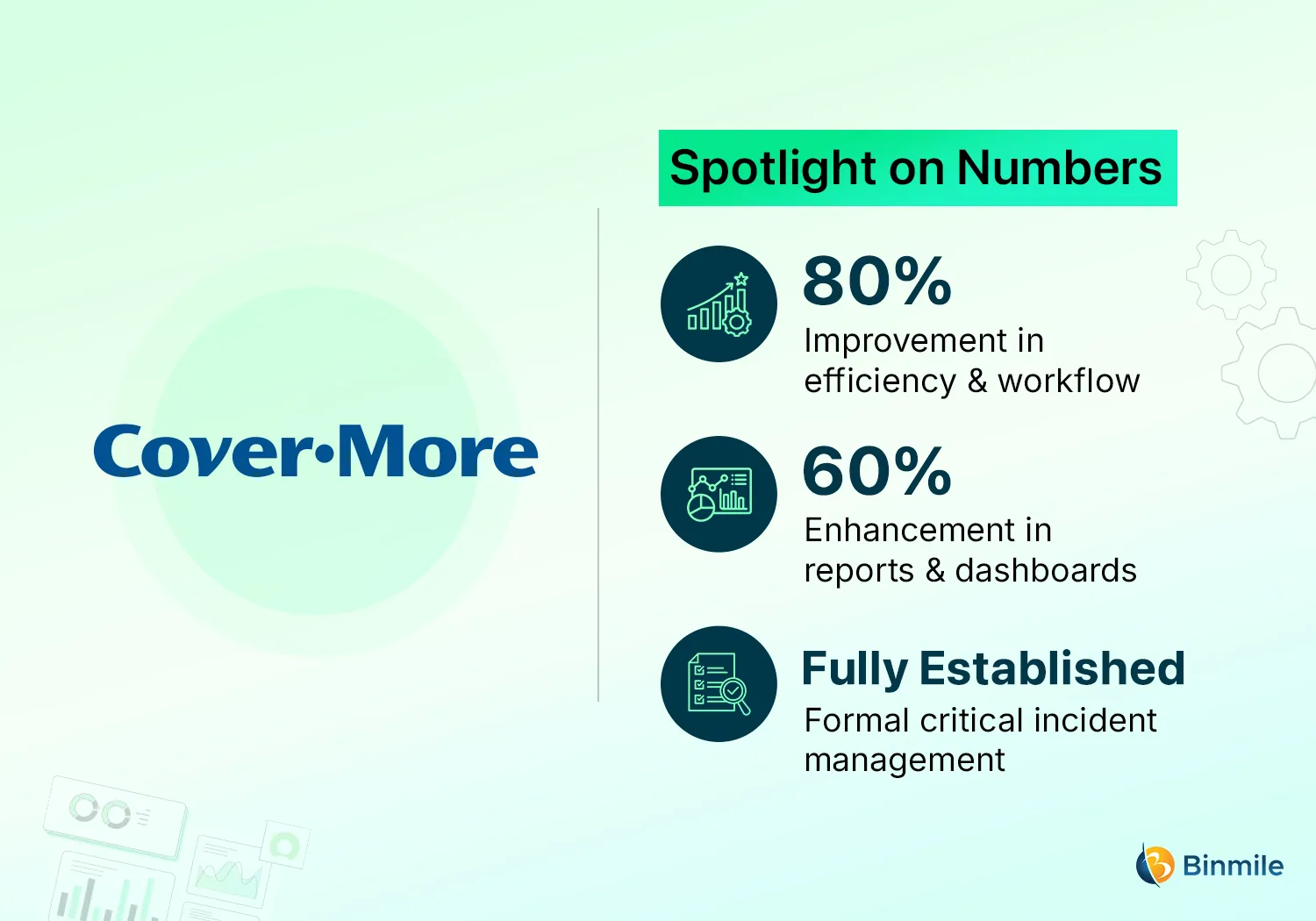
Key Actions by Binmile
- Diagnosed ITSM inefficiencies and mapped process gaps
- Re-architected ServiceNow to separate incidents from service requests
- Designed automated workflows to standardize issue handling
- Integrated dashboards and reports for real-time performance insights
In Summary: ServiceNow AIOps Implementation
ServiceNow AIOps is evolving beyond traditional alert management and noise reduction. By combining AI-driven detection, contextual analysis, automation, and agentic capabilities, organizations can move toward proactive and self-healing IT operations. The goal is not simply to help teams respond to more alerts faster, but to prevent issues where possible and automate resolution for known problems, while keeping people in control of complex decisions.
If you want to unlock the full potential of the ServiceNow AIOPS dashboard for your organization, consider partnering with a certified ServiceNow consulting services provider. These experts can design and implement tailored AIOps strategies from architecture planning to automation execution that align with your business goals.
Partner with us to make your IT operations smarter, faster, and more resilient. Contact us today to start your ServiceNow AIOps transformation.
Frequently Asked Questions
ServiceNow AIOps implementation is the process of deploying and configuring ServiceNow’s AI-driven IT operations capabilities to monitor infrastructure, analyze events, identify issues, and automate remediation.
It helps organizations correlate IT data, detect anomalies, identify potential root causes, and automate repetitive remediation workflows, allowing IT teams to manage growing environments with less manual intervention.
A typical ServiceNow AIOps implementation involves assessing the IT environment, defining use cases, integrating data sources, configuring monitoring and event management, establishing automation workflows, testing the setup, and continuously optimizing performance.
The timeline depends on factors such as the complexity of the IT environment, the number of integrations, data sources, use cases, and the level of automation required. A phased implementation can help organizations demonstrate value while expanding capabilities over time.
Common challenges include integrating diverse data sources, managing data quality, defining appropriate automation rules, minimizing disruption during deployment, and ensuring teams are prepared to adopt AI-driven IT operations.
Organizations can improve implementation outcomes by starting with clearly defined use cases, integrating reliable data sources, establishing governance and automation policies, testing workflows thoroughly, and continuously measuring operational improvements.