Artificial Intelligence is one such technology that has dominated the tech field for quite some time. It has reached the top of the hierarchy and promises greater efficiency, deeper insights, and significant advancements. However, you must know that the power of AI is restricted to some tech giants, making many relevant contributions a bit difficult. Although everyone is making the most of this cutting-edge technology, we must admit that AI follows the basic processes of centralization. These include challenges associated with the privacy of data, the risk of facing a single point of failure, the potential for AI failure, and the scope of imposing a monopoly. That’s where Decentralized AI comes into the picture. It works well with 95% accuracy, 94% precision, and 96% recall, emerging as a realistic option to the standard AI frameworks deployed so far.
Let’s delve into the lesser-known world of Decentralized AI and learn its role in addressing some major issues, its applications in various industries, the key technologies involved in it, and how to start your Decentralized Artificial Intelligence journey.
What is Artificial Intelligence?
Artificial Intelligence is a sort of computer technology that is utilized to perform a wide range of tasks that are generally done by human beings. It includes right from understanding patterns in complicated datasets and analyzing those patterns for decision-making to something as simple as playing games against unknown users online. AI agents powered by Artificial Intelligence technology are so smart that they learn and keep updating without human involvement to ensure smooth functioning. You can use them for a variety of purposes, such as customer service, data analysis, and automating repetitive tasks.
Decentralized AI: An Overview
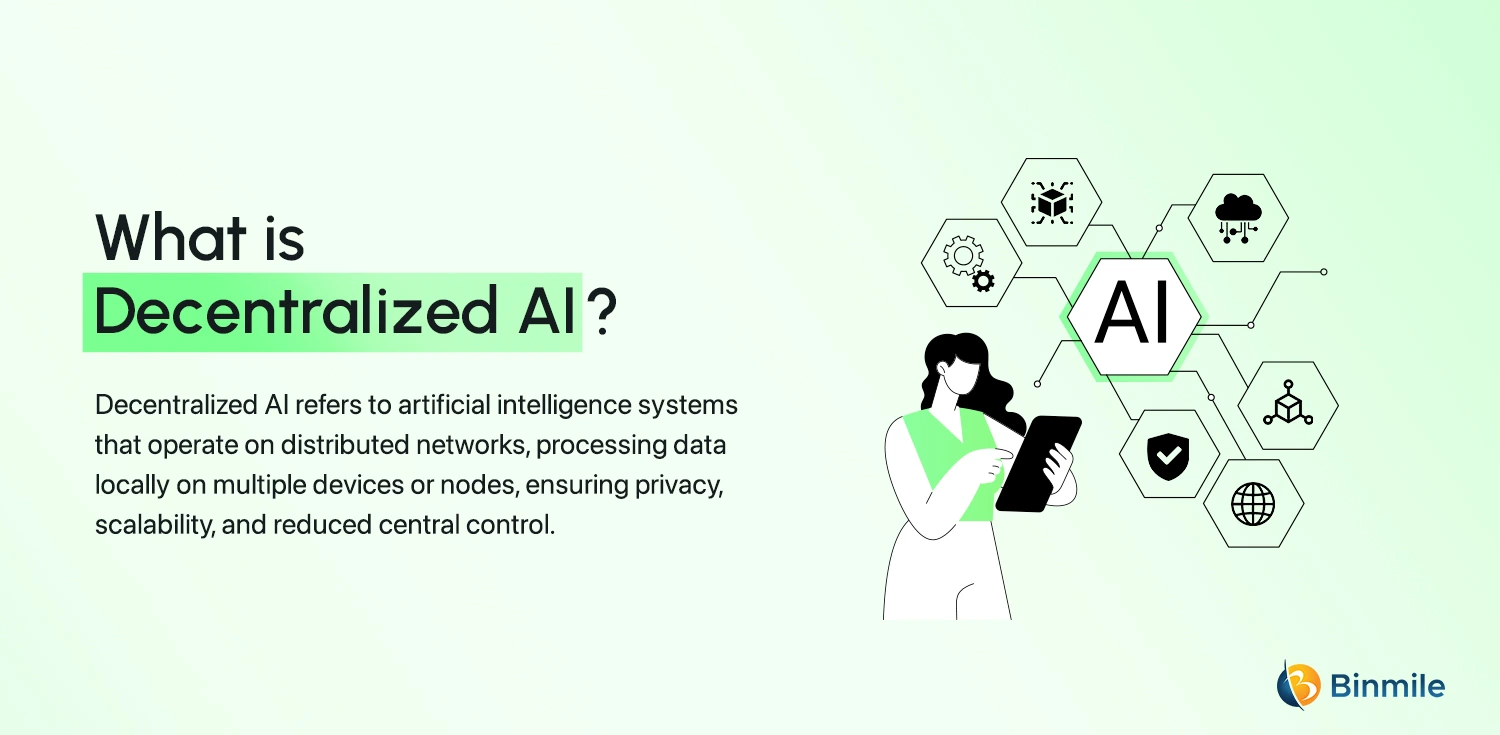
Decentralized AI, also known as Distributed AI, is an approach to using Artificial Intelligence that entails the distribution of AI computation and decision-making abilities across various nodes or devices. Unlike centralized AI systems, where all the computation job is carried out on a single server or cloud, Decentralized Artificial Intelligence takes advantage of the collective potential of a network of devices, enabling higher scalability, privacy, and resilience.
How Does Decentralized AI Work?
In Decentralized AI computing, every node in the network leverages its computational resources, like processing power and data, to collectively train models and drive predictions. This collaborative approach allows the creation of smart systems that are not dependent on only one point of failure and can work in a peer-to-peer manner.
Role of Decentralized AI in Solving Significant Problems
Distributed AI has the ability to resolve multiple critical issues related to traditional centralized AI systems. For example:
- One of the biggest troubles is data privacy, which Decentralized AI handles well by distributing data across several nodes. This makes sure that no single entity has full access to the information, thus improving data privacy.
- A Decentralized AI system fosters greater transparency and trust by building transparent and auditable models where various nodes can analyze and verify the decision-making processes.
- The functional model created by Decentralized AI companies can manage massive-scale datasets and computationally intensive tasks efficiently by exploiting the power of distributed computing. This technique allows quicker and more efficient processing of complicated AI algorithms.
- Decentralized Artificial Intelligence offers superb reliability in important applications as it can continue serving properly even if some nodes or devices go offline.
Best Way to Begin Your Decentralized AI Journey

Decentralized AI is a modern approach to AI that distributes computing and decision-making ability to a network of connected devices. To commence the journey of Decentralized Artificial Intelligence implementation, you can check out this step-by-step guide:
-
Step 1: Define Your DeAI Goals
Set off by recognizing the plights you want to resolve with a Decentralized AI blockchain. Decide whether you wish to strengthen privacy, minimize latency, or enhance data security. Having clarity in your goals is important to achieve success.
-
Step 2: Choose Suitable Edge Devices
Decentralized AI projects count on edge devices for data processing. Select appropriate edge devices, like IoT sensors or mobile phones, and create AI algorithms that can run efficiently on such devices, reducing the requirement for centralized cloud computing.
-
Step 3: Ensure Data Privacy
Make sure to apply strong data privacy and security measures for Decentralized AI platforms. Implement encryption and authentication protocols to protect data, and think of utilizing blockchain to boost trust and transparency.
-
Step 4: Embrace Collaborative Learning
Federated learning is essential for a Decentralized app. Build AI models that can be trained collaboratively across a vast network without the need to share raw data. This method helps maintain data privacy and develop a stronger AI model.
-
Step 5: Pick the Right Nodes
Choose the devices that will become part of your Decentralized AI network. Make sure they can run AI algorithms and are interconnected for smooth interaction. The selection of nodes heavily impacts the effectiveness of your Distributed AI implementation.
-
Step 6: Build Decentralized Decision-Making
Create AI models and algorithms that enable Decentralized decision-making. Allow these models to make predictions and take plunges on edge devices, mitigating latency and empowering real-time AI capabilities for Decentralized app development services.
-
Step 7: Consider Blockchain Integration
Factor in incorporating blockchain to upsurge transparency and data integrity. Use smart contracts for automated and reliable transactions within your Decentralized AI network.
-
Step 8: Establish Compliance and Regulation
Pay heed to regulatory compliance, especially regarding data management and privacy, as Distributed AI systems often process sensitive data. Verify that your system complies with relevant laws, like GDPR or HIPAA.
-
Step 9: Collaborate and Open Source
Engage with the Decentralized AI community and think of open-source development. Partnering with industry experts and sharing knowledge speeds up Distributed AI advancements. Partaking in open-source projects can help you gain access to humongous collective expertise.
-
Step 10: Carry Out Continuous Improvement
Decentralized AI is an evolving field. Frequently update and improve your Distributed AI system based on feedback, trending technologies, and new applications. Releasing new variants constantly keeps your implementation agile and effective.
-
Step 11: Execute Real-World Testing
Prior to deploying a Decentralized app, execute real-world testing to make sure your Distributed AI system works as intended and meets your expectations. Be ready to make certain changes depending on the insights received during testing.
-
Step 12: Explore Scaling & Integration Options
Once you have a functional Decentralized app in place, look for opportunities to scale it across various use cases and industries. Incorporation with current infrastructure or services is essential for the global adoption of Distributed AI systems.
Redefine the future with decentralized AI! Let’s build groundbreaking solutions that improve data privacy, ensure compliance, and scale operations seamlessly.
Top Powerful Technologies Behind Decentralized AI Projects
Numerous key technologies are powering the development and adoption of Decentralized app. These technologies drive improved performance, scalability, and security.
- Blockchain Technology: Blockchain renders a secure and transparent method to store and share data across decentralized networks. Its unchangeable ledger makes sure of data integrity and promotes trust among participants.
- Federated Learning: This machine learning practice allows Decentralized AI models to be trained across several decentralized devices without sharing raw information. It improves privacy and minimizes the risk of data breaches while still empowering collaborative learning.
- Edge Computing: By processing data near where it originated, edge computing mitigates latency and bandwidth utilization. This state-of-the-art technology is imperative for real-time applications and supports the scalability of Decentralized app.
- Decentralized Identity Solutions: These solutions allow users to handle their identities privately and securely. By leveraging Decentralized Identifiers, people can control their personal data and share it desirably.
- Artificial Intelligence Algorithms: Advanced AI algorithms powered by AI programming languages, like deep learning and reinforcement learning, are being adjusted for a decentralized ecosystem. These algorithms can run efficiently across distributed networks, improving the abilities of Decentralized AI solutions.
Top 5 Use Cases of Decentralized AI in Businesses
Innovations in AI, for instance, Distributed AI has the ability to revolutionize multiple industries by offering unique solutions that reap the benefits of both Artificial Intelligence and Decentralized technologies. Below you can check out some popular applications:
- Healthcare: Decentralized AI can simplify secure patient data sharing among medical service providers, facilitating better diagnosis and treatment methods. It can also help in drug discovery by analyzing considerable datasets without interfering with patient privacy.
- Finance: In the financial domain, Decentralized AI can improve fraud detection and risk assessment. By analyzing transaction patterns in a distributed network, it can detect discrepancies more effectively than conventional systems.
- Energy Management: Artificial Intelligence can be used to enhance energy usage in decentralized energy grids. By analyzing data from a multitude of sources, it can estimate energy demand and adapt supply accordingly, fostering sustainability.
- Supply Chain Management: Decentralized AI computing can improve supply chain operations by offering real-time insights into demand forecasting, inventory levels, and logistics. This results in increased efficiency and decreased costs.
- Marketing and Advertising: Decentralized app can analyze customer behavior across several platforms, enabling companies to design targeted marketing campaigns. This translates into higher conversion rates and increased consumer engagement.
Lead the decentralized AI revolution from the front! Embrace this cutting-edge technology to achieve greater ROI and sustainable growth for your organization.

Current Challenges of Decentralized AI Platforms
| Challenge | Description | Solution |
|---|---|---|
| Related to Scalability | Blockchain and AI require significant processing power, which complicates liability concerns, particularly in large-scale business deployments. AI as a Service demands extensive computing resources for training and inference, while Blockchain networks face challenges from limited transaction throughput. | Embracing new consensus tactics, like proof of stake and the adoption of layer two solutions to increase the liability without compromising the decentralization are two ways to deal with these obstacles. |
| Complex Art of Integration | Adaptive AI and Blockchain present challenges in integration due to their structural differences. While Blockchain operates on decentralized technology with data distributed across nodes, AI relies on centralized computation for model training. Creating a robust framework that ensures fast performance, secure connections, and data integrity is complex. | To effectively solve these architectural differences, it is important to implement inventive design tactics for bridging the gaps perfectly. |
| Safety Concerns | There is a tension between the immutable and transparent nature of Blockchain and the need for AI to have access to large data sets that might comprise sensitive information. It is no less than a challenge to maintain a balance between data privacy and transparency. | The use of zero-knowledge proofs for data validation without disclosure and Federated learning for decentralized AI training are emerging as methods to protect privacy while maintaining operational efficiency. |
| High Computation Demands | This merger has the ability to overload the existing infrastructure, which is required for massive data processing, storage of information, and an extra locomotive to block their networks, i.e., already facing issues with quick transactions and storage constraints. | Teams are experimenting with change activities to increase the pressure applied to block networks and resolve this problem. Additionally, they are creating more effective consensus processes to better utilize currently available resources. |
The Takeaway
That’s all for now! Artificial Intelligence Decentralized is valuable to individuals, which when brought together, offers multiple new opportunities across industries. In this blog, we learnt what is AI, what is Decentralized AI, and how Artificial Intelligence when combined with Blockchain leads to various use cases. We have also seen the importance of Decentralized Artificial Intelligence in addressing some common challenges along with the right way to start your distributed AI journey. Above all, we acquired knowledge about some significant challenges that you may come across when trying to implement distributed AI within your organization and a few ways to deal with them.
With almost every business owner searching for ways to refine their operations and consumer experience by automating tasks, the intersection of AI and Blockchain is expected to only expand in different industries down the line. Thus, if you wish to experience the full capability of Distributed AI and implement it in your business operations, the best thing you can do is hire AI developer.