Every organization is on a mission to turn raw information into business insights. But the real challenge lies in storing, managing, and analyzing this data efficiently. Coherent Market Insights projects that the data lake market will reach USD 19.04 billion by 2025, and it expects the data lakehouse market to grow at over 21% CAGR in the coming years.
These numbers prove one thing: companies are investing heavily in modern data architectures. But the confusion remains: What is the difference between a data warehouse, a data lake, and a data lakehouse? Let’s decode each and help you choose the right one for your needs.
What is a Data Warehouse?
A data warehouse is an organized and centralized repository developed to capture and store processed business information from several sources. While operational databases focus on real-time transactions, data warehouses support analytical workloads and offer stable historical views of data necessary for business intelligence (BI) and reporting.
The data warehouse follows the core principle of schema-on-write, which means it cleanses and formats data before loading it. It maintains data integrity at entry, which enhances the speed and accuracy of insights derived from queries.
 Organizations standardize data for unified analysis during the ETL process in data warehousing (Extract, Transform, Load). This involves integrating data from sales and marketing tools, CRMs, ERPs, and warehousing systems.
Key Advantages of a Data Warehouse:
- High Data Quality and Consistency: All dashboards and reports are generated from reliable and unified data.
- Optimized for Analytics: Designed to handle complex queries and aggregations without disruption to the daily operations of an organization.
- Supports Historical Analysis: Over time, data warehousing enables the business to identify and analyze trends, patterns, and anomalies.
- Secure and Compliant: Data protection, as well as regulatory compliance requirements, are fulfilled through governance and audit controls.
Typical Use Cases:
- Financial performance tracking
- Customer analytics and segmentation
- Marketing ROI measurement
- Operational forecasting and strategic planning
In short, a data warehouse is ideal for enterprises dealing with structured data that demand accuracy, stability, and governance in analytics. It is a vital foundation in modern data management frameworks and complements data lakes for a complete analytical ecosystem.
What is a Data Lake?
A data lake is a system for storing large amounts of raw data in a centralized and scalable manner. It can be structured, semi-structured, or unstructured. A data lake differs from a data warehouse in that it does not impose structure on data during ingestion. With a lake, organizations can adopt a “store-then-structure” approach. Only during analysis or processing is data structured, allowing for flexible and cost-effective data storage.
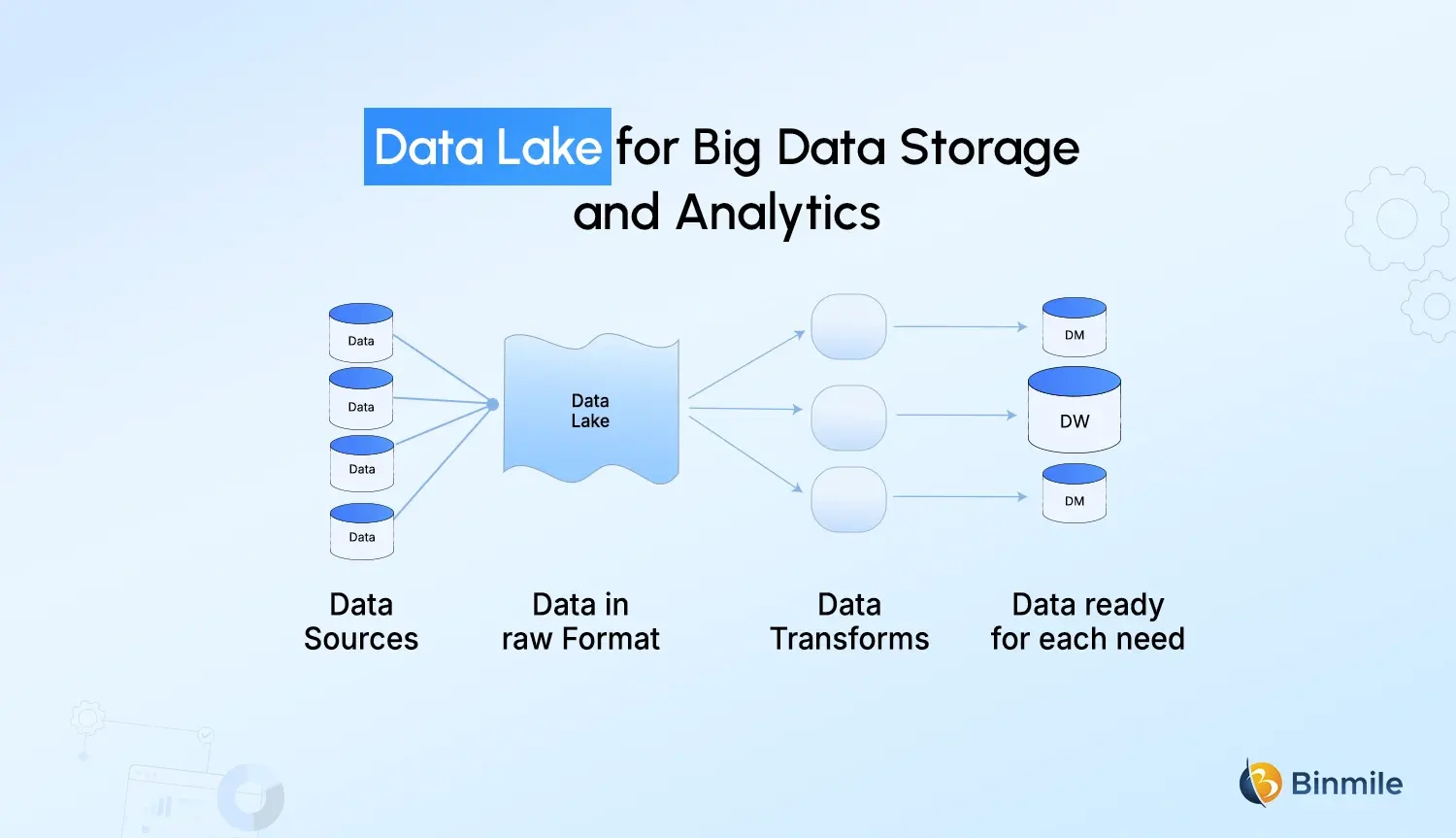
This flexibility is what makes data lakes invaluable for big data and data lake configurations. Systems easily manage continuous data inflow from a wide range of sources, including social media, mobile apps, IoT devices, and web logs.
Core Benefits of a Data Lake:
- Cost-Effective Storage: Easily manages petabytes of data due to its use of commodity hardware and cloud storage.
- Supports All Data Types: Handles all data types, including images, video, JSON, logs, and all types of sensor data.
- Scalable and Flexible: The system is designed to be flexible and is easily scalable.
- Foundation for AI and ML: It stores raw data that users can use in predictive analytics, data modelling, and machine learning, among other things.
However, without proper lake data management and governance practices, a data lake can become disorganized and inefficient, often referred to as a data swamp. This is where data governance services come into play, ensuring data integrity, quality, and discoverability.
Common Use Cases:
- Real-time analytics and log processing
- AI and machine learning model training
- IoT and sensor data analysis
- Data exploration and experimentation
In summary, a data lake empowers organizations with agility and scalability, making it indispensable for data engineering for AI and modern analytics. It complements data warehousing and data lakes architectures to create a seamless flow between raw data and refined insights.
Strengthen your data pipeline with our data engineering services powered by AI-driven data delivery.

What is a Data Lakehouse?
The data lakehouse complex integrates the best functionalities of a data lake and data warehouse. It is a unified platform with the ability to process and analyze large volumes of structured, semi-structured, and unstructured data in real-time. This real-time provision is essential for organizations looking to improve their operational efficiencies and data-driven decision-making processes.

This hybrid integration in data architecture is developed to address the most critical business use cases. It handles the challenges of performance and governance provided by data lakes. It also addresses the issues of structure, type diversity, and scalability, which are limitations of data warehouses. This is the reason data lakehouses support and facilitate the simultaneous use of schema-on-read and schema-on-write.
Core Features and Benefits of a Data Lakehouse:
- Unified Data Management: Consolidates separate systems for raw and structured data.
- End-to-End Analytics: Real-time insights, BI reporting, and advanced analytics in a single environment.
- Optimized Performance: They use caching and query optimization to process lake-scale data at warehouse speed.
- Strong Governance and Security: Built-in access controls, compliance, and other governance tools ensure reliability.
- Cost and Operational Efficiency: Simplified architecture management and reduced data duplication.
Common Use Cases:
- Unified analytics across departments
- AI-powered insights and automation
- Streaming data analytics and real-time dashboards
- Enterprise-scale reporting and predictive analytics
Businesses are beginning to understand the evolving role of data lakehouses in data engineering and governance. They are the perfect fit for companies with varied data ecosystems. They combine the scalability of big data with the meticulous analysis capabilities of data warehouses.
A combination of flexibility, control, and affordability is resulting in the data lakehouse model being the predominant option for ‘smart’ companies that are utilizing advanced analytics and data management within the AI evolution.
Data Lakehouse vs Data Warehouse vs Data Lake: Key Differences Explained
| Feature | Data Warehouse | Data Lake | Data Lakehouse |
|---|---|---|---|
| Data Type | Structured | Raw, Semi-structured, Unstructured | All types |
| Schema Type | Schema-on-write | Schema-on-read | Flexible |
| Use Case | BI, Reporting | Big Data, ML, AI | Unified Analytics |
| Performance | High | Moderate | High |
| Cost | Higher | Lower | Moderate |
| Governance | Strong | Requires management | Integrated |
| Storage | Relational databases | Object storage | Hybrid |
This quick comparison shows that while data lakes offer flexibility, data warehouses deliver reliability, and data lakehouses combine both for a balanced solution.
Data Lakehouse vs Data Warehouse vs Data Lake: The Right One For Your Business?
One’s business goals, the types of data, and required analytics will ultimately determine the choice of a data lakehouse, data lake, or data warehouse.
- For structured reporting, a data warehouse is most suitable.
- For big data and AI workloads, a data lake is the option that provides the highest scalability.
- Real-time analytics, the ability to manage varied data formats, and a dynamic data ecosystem all point towards a data lakehouse.
Advanced data management, the latest Gen AI data privacy governance, and outdated systems continuing to exist indicate that the future is with lakehouses.
Assess your existing data with our data governance services to build a strong and reliable framework.

Conclusion
Data has become the new language of business, but only those who understand how to structure, manage, and apply it can turn it into real intelligence. Choosing between a data lake, data warehouse, and data lakehouse is not just about technology; it is about aligning data strategy with long-term business goals.
However, implementing these architectures effectively requires more than just infrastructure; it needs the right expertise in data engineering, governance, and integration. That is where Binmile helps businesses gain an edge. As a custom software development company offering end-to-end data engineering and governance services, Binmile helps organizations modernize their data ecosystems and unlock meaningful insights from complex data landscapes.
Frequently Asked Questions
A Data Warehouse stores structured data for reporting and business intelligence, while a Data Lake handles raw and unstructured data at scale. A Data Lakehouse combines both approaches, offering flexibility, scalability, and analytics capabilities in a single platform.
Modern businesses generate massive amounts of structured and unstructured data. Data Lakehouses help organizations manage both efficiently while reducing storage costs and improving real-time analytics and AI readiness.
Data Lakehouses are often preferred for AI and machine learning because they support large-scale raw data processing along with structured analytics. This makes it easier for businesses to build data-driven applications faster.
An outdated or unsuitable architecture can create data silos, increase costs, slow decision-making, and limit scalability. Choosing the right platform helps businesses improve agility, analytics performance, and operational efficiency.
Data Lakehouses are built for handling large and growing datasets across multiple sources. They support scalable cloud infrastructure, making it easier for businesses to process real-time data and expand analytics capabilities without major infrastructure changes.