A Configuration Management Database can contain thousands or even millions of configuration items, but its value depends on how accurately those records reflect the real IT environment. ServiceNow itself classifies CMDB data ingestion adoption as low when fewer than 80% of CIs are processed through the Identification and Reconciliation Engine (IRE), moderate at 80% to 90%, and high above 90%. This makes data quality and governance more than administrative concerns. They directly influence how confidently an organization can use its CMDB for operations, reporting, automation, and AI.
That is where ServiceNow CMDB Health becomes important. It gives IT teams a structured way to assess whether configuration data is complete, correct, compliant, and properly connected. More importantly, it turns data quality problems into something teams can monitor and act on rather than discovering them only when an incident, audit, change, or reporting exercise exposes a gap. This article looks at how CMDB Health works, the metrics behind it, its role in ITOM and service visibility, why it matters for AI readiness, and the practices that help organizations maintain a healthy CMDB over time.
What Is ServiceNow CMDB Health and Why Does It Matter?
ServiceNow CMDB Health is a set of capabilities designed to evaluate the quality and reliability of configuration data stored in the CMDB. Rather than treating every CI as equally trustworthy, it evaluates the data against defined health criteria and highlights where records fail those checks.
It helps organizations evaluate the quality and reliability of configuration data stored in the CMDB. It checks whether configuration items (CIs) are complete, accurate, compliant, and properly connected, while highlighting issues such as missing information, duplicate records, stale CIs, and broken relationships.
A CMDB may contain thousands of records, but its value depends on how trustworthy that information is. Poor-quality data can affect incident resolution, change impact analysis, service mapping, ITOM visibility, reporting, security, and automation.
The CMDB Health feature brings these checks together through KPIs, health rules, dashboards, and remediation capabilities. By continuously monitoring data quality, organizations can maintain a reliable CMDB that supports day-to-day IT operations while creating a stronger foundation for reporting, automation, and AI-driven workflows.
Understanding the Key ServiceNow CMDB Health KPIs
The ServiceNow CMDB Health KPIs provide a structured view of the condition of configuration data. Each KPI looks at a different aspect of data quality. These KPIs are aggregated into health views that can be examined at different levels, including CI classes, services, and health groups.
1. Completeness
Completeness checks whether important CI information is available. Missing fields such as owner, location, or model details can make records less useful for IT operations.
2. Correctness
Correctness checks whether CMDB data accurately reflects the actual IT environment. It identifies issues such as duplicate, orphan, stale, or outdated CIs and invalid relationships.
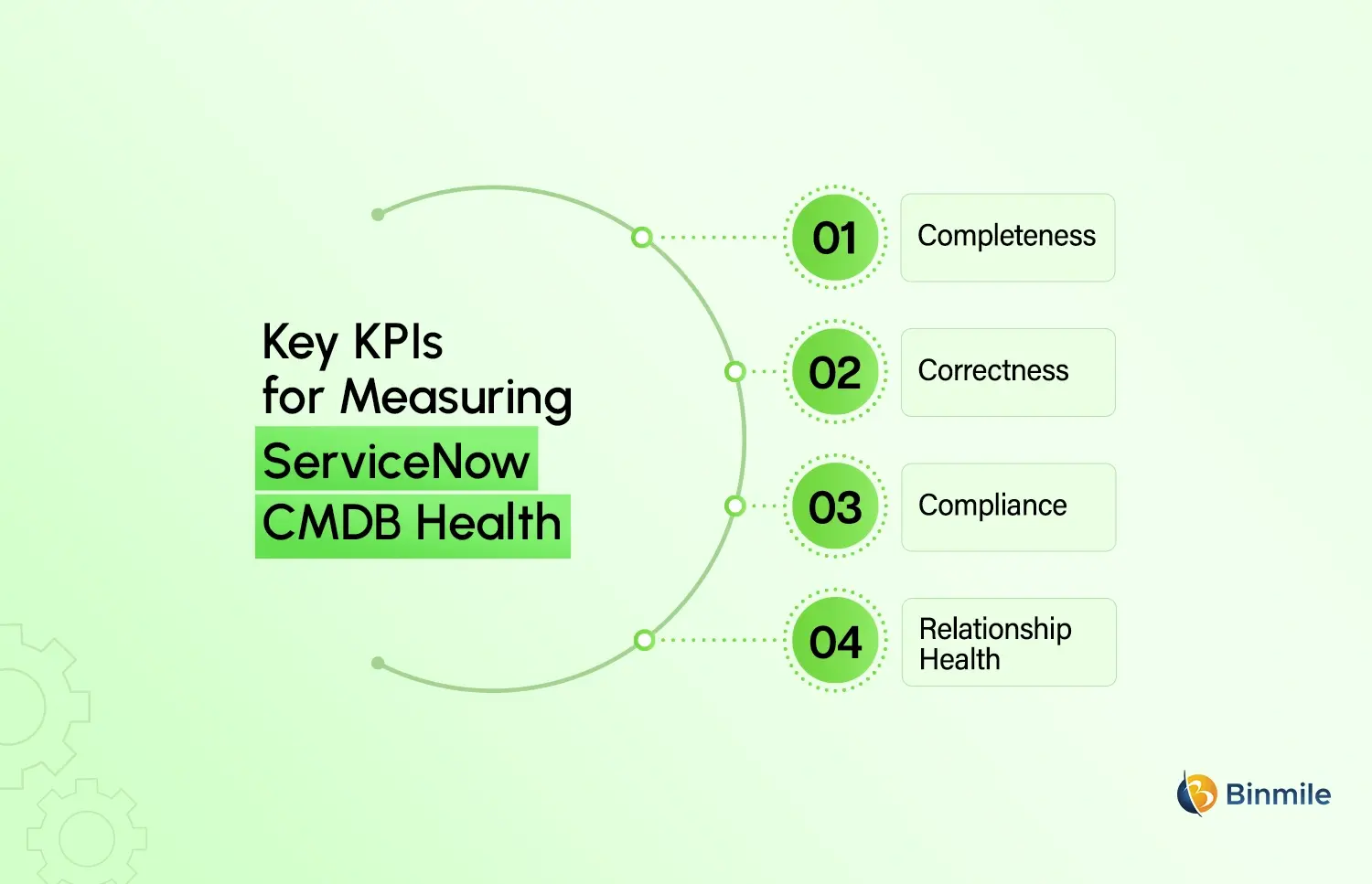
3. Compliance
Compliance checks whether CI data meets defined organizational standards and requirements. It helps identify records that fail audits or configured compliance rules.
4. Relationship Health
Relationship Health evaluates how accurately CIs are connected. It helps identify duplicate or orphan relationships and ensures dependencies between infrastructure, applications, and services are properly represented.
What Is a CMDB Health Score?
The CMDB Health Score provides an aggregated view of CMDB conditions rather than requiring teams to examine every metric individually. ServiceNow calculates the overall score using the core KPI results. The default calculation aggregates completeness, correctness, and compliance, although organizations can configure calculation and weighting approaches depending on their requirements.
However, a single score should never be treated as the complete story.
Imagine two CMDB environments with the same overall score. One may have excellent completeness but serious relationship problems. The other may have strong relationships but a large number of stale CIs. The number tells you that there is an issue. The underlying metrics tell you what needs attention. That is why teams should monitor the individual KPI results alongside the overall score instead of setting an arbitrary target and considering the work finished once it is reached.
How CMDB Health Dashboards Turn Data Problems Into Action
The CMDB Health dashboards provide a central view of CMDB performance and allow teams to drill into problem areas.
| What Teams Can Identify | Why It Matters |
|---|---|
| Incomplete CI Classes | Highlights where important configuration data is missing |
| Duplicate CIs | Helps identify unreliable or conflicting records |
| Stale Configuration Data | Shows where outdated information may affect operations |
| Inconsistent Data Sources | Helps pinpoint recurring data-quality problems |
| Unresolved CI Ownership | Makes remediation responsibilities clearer |
| Missing Relationships | Reveals gaps in service and infrastructure visibility |
ServiceNow also supports views by CMDB health groups, allowing organizations to evaluate health across defined groups of configuration items. This can be particularly useful for large environments where one enterprise-wide number does not provide enough context.
How ServiceNow CMDB Health Improves ITOM and Service Visibility
ITOM relies on reliable configuration data to provide a clear view of the IT environment. ServiceNow Discovery identifies infrastructure resources, while Service Mapping connects them with applications and business services. CMDB Health helps ensure this information remains accurate and useful.
-
Improve Incident Visibility
Accurate CI and service data helps teams quickly understand which systems and services are connected to an incident, supporting faster investigation and resolution.
-
Strengthen Change Impact Analysis
Reliable CI relationships provide better visibility into the systems and services that could be affected by a planned change.
-
Improve Service Mapping
Healthy relationships between CIs make application dependencies and service maps more accurate, giving teams a clearer view of the technology supporting business services.
-
Support Operational Monitoring
Trusted CMDB data allows ITOM tools to correlate infrastructure, events, and services more effectively, reducing gaps in operational visibility.
-
Prioritize Remediation
CMDB Health helps teams identify critical data-quality issues and focus remediation efforts on CIs and services with greater operational importance.
Ultimately, ITOM can collect and connect vast amounts of information, but ServiceNow CMDB Health helps ensure that information can be trusted.
Why CMDB Health Is Becoming Important for AI Readiness
AI systems are only as useful as the information they can access.
This becomes particularly important as organizations move from traditional analytics toward AI-assisted operations, autonomous workflows, and ServiceNow Agentic AI use cases. An AI agent working with infrastructure information needs reliable context. If a service has incorrect ownership, an application relationship is missing, or a retired server is still marked as active, an automated system may act on an inaccurate representation of the environment.
That makes CMDB health an important part of AI Readiness.
A mature AI foundation requires more than selecting an AI model. It also requires trustworthy enterprise data, clear relationships, appropriate access controls, consistent definitions, and governance. For organizations investing in AI development services, the same principle applies. Whether AI is being used for service operations, predictive analytics, workflow automation, or decision support, the quality of the underlying enterprise data influences the reliability of the resulting application.
This is why improving CMDB health should be considered part of preparing the operational data layer for AI, rather than a separate housekeeping initiative.
How to Build and Maintain a Healthy CMDB
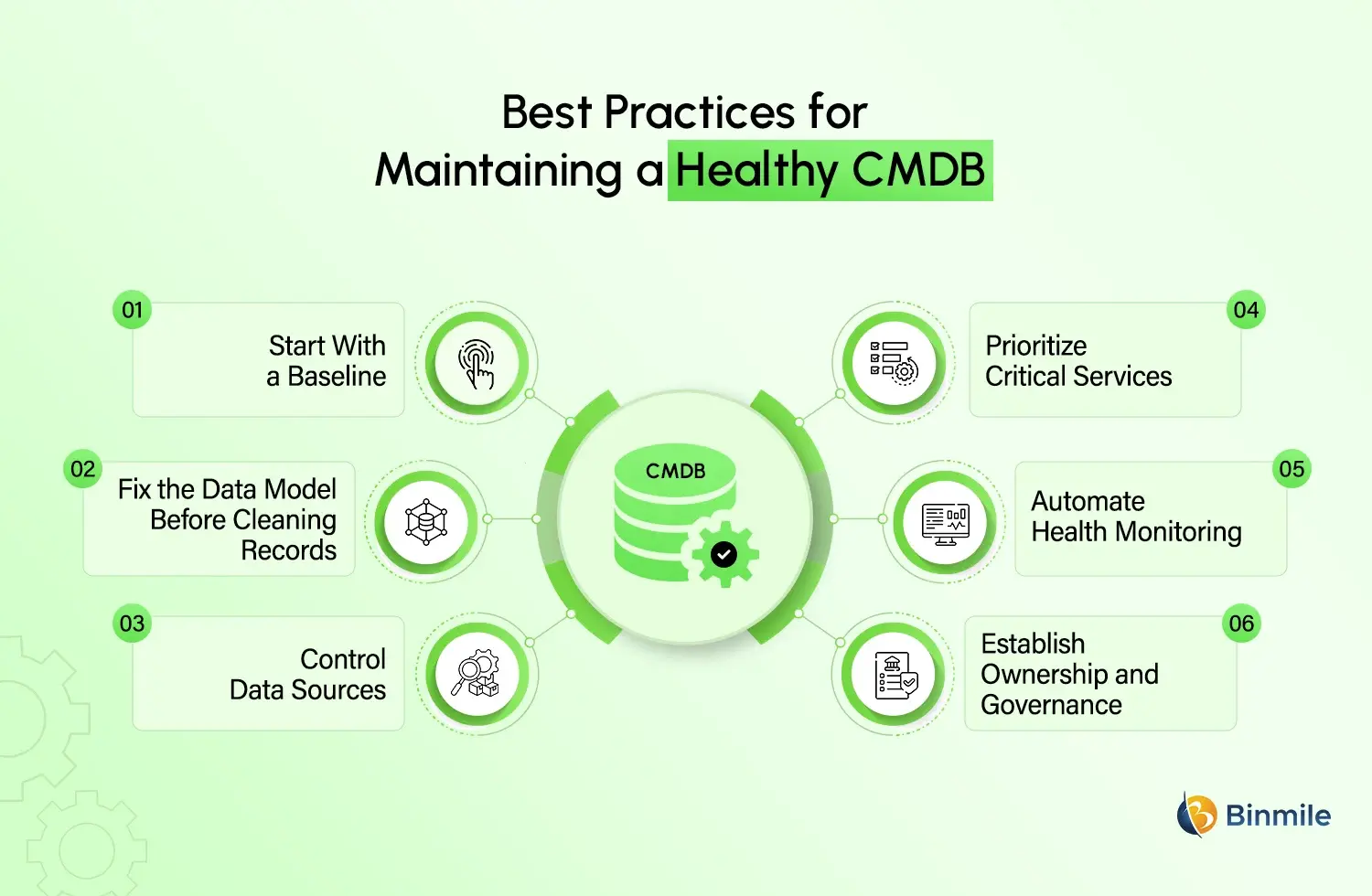
Improving CMDB health is rarely about fixing everything at once. A practical approach is to establish a baseline, identify the highest-impact issues, and then create a repeatable governance process.
-
Start With a Baseline
Review the current CMDB Health Score and the individual KPI results. Look beyond the overall percentage and identify which classes, services, data sources, and metrics are creating the largest gaps.
-
Fix the Data Model Before Cleaning Records
If the underlying CMDB structure does not reflect the organization’s services and configuration relationships, cleaning individual records will only provide temporary improvement.
Alignment with CSDM and clearly defined CI classes can create a stronger foundation for long-term management.
-
Control Data Sources
Multiple systems may contribute information to the CMDB, including Discovery, cloud platforms, endpoint management systems, integrations, and imports.
Without appropriate identification and reconciliation controls, these sources can create duplicate or conflicting records. ServiceNow’s IRE helps process and reconcile CI information, making source governance an important part of CMDB management.
-
Prioritize Critical Services
Not every CI carries the same business importance.
A practical remediation strategy starts with CIs supporting critical business services. Fixing the data associated with those services can deliver more immediate operational value than attempting to clean every record simultaneously.
-
Automate Health Monitoring
Manual CMDB reviews cannot keep pace with rapidly changing infrastructure.
Scheduled health evaluations, dashboards, discovery processes, and remediation workflows can help identify issues continuously. ServiceNow also provides configurable health settings and scheduled jobs for CMDB Health evaluations.
-
Establish Ownership and Governance
Someone must be responsible for the accuracy of configuration data.
Clear ownership, certification processes, data standards, regular KPI reviews, and defined remediation responsibilities help prevent the CMDB from returning to the same state after a cleanup exercise.
Is poor CMDB data making it harder to maintain ITOM visibility, generate reliable reports, and manage service dependencies?

What Are the Common Mistakes That Reduce CMDB Health
Several problems repeatedly undermine CMDB initiatives.
-
Treating the CMDB as a Static Database
IT environments constantly change with cloud infrastructure, SaaS applications, containers, and distributed systems. Without regular updates and monitoring, CMDB data can quickly become outdated.
-
Focusing Only on Completeness
A fully populated CI is not necessarily accurate. Organizations also need to check for stale, duplicate, incorrect, and inconsistent records.
-
Ignoring CI Relationships
A CMDB with thousands of CIs but weak relationships offers limited visibility. Accurate dependencies are essential for service mapping, impact analysis, and ITOM operations.
-
Chasing the Health Score
Improving the CMDB Health Score without fixing the processes causing data-quality issues only provides a temporary improvement. Duplicate records, stale CIs, and recurring data gaps need to be addressed at their source.
-
Lack of Ongoing Governance
CMDB health requires continuous monitoring, clear ownership, and regular remediation. The goal should be sustainable data quality, not simply a better dashboard number.
How ServiceNow CMDB Management Supports Long-Term IT Operations
Effective ServiceNow CMDB Management brings together data governance, discovery, reconciliation, relationship management, health monitoring, and continuous remediation.
It also needs to remain aligned with broader ServiceNow processes.
A well-planned ServiceNow implementation should consider CMDB architecture early rather than treating configuration management as something to be addressed after other modules are deployed. This becomes especially important when organizations are implementing ITOM, ITSM, SecOps, asset management, analytics, or AI capabilities that depend on configuration data.
The objective is not to create a perfect CMDB overnight. It is to create a CMDB that becomes increasingly accurate, useful, and governed as the environment evolves.
Ready to improve configuration data quality and build a stronger foundation for AI-driven operations?

How Binmile Can Help Strengthen ServiceNow CMDB Health
Maintaining CMDB health requires more than running dashboards and addressing individual data-quality alerts. It requires a combination of platform expertise, data governance, integration knowledge, and an understanding of how configuration information supports broader IT operations.
Binmile can help organizations assess existing CMDB structures, identify data quality gaps, improve CI relationships, strengthen reconciliation practices, and establish health monitoring aligned with business priorities. This can include supporting ServiceNow CMDB Management, ITOM initiatives, ServiceNow Implementation, and broader AI readiness programs where trusted configuration data plays an important role.
The focus remains on creating a CMDB that supports the organization’s actual operational needs rather than simply improving a percentage on a dashboard. With the right governance and remediation approach, CMDB Health can become an ongoing operating discipline that strengthens service visibility, reporting, automation, and future AI initiatives.
Frequently Asked Questions
ServiceNow CMDB Health evaluates configuration data for completeness, correctness, compliance, and relationship quality. It helps organizations identify inaccurate, missing, duplicate, stale, or non-compliant CIs before they affect IT operations.
CMDB Health improves ITOM by making configuration data more reliable for Discovery, Service Mapping, incident management, and change impact analysis. Accurate CI relationships help teams understand infrastructure dependencies and identify affected services faster.
Reliable AI and reporting require trustworthy enterprise data. CMDB Health helps identify missing, stale, duplicate, or inaccurate configuration records, creating a stronger data foundation for analytics, automation, AI-assisted operations, and consistent operational reporting.
The core ServiceNow CMDB Health metrics cover completeness, correctness, and compliance. Correctness includes areas such as duplicate, orphan, and stale CIs, while relationship health evaluates issues such as duplicate and orphan relationships.
Businesses can establish a baseline, improve their data model, govern data sources, tune identification and reconciliation rules, close Discovery gaps, remediate critical CIs, monitor CMDB Health dashboards, and maintain continuous ownership and governance.