Salespeople do far more than talk to prospects. They research accounts, qualify leads, chase replies, book meetings, update CRM records, and check which opportunities need attention next. When that work starts piling up, selling can become a surprisingly administrative job. AI is changing that balance. According to Salesforce, 89% of sales teams in India have already implemented or are experimenting with AI, while another 10% are evaluating it.
An AI sales agent takes automation a step further by handling parts of a sales workflow on its own. It can look at customer information, understand the situation, decide what action is appropriate, and use connected systems to carry it out. The important part is that the business decides how much freedom the agent gets. This guide explains what an AI sales agent does, where it can be useful, how to build one, what affects its cost, and when buying an existing solution may make more sense.
What Is an AI Sales Agent?
An AI sales agent is software that can manage specific sales activities using AI, business information, and connected tools. A company might use one to research prospects, qualify leads, send follow-ups, schedule meetings, or keep CRM records updated.
The difference from traditional automation comes down to how the system handles information.
A rule-based workflow might send an email whenever someone downloads a whitepaper. An AI sales agent can consider several things before deciding what happens next. It may look at the person’s company, role, previous interactions, website activity, and current position in the sales funnel.
That does not mean the agent should be allowed to make every sales decision. Its access can be limited by permissions, approval rules, and escalation conditions. For example, it could qualify an inbound lead independently but hand pricing discussions to a salesperson.
Depending on the use case, the same technology can work as an AI sales assistant, prospecting agent, qualification agent, or sales forecasting assistant, with AI Assistant Development helping businesses create assistants tailored to specific sales workflows.
How Does an AI Sales Agent Work?
The exact workflow depends on what the business wants the agent to accomplish. A prospecting agent will need different information from one handling customer follow-ups.
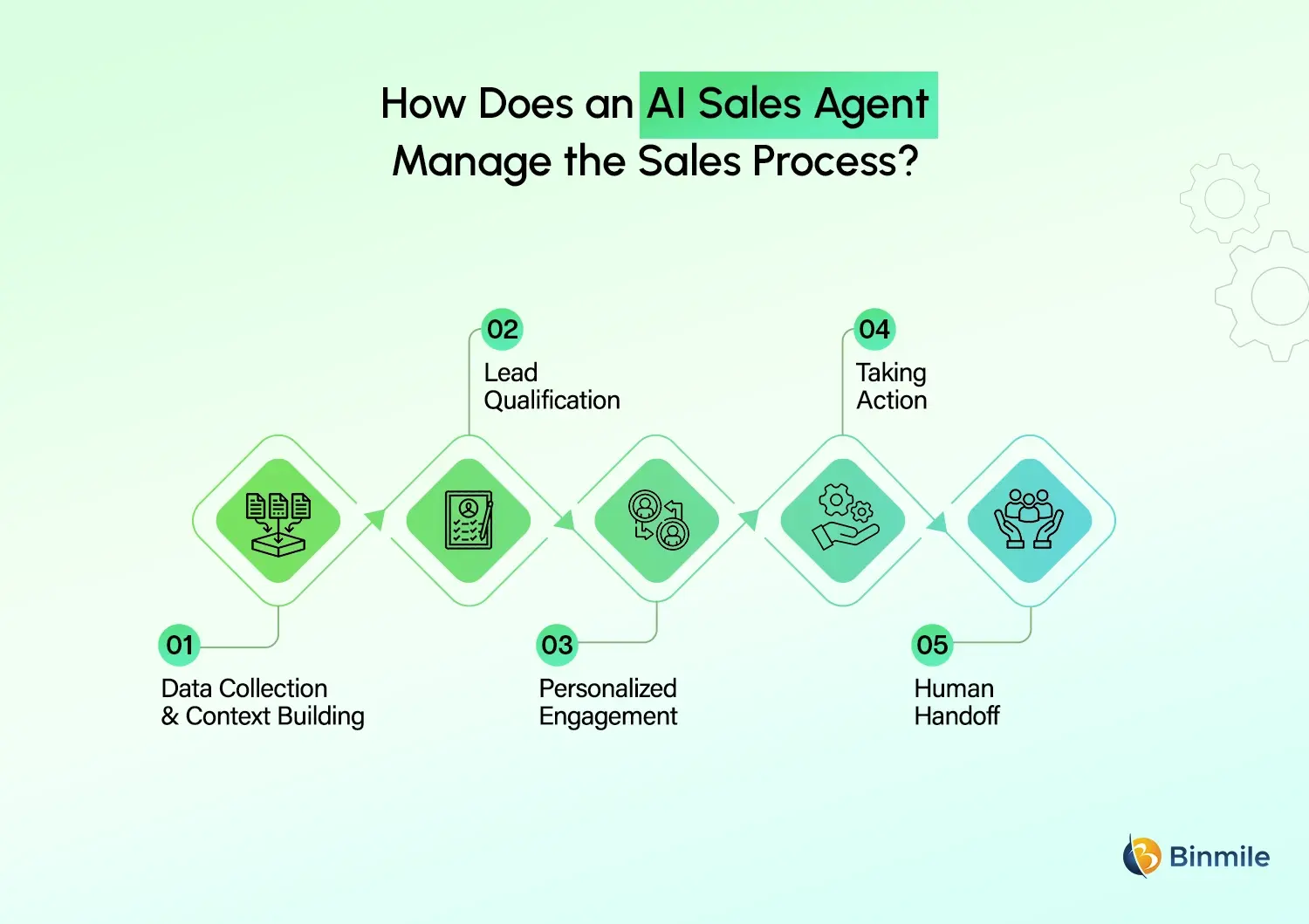
In most cases, the process begins with gathering context. The agent then works out what that information means, selects the appropriate tool or action, and either completes the task or passes it to a person.
-
Data Collection and Context Building
The agent can pull information from CRM records, emails, websites, customer conversations, product databases, and internal documents to understand the prospect and the situation.
-
Lead Qualification
It can compare a lead against the sales team’s criteria using information such as company profile, engagement, product interest, previous conversations, and buying signals.
-
Personalized Engagement
Rather than treating every prospect the same, the agent can use available customer information to prepare a relevant email, response, or follow-up.
-
Taking Action
With the right permissions, it can update records, assign leads, schedule meetings, send approved communications, or trigger another workflow.
-
Human Handoff
Some situations need a salesperson. Negotiations, sensitive questions, unusual requests, or high-value opportunities can be transferred to a person along with the context already collected.
AI Sales Agent vs AI Sales Assistant: What Is the Difference?
An AI sales assistant generally works for a salesperson. An AI sales agent can work through a defined sales process.
An assistant might summarize a call, draft an email, find information about an account, or suggest which prospects deserve attention. The salesperson decides what happens next.
An agent can take that process one step further. After identifying a suitable prospect, it might qualify the account, start an approved outreach sequence, follow up after a certain period, update the CRM, and arrange a meeting if the prospect responds positively.
| AI Sales Assistant | AI Sales Agent |
| Supports sales representatives | Handles defined sales workflows |
| Usually responds to instructions | Can work toward a set objective |
| Drafts emails and summaries | Can send approved communications |
| Provides recommendations | Can perform permitted actions |
| Often needs user approval | Can work with controlled autonomy |
| Supports individual productivity | Automates parts of the sales process |
The two approaches can work together. An agent can handle routine workflow steps while an assistant helps salespeople understand accounts and make better decisions.
What Can an AI Sales Agent Automate?
The best use cases are not necessarily the most complicated ones. Repetitive activities that involve customer information and follow a reasonably clear process are often a good starting point.
-
Lead Generation and Prospecting
Researching potential accounts can take longer than expected. An AI sales agent can find companies that match an ideal customer profile and collect relevant information before the sales team starts outreach.
Part of that groundwork often means figuring out how to find anyone’s email at a target company, so outreach does not stall at the research stage waiting on a verified contact
That gives representatives a more useful starting list and cuts down the time spent researching every account manually.
-
Lead Qualification and Scoring
Not every new lead deserves the same level of attention. An agent can review company details, engagement, product interest, previous interactions, and other buying signals before deciding where a lead belongs.
It might send a strong lead to a salesperson, place a weaker one into a nurture workflow, or flag an uncertain case for review.
-
Personalized Outreach
AI-powered sales agents can use information about a prospect’s company, role, previous conversations, and funnel stage when preparing outreach.
The objective is not simply to increase the number of emails sent. A smaller number of messages with useful context can be far more valuable than a large batch of generic outreach.
-
Meeting Scheduling
Once a prospect agrees to a call, the agent can check calendars, suggest available times, send the invitation, and update the relevant sales record. A salesperson no longer needs to coordinate every step manually.
-
CRM Management
CRM updates are important, but they are easy to postpone when a representative is busy with customers.
An agent can capture information from emails, calls, and other interactions and use it to update contact details, opportunity stages, notes, summaries, and follow-up tasks. This is one of the practical applications of AI in CRM because it addresses a routine problem without requiring the sales team to learn an entirely new process.
-
Sales Forecasting
AI sales forecasting can look at more than pipeline value. Historical performance, opportunity activity, customer engagement, and changes in deal status can provide additional signals for sales leaders.
It will not make uncertainty disappear, but it can give managers more information when assessing pipeline health and potential risks.
-
Post-Sales Engagement
The sales relationship often continues after the contract is signed. Depending on the business, an agent can help with renewal reminders, customer check-ins, cross-selling, upselling, and identifying accounts that may need attention. Similar capabilities are also used in AI Customer Service Agents to support customers after the sale.
What Are the Key Benefits of AI Sales Automation?
AI sales automation works best when it removes work that does not require a salesperson’s full attention. The goal is not to make every customer interaction automatic. It is to give representatives more time for the parts of selling where experience and judgment matter.
-
Faster Response Times
An agent can handle routine enquiries immediately, even when the sales team is unavailable. It can answer basic questions, collect initial information, and keep a prospect engaged until a representative needs to step in.
-
Better Lead Prioritization
A sales team may receive more leads than it can investigate properly. An agent can perform the first round of analysis and bring stronger opportunities to the team’s attention.
-
More Consistent Follow-Ups
Good opportunities can disappear simply because a follow-up was missed. An agent can keep track of pending actions and determine the next step based on the prospect’s response.
-
Reduced Administrative Work
Updating a CRM, writing a routine follow-up, preparing a meeting summary, or arranging a calendar invite may only take a few minutes. Across hundreds of opportunities, however, those minutes become hours.
-
Personalized Customer Experiences
Personalization is difficult to maintain when representatives manage large numbers of accounts. An agent can bring relevant customer information into the workflow so communication remains specific without requiring every message to be written from scratch.
-
Scalable Sales Operations
When lead volumes increase, manual effort does not have to increase at the same rate. AI agents can take care of routine work while salespeople focus on qualified opportunities.
Ready to turn repetitive sales processes into intelligent, automated workflows?

How to Build an AI Sales Agent
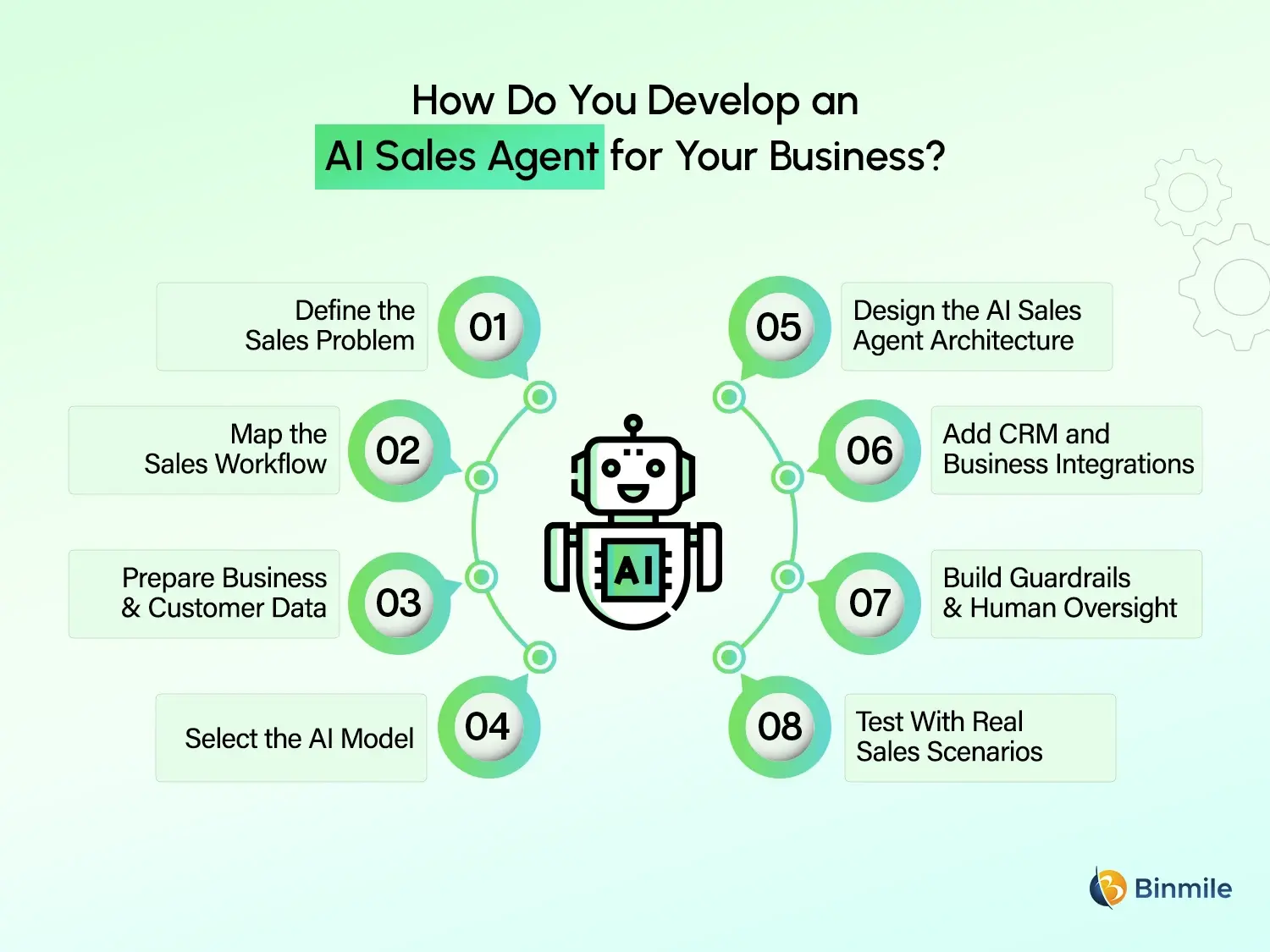
The starting point for AI sales agent development should be the sales problem, not the AI model. A business needs to know what it wants the agent to accomplish before deciding how the technology should work, or it can work with an AI development company to define the architecture and deployment approach.
-
Define the Sales Problem
Choose a specific problem first, such as lead qualification, prospecting, follow-ups, meeting scheduling, CRM updates, or sales forecasting.
-
Map the Sales Workflow
Document the existing process. Identify where information comes from, who makes decisions, which systems are updated, and when a salesperson needs to become involved.
-
Prepare Business and Customer Data
Give the agent access to information it actually needs. Depending on the use case, this could include CRM records, product details, FAQs, sales playbooks, customer conversations, pricing information, and company policies.
-
Select the AI Model
Model selection depends on the job. Consider reasoning ability, context requirements, response speed, tool-calling support, security, expected usage, and cost rather than choosing a model simply because it is popular.
-
Design the AI Sales Agent Architecture
A typical AI sales agent architecture connects the model to the information and tools required to complete the workflow.
The AI orchestration layer manages the movement between these components. It helps determine what the agent needs, which tool should be used, and what action comes next.
-
Add CRM and Business Integrations
Salesforce, HubSpot, Microsoft Dynamics, email, calendars, marketing platforms, and customer support tools may all need to connect with the agent. These integrations allow an AI agent for sales to work within the systems the sales team already uses.
-
Build Guardrails and Human Oversight
Decide exactly what the agent is allowed to do. Sending an approved follow-up is very different from changing a commercial term or responding to a sensitive customer complaint. Permissions and approval rules should reflect that difference.
-
Test With Real Sales Scenarios
Testing should include the messy cases, not just the easy ones. Try incomplete records, conflicting information, unexpected questions, inactive prospects, pricing requests, failed integrations, and conversations that should be handed to a person.
How Much Does It Cost to Develop an AI Sales Agent?
There is no useful single price for AI sales agent development because the scope can vary enormously. A small agent that qualifies inbound leads is a different project from an enterprise system connected to CRM, email, calendars, analytics, and several sales workflows.
The major cost factors include the complexity of the workflow, number of integrations, AI model usage, customization, security, data requirements, and the interface needed by users. An agent working quietly in the backend will generally require less development than a complete sales platform with dashboards, analytics, user management, and conversation history.
The better way to estimate the budget is to start with the process being improved. For businesses that do not want to build and maintain the entire AI infrastructure themselves, Artificial Intelligence as a Service can also be considered as part of the implementation strategy. Once the required integrations, autonomy, security controls, and expected outcome are clear, the development scope becomes much easier to estimate.
Build or Buy an AI Sales Agent?
Buying an existing AI sales agent software platform is often sensible when the product already covers the team’s requirements. It can shorten the implementation period and avoid building capabilities that are already available.
Custom development becomes more attractive when the business has unusual workflows, proprietary data, complex integrations, specific security requirements, or needs tighter control over how the agent behaves.
| Consideration | Buy | Build |
| Deployment | Faster | Takes longer |
| Customization | Platform dependent | High |
| Integration Flexibility | Depends on vendor | Greater flexibility |
| Control | Vendor dependent | Greater control |
| Initial Investment | Usually lower | Usually higher |
| Unique Workflows | May require compromises | Built around the business |
| Governance | Vendor dependent | Can be customized |
A hybrid approach can work too. A company may use sales agent software for standard functions and develop custom components around the areas where its own process needs something different.
When comparing the best AI sales agent options, do not judge them only by the number of features on the product page. Integration, data handling, governance, customization, and the fit with the existing sales process are far more useful criteria.
What Are the Common Challenges in AI Sales Agent Implementation?
The difficult part of AI sales agent implementation is often what surrounds the model. Real sales environments have old CRM records, incomplete information, exceptions, changing processes, and several systems that were never designed to work together.
-
Poor Data Quality
If customer records are incomplete or outdated, the agent has a weak foundation to work from. Better prompts cannot compensate for information that is simply wrong.
-
Too Much Autonomy
An agent does not need access to every sales system just because it can technically connect to them. Its permissions should correspond to the tasks it has been assigned.
-
Generic Communication
An AI-generated message can be grammatically perfect and still sound like something no salesperson would send. Customer history, product knowledge, previous interactions, and brand guidelines give the agent the context needed to avoid this.
-
Weak CRM Integration
A disconnected agent creates another place for salespeople to check information. If representatives still have to copy updates manually into the CRM, a major part of the automation benefit disappears.
-
Lack of Monitoring
Sales workflows change. Qualification rules are updated, products evolve, pricing changes, and customer expectations shift. An agent that worked well six months ago may need new instructions or data today.
Need an intelligent AI sales agent to automate lead qualification, engagement, and sales workflows?

How Binmile Can Help With AI Sales Agent Development
An AI sales agent works best when the technology is built around an actual sales workflow. That means understanding the data involved, connecting the right systems, deciding where automation is useful, and setting sensible boundaries around autonomous actions.
Binmile develops custom AI sales agent solutions for use cases including lead qualification, personalized engagement, CRM software development, sales assistance, and intelligent forecasting. These solutions can be designed around existing business systems, helping organizations introduce AI without having to replace the technology their sales teams already depend on.
For organizations considering custom AI agent development, the focus is on creating practical workflows that reduce repetitive work while leaving important customer decisions in human hands.
Frequently Asked Questions
An AI sales agent is software that uses AI to perform sales tasks such as prospecting, lead qualification, personalized outreach, follow-ups, scheduling, and CRM updates. It uses business data and connected tools to complete defined workflows.
The cost depends on complexity, integrations, AI models, customization, security requirements, and expected usage. A basic agent costs considerably less than an enterprise solution with multiple systems, advanced workflows, and extensive governance.
Development timelines vary based on scope. A focused proof of concept can be developed relatively quickly, while a production-ready enterprise AI sales agent with CRM integrations, security, testing, analytics, and custom workflows requires substantially more development time.
AI sales agents typically use large language models, machine learning, APIs, databases, vector search, orchestration frameworks, cloud infrastructure, and CRM integrations. Technologies are selected according to the agent’s workflow, security, scalability, and business requirements.
Yes. AI sales agents can integrate with Salesforce, HubSpot, and other CRM platforms through APIs, webhooks, and supported connectors. These integrations allow agents to access customer information, update records, manage leads, and trigger sales workflows.
An AI sales agent can automate prospect research, lead qualification, personalized outreach, follow-ups, appointment scheduling, CRM updates, sales assistance, pipeline monitoring, forecasting support, and selected customer engagement activities.
Buying is often faster when existing features match your workflow. Building can be better when you need unique processes, proprietary data, complex integrations, stronger control, or enterprise-specific security and governance. Hybrid approaches can also work well.