The process of building business applications has transformed big time in the past few years. Many companies are ditching rigid techniques and embracing more adaptable ones to encourage creativity and faster turnarounds. This shift is clearly visible in the widespread adoption of DevOps and Agile methodologies. These approaches improve development team productivity by enabling more efficient workflows. The POD model extends the principles of DevOps and continues to gain popularity worldwide. It enhances efficiency by dividing large development teams into smaller, self-sufficient groups that can operate more effectively.
In this blog, we will shed light on the PODs business model, its benefits, and how to implement it across your organization. Let’s explore it in detail:
What Does POD Mean in Software Development?
POD stands for “Product-Oriented Delivery”, a software development strategy that focuses on creating small cross-functional teams. These teams take responsibility for specific project requirements or tasks. Each POD team contributes to product ideation, development, testing, and operations. This collaborative approach makes the POD model highly self-sufficient and capable of delivering end-to-end outcomes efficiently.
The POD model is based on Agile methodology, which promotes breaking large projects into smaller sprints. This approach helps teams deliver customer requirements more effectively and incrementally. The DevOps model extends Agile methods by combining development and operations functions. This integration improves efficiency and reduces the likelihood of deployment-related issues and bugs
In fact, as per Gartner, 85% of businesses have adopted or plan to adopt a POD model soon. In this product engineering and team management model, a POD team typically consists of four to ten members. The team includes skilled engineers and a dedicated POD leader. This structure helps maintain agility, collaboration, and efficient project execution.
The Ideal POD Structure and Framework
A co-located, multi-disciplinary Agile team helps organizations achieve higher efficiency and collaboration. An ideal team includes frontend and backend engineers, designers, quality engineers, and DevOps specialists. An architect typically supports the team and serves as the product owner.
A POD software team also brings expertise in specialized areas such as UI development, microservices, cloud-native technologies, AI and machine learning, and DevSecOps. Additionally, it leverages reusable solution accelerators and modern development tools. These capabilities help improve productivity, accelerate delivery, and enhance product quality.

The best traits of a POD team include result-oriented product development with adherence to Agile principles. Just so you know, PODs are self-organizing teams with a product engineering mindset that prioritizes people and communication. They are instructed to apply cutting-edge product engineering practices while paying attention to non-functional expectations.
Top 6 Benefits of the POD Model You Must Know
POD in business works best when your project requirements are complicated to define. Binmile PODs match flexibility and collaboration to let you experience the benefits of this business model that you might not have experienced yet. For instance, you can expect a POD-driven model to provide you with:
1. Improved Focus
The team deployed to POD software development delivers more productivity when they are focused on only a few tasks, goals, or a large project at a time. This dedicated nature prevents them from doing multiple things simultaneously, which may hinder them from giving sufficient time to each task.
2. Increased Flexibility
Flexibility is a core principle of all Agile teams, including those structured under the POD model in business. These squads of team members are structured to quickly respond to modifications in project requirements, market conditions, or client feedback.
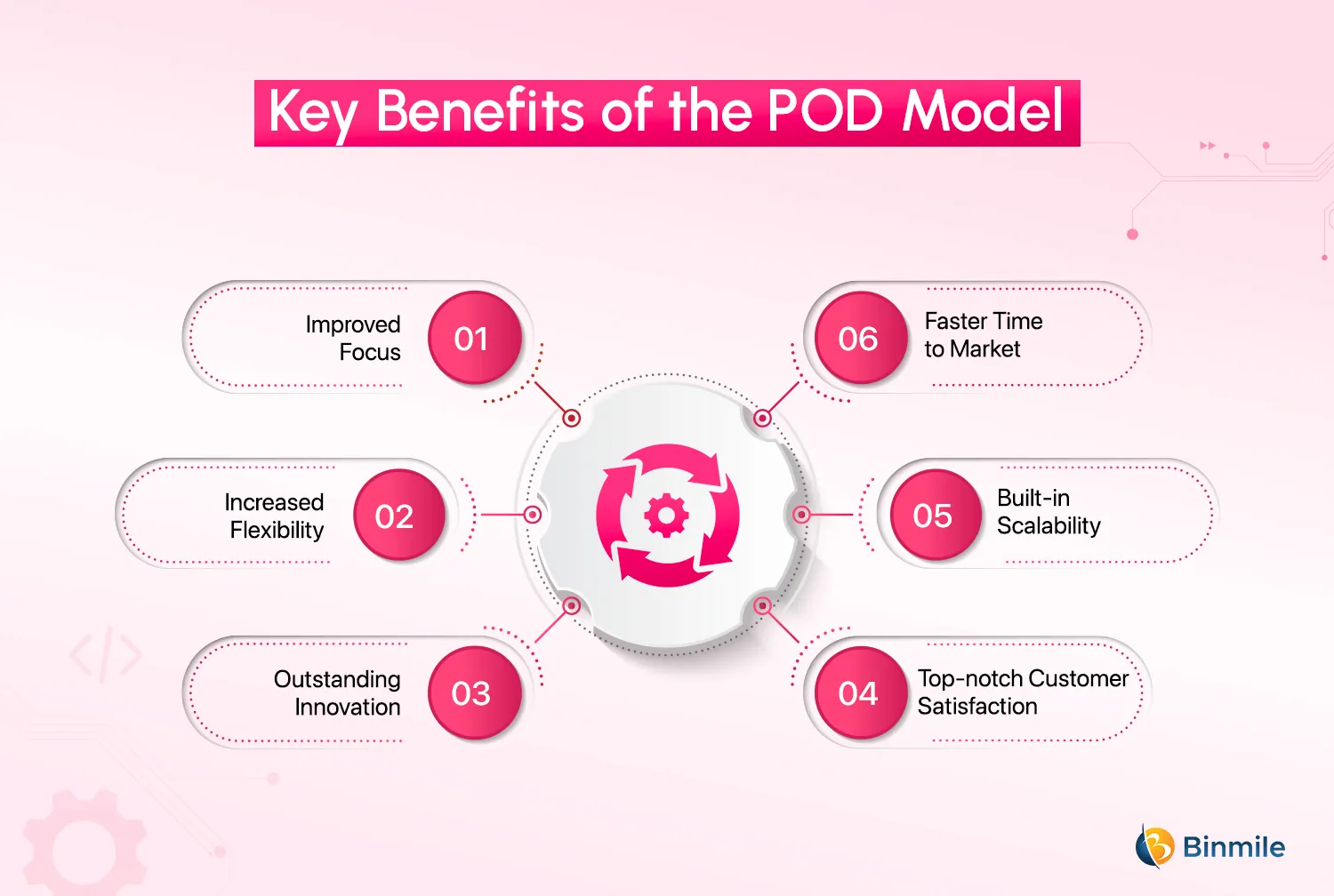
3. Outstanding Innovation
A product owner is responsible for prioritizing work in an Agile POD when working in a Product-oriented Delivery ecosystem. The horizontal hierarchy of a POD in Agile fosters extreme collaborative efforts, with team members motivated to recommend and experiment with new ideas.
4. Top-notch Customer Satisfaction
The team formed for product development services entails stakeholders, including customers, in the development process to take into account their feedback for changes. By leveraging a direct line of communication, the final product is developed so well that it lives up to the expectations of its target users.
5. Built-in Scalability
While every POD can run independently on various aspects of a project, such a POD model is scalable to a great extent. Businesses can increase or decrease the number of PODs based on project size and complexity without any major disruption in workflow or productivity.
6. Faster Time to Market
Last but not least, the smooth development cycles of Agile PODs, supported by a top software development company, result in a faster time to market owing to their continuous integration and delivery of new functionalities.
What else? According to a new study published on a global media company’s website, Forbes, the adoption of agile has increased from 37% to 86% for software development teams. And since work has become more unpredictable and volatile these days, ensuring high speed and flexibility in the process is key to success down the line.
How can the POD model improve teamwork and speed up results? Discover its impact on your business today!
PODs Business Model: When and Where to Apply?
There are many scenarios for which you need to hire a software engineer for POD model development. Here is a list that you must check out:
-
Complex Projects
The project needs changes over time, a bite-sized Agile team, such as POD, is the best option to allow swift pivots, especially when the project encompasses various disciplines or technologies.
-
Startups and Scale-ups
For startups and growing organizations that want to respond quickly to market feedback, the agility of the POD software team expedites product development cycles and matches the speed.
-
Fast-paced Industries
With their ability to swiftly adapt and innovate, PODs are extremely required in areas where market demands and technology evolve quickly, like eCommerce, healthcare, fintech, and digital services.
-
R&D Innovation
The interdisciplinary approach of POD teams fits the bill of any project with innovative support, as squads of a leading MVP development company are encouraged to address challenges creatively.
-
Distributed Operations
When teams are distributed across multiple locations, an Agile POD structure can help them work independently while staying aligned with the objectives of the organization.
Is Implementing POD in Business the Right Decision?
The POD model is highly advantageous for companies that value agility, have a clear vision yet flexible project scope, and are ready to invest in creating a versatile and skilled workforce. It suits the ecosystem where speed and innovation are key to success.
Determining team strategy is important in evaluating if the POD model aligns with the goals and capabilities of a company. However, startups or organizations with limited resources may find the POD’s operational cost difficult to justify for their software development projects.
How Binmile Implements the POD Model for Clients: A Step-by-Step Process
1: Evaluating Client Needs
We work with our clients to gauge their existing infrastructure, organizational culture, and processes, including their team skill sets and dynamics. Performing this assessment helps decide their preparation for Agile PODs and assists us in customizing the POD model effectively.
2: Customizing Agile POD Design
Depending on the assessment, we create a tailored Agile POD strategy that aligns with the company’s goals, challenges, and project requirements. We choose the right blend of skills for every POD team, decide their optimum size, and outline the team’s responsibilities.
3: Training & Specialized Coaching
Binmile also provides training and coaching facilities to equip clients’ teams with the essential Agile skills and mindset if needed. It includes Agile techniques, collaboration and interaction tools, and best practices for functioning within a POD team structure.
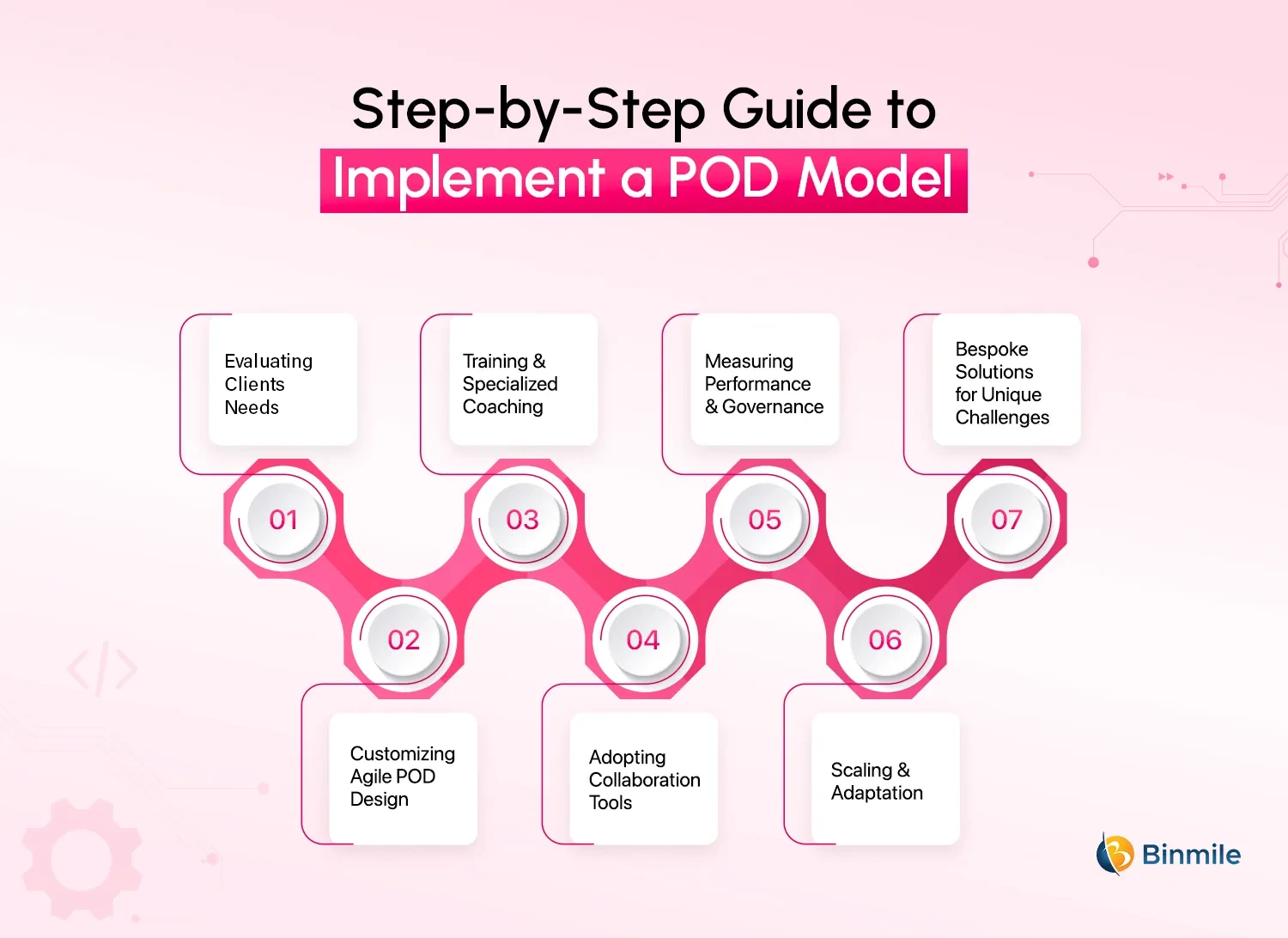
4: Adopting Collaboration Tools
Our clients get expert advice in choosing and implementing the correct collaboration tools, complete with project management solutions to simplify the movement from one place to another among POD software members and across various POD teams.
5: Measuring Performance & Governance
We help clients establish governance structures and performance metrics to track and measure the success of their Agile PODs. And this includes well-defined KPIs, creating reporting systems, and daily review and feedback mechanisms.
6: Scaling & Adaptation
Our experts also offer help in scaling the POD model up or down depending on project demands and results. This comprises guidance on changing team compositions, processes, and tools as clients get deeper insights into what works best for their business.
7: Bespoke Solutions for Unique Challenges
We grasp the specific challenges clients experience in applying Agile PODs. Our customized solutions, consultancy, and support resolve these issues for a seamless, successful transformation to the POD model.
Struggling with slow development? See how the POD model speeds up software delivery like never before with Binmile Team!
Best Practices to Follow for POD Definition Business
Irrespective of the POD model in use, there are a few best practices that you must follow:
- Have at least one POD member in your team with domain skills and expertise, and create a plan to upskill the rest of the members
- Always ensure alignment with consumer-used productivity tools
- Every POD should support polyglot programming (the practice of writing software using multiple programming languages), and each POD
- A member should learn one main and at least one trivial language or technology.
- When setting up the POD team and the infrastructure, ensure not to compromise on the dev environment.
- Prioritize fixing any infrastructure issues and always keep an eye on NFRs (Non-functional requirements)
Be informed that even the best-laid plan can go haywire, but a team with the right set of skills and clear goals can help overcome any obstacles. PODs are the best solution to deal with such challenges. They are in high demand, can scale, and can be the differentiator between a good and a great product. The priority should be to build the right foundation for PODs, factoring in both domain and technology. Give equal importance to both the tech and soft skills of the POD software team to create a powerful agile culture with a product mindset.
Also Read: How to Scale Engineering Teams
How Walmart Introduced POD Technology Across Its Organization?
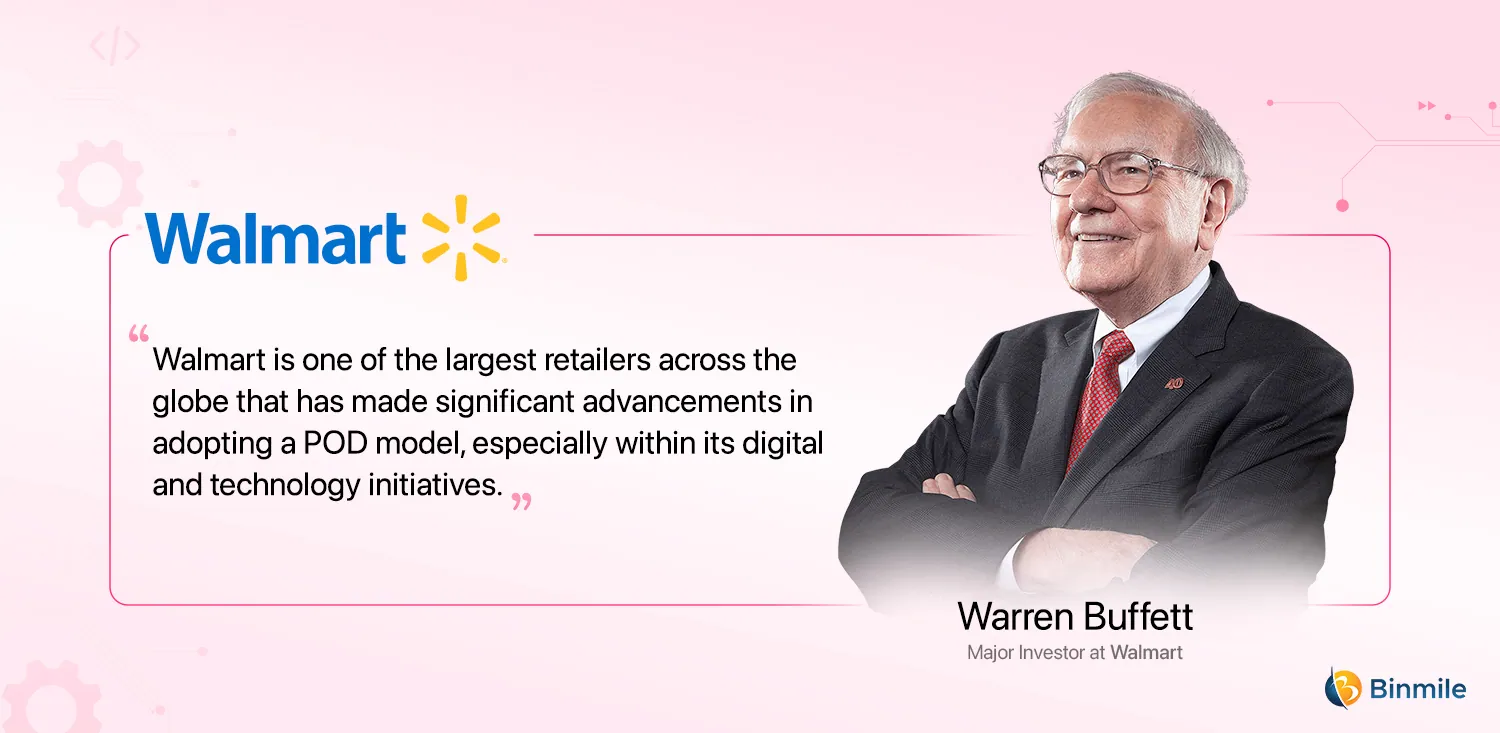
Walmart is one of the largest retailers across the globe that has made significant advancements in adopting a POD model, especially within its digital and technology initiatives. Although the brand is traditionally known for its operations and supply chain expertise, it has invested heavily in technology and product development, strategically restructuring its business model to support such new focal points.
1: Business Structure
Walmart’s business structure has evolved significantly over time. It has moved from a purely operations-driven model to one that places strong emphasis on technology and product development. This shift has enabled the company to drive innovation and improve customer experiences. The biggest sign of this transition is the setup of Walmart Labs, the tech-focused subsidiary of the company. This Lab operates semi-autonomously, working more like a tech startup than a traditional retail unit. It is structured around cross-functional teams comprising engineers, product managers, data scientists, and designers. These POD software teams are focused on developing, testing, and tweaking digital products to improve retail operations and customer experiences at Walmart.
2: Innovation & Product Development
Every digital initiative at Walmart Labs is considered a product. Teams skilled in software development models work on a wide range of digital products, like Walmart applications, grocery pickup & delivery services, in-store technology, and eCommerce sites. They rely on a consumer-focused, iterative approach to product development, often making the most of agile methodologies to rapidly test and refine their work by taking inspiration from customer feedback and data-driven insights.
3: Data as a Product
Another important aspect of Walmart’s transformation towards a POD model is its innovative use of data. Data is considered a product, with dedicated teams accountable for its gathering, analysis, and application. This allows Walmart to obtain valuable insights and inform strategic decision-making, from personalizing buyer experiences to enhancing supply chain operations.
4: Integration with Traditional Retail Operations
Although Walmart Labs operates with a great degree of freedom, it is not separated from other Walmart operations. There is a robust feedback loop and partnership with the traditional retail units. This makes sure that the virtual products created by Walmart Labs, following a proper software development process are completely aligned with the comprehensive organizational strategy, and can effectively support and improve Walmart’s retail operations.
All in all, Walmart’s transformation with the development of the POD model is evident in its business structure, especially within Walmart Labs. The focus on technology, data, and product development lets Walmart innovate, enhance consumer experiences, and maintain its competitive edge in the quickly evolving retail environment.
Conclusion
Now that you have understood the entire model, you must have grasped the usefulness of the POD model in product engineering. Leverage faster time to market, improved collaboration, better accountability, and enhanced quality by adopting it. Investing in this model is an effective choice for businesses seeking a flexible, scalable, and adaptable development approach. It combines cross-functional teams with Agile methodologies to improve project execution. This enables organizations to build high-quality products that align with customer and stakeholder expectations.
To get started, businesses can consult a software development team for startups and share their project requirements. With the right expertise and approach, teams can deliver a robust application within a few months
Frequently Asked Questions
The POD model in IT services involves creating small, independent teams tailored to the specific needs of a project or product. Each POD functions like a mini-startup within the larger organization, with clearly defined goals, metrics, and responsibilities. By leveraging the POD IT services model, companies can better manage workloads, reduce dependencies, and ensure consistent progress through agile methodologies. It allows for more transparency, faster problem resolution, and a customer-focused approach to delivery.
The Agile POD delivery model takes agile principles a step further by embedding full ownership within each team. While traditional agile teams may focus on specific tasks or modules, PODs are designed around complete business outcomes. Each POD is autonomous, empowered to make decisions, and capable of handling everything from planning and development to testing and deployment. This minimizes dependencies, shortens feedback loops, and fosters a culture of continuous improvement.
The POD development model is ideal when:
-
Your project demands rapid, incremental releases
-
You need specialized expertise for niche components
-
You aim to scale your teams without compromising agility
-
You’re developing complex products that need focused attention
-
You want to reduce time-to-market and increase responsiveness to change
This model works exceptionally well for long-term product development and evolving digital transformation goals.
Absolutely. Many organizations opt to outsource POD teams to experienced technology partners or software development companies. This allows access to a global talent pool, industry-specific expertise, and agile best practices, all without the challenges of in-house hiring. Outsourcing PODs offers flexibility, scalability, and reduced operational overhead, making it a smart move for companies looking to innovate at speed while staying focused on their core business.
The POD model in Agile refers to organizing cross-functional teams, or “PODs,” to handle end-to-end delivery of specific features or product components. Each pod operates autonomously, with clearly defined roles, shared responsibilities, and a strong focus on collaboration and accountability. This model supports Agile principles by promoting iterative development, continuous feedback, and faster time-to-market.