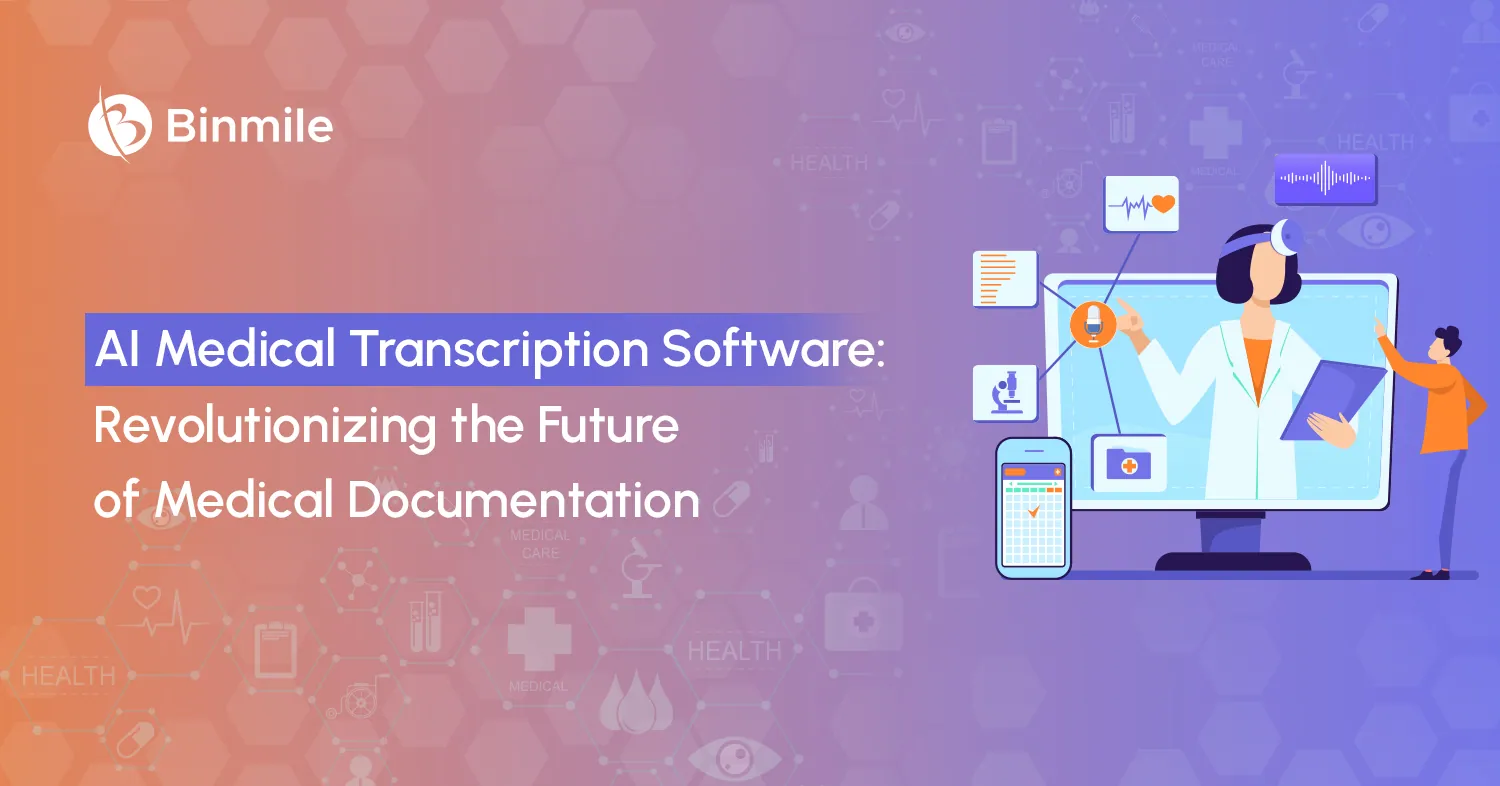
Technology has reshaped clinical documentation, shifting it from paper-based to electronic health records (EHRs are an online database used by clinicians to store and access patient information). While EHRs have made it easier for healthcare professionals to access patient data with greater accuracy of healthcare records, they have also introduced new challenges. Administrative tasks, such as data entry and record management, are time-consuming and expensive, and frequently divert medical specialists from their primary focus: patient care. Additionally, keeping up with evolving medical terminology and ensuring compliance with legal and insurance requirements further complicates the process. However, AI transcription software offers promising solutions.
However, AI-based transcription software tools offer promising solutions. Artificial intelligence is making a significant impact in healthcare by streamlining administrative tasks, particularly in the transcription process. These AI tools enable faster and more accurate transcription, reducing the potential for human error and freeing up valuable time for providers to focus on patient care. So what is AI medical transcription software? In this blog, we will explore how AI medical transcription software is transforming the healthcare industry, enhancing efficiency, and improving patient outcomes. We will also discuss the challenges and opportunities healthcare professionals should consider to effectively leverage AI in the medical field.
7 Key Insights of AI Innovations in Medical Transcription Software
These AI-powered scribe software are trained to recognize medical speech and terms and convert them into written text for the person who speaks to them. It does so by leveraging advanced speech recognition and natural language processing that capture, understand, and later process all the medical terms and/or patient information. It has brought a transformative impact on the process of converting audio recordings of physician-patient interactions into written text, making it more accurate, faster, and more. So, let’s explore this transformative journey and the immense potential of AI in the medical field.
1. Enhanced Accuracy via Natural Language Processing
By utilizing AI innovations such as NLP transcription systems, we are significantly improving accuracy in medical documentation. These systems can handle a variety of tasks that traditional transcription methods cannot. They accurately understand medical terminology and significantly reduce the risk of medical errors caused by manual transcription mistakes.
Additionally, these systems can recognize contextual nuances in clinical conversations and differentiate between similar-sounding medical terms. This enables them to accurately capture every detail. Furthermore, these systems can adapt to individual physician speech patterns and accents, further enhancing transcription accuracy.
2. Real-Time Transcription and Documentation
With its capabilities to provide real-time transcription during medical consultations and intelligent systems that convert spoken words into written text instantly, these allow physicians to generate preliminary medical notes during patient interactions. This real-time capability ensures prompt documentation and enables healthcare professionals to review and edit documents immediately.
Moreover, when integrated with EHR systems, AI transcription saves valuable time for healthcare providers and ensures that documentation is both accurate and up-to-date, enhancing the overall efficiency of patient care.
3. Advanced Speech Recognition and Context Understanding
Modern AI transcription systems offer far more than basic speech-to-text capabilities. These advanced tools understand the specific context of medical conversations and accurately transcribe specialized medical terminology. They can distinguish between multiple speakers in a conversation, which is crucial in group consultations or multi-participant discussions.
Additionally, AI transcription systems can recognize and correctly transcribe medical abbreviations and acronyms, ensuring precise documentation. By adapting to various medical specialties and their unique vocabularies, AI transcription can produce more accurate and meaningful documentation, benefiting both physicians and patients.

4. Predictive Analytics and Proactive Healthcare Insights
AI transcription software is capable of offering predictive analytics in healthcare; it is done when the software can analyze conversation patterns during patient-physician interactions. This later helps in identifying potential health risks and generating early warning signals for complex medical conditions. These tools can also extract subtle health indicators from dialogues, providing valuable insights that support personalized preventive care.
In addition, AI transcription can assist in clinical decision-making by interpreting data and offering contextual insights, transforming transcription from a passive recording process into an active contributor to healthcare intelligence.
5. Seamless Integration with Emerging Medical Technologies
It can directly interface with telemedicine platforms such as mHealthcare applications, remote patient monitoring tools, clinical decision support systems, or even voice-activated assistants, thus enhancing remote consultations by transcribing conversations in real time. Thus, offering interoperability across different healthcare IT ecosystems leads to enhanced real-time documentation and accuracy, reducing administrative burdens for healthcare professionals and improving decision-making and patient care.
These advanced tools understand the specific context of medical conversations and accurately transcribe specialized medical terminology.
6. Voice-enabled Transcription and Editing
These two technologies are offering significant time-saving benefits for medical professionals, as this AI-powered medical transcription software offers hands-free transcription. Therefore, physicians and healthcare workers can dictate notes directly into the system and eliminate the need for manual typing. This also allows them to modify transcribed documents rapidly and efficiently. This functionality improves productivity and streamlines the transcription process, thus reducing the administrative burden on healthcare providers and allowing them to focus more on patient care and clinical decision-making.
7. Multilingual Support and Global Accessibility
With multilingual communication, AI-based medical transcription software is enabling the accessibility of healthcare by supporting. This software can automatically translate medical conversations and support a wide range of languages and dialects while ensuring that medical terminology is preserved across language translations.
Such capability is particularly important in diverse healthcare settings, where physicians and patients may speak different languages. Therefore, AI transcription minimizes communication barriers, improves care for multilingual patient populations, and facilitates better health outcomes across global healthcare environments.
Empower healthcare efficiency and revolutionize your medical services with advanced AI development solutions.

Challenges and Opportunities of AI Innovations in Medical Transcription Software
Undoubtedly, artificial intelligence (AI) is revolutionizing the field of medical transcription, offering tons of advantages. The primary role is automating the process of converting spoken medical language into written text, which leads to increased efficiency and allows healthcare professionals to focus on patient care rather than administrative tasks. Additionally, AI-powered transcription software can improve accuracy by recognizing and interpreting complex medical terminology, reducing the risk of errors in medical records. That is the reason there is a growing demand for EHRs, which is propelling the adoption of AI-based medical transcription software. The market size is expected to surpass $3.05 billion valued in 2024 and reach a valuation of around $9.19 billion by 2031.
While AI offers immense potential, there are challenges to consider. As medical records contain sensitive patient information, medical professionals must ensure data privacy and security. Moreover, AI algorithms are trained on diverse datasets, so AI development companies must ensure that the input is without any biases and can interpret, process, and accurately convert voice to text in different languages, tones, or dialects. However, with careful consideration and implementation, AI can unlock new opportunities in medical transcription, leading to improved patient care and more efficient healthcare systems.
Tap into the booming medical transcription market, projected to grow from $3.05 billion in 2024 to $9.19 billion by 2031, with our advanced AI solutions for the healthcare industry!
Conclusion
The advent of advanced technology has brought in a massive shift in how clinical documentation has shifted from manual transcription to dictation software to finally AI medical transcription software. Not only has AI helped in automating the process, but it also saves time and improves accuracy. However, to successfully utilize the benefits, healthcare professionals and service providers need the expertise of AI development companies with solid experience.
This is where our applied AI services company can help you out. Our AI experts are highly trained and excel at building top-notch custom software solutions using cutting-edge technologies such as AR/VR, IoT, and, of course, AI/ML. We drive on our client-centric approach and commitment to providing the best in the industry customer experience, combined with our technological prowess, which sets us apart from all the other healthcare software development service providers in the market. So, let us empower you to leverage AI in the medical field.
Frequently Asked Questions
AI-powered medical transcription software converts physician conversations into structured clinical notes in real time. This reduces manual documentation effort, improves accuracy, and helps healthcare professionals spend more time on patient care instead of paperwork.
Traditional documentation processes are time-consuming and prone to human errors. AI innovations help hospitals and clinics streamline workflows, accelerate record processing, and improve operational efficiency while maintaining compliance and data accuracy.
Yes. AI automates repetitive documentation tasks such as note creation, data entry, and record management. This minimizes clinician burnout, speeds up workflows, and allows medical staff to focus on higher-value patient interactions.
Modern AI transcription platforms are built with advanced security protocols, encryption, and HIPAA-compliant frameworks. This ensures sensitive patient data remains protected while enabling secure and efficient medical documentation workflows.
Faster and more accurate documentation enables healthcare providers to access patient records quickly and make informed decisions in less time. This improves treatment quality, reduces delays, and creates a smoother patient experience overall.