Organizations depend a lot on technology to promote efficiency and continuously maintain IT applications, systems, and related infrastructure. They implement a variety of strategies to keep a balance between innovation and growth while keeping on top of the day-to-day activities. Despite that, at times, IT teams do not have the visibility and control required to understand how their services are performing. Without that insight, it becomes difficult for businesses to correct the issues or improve the affected area. They need a consolidated and integrated IT foundation that provides real-time insights and automation across every element of their IT services. Enter ServiceNow IT Operations Management (ITOM) and IT Service Management (ITSM).
These two become a crucial enabler that helps businesses deliver IT services. They are both similar and distinct in several ways and also complement one another to optimize service workflows when combined. Businesses must understand the platforms, their features, and their differences to fully harness their capabilities. In this blog, we will explore the scope of service management and operations management within an organization. In addition, we will share what advantages you get when you integrate both of them.
Getting Started with ITSM and ITOM ServiceNow: An Overview
IT Service Management (ITSM)
It refers to adopting a strategic approach that helps organizations manage and deliver IT services to their end-users more effectively and cost-efficiently. ITSM consists of designing, delivering, managing, and other factors focusing on how to improve operations utilizing IT resources and facilities. With the help of ITSM software, businesses can entirely disburse activities and processes from service management to change management, problem and incident management, knowledge management, and software & hardware asset management.

IT Operations Management (ITOM)
The process lets organizations manage all technological components and application requirements. It incorporates management of applications, services, storage, networking, and connecting elements within an organization so that they meet the client’s and the organization’s needs and SLAs. ITOM ensures availability, performance, and efficiency within an organization’s services and processes.
The Synergy of ITOM & ITSM Helps You:
- Automate incident resolutions
- Pinpoint and isolate the root cause of incidents
- Prioritize response by impact and urgency
- Escalate incidents to the right teams
- Contextualize alert floods and business services impacted
- Integrate ticketing and communications bi-directionally
- Control and maintain the entire life cycle of IT assets, right from ServiceNow CMDB
- Optimize the allocation of resources to cut down on IT spend
Read More: Citizen Development With ServiceNow
Unlocking the Full Potential of ServiceNow: ITSM and ITOM Integration Strategies
We understand how both ITSM and ITOM help businesses create a solid yet flexible foundation for delivering modern, efficient IT services. So, imagine what these two can help you achieve when combined?! But how should you go about implementing ServiceNow modules? Let’s explore 5 effective steps you need to take to set your organization up for success.
1. Assess Integration Requirements
Start with assessing your integration needs before kick-starting the combining of these two. This incorporates understanding the key features of ITSM and ITOM and how they support your overall business aspirations. Identify the most critical processes, data, and workflows that demand synchronicity between ITSM and ITOM to increase operational efficiency and boost service delivery. Doing so will help you figure out capabilities plus functionalities that could be used to bridge any gaps and holistically solve integration needs.
2. Consider Utilizing CMDB
CMDB or configuration management database is a self-updating record of all the things and services in your IT environment. With it, your team can click on an individual user, item, or device and quickly see all related services and incident information, saving hours of investigation time. Leveraging ServiceNow’s Discovery feature, you can proactively search and update its records, meaning you will always be working from near-real-time, factual data, a fundamental requirement for any service desk. So, when you plan to combine ITOM and ITSM, all you need to do is start with a few network assets and services, and as it grows, your CMDB will create and maintain a single system of record that not only optimizes your ITSM capabilities but also supports them in working better together.
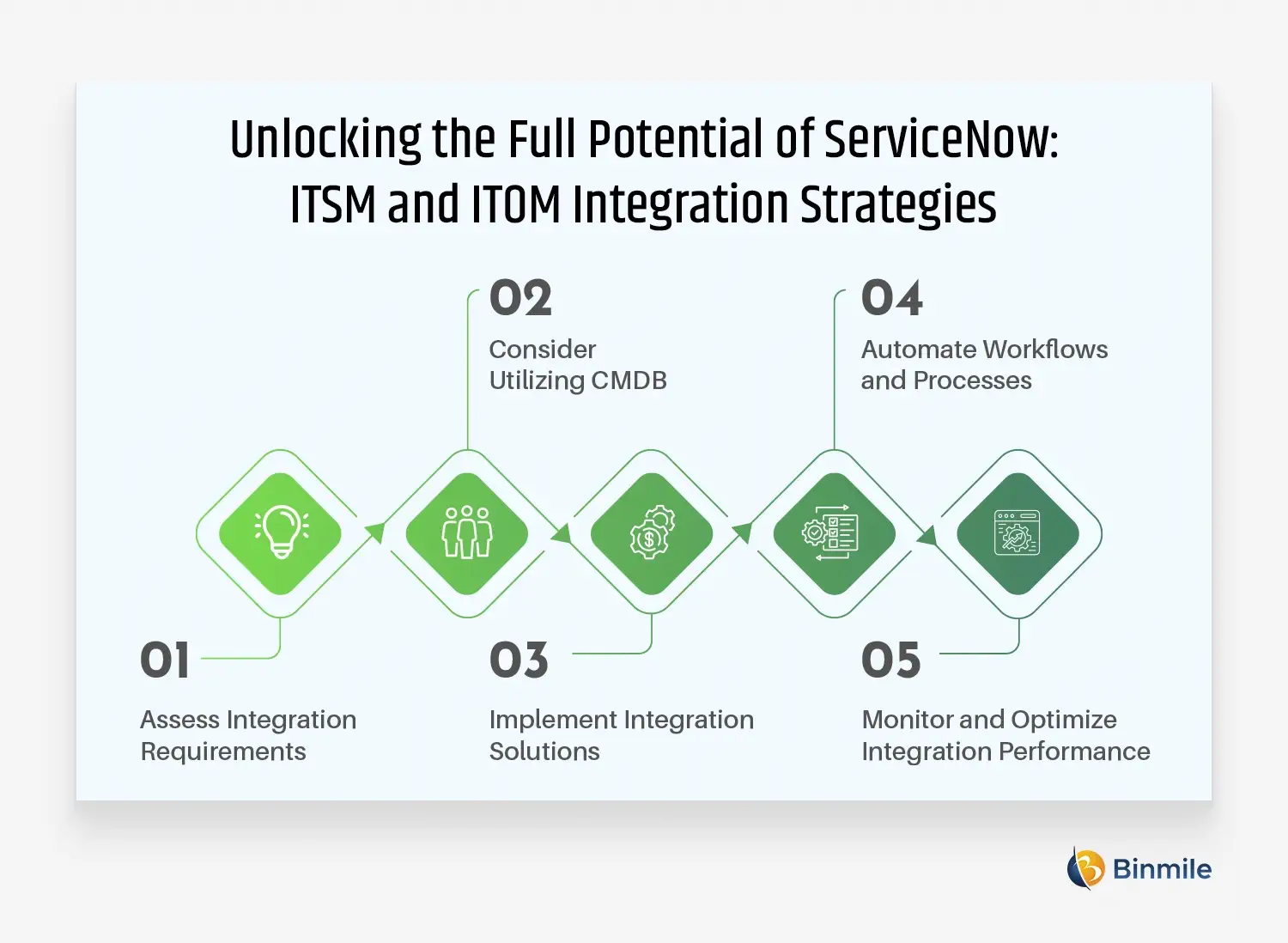
3. Implement Integration Solutions
Adopt the integration architecture by implementing custom integration solutions or leveraging the built-in connectivity between ServiceNow ITOM and ITSM modules. Define data mappings, transformation rules, and event triggers to enable real-time data exchange between the two systems. Test the complete integration in a controlled environment to ensure accurate data alignment, seamless interoperability, and strong security across the ITSM and ITOM setup.
4. Automate Workflows and Processes
Automation is a key feature to gauge the efficiency and effectiveness of operations both in ITSM and ITOM. Use ServiceNow automation facilities to eliminate various tasks, workflows, and processes that are repeated. Set up process automation rules and workflows for service provisioning, fault diagnosis, and change management using predefined conditions and triggers. Embed automated notifications, escalations, and approvals to support seamless collaboration between the ITSM and ITOM teams. This approach enhances overall operational efficiency and improves responsiveness.
5. Monitor and Optimize Integration Performance
Businesses must track the performance of the systems and optimize it wherever required. Devise rigorous monitoring systems that will actively collect data regarding the effectiveness and well-being status of the integration between the ITSM and the ITOM. Parameters such as data throughput, latency, error rates, and system uptime will help you spot possible deviations. This, in turn, will help you with system optimization, integration workflows, configurations, and resource allocations. The setup of periodical performance reviews and the adaptation of the integration processes remain the key factors for the effectiveness and successful integration.
Also Read: AI with ServiceNow
Ready to get started? Get in touch to know how we can help you make the most of ServiceNow’s capabilities to achieve your business goals!
Driving Business Success: 4 Benefits of Combining ITSM and ITOM in ServiceNow
Leveraging the benefit of combining IT Service Management (ITSM) and IT Operations Management (ITOM) does more than enhance business operations or help you deliver the best service to your employees. So, let’s discuss what else it can do for your business as well as your employees:
-
Increases Operational Efficiency
It enhances the visibility of the organization’s data center and IT assets and automates previously dispersed services and operations with real-time analysis. This enhances your IT team’s accountability and, in turn, increases operational efficiency.
-
Promotes Security
Both ITSM and ITOM offer robust security features that empower organizations to get complete access to assets, endpoints, and vulnerabilities, enabling multi-layered security and flawless resilience.
-
Faster Adaptability
Integration of ITSM & ITOM allows responding to changes faster and minimizing risks as it supports better coordination between the IT teams and systems.
-
Cost Savings
Leveraging automation and more effective resolutions by integrating ITSM and ITOM, you can cut down on major costs. How? Well, considering how costly recurring inefficiencies or downtime can be, ITSM and ITOM can help you get a significant return on investment with reduced disruptions.
Read Further: Expert Advice on ServiceNow ISTM
Conclusion
With the quickened pace of business requiring faster scaling, leaders and decision-makers must adapt and optimize their processes. To maintain a competitive edge, you need complete control and visibility into your IT infrastructure and resource performance. The technology landscape continues to evolve rapidly, pushing IT teams to work harder, smarter, and more efficiently. However, managing IT can become costly and time-consuming without streamlined processes and systems that support your business goals. How do you achieve this? By bringing together your operational and service IT management.
In this blog, we explained why combining ITOM and ITSM helps you resolve incidents faster, drive proactive innovation, and deliver the modern IT experience your people and customers expect. We also explored five essential steps to leverage the synergy between ITSM and ITOM. These steps help you gain the visibility and control needed to deliver efficient, effective, and modern digital services. Additionally, you can seek ServiceNow consulting services partners that enable you to properly integrate ITSM and ITOM, so you can immediately begin to see these benefits come to life in your environment.
Frequently Asked Questions
IT Service Management focuses on delivering and managing IT services, while IT Operations Management monitors, manages, and optimizes the underlying IT infrastructure. Together, they create a more efficient and reliable IT environment.
ServiceNow integrates ITSM and ITOM by connecting service management workflows with infrastructure monitoring, event management, discovery, and automation. This enables faster incident resolution, improved visibility, and proactive IT operations.
Organizations benefit from improved service availability, reduced downtime, automated workflows, better asset visibility, faster root cause analysis, enhanced operational efficiency, and an improved user experience.
Medium and large enterprises with complex IT environments, multi-cloud infrastructure, distributed teams, or ongoing digital transformation initiatives can benefit significantly from implementing ITSM and ITOM together.
A ServiceNow consulting partner can customize ITSM and ITOM workflows, integrate enterprise systems, automate operations, reduce implementation risks, and maximize the return on your ServiceNow investment.