Fintech is a blend of financial services and technology that has redefined the way individuals interact with money. Many finance and non-finance companies are adopting this technology to get a competitive edge. They are building customized financial software solutions, either in-house or by outsourcing to IT services companies.
To build a fintech app solution, businesses need to choose the right frontend and backend technologies that will streamline the development process, thus making it more efficient. So, what are the top frontend and backend technologies that drive fintech app development processes? This blog will help you understand the fintech market overview, the top 5 frontend and backend languages/technologies, and major fintech trends. Firstly, let’s deep dive into the fintech market and how it has reshaped the banking industry:
Finance Technology Market Overview and Its Scenario
Before selecting the right technology for FinTech development, it’s crucial to examine the BFSI market. The evolution of FinTech has surpassed traditional banking, leaving it behind in the race. This is primarily achieved due to the emergence of advanced technologies, including AI, RPA, IoT, Big Data, Blockchain, and Cloud Computing. These technologies gave the fintech industry a significant boost to grow in areas such as online banking apps, mobile wallets, mobile money transfer, and global payment systems.
The finance technology market, or fintech market, has a wide range of sectors, like InsurTech, digital payments, lending, and embedded finance, within it. According to a global data and business intelligence platform, the total transaction value in the digital payments market is expected to reach USD 38.07 trillion by 2030.
Key Frontend And Backend Technologies Driving Fintech Product Development
Some of the most popular solutions in fintech are InsurTech products, cryptocurrency wallets, stock-trading apps, mobile payment apps, crowdfunding platforms, RegTech solutions, and neobanks. To build such applications, many companies avail fintech software development services to choose and rely on one of the popular frontend and backend technologies.
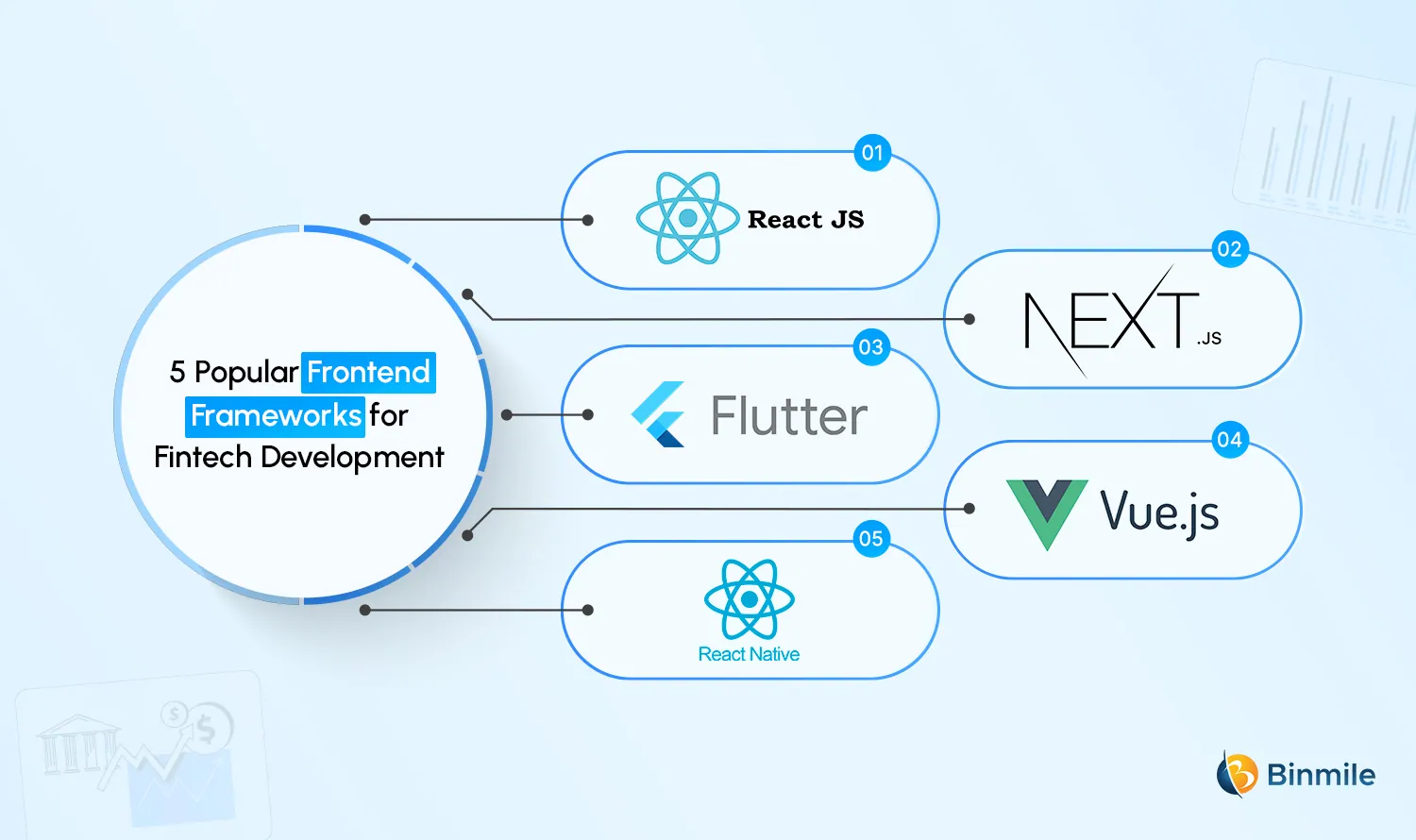
For visualizations and smooth user experiences, the top 5 frontend technologies are React.js, Next.js, Flutter, Vue.js, and React Native. On the other hand, the top 5 backend technologies that ensure the security of financial data and information in the current fintech sector include Python, Java, C++, Go (Golang), and Rust.
Let’s explore these technologies and why they are preferred in detail:
Top 5 Frontend Technologies for Finance Technology App Development
Here is a comprehensive comparison between these 5 frontend technologies:
| Factor Criteria | React.js | Next.js | Flutter | Vue.js | React Native |
|---|---|---|---|---|---|
| Release Date | 2013 | 2016 | 2017 | 2014 | 2015 |
| Type | JavaScript Library | React Framework + Built-in TypeScript | UI Software Development Toolkit | JavaScript Framework | JavaScript Library |
| Unique Features |
|
|
|
|
|
| Primary Languages Used | JavaScript | JavaScript + TypeScript | Dart | JavaScript | JavaScript |
| Scalability | High due to modular components and a rich ecosystem | Medium to high (Best option for complex and large apps) | Medium (Provides fast UI updates and a rendering engine) | Moderate to high (Good for rapid MVPs) | Moderate to high (Best for large apps) |
| Routing System | React Router DOM library | File-system Based Routing | Navigator Widget and Route Class | Client-side Router | React Navigation and Routing |
| Performance and Speed | High | Extremely High | High | Moderate to High | High |
1. React.js
React.js, or React, is a popular and modular frontend JavaScript library used in fintech applications. It is a component-based architecture and enables developer teams to create reusable UI components. It supports TypeScript and strict typing conditions, which helps businesses provide fintech-grade reliability and ensures that the customer’s sensitive data remains secure without failure.
React is proven to be one of the major choices when it comes to building modern finance development applications. This is because of its interactive user interface, which comes with real-time updates whenever an alert is seen in the market data transaction reports or reviews.
Ideal Scenarios to Use React.js:
- Developing real-time inventory management systems used in financial operations or B2B payments
- Developing single-page apps and SaaS platforms like robo-advisory platforms that have real-time dashboards
- Developing dynamic charts or alert features for budgeting apps
2. Next.js
Next.js, or Next, is built on React and goes beyond just UI to also include some backend capabilities, making it a fully functional technology. Full-stack Next.js development services offer pre-rendering support functionalities such as static site generation (SSG) and server-side rendering (SSR). These functionalities can be used by businesses to improve their app’s performance and SEO capabilities.
Next is one of the ideal frontend technologies, as it helps businesses to protect their clients’ financial data during transaction processes. This is because it comes with built-in and advanced security features and doesn’t need to leverage any third party for this.
Ideal Scenarios to Use Next.js:
- Developing dynamic financial advisory booking applications that have secure payment processing and real-time calendars
- Developing fintech marketing websites that have lead-generating form systems
- Developing lead-generation landing pages with ROI calculators
3. Flutter
Flutter is an open-source UI development toolkit that allows developers to build secure and efficient fintech applications using a single codebase. This means that it has cross-platform capabilities, and businesses can leverage this language for building a single codebase that can be operated on multiple operating systems or platforms.
With its customizable and extensive UI components and a rich ecosystem of innovative widgets and animations, Flutter is a popular choice amongst fintech companies. Additionally, it helps businesses to enhance their applications’ performance and responsiveness, ultimately making it smooth for end users.
Ideal Scenarios to Use Flutter:
- Developing progressive web apps (PWAs) like budget-tracking fintech platforms that offer more flexibility and SEO capabilities
- Developing finance apps that have bill reminders and a beautiful UI/UX
- Developing banking applications that come with faster time-to-market and efficiency
4. Vue.js
Vue.js, or Vue, is a progressive frontend technology or framework known for its simplicity and is one of the major frontend technologies for fintech product development. It primarily uses and extends HTML templates and attributes with the help of special directives embedded in the syntax.
Vue is ideal for startups or small businesses, as it comes with feature-rich UIs and has an easy learning curve compared to React or Next. Moreover, it has a reactive data binding system to trigger updates that help businesses ensure data consistency.
Ideal Scenarios to Use Vue.js:
- Developing insurance claim processing apps that have features like automated workflows, real-time data visualization, and analysis
- Developing interactive user interfaces for credit or KYC registration portals with live search and instant form validation
- Developing compliance tracking platforms to centralize data
5. React Native
React Native is a JavaScript library that is based on the React library. It enables fintech teams to build and deliver high-performance native mobile applications. For building user interfaces, it ensures a smooth and truly native look by providing a set of agnostic native components such as View, Image, and Text. These native components can be directly mapped to the UI building blocks of React Native.
It uses Java APIs on Android components to render native UI components and Swift on iOS for rendering the same. This allows fintech companies to build cross-platform-friendly apps that are cost-effective and have a seamless user experience.
Ideal Scenarios to Use React Native:
- Developing P2P payment and splitting apps that have secure peer-to-peer transactions
- Developing investment apps that come with secure payment integration with the help of biometrics
- Developing a crypto wallet that enables integration of advanced encryption modules and provides charts
Build your fintech app with proven tech stacks like Python, used by Stripe and Venmo. Start your secure app journey today with Binmile!
Top 5 Backend Technologies for Finance Technology App Development
Now, let’s explore a detailed comparison between these 5 backend technologies:
| Factor Criteria | Python | Java | Ruby on Rails | C++ | Go (Golang) |
|---|---|---|---|---|---|
| Release Date | 1991 | 1996 | 2004 | 1985 | 2009 |
| Type | High-level, General-purpose | Memory-safe, Object-oriented | Dynamic, Object-oriented | Object-oriented | Compiled, Statically Typed |
| Unique Features |
|
|
|
|
|
| Primary Languages Used | Mainly C; also in some cases Java and C# | C and C++ | Ruby | Extension of the C language | Initially in C; now in Go after version 1.5 |
| Concurrency | Mostly single-threaded, but sometimes supports multi-threading for GUI actions. | Advanced multi-threading using Java Virtual Machine (JVM) | Limited multi-threading, but by default runs single-threaded | Manual thread management | Advanced multi-threading capabilities using Goroutines and channels |
| Popular Frameworks and Libraries | Django, NumPy, Pandas | Spring, Hibernate, Google Guava | It’s a framework itself and has core frameworks like Active Record, Action Mailer, and Action Pack. | Qt, Boost, OpenCV | Gin, Echo, Fiber |
| Performance and Speed | Moderate, but high in analyzing large datasets | Moderate to High | Low to Moderate | Extremely High | Extremely High |
1. Python
Java and C++ are popular languages for making software and apps in the finance industry, but Python has recently emerged as a high-level and interpreted development language. It surpasses Java and C++ and is used by 51% of developers, as shown in the recent statistical survey.
Python is known for its simplicity and robust modeling capabilities, which make it the first choice for financial companies. Zopa, Robinhood, Affirm, Venmo, and Stripe are some successful fintech apps developed with Python, facilitating the backend capabilities.
The following are some use cases where Python is used as a backend language for fintech app development:
- Robo-advisors and wealth management systems
- Third-party APIs integrations for open banking
- Risk modeling and data analytics
- Digital-only using mobile wallets and UPI
- Fraud prevention and detection using big data analysis
2. Java
Java is another powerful memory-safe backend programming language for the Fintech industry. The finance industry uses Java development services to handle and secure a massive amount of data every day. Here, Java fits perfectly, as it enables teams to build scalable fintech apps with robust security features. It is also known for its mature community of experienced developers.
The main reason for Java being the core backend choice for fintech is its cross-platform execution capabilities. This lets teams execute and operate the Java Virtual Machine or JVM across any operating system that supports it. In short, Java is a mature technology that contributes extensively to the ongoing fintech revolution.
This coding language is extensively used by some successful fintech business models as well as popular banks for:
- Electronic trading platforms
- Retail and corporate banking portals
- Assets and wealth management
- Customer-facing applications
- Fraud detection systems
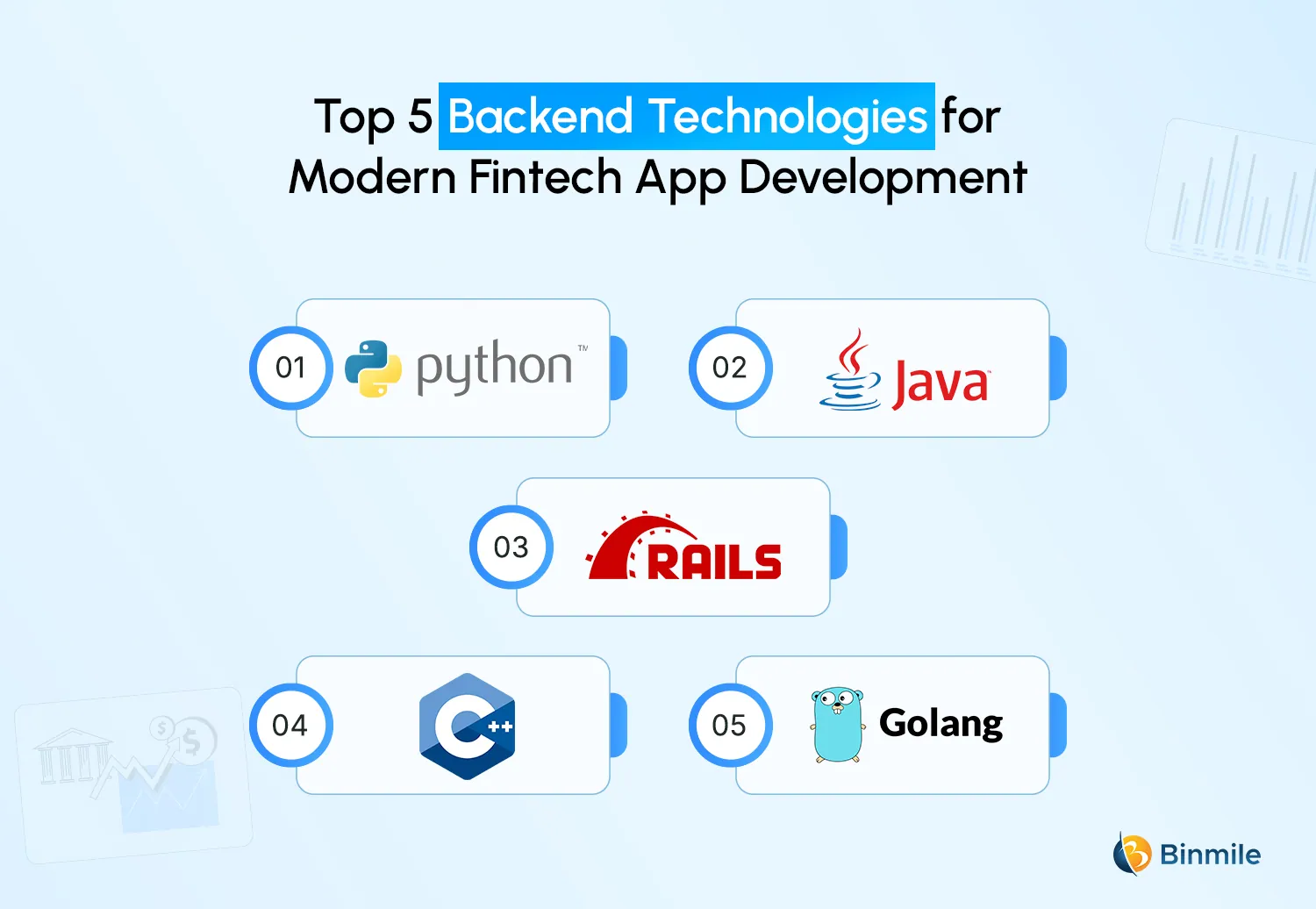
3. Ruby on Rails
Ruby on Rails, or RoR, is a dynamic and object-oriented backend language that helps developer teams to quickly create and deploy applications. By leveraging this backend language, teams can focus on integrating important features and core business logic rather than building a full-scale development app first. It is well-suited for startups because it has:
- Powerful built-in security mechanisms
- Time and cost-efficient traits
- High performance and stability qualities
RoR is one of the most popular backend languages among fintech companies or startups, as it expedites the development process and releases the MVP faster in the targeted market. Coinbase, Stripe, and Fundera are some of the startups that leverage it for building rapid fintech MVPs.
The following are some fintech use cases where Ruby on Rails has worked wonders:
- Payment gateway systems and mobile wallets
- B2B lending platforms
- Insurance technology (InsurTech) applications
- Equity-based crowdfunding apps
- Customer relationship management (CRM) portals
4. C++
Finance technology companies prefer the C++ programming language as the backend when speed and app performance are the most important factors to focus on. It is a general-purpose programming language that is highly useful when it comes to creating low-latency programs or codebases. Latency means the time taken by the server to communicate with a device. These Low-latency codebases built using C++ are ideal for most companies, as this language offers real-time stock exchange and risk analysis functionalities.
C++ is heavily used in finance technology because of its ability to handle complicated business applications, and it has a firm hand on memory management and usage. Bloomberg, Goldman Sachs, and more such finance companies leverage C++ for real-time capabilities.
What else? C++ is highly suitable for fintech custom software solutions involving:
- Advanced computations and simulations
- High-frequency trading platforms
- Complex mathematical computations in derivatives
- Performance-based banking applications
- Data processing with risk analysis
5. Go (Golang)
Golang, commonly known as Go, is developed by Google and is a compiled and open-source emerging language, and is considered one of the fastest-growing languages for building fintech applications. With its ability to perform multiple tasks or requests simultaneously with ease, it is an ideal backend option for creating fintech apps that deal with heavy-load tasks and services and require real-time processing functionalities.
Go also ensures that application memory is efficiently managed and optimized, which helps teams to build high-performance, intensive finance technology apps. In addition to this, it is widely adopted while building architectures that are focused on using cloud-native and microservices design approaches. Top fintech companies using Go as a backend language are Monzo and American Express.
The top fintech use cases where Golang is utilized for its powerful and secure backend capabilities are:
- Serverless cloud-native applications or platforms
- Transaction and high-speed payment processing gateways
- Digital banking platforms based on microservices
- Real-time fraud detection systems
- Cryptocurrency applications
Top Fintech App Development Trends to Watch Out for
Many fintech startups or companies are incorporating modern approaches or trends these days, resulting in increased competition and rapid growth in the market. Therefore, businesses must leverage one of the fintech app development trends to stay ahead. These fintech development trends redefine the development approaches to provide convenience to their customers. Now, let’s explore some of the best fintech trends:
1: Fintech as a Service (FaaS)
It is one of the growing fintech trends and is an intelligent software engineering service platform. FaaS helps fintech teams to use an API or cloud platform for leveraging financial services such as digital wallets, lending, insurance processing, etc., rather than creating them from scratch for their application. It provides several benefits to fintech startups, banks, and even non-financial companies. Some of the benefits are:
- Greater convenience
- Higher security
- More personalized services
- Optimal customer experiences
2: Artificial Intelligence
AI continues to be a core Fintech trend, reshaping the current operational approaches within the banking industry. With the rise of GenAI (Generative AI) in banking, it enables financial institutions and companies to drive down operational costs, boost risk management, and enhance customer experiences. GenAI goes beyond chatbot systems and helps institutions to make informed business decisions, such as improving security postures using modern fraud detection capabilities. In this way, teams can create a more secure Fintech app.
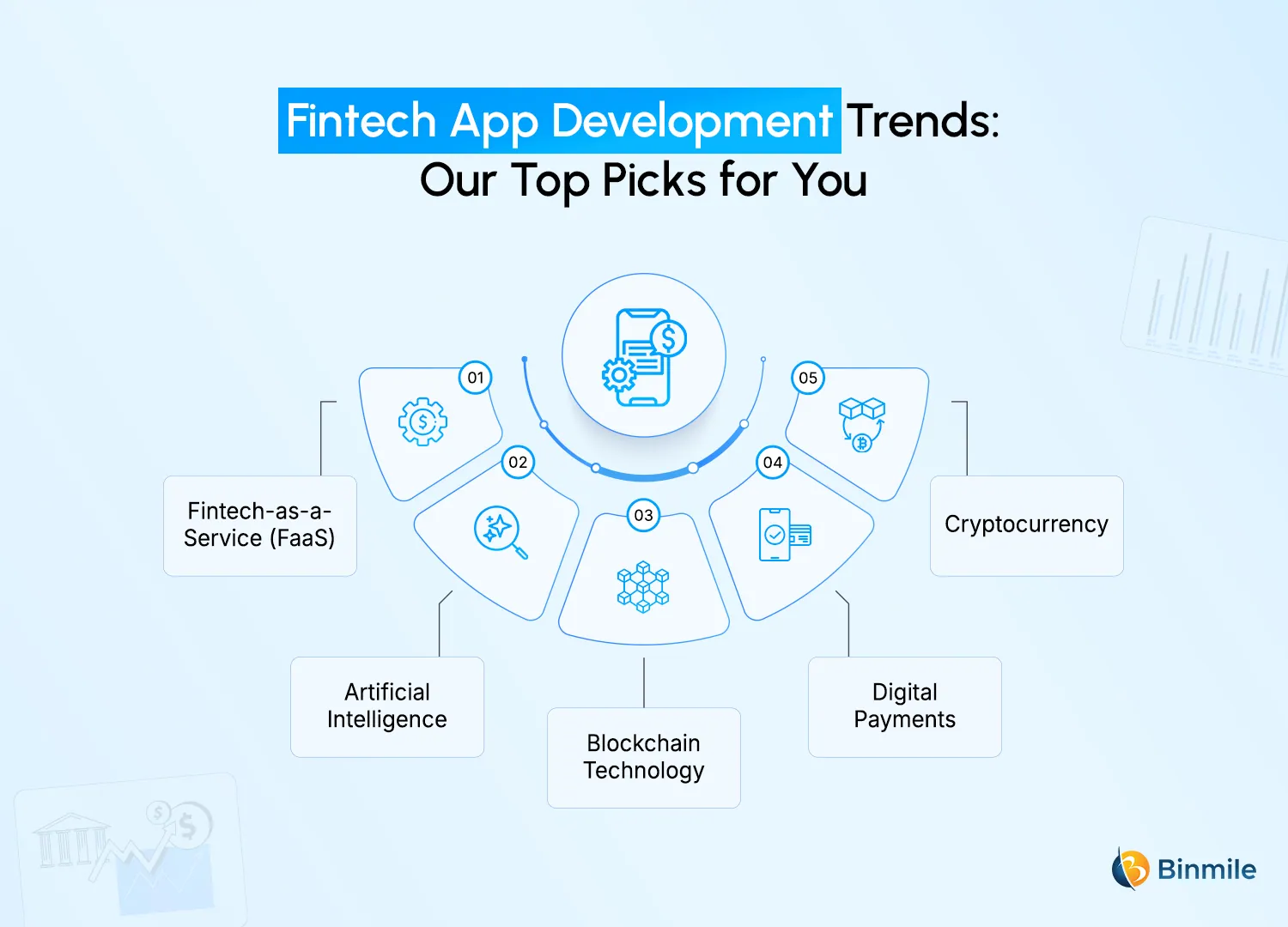
3: Blockchain Technology
Blockchain technology has revolutionized the way businesses handle data and financial transactions and is one of the core fintech trends. It allows companies to protect data by verifying client identities and tracking the transactions in real time. By leveraging this technology, businesses can also integrate DeFi solutions to remove the dependency on 3rd-party providers such as brokers or banks. This helps businesses in offering their users more cost-effective financial transaction solutions.
4: Digital Payments
With the rise of digitalization, the payment industry is also experiencing a major technological shift as companies adopt containerized architectures on the cloud to achieve:
- High scalability
- Zero downtime
- Cost-effectiveness
By utilizing this trend, financial institutions or companies can develop and deploy new features such as real-time monitoring and analytics, mobile payments, etc., in their existing systems. This helps meet evolving business needs and also provides enhanced accessibility and convenience to rural populations.
5: Cryptocurrency
Cryptocurrency is a digital currency and is considered an emerging fintech trend. It is a valuable investment with main features such as minimal transaction fees for online exchange of funds and instant payments. It also provides enhanced security, which is an important feature for building trust within the fintech ecosystem. Businesses utilizing this trend can facilitate efficient payment transactions without using a service provider and also ensure transactions are transparent, ultimately reducing fraud.
Empower your fintech startup with tailored app solutions. Stay ahead trends like AI, blockchain, & digital payments with Binmile.
Conclusion
Choosing a specific tech stack for fintech development is extremely important for fintech institutions and startups. Before selecting one of the top technologies, businesses must research and plan out what kind of product or service their organization aims to deliver. Analyze and clear confusion, like what to build- a digital-only banking app or a payment app.
When it comes to picking the right tech stack for fintech product development, you need to analyze the use cases of available technologies, which we have discussed earlier. Additionally, the choice of coding language for a fintech app depends on the project’s technical needs. If you need help developing your desired fintech application to suit your targeted customers’ needs and preferences, it makes sense to get in touch with Binmile.
Frequently Asked Questions
Fintech app technologies include the programming languages, frameworks, databases, cloud platforms, APIs, and security tools used to build financial applications. Choosing the right technology stack improves performance, scalability, compliance, and user experience.
Modern fintech applications commonly use technologies such as Java, Python, Node.js, React, Angular, Flutter, Kubernetes, Docker, AWS, Microsoft Azure, PostgreSQL, MongoDB, and AI-powered analytics to deliver secure and scalable solutions.
Organizations should evaluate security, regulatory compliance, scalability, integration capabilities, development speed, maintenance costs, cloud compatibility, performance requirements, and future business growth before choosing a technology stack.
The right technology stack enables faster product launches, strengthens cybersecurity, supports regulatory compliance, improves transaction processing, enhances customer experiences, and reduces long-term operational costs.
A fintech development partner can assess business goals, recommend suitable technologies, design scalable architectures, integrate third-party financial services, ensure compliance with industry regulations, and optimize application performance for long-term success.