Many enterprises today are dealing with rising workloads, manual processes, and disconnected systems. According to McKinsey, companies that adopt AI-driven automation can cut operational costs by up to 30 percent while boosting productivity across departments. This shift has prompted businesses to seek platforms that can not only automate tasks but also take data-driven actions independently. Many organisations experimenting with ServiceNow Development and modern automation strategies are also seeing this shift.
In this blog, we will explore how ServiceNow’s agentic AI is transforming the way organisations design workflows, manage operations, and deliver seamless digital experiences. We will also look at how it works, the implementation steps, the major reasons behind its rising adoption in 2026, and a final section on how the right partner can help you execute this transition successfully.
How Does ServiceNow Agentic AI Work?
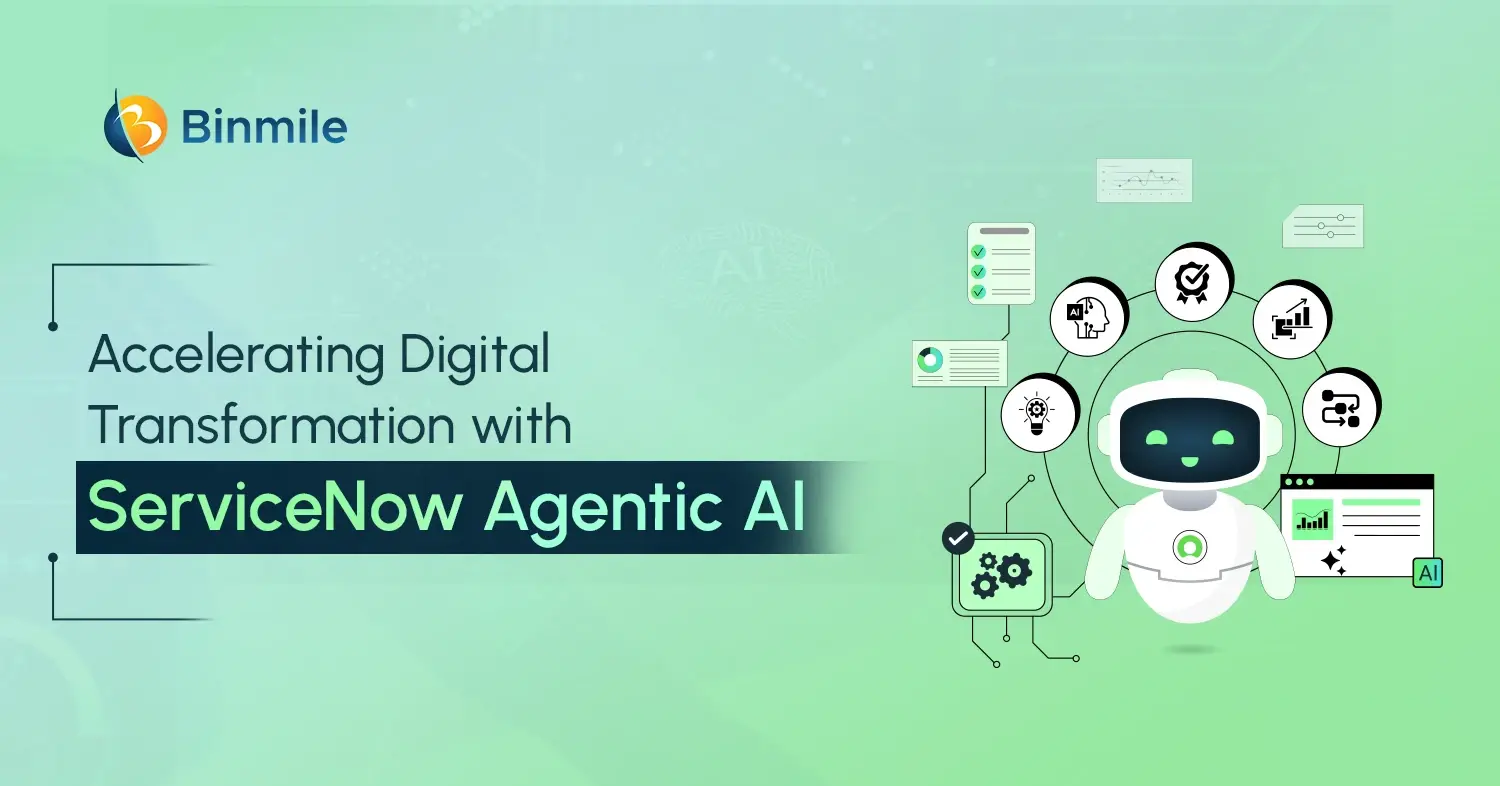
ServiceNow agentic AI acts like an intelligent digital workforce that understands context, makes decisions, and performs actions across enterprise systems. It becomes even more effective when combined with the Now Platform and its ecosystem of ServiceNow AI agents, ServiceNow technology, and the ServiceNow AI Platform, allowing organisations to run smarter and more connected workflows.
The AI begins by analysing data across processes, including incident histories, service requests, system patterns, and CMDB records stored within ServiceNow workflow environments. This helps it interpret the situation accurately instead of reacting to isolated inputs. Once it forms an understanding, it uses reasoning to decide the next best step. Because it is built natively on the Now Platform, the AI works smoothly across key suites such as ServiceNow IT Service Management, IT Operations Management, Customer Service Management, HR Service Delivery, Asset Management, and Creator Workflows. It also connects effortlessly with platform capabilities like Integration Hub, App Engine, and the CMDB. This native compatibility reduces complexity and enables organisations to scale AI-driven automation without disrupting their existing ecosystem.
In simple terms, ServiceNow agentic AI blends intelligence, reasoning, and independent execution to simplify enterprise operations. It does not just automate tasks but understands the context behind them, making it a powerful step forward for digital transformation.
What are The Steps to Successfully Implement ServiceNow Agentic AI
Organisations need a structured approach when implementing agentic capabilities within the platform. Here is a simple step-wise framework:
1. Identify High-Value Use Cases
Determine the ServiceNow agentic AI use cases that have the highest value. These often include IT incident handling, HR service delivery, finance approvals, asset tracking, or complex workflow automation. Prioritize areas with a high reliance on manual work or operational delays, as these will provide the fastest benefits. This early clarity also helps build a strong foundation for scaling later. Some teams also assess potential cases based on ServiceNow App Engine Services readiness.
2. Assess Current Systems and Data
Consider the systems and integrations you have, the databases, and the accuracy of your ServiceNow CMDB. Agentic AI performs optimally when these data are of high quality. At this point, Cleansing, standardizing, and organizing your data will minimize errors later by helping the AI to respond with high accuracy. This step ensures the AI receives the right context every time it acts.
3. Map Workflows for AI Readiness
For each workflow, break down the components into smaller tasks to find any steps that could be automated or are supported by AI reasoning. Look for areas of stagnation, repetitive tasks, and manual approval processes. This prepares the workflows to be organized so that ServiceNow AI agents can function without friction. It also prevents the AI from getting stuck due to unclear or poorly defined processes.
4. Integrate with the Now Platform
Merge all your data sources, legacy systems, APIs, and business applications to form one integrated system. Your AI needs to draw from multiple platforms to perform complete processes. Many organizations bring in ServiceNow implementation partners at this stage to facilitate and automate the integration without too many problems and errors. Proper integration also reduces future maintenance issues. Companies performing large-scale ServiceNow Upgrade projects also ensure their systems are aligned before implementing the AI.
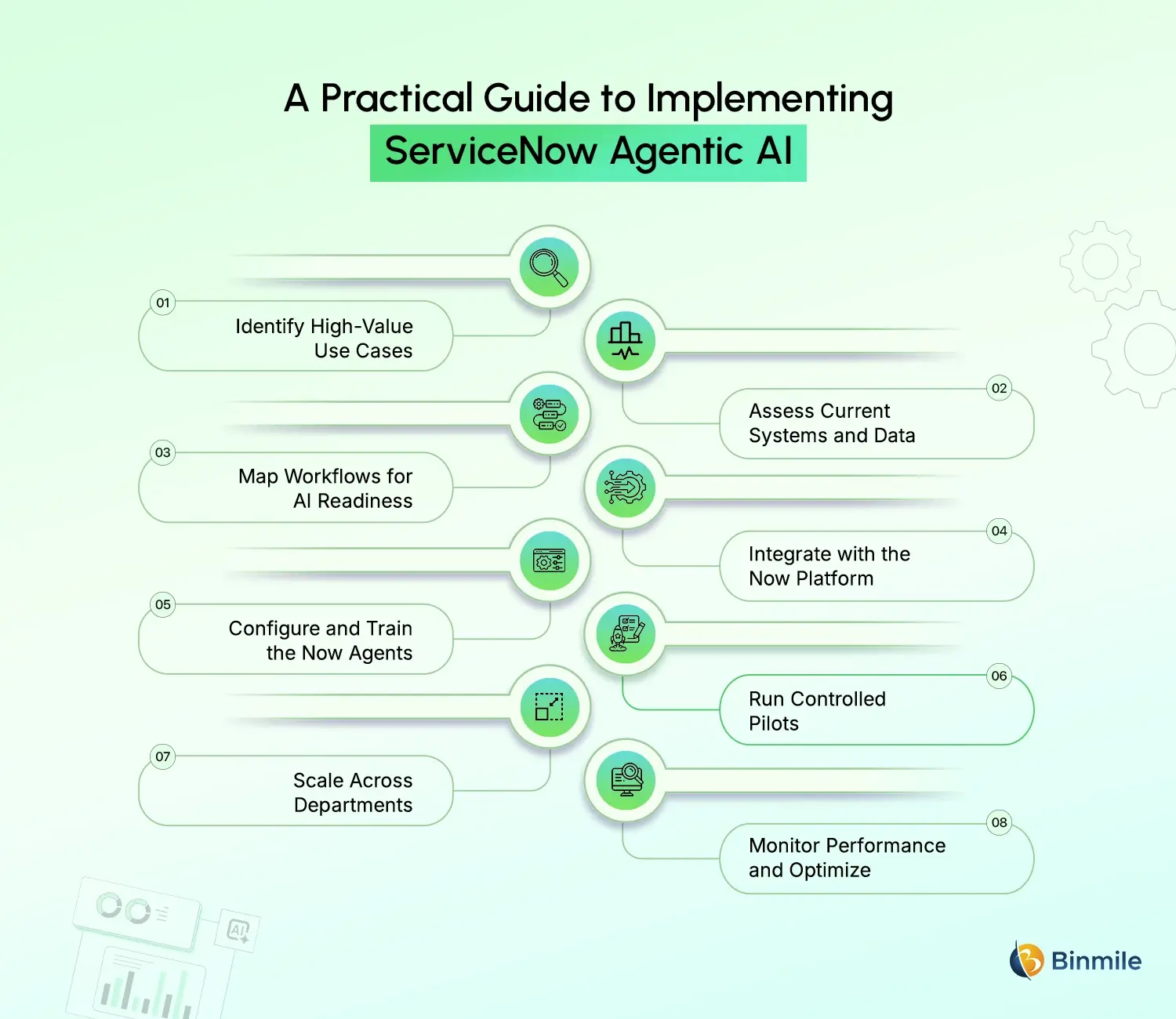
5. Configure and Train the Now Agents
Describe the behavior you expect from your ServiceNow agent. Determine what your triggers, reasoning, escalation, and actions the agent can take. This is when the agent is taught to think and respond to the organisation’s structure and policies. A well-trained agent behaves consistently even in complex workflows.
6. Run Controlled Pilots
Do limited deployments first before you go big, and distribute your ServiceNow AI agents to defined small teams or units. This is to check how accurate, fast, and useful the agent is, plus this will help you determine things you should improve and adjust. With these insights, you can refine the AI before full-scale deployment.
Looking to optimize costs, automate operations, and unlock greater efficiency with ServiceNow?
7. Scale Across Departments
Increase the ServiceNow agent distribution to other supported business units, i.e., HR, customer service, procurement, finance, and IT. When the results from the limited deployments were good, and other units can use them, it will help the users to adjust and adapt fast when done in small portions. As adoption increases, you also get more data to improve agent performance and decision-making. This scaling process becomes easier when the organisation already uses ServiceNow Integration Hub for broader connections.
8. Monitor Performance and Optimize
Keep an eye on how the AI agents behave in real time. Track performance metrics, refine the agent’s logic, and adjust workflows whenever needed. With guidance from ServiceNow solutions experts, you can continuously improve accuracy, productivity, and overall workflow efficiency. Support from ServiceNow solutions experts helps maintain long-term accuracy and stability.
Why Companies Are Moving to ServiceNow Agentic AI in 2026
The shift toward agentic AI is not a trend but a strategic requirement. Businesses want faster operations, predictive intelligence, and reduced reliance on manual intervention. Here are the reasons driving this adoption:
1. Rising Operational Complexity
Businesses are handling a mix of operational tools and user volumes across hybrid cloud ecosystems. Agentic AI streamlines the processes by handling operations autonomously.
2. A Need for Proactive Issue Resolution
Automation is designed to respond to queries. Agentic AI identifies disruption based on behavioral cues and triggers processes to preempt the need for automation.
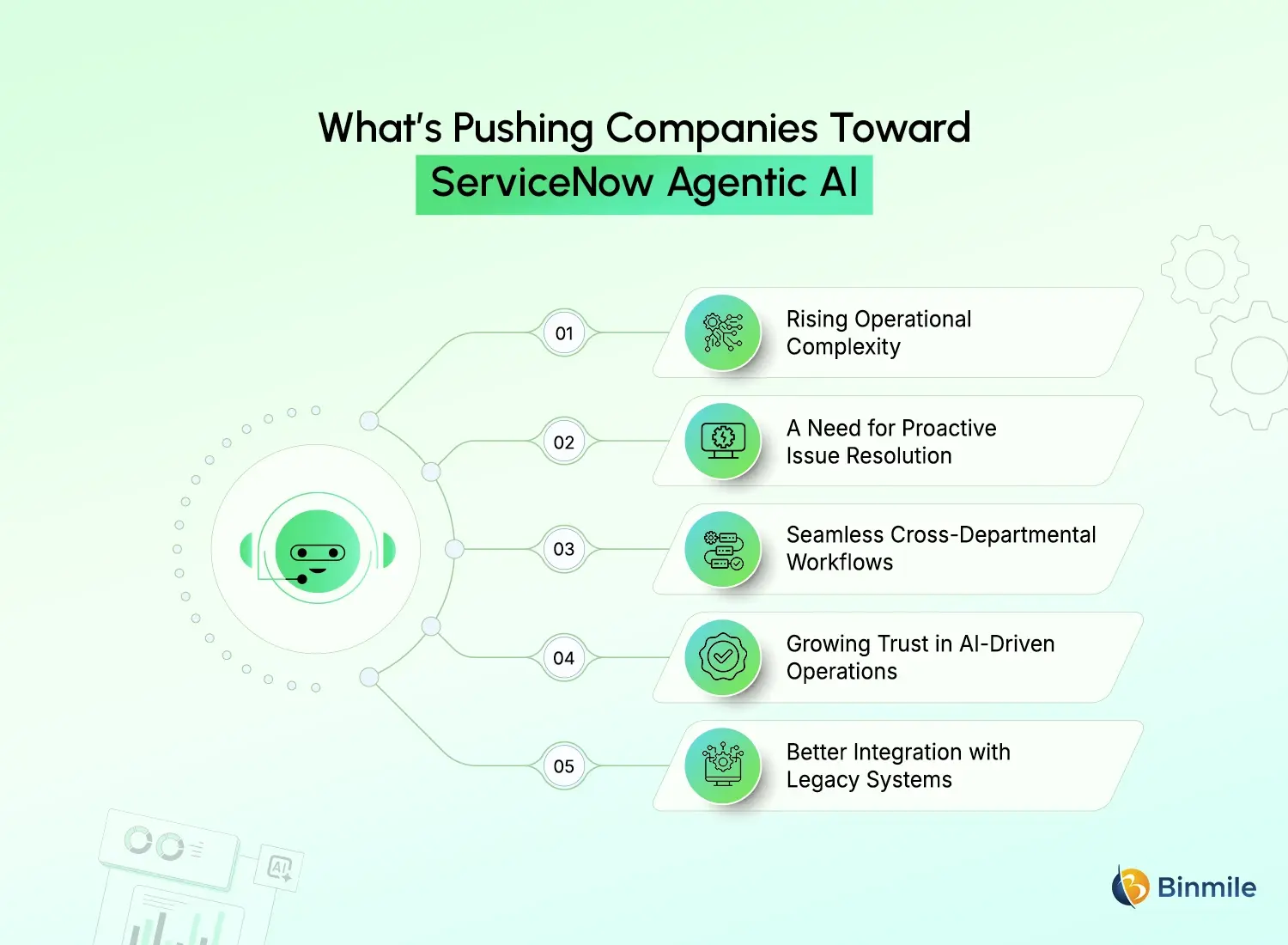
3. Seamless Cross-Departmental Workflows
AI agents and ServiceNow IT operations management enable integration across applications and systems without the need for user consents, creating a unified flow across IT, HR, and Finance.
4. Growing Trust in AI-Driven Operations
The operational benefits of AI have been extended across automation, and this has increased confidence in the technology for providing deeper levels of automation.
5. Better Integration with Legacy Systems
By 2026, organisations want to avoid large-scale lifts and shifts of their operating environments. With ServiceNow agentic AI, businesses can integrate with older systems and newer applications without disruption.
Want to streamline workflows, reduce operational spend, and maximise the value of your ServiceNow?
How a Trusted Partner Helps in Executing This Transformation
Implementing the ServiceNow AI platform requires strong knowledge, workflow experience, and the ability to integrate systems without disrupting day-to-day operations. This is where the right partner makes a significant difference.
A skilled ServiceNow team helps organisations streamline the implementation process through structured assessments, workflow planning, AI readiness analysis, and smooth integration with the broader ecosystem. They also guide companies in prioritising use cases, training Now agents, optimising the ServiceNow Implementation Process, and scaling automation across functions. Since each enterprise has different data structures, legacy systems, maturity levels, and workflow needs, a custom approach becomes essential. A specialised delivery team ensures that performance tuning, continuous optimisation, upgrades, and cross-departmental deployment are executed correctly. This gives businesses the confidence to adopt advanced automation without operational risks.
A partner like Binmile supports organisations through this entire journey by bringing technical expertise, platform understanding, and hands-on AI implementation experience. Their focus on building scalable enterprise workflows allows companies to make the most of ServiceNow company capabilities, even when dealing with complex IT environments. Instead of overwhelming teams with sudden changes, they help simplify the transition and align AI agents with long-term business goals.
Frequently Asked Questions
Among the functions, IT operations, customer service, HR, finance, and procurement experience the most residual benefits, as these functions each have a high concentration of repetitive workflows and data-driven tasks.
It employs reasoning, contextual awareness, and independent decision-making rather than being confined to rigid workflow triggers and rule-based automation.
No, it assists employees by alleviating low-value, manual tasks and enabling employees to engage in work that requires more critical thinking, judgment, and interpersonal or direct collaboration.
Absolutely, it can do so via APIs, connectors, and integration functionalities within the Now Platform that allow it to engage with both new and legacy systems.
Not really. Once it is configured, a small team will be able to manage the system, while the Now Platform streamlines continuous governance and management of the system, making it easy to improve over time.