Financial institutions deal with uncertainty every single day. Market volatility, credit defaults, fraud attempts, regulatory pressure, and operational disruptions are part of routine operations. According to a report by Allied Market Research, the global predictive analytics market is expected to reach $35.45 billion by 2027, growing at a CAGR of 21.9 percent. This rapid growth reflects how businesses are shifting from reactive decision-making to data-driven forecasting. In finance, that shift is especially important because risk is not optional; it is constant.
In this blog, we will explore the role of predictive analytics in finance, understand financial predictive modeling, examine predictive analytics use cases in finance, and discuss benefits, future trends, and implementation strategies. We will also answer key questions about predictive analytics software, predictive models, and adoption challenges for financial institutions.
The Role of Predictive Analytics in Finance
The importance of predictive analytics goes beyond making estimates in finance. It involves the anticipation of real-time and historical information in order to identify real-time threats and mitigate risk before it becomes a reality.
Conventional risk management methods focused on historical reports and Excel sheets. While these methods still hold, they become obsolete with the emergence of innovative approaches. Predictive analytics in finance and accounting involves the use of statistical algorithms, ML, and developmental techniques of AI to capture the data in patterns and form predictions.
For instance, rather than looking back on loan defaults for the previous quarter, predictive methods can estimate the chances of default while the loan is still in the application phase. This gives a financial institution the liberty to modify the interest rate and collateral requirements, or even reject the loan application if it is perceived to be high risk.
In corporate finance predictive analytics, companies apply forecasting techniques to identify and analyze risks associated with the cash flow, capital allocation, and the level of risk the business is exposed to in the market. Chief Financial Officers have the ability to recreate scenarios where income levels decline or expenditure levels increase, and thus formulate strategies to mitigate the effect of those situations.
Simply put, predictive analytics captures the financial data as is and converts it into financial insights for the purpose of explaining the mitigation of risk.
Understanding Financial Predictive Modeling
Financial predictive modeling is the backbone of predictive analytics in finance. It involves building mathematical models that estimate future financial outcomes based on historical data and variables.
Common types of predictive models used in finance include:
-
Credit Risk Models
These gauge the probability of a borrower defaulting based on factors such as credit history, income, repayment behavior, and other market variables.
-
Fraud Detection Models
These analyze consumer behavior and identify outliers in transaction activity as the transactions occur. Fraud detection improves with machine learning as it is trained on past fraudulent transactions.
-
Market Risk Models
These identify risk related to interest rates, currency exchange rates, and stock prices.
-
Liquidity Risk Models
They identify the risk of running out of cash and identify the minimum amount of working capital needed.
-
Operational Risk Models
These identify risk stemming from broken machinery, a failure to comply, or mistakes in internal organizational processes.
Predictive analytics software combines all of these models with dashboards, automations, and reporting. This increases visibility on the organizational performance continuously, as opposed to monthly reporting, for the risk management teams, FP&A teams, and management.
What are the Use Cases of Predictive Analytics in Finance
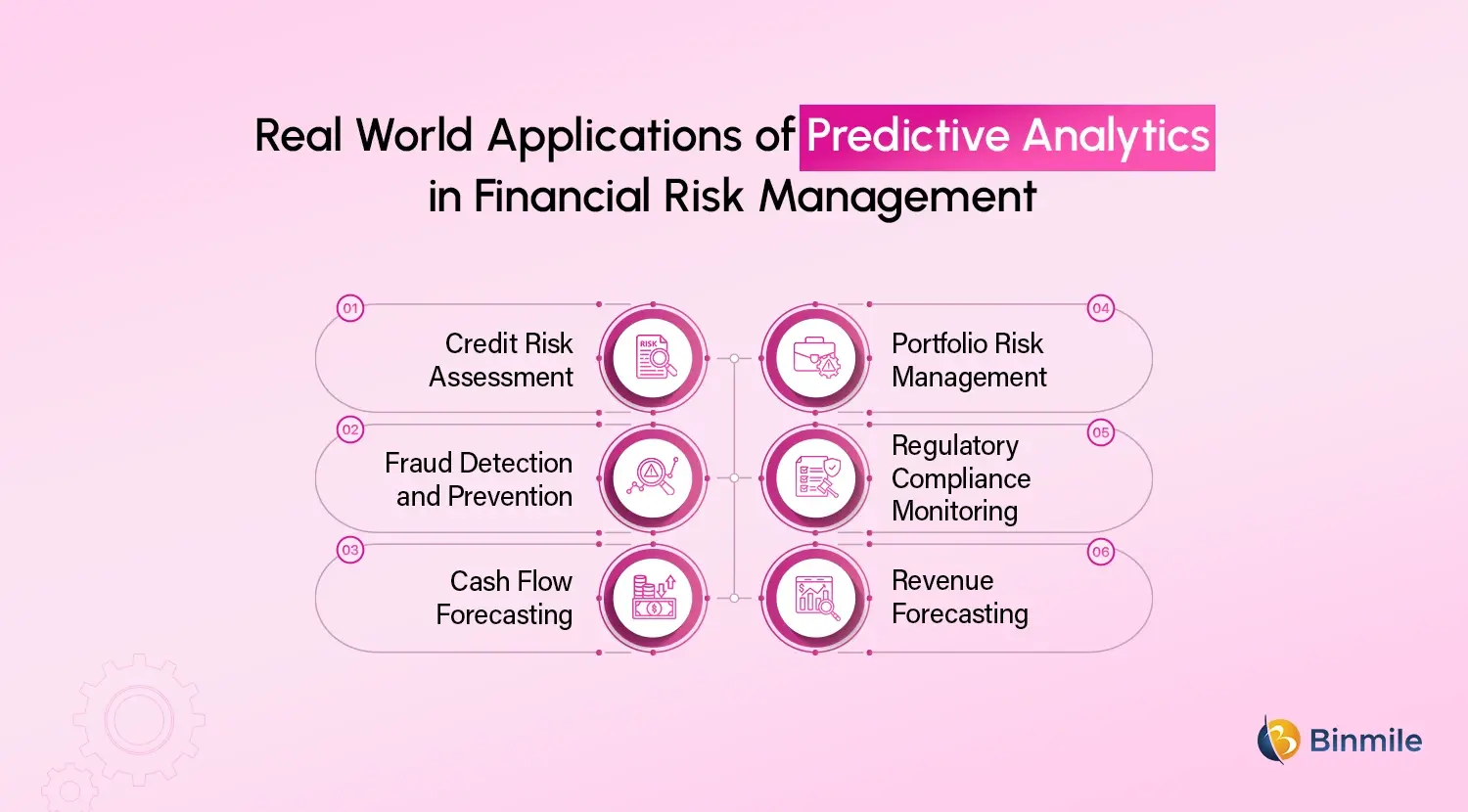
The practical value of predictive analytics use cases in finance becomes clear when we look at real-world applications.
1. Credit Risk Assessment
Using traditional methods like credit scores typically leads to the rejection of loan applications, which could otherwise positively contribute to the economy. Predictive analytics within the lending banks allows the consideration of credit card transactions and spending habits to improve efficient economic forecasting. By identifying and forecasting macroeconomic indicators, along with the above variables, predictive analytics allows lending banks to economically improve this lending decision and subsequently increase the accuracy of the loan decisioning process, and also mitigate the impact of non-productive loans.
2. Fraud Detection and Prevention
Fraud is always changing, and it is also leading to rule-based systems, resulting in detection failure. With the advent of predictive analytics, fraud is analyzed on the basis of linear and non-linear transactional patterns, as well as fraud detection and process automation.
This leads to the reduction of false positives and increases the trust of the customers.
3. Cash Flow Forecasting
Cash Flow is a predictive analytics term that is understood as a sequence of payments made to the business as consideration for its services and is computed as cash inflows and outflows. Liquidity crises in the business are avoided when cash flow forecasting is performed.
4. Portfolio Risk Management
Predictive models are proven to be effective in assessing the impact of risk on a portfolio and predicting the possibility of a market downturn.
5. Regulatory Compliance Monitoring
Certain laws and regulations govern a business and require the business to submit its reports and provide explanations of actions and events that answer the requirements of the regulations, including predictive analytics.
6. Revenue Forecasting
Accurate revenue forecasting supports strategic decision-making. Finance teams can estimate demand, pricing changes, and market shifts more reliably using data analytics services.
What are the Benefits of Predictive Analytics in Finance
The benefits of predictive analytics in finance extend across risk, performance, and operational efficiency.
-
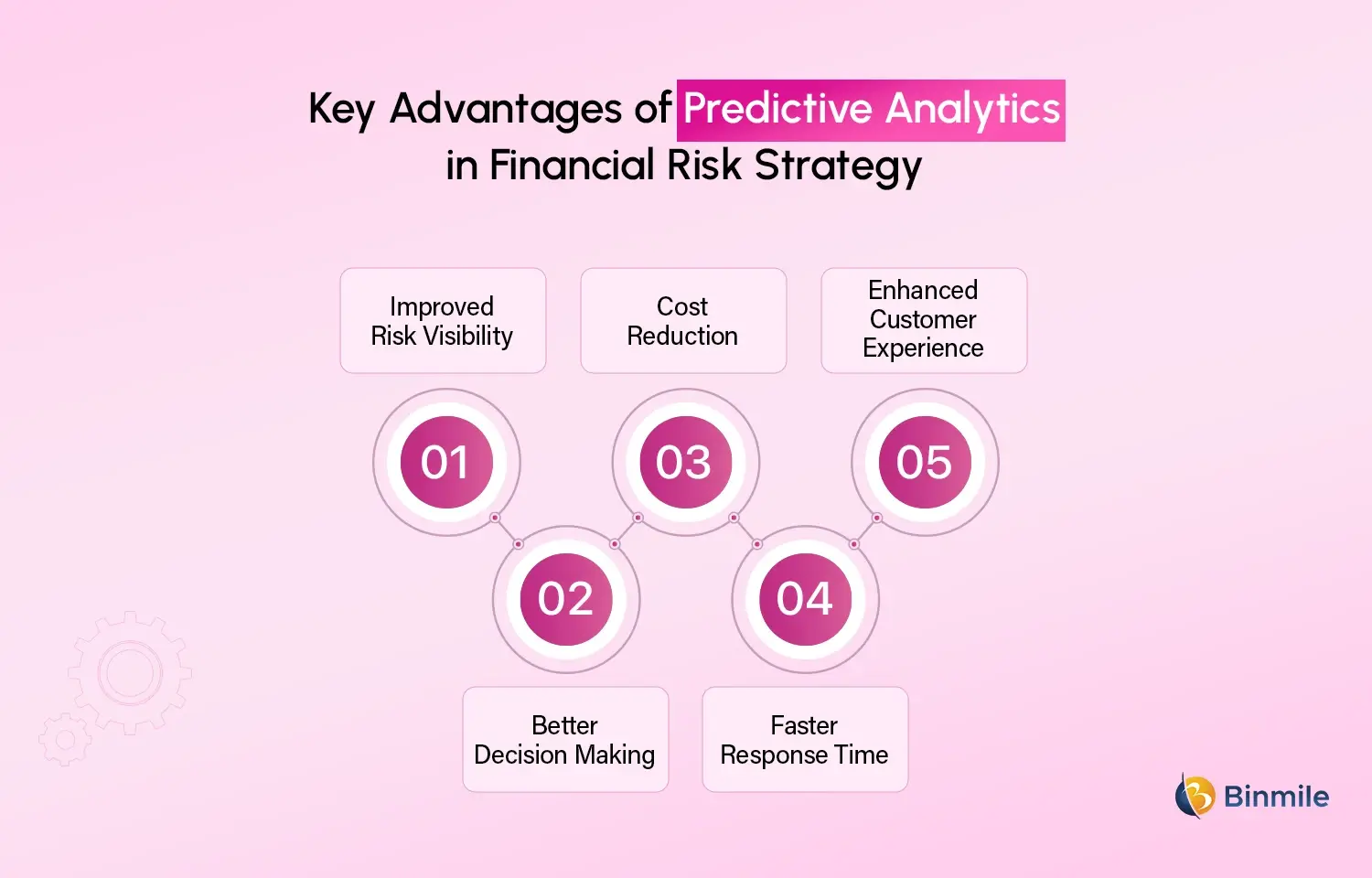
Improved Risk Visibility
With predictive analytics in finance, loss prevention is made possible, as threats can be identified and analyzed rather than waiting for losses to occur.
-
Better Decision Making
With the use of data to support a claim, there is no need for guesswork. Predictive models give measurable probabilities, whether it be for allocating capital or providing loans.
-
Cost Reduction
Efficient management of risk, along with optimized allocation of capital and prevention of fraud, operational costs, and financial losses, are decreased.
-
Faster Response Time
In real-world situations, particularly in areas with heavy use, such as digital banking and the fintech app development company, automated predictive analytics technologies provide real-time analytics.
-
Enhanced Customer Experience
Predictive analytics solutions examine customer behaviours to enable risk-based pricing and customized financial products.
Comparing Traditional Risk Management vs Predictive Analytics
| Aspect | Traditional Risk Management | Predictive Analytics in Finance |
|---|---|---|
| Approach | Historical and reactive | Forward-looking and proactive |
| Data Usage | Limited datasets | Large structured and unstructured datasets |
| Speed | Periodic reporting | Real-time insights |
| Accuracy | Manual and rule-based | AI-driven predictive models |
| Decision Support | Static reports | Dynamic dashboards and simulations |
This comparison clearly shows why predictive analytics use cases in finance are becoming essential rather than optional.
Looking to reduce financial risk with intelligent forecasting and AI-driven insights?

What are the Challenges in Implementing Predictive Analytics
Although there are numerous benefits associated with predictive analytics in finance and accounting, there are also several challenges that are associated with its adoption. One of the challenges is the quality of the data. Predictive models are only as reliable as the financial data that is used to estimate forecasting. This, however, may require organizations to spend considerable time cleaning and structuring data.
Predictive analytics may also be negatively impacted by the legacy financial systems with which they are integrated. This is especially the case in many financial institutions that are still relying on legacy systems, do not afford the luxury of being able to perform any analytics in real-time, and are also lacking the necessary capabilities of advanced Artificial Intelligence. Regulatory compliance also plays a critical role, as financial institutions must ensure their predictive models are transparent and explainable. Additionally, skilled professionals with expertise in financial predictive modeling and AI development are essential to manage and maintain these systems effectively. With the right planning and technical support, these barriers can be overcome.
What are the Future Trends of Predictive Analytics in Finance
The future trends of predictive analytics in finance indicate deeper integration with AI and automation.
-
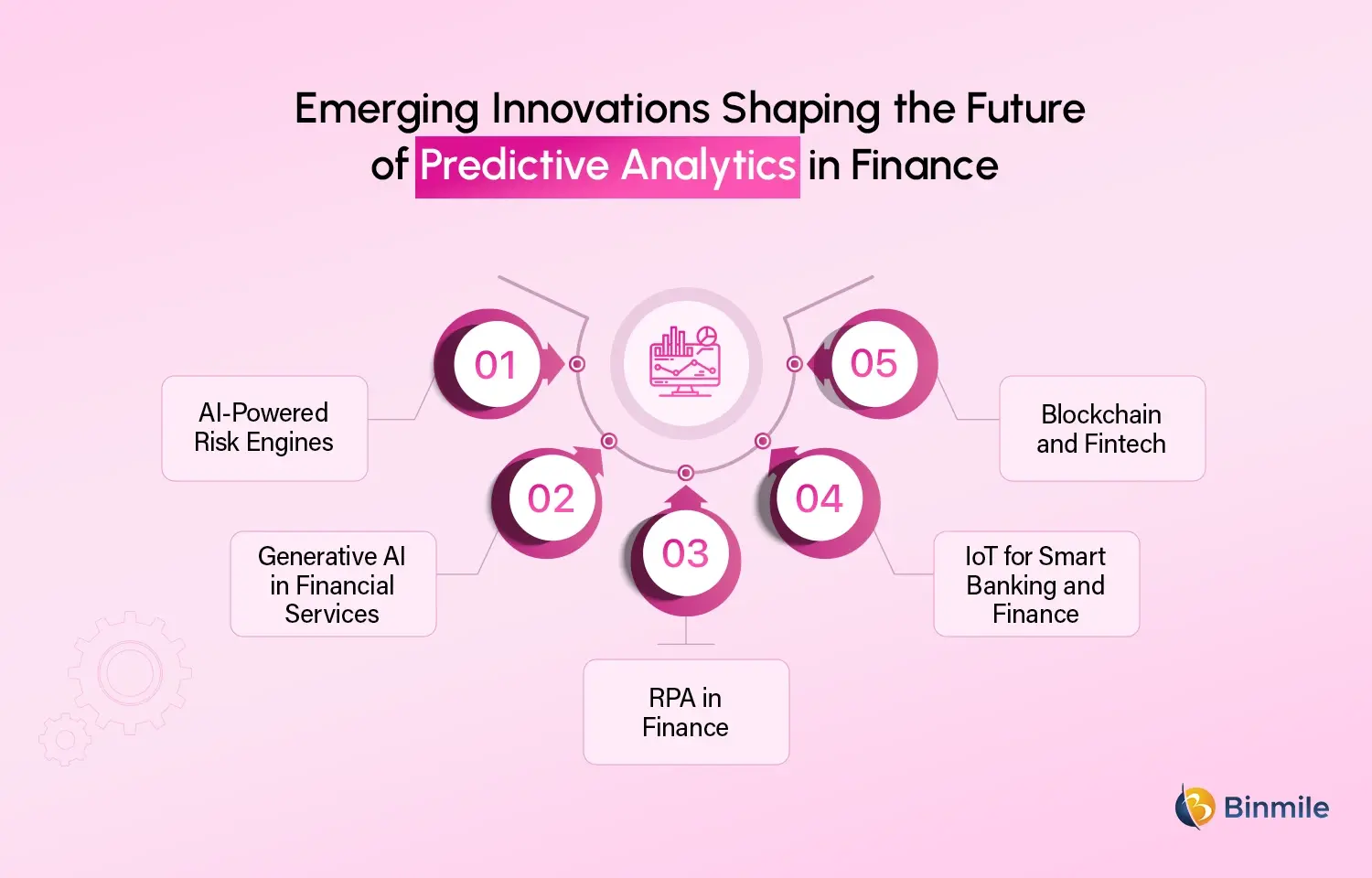
AI-Powered Risk Engines
AI will further advance risk scoring models and will enhance these systems automatically as they receive additional financial data.
-
Generative AI in Financial Services
Generative AI in financial services will assist in the rapid simulation of intricate financial situations and the stress-testing of models.
-
RPA in Finance
When combined with predictive analytics, RPA in finance will increase the speed of compliance workflows and reduce manual mistakes by completing some of the repetitive tasks associated with risk assessments.
-
IoT for Smart Banking and Finance
IoT for smart Banking and Finance will further enhance predictive models by providing new streams of data, including ATM usage and branch traffic data.
-
Blockchain and Fintech
Technology in blockchain and fintech will improve the clarity of transaction records, and predictive analytics will identify patterns within those records for unusual occurrences.
Ready to strengthen your risk management with advanced predictive models and automation?
How Binmile Supports Predictive Risk Management
Organizations looking to strengthen risk management need more than just tools. They require integrated predictive analytics solutions aligned with their financial goals.
Binmile helps financial institutions design customized predictive analytics software that integrates seamlessly with existing systems. By combining expertise in AI in finance, machine learning, RPA in finance, and fintech app development, the team builds scalable predictive models tailored to specific risk profiles.
Through structured data analytics services and automation strategies, businesses can modernize their risk frameworks without disrupting ongoing operations. The focus remains on improving forecast accuracy, strengthening compliance, and enabling proactive financial decision-making.
Financial institutions that adopt predictive analytics in corporate finance with the right technology partner can transform risk management from a defensive function into a strategic advantage.
Frequently Asked Questions
An FP&A model is a financial planning and analysis framework used to forecast revenue, expenses, and cash flow. It supports budgeting, scenario analysis, and performance tracking, often enhanced today by predictive analytics tools for better accuracy.
Banks, insurance companies, investment firms, fintech startups, corporate finance teams, and accounting departments can all benefit. Even small financial institutions can use predictive analytics software to improve risk assessment and decision-making.
It can manage credit risk, market risk, liquidity risk, operational risk, and fraud risk. Predictive models analyze patterns to forecast potential losses and recommend preventive actions before financial damage occurs.
While larger datasets improve accuracy, even moderate data volumes can generate valuable insights. Clean, structured, and relevant data is more important than sheer quantity for building reliable predictive models.
Accuracy depends on data quality, model design, and continuous training. With proper implementation, AI-powered predictive analytics can significantly outperform traditional forecasting methods and improve decision reliability.
They should assess data readiness, modernize IT infrastructure, train teams, and define clear risk objectives. Partnering with experienced data analytics services providers can streamline implementation and reduce integration challenges.
Yes, cloud-based predictive analytics solutions make adoption affordable and scalable. Smaller firms can start with focused use cases such as fraud detection or credit scoring and expand gradually.