Speed has become the new standard of customer experience. Whether it is booking a cab, ordering groceries, scheduling a doctor appointment, or hiring a technician, users expect services to be available instantly and delivered seamlessly. Businesses that fail to meet this expectation risk losing customers to competitors who can.
According to industry research, the global On-Demand Services Market is projected to grow from around USD 216 billion in 2026 to approximately USD 346 billion by 2035, expanding at a compound annual growth rate (CAGR) of about 5.4 percent over the forecast period. This reflects sustained demand for digital service platforms across sectors as consumers increasingly prefer fast, app-based access to services.
This blog will break down how modern service businesses are being transformed by on-demand app technology, the opportunities and challenges that come with it, and what you should keep in mind when considering a digital solution for your own business needs. You will learn about implementation cost drivers, the variety of on-demand app development solutions available, effective monetization strategies, business models that succeed with on-demand applications, and real-world examples of apps reshaping industries.
What is On-Demand App Development
On-Demand App Development refers to the process of building digital platforms that connect customers with service providers in real time through mobile or web applications. These types of applications provide requested services in real-time or have minimal time delays.
Instead of relying on traditional booking systems, phone calls, or physical visits, customers can browse services, schedule appointments, make payments, and track service status directly within the app. Examples of this are food delivery services, taxis, online medical consultations, home service providers, and online cargo services.
On-demand applications, unlike most applications, have only a few goals in mind when they are created: the app should provide instant service, it should be convenient for users to use the app, and it should help in adding more operational capacity. Businesses today often collaborate with experienced on-demand app developers to build custom on-demand mobile apps tailored to their operational structure. This is made possible by simplifying service processes, reducing the need for human intervention through automation, and enhancing the demand/supply connection.
What are the Benefits of On-Demand App Development
Investing in on-demand applications offers measurable advantages for service businesses.
-
Improved Customer Convenience
On-demand applications streamline the customer’s experience from the get-go. Customers can quickly search for services, check prices, book, and pay. Instant confirmation, support contact, plus tracking adds transparency to the process. Overall, the experience helps to build trust with customers and leads to more returns.
-
Higher Operational Efficiency
Usually, telephone coordination and the completion of paper-based processes lead to delay and error. Manual approaches to dispatch, scheduling appointments, and payment reconciliations have now become obsolete as a result of on-demand services. Because of this, staff can focus on more direct customer interactions, and as a result, businesses can provide the same amount of service with a greater volume.
-
Better Data Insights
Every interaction within the app generates data. Every day, businesses track the frequency of services rendered, preferences of the customer, the time of year, the season, and the geography. This data can be used to better price services and target marketing.
-
Increased Revenue Opportunities
The potential for the app to serve more customers from outside of the core service income (such as commissions from other services, subscriptions, and advertising with pay to promote services within the app) provides the business with greater economic security and less dependence on one income stream.
-
Scalability
Digital infrastructure allows businesses to expand to new cities or service areas without opening physical branches. With the right backend architecture, onboarding new service providers becomes faster and more cost-effective.
-
Stronger Brand Visibility
A well-designed mobile app acts as a constant brand touchpoint. Push notifications, loyalty programs, and personalized offers keep customers engaged and reinforce brand presence in a competitive market.
Breaking Down the Costs Behind On-Demand App Development Solutions
Many business leaders hesitate to build on-demand apps because they fear high initial investments. However, understanding the components of on-demand app development cost can help demystify the process:
1. Core Features
For apps, customer authentication, service lists, order tracking in real time, payments, and communication suites are needed. Though more advanced elements like AI-based suggestions or changing prices can make the cost higher.
2. Platform Choice
Choosing whether to go on iOS, Android, or both is a factor for both time and cost in development. Using cross-platform frameworks will be cheaper, but will be at the cost of their performance and the native feeling.
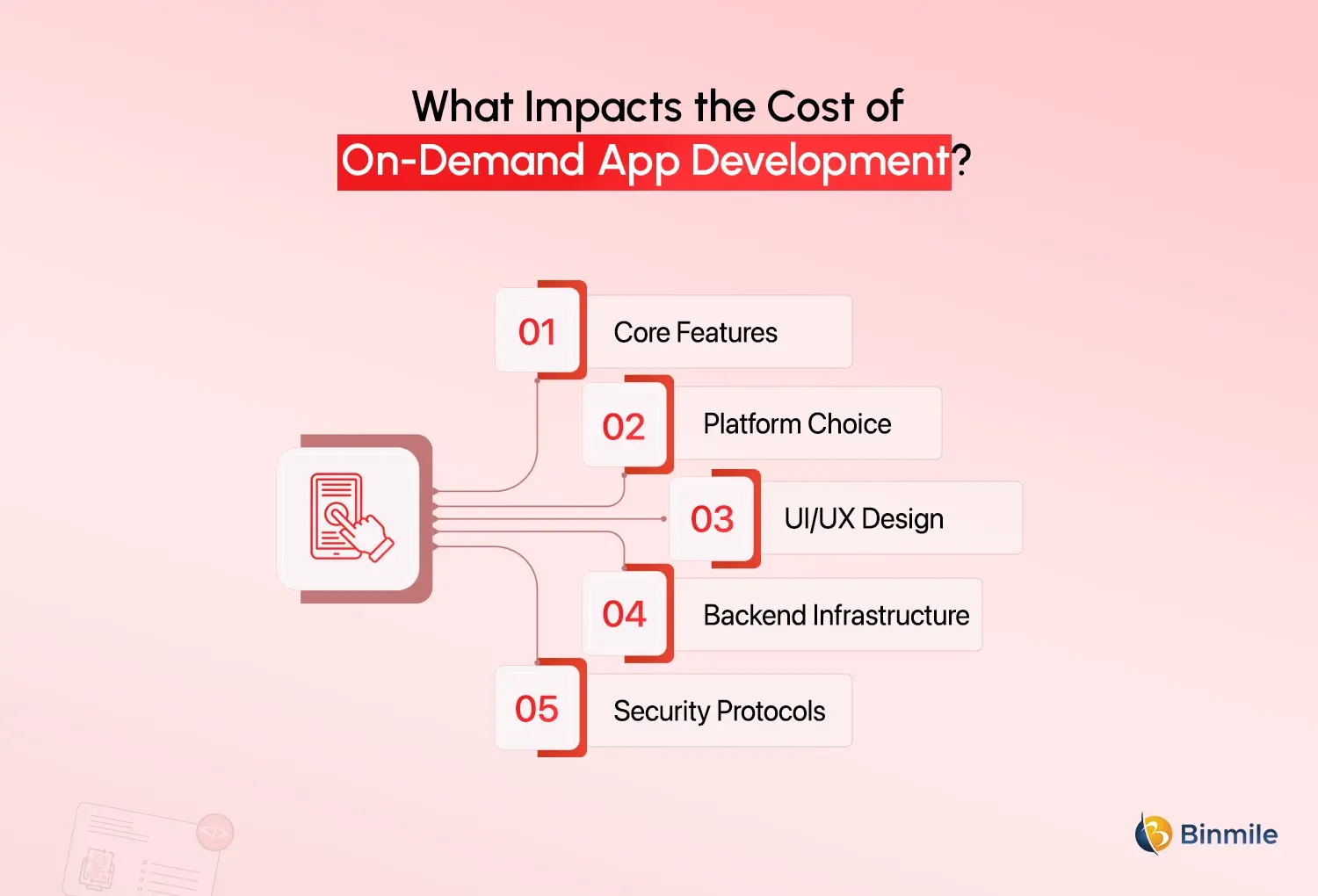
3. UI/UX Design
The more seamless and simple an interface and system is, the more users will adopt it. That is the reason why companies design them to be simple and intuitive.
4. Backend Infrastructure
For an app to remain responsive at peak times, it will need scalable servers, an API, and a database. When using a cloud system, it will cost more, but the system will be more reliable.
5. Security Protocols
To maintain a user’s trust, as well as to meet certain regulations, the app needs to have a strong system to protect the data. That is due to the personal and payment data a user shares.
Which Industry Benefits Most from On-Demand Apps
While almost every service sector can benefit from the on-demand app trends, certain industries have experienced particularly strong transformation through on-demand applications.
-
Healthcare
The healthcare app development has offered instantaneous medical consultations, the scheduling of appointments digitally, the management of prescriptions, and the monitoring of patients remotely. With all of the above seamless healthcare services, patients can access healthcare services more quickly, and healthcare providers can lessen their administrative load and better manage their appointments.
-
Food and Grocery Delivery
The on-demand services created by restaurants and supermarkets have improved the management of orders, automated the sending of orders to delivery personnel, and enabled received orders to be tracked in real time. All of the above have helped improve the accuracy of orders placed and the satisfaction of customers.
-
Transportation and Logistics
In the logistics and transportation industry, ride-hailing services and courier services have to utilize GPS to track their vehicles, have automated systems to dispatch drivers, and have systems to optimize their delivery routes. All of these systems help to reduce the waiting time for clients, improve the efficiency of the delivery process, and make better use of the vehicles in the fleet.
-
Home Services
On-demand services have been integrated into the booking of services such as plumbing, cleaning, electrical, and appliance repair. Customers have the ability to compare service providers, check their ratings, and book an intervention at the service provider of their choice.
-
Beauty and Wellness
For better operational management and improved customer retention, beauty salons, fitness trainers, and wellness professionals utilize booking apps, offer and manage memberships, and send booking reminders.
Industries where speed, convenience, and service reliability matter most tend to see the highest return from on-demand applications.
Looking for a custom on-demand platform that scales with your business needs?
On-Demand App Development Guide: Key Steps and Best Practices
A solid On-Demand App Development Guide walks through the entire lifecycle, from on-demand app idea validation to continuous improvement. Below is a more detailed roadmap:
| Stage | What Happens |
|---|---|
| Research & Strategy | Conduct market analysis, define your target audience, study competitors, validate your service demand, and outline on-demand business models. This stage also includes defining long-term scalability goals. |
| Feature Prioritization | Identify core functionalities required for launch. Focus on solving primary customer pain points first. Advanced features can be added later based on user feedback and data insights. |
| Design | Create wireframes, interactive prototypes, and UI mockups. Emphasis is placed on intuitive navigation, minimal friction, and consistent branding to ensure high engagement. |
| Development | Build the frontend user interface, backend server logic, APIs, database systems, and third-party integrations such as payment gateways or maps. Code optimization and performance planning happen here. |
| Testing | Perform functional testing, usability testing, performance testing, and security audits to ensure the app works smoothly across devices and scenarios. |
| Launch & Marketing | Deploy the app to stores, optimize app store listings, initiate digital marketing campaigns, and onboard initial users and service providers. |
| Optimization | Analyze user behavior data, identify drop-off points, introduce updates, refine features, and enhance performance for long-term retention. |
This structured process ensures your on-demand applications are reliable, user-friendly, and scalable.
How On-Demand App Monetization Drives Revenue
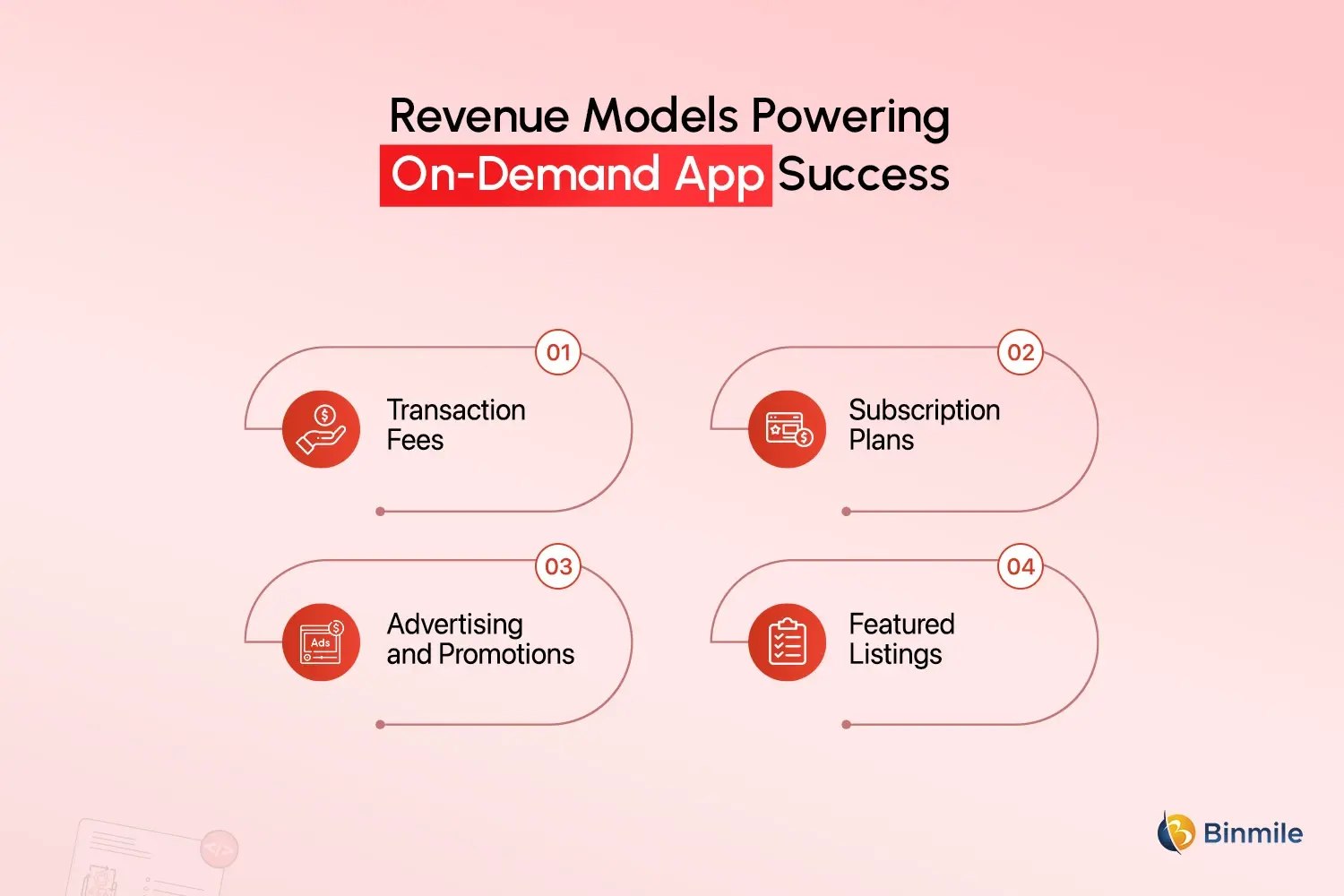
Sustainable monetization ensures long-term success. Each revenue model serves different strategic goals. Here are some on-demand app monetization strategies that help in driving revenue.
-
Transaction Fees
The on-demand app platform charges a fixed percentage or flat fee for each successful transaction. This model aligns revenue with usage, making it scalable as order volume grows.
-
Subscription Plans
Customers or service providers pay a recurring fee for premium features such as priority booking, discounted services, or enhanced visibility. This creates predictable revenue streams.
-
Advertising and Promotions
Businesses can collaborate with brands or local vendors to display targeted ads within the app. Smart advertising enhances user experience without being intrusive.
-
Featured Listings
Service providers can pay for premium placement in search results or categories. This increases visibility while generating additional revenue for the platform.
The key is balancing profitability with user convenience so monetization enhances rather than disrupts the experience.
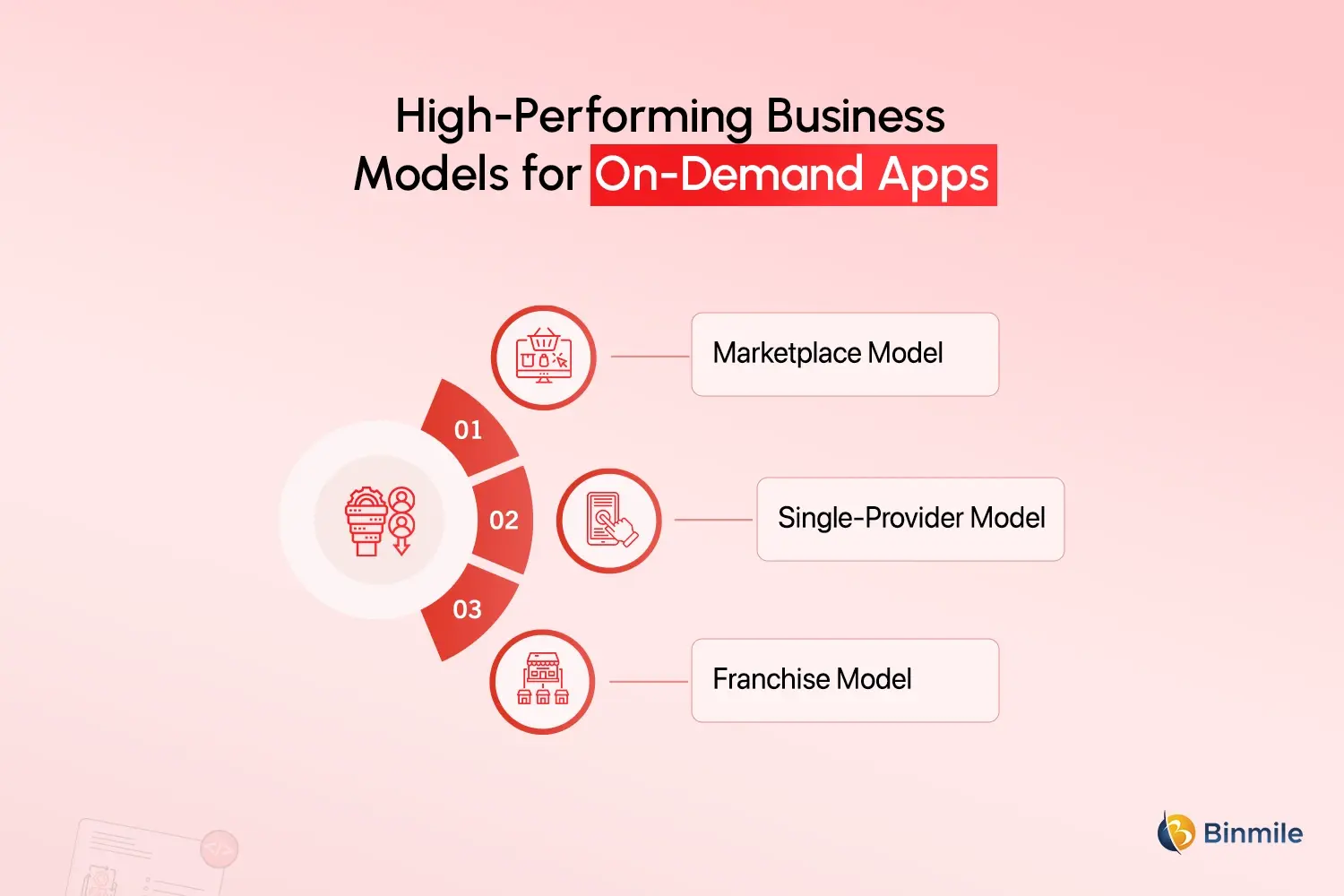
Popular On-Demand Apps Business Models That Work
Different service businesses adopt different structural approaches depending on operational goals.
-
Marketplace Model
The revenue is generated through a marketplace model in which the app acts as a middleman between customers and independent service providers, with commission as the primary revenue source. This model is highly scalable, but due to the rapid growth, there is a need for effective quality control.
-
Single-Provider Model
This model involves the highest operational expenditure but offers the highest control of service quality as the company owns all service providers.
-
Franchise Model
The model combines centralized control and operational decentralization. The app offers the opportunity for multiple franchise owners to deliver standardized services under one brand.
Each model influences technical architecture, pricing logic, and administrative controls within the app.
Ready to revolutionize your service business with a tailored on-demand app solution?
Accelerating On-Demand Business Success with the Right Technology Partner
Transforming a service business through digital platforms requires more than technical execution. It demands strategic thinking, scalable architecture, and a clear understanding of user behavior. A development partner that combines deep industry insight with strong engineering capabilities can significantly reduce risks and accelerate time to market.
Binmile supports organizations across industries by designing and delivering high-performance digital solutions tailored to evolving business needs. From MVP development for startups to complex enterprise-grade platforms, the focus remains on building scalable, secure, and intuitive on-demand applications. By collaborating with skilled on-demand app developers and following a disciplined app development process, businesses gain solutions that drive efficiency, monetization, and sustainable expansion.
Frequently Asked Questions
Costs vary widely based on complexity, features, platforms, and design. Small apps might start around modest budgets, while large enterprise-grade applications reach six figures or more, depending on requirements.
Service businesses like food and grocery delivery, ride-hailing, home services, logistics, and healthcare see the highest impact due to direct user engagement and repeat usage.
Common monetization models include transaction fees, subscriptions, advertising, and featured listings that generate revenue while keeping the user experience smooth.
Custom solutions are ideal for unique workflows and branding needs. Template platforms can be suitable for quick market entry, but often limit differentiation and scalability.
Typical development cycles range from a few months for basic solutions to a year or more for complex, feature-rich applications.