Organizations want to constantly improve their systems to better meet user demand while keeping their systems secure and resilient. Increased digital engagement increases user expectations for businesses to provide accurate and fast services that can be accessed anytime. Gartner predicts that public cloud services will hit $679 billion in 2024 and over $1 trillion in 2027. This phenomenon illustrates how critical the cloud is to decreasing economic profitability. When businesses move to the cloud, they rethink how to build and protect their systems.
Organizations that move to cloud modernization are changing outdated technology and systems. These systems that are more flexible and secure will provide improved scalability. This is exactly what we will discuss in this blog. Additionally, we will discuss the real challenges that organizations face with cloud modernization and real examples. Taking all of this into account, we can create an environment that will be cloud-ready to meet our challenges.
What is Cloud Modernization
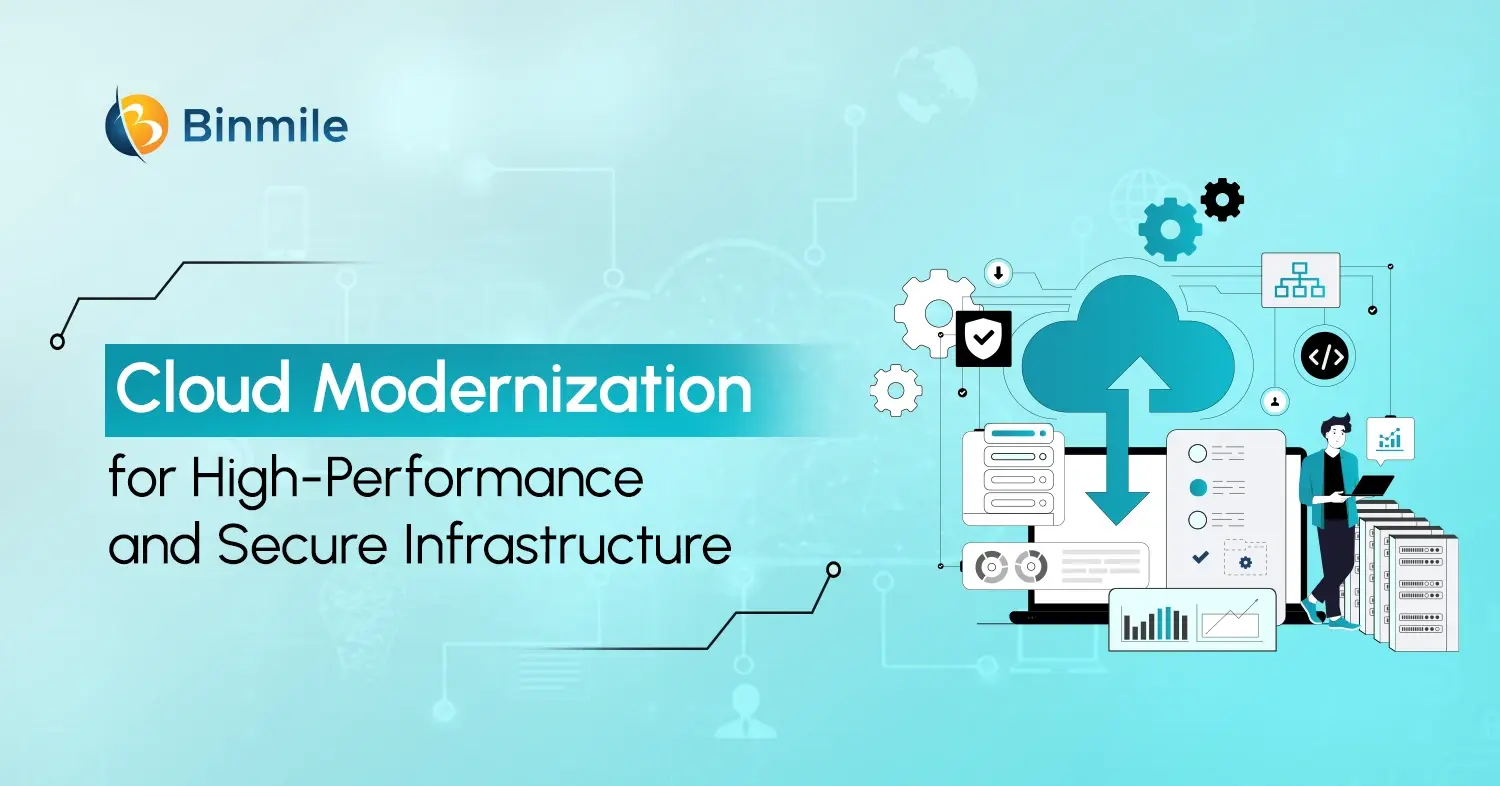
Cloud modernization refers to the process of upgrading existing IT systems, applications, and infrastructure to fully leverage cloud capabilities. Incorporating cloud technology is more about building new systems and changing how systems are run and created than moving data from on-premise servers to the cloud. This includes moving legacy systems to the cloud and rebuilding them as a microservices architecture and using new development methodologies that allow for more agility and speed. This also includes cloud data modernization for databases and cloud infrastructure modernization for higher performance.
Cloud migration and modernization aim to keep innovation and better performance, scalability, and security as the main focus of the migration. Modernization of the cloud allows businesses to repurpose old systems into productive and new systems instead of just moving systems to the cloud.
Why Businesses Need Cloud Modernization
Legacy systems create inflexible systems that increase costs and impact security. Most systems are expensive to maintain and to fight vulnerabilities and poor performance.
Here is why modernization becomes necessary:
1. Increasing Demand for Scalability
Legacy IT systems cannot adequately accommodate abrupt increases in traffic. In contrast, contemporary cloud systems seamlessly add or subtract resources in response to fluctuations in demand.
2. Rising Security Concerns
Systems that are subjected to cloud modernization solutions are far less susceptible to cyber threats. Newer cloud systems incorporate modern security tools that are far better at safeguarding data and application transformation.
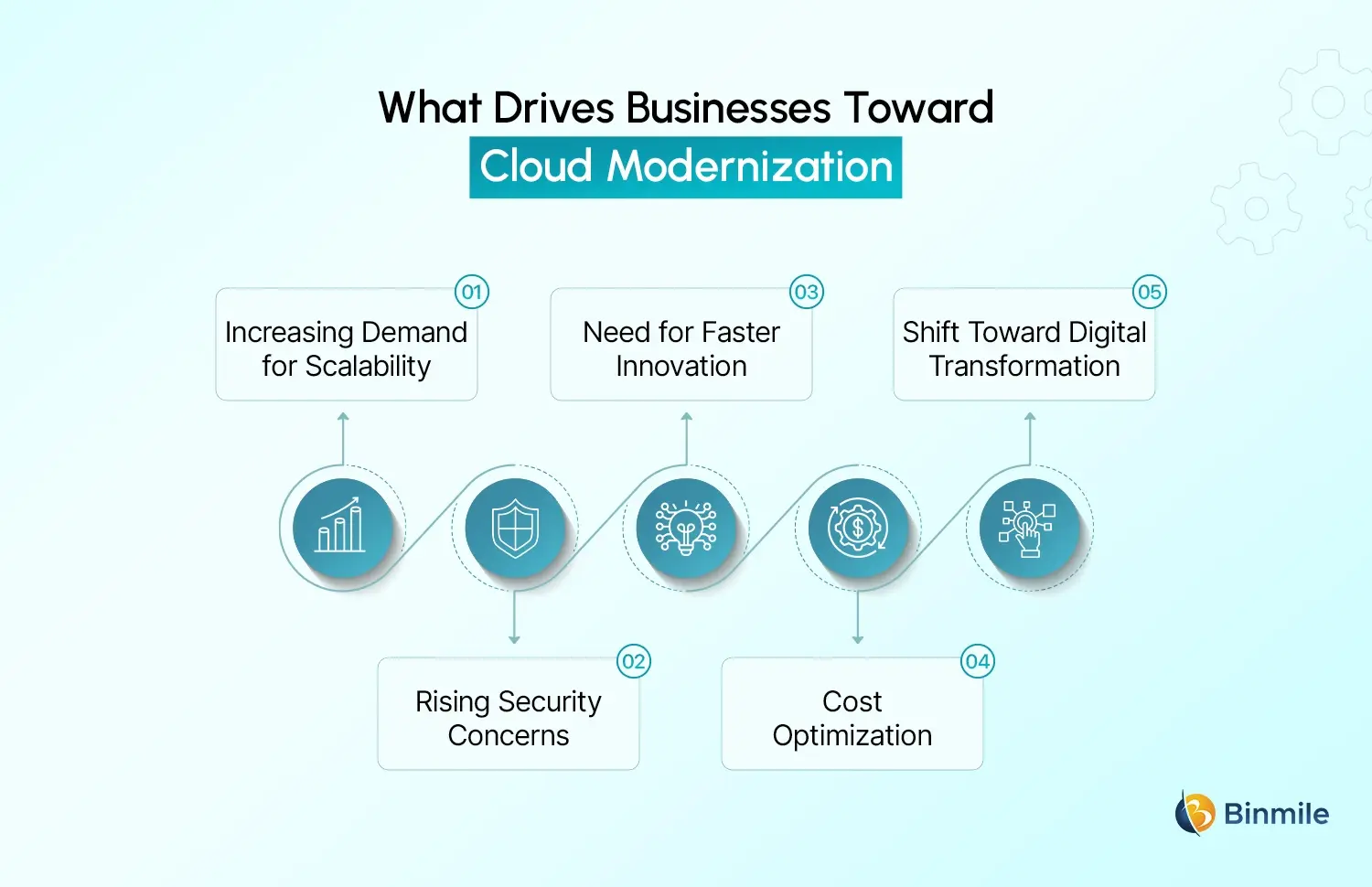
3. Need for Faster Innovation
Businesses desire quick turnaround for product updates. The latest cloud systems allow for rapid business processes and innovations by virtue of continuous integration and delivery.
4. Cost Optimization
Outdated IT systems are financially burdensome. Applying a cloud modernization strategy to IT systems is less expensive due to reclaimed resources and a more efficient use of measures.
5. Shift Toward Digital Transformation
The modern-day consumer is accustomed to convenient and efficient digital processes. Without updating systems, businesses put themselves at a risk of obsolescence.
Key Business Benefits of Cloud Modernization
Cloud modernization brings measurable improvements across performance, scalability, and security. Let us understand the benefits in detail.
-
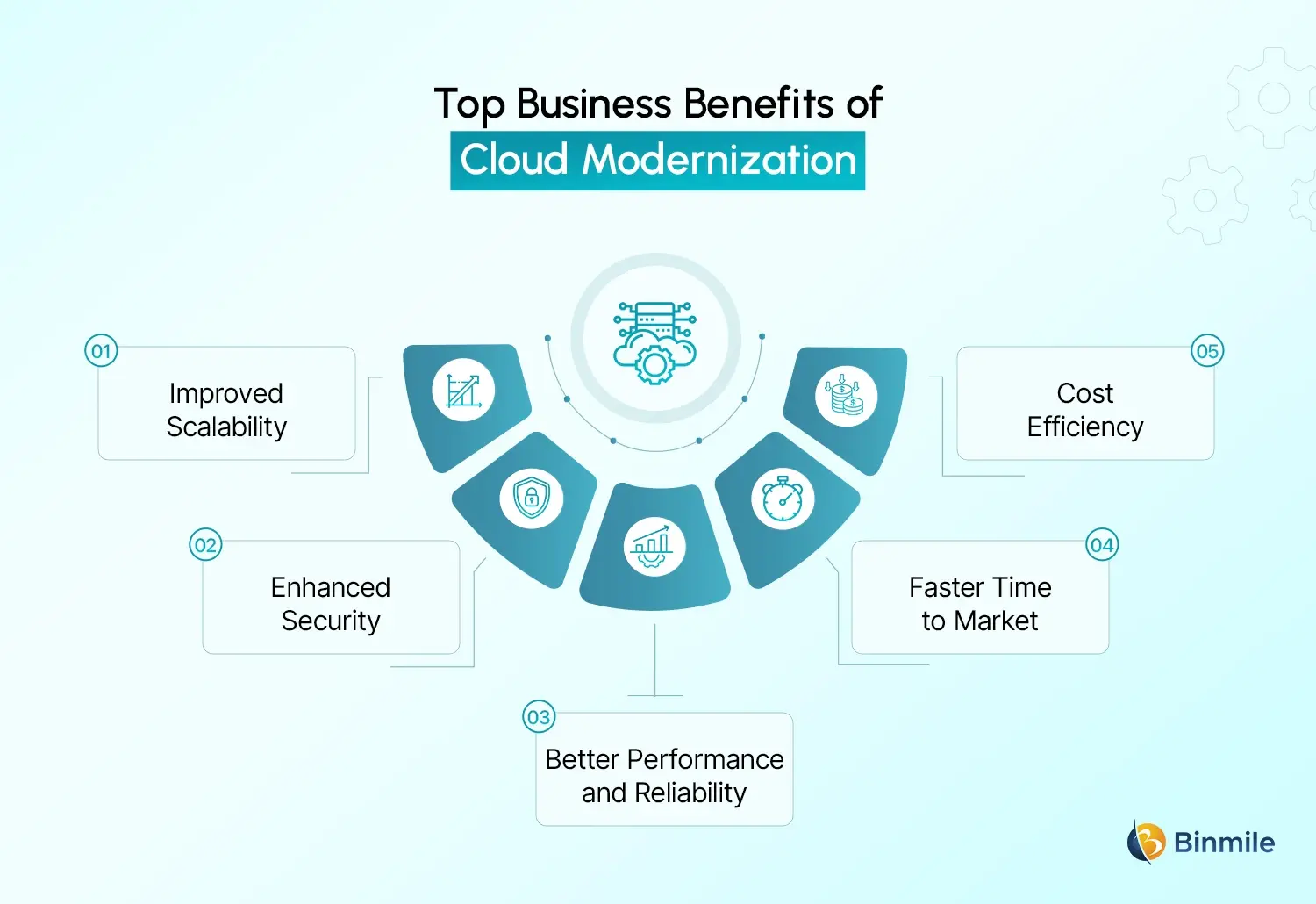
Improved Scalability
Cloud modernization enables dynamic scaling based on demand. Auto-scaling handles traffic spikes, pay-as-you-go avoids overspending, and global infrastructure supports expansion, ensuring consistent performance for businesses with fluctuating workloads.
-
Enhanced Security
In cloud systems, data can be better protected with the use of continuous updates to cloud systems that reduce the chance of threats. Automated systems can detect threats better than traditional systems. The use of systems that control and monitor a system has proven better than traditional systems.
-
Better Performance and Reliability
The use of cloud technology and distributed systems, along with load balancing, helps with cloud modernization and improves performance. It increases speed and ensures that applications are stable and responsive, even during heavy workloads.
-
Faster Time to Market
With cloud resources and automation, businesses are able to implement updates, segment testing, and launch features much more quickly, enhancing competitive advantages and responding to market changes.
-
Cost Efficiency
Modernizing to the cloud eliminates the need for physical infrastructure, optimizes resource allocation, and reduces maintenance, giving businesses the ability to become more proactive with managing costs.
Cloud Modernization Checklist
Before starting a modernization journey, businesses need a clear roadmap. Here is a practical checklist:
1. Assess Existing Systems
The first thing you need to do is understand your current IT environment. This means understanding your current applications as well as your infrastructure, dependencies, and limitations in terms of performance. From a proper understanding, you can discern what systems need your focus and those you can modernize at a later time.
2. Define Business Goals
Your modernization efforts should, in a way, match your other business goals. Whether it is the growth of your business, improvement of security, and/or a reduction of costs, having your goals aligned will give you focus and clarity in the decision-making process.
3. Choose the Right Approach
Different systems will need different approaches in terms of modernization. From business goals, time, and the complexity of it all, you can choose the correct approach in terms of replatforming or up and shifting a cloud migration for other applications.
4. Prioritize Applications
In a perfect world, you would modernize every system at the same time, but here on planet Earth, that is not the case. That’s why you will need to take a phased approach to it all to mitigate risk and ensure things happen in a logical manner.
5. Select the Right Tools and Platforms
The tools you choose should match things like security integration, scalability, and other business goals that you may have for the long haul.
6. Implement Security Measures
Security should be considered from the start. This includes the development of safeguards to protect systems and data in an application modernization project, including access controls, encryption, compliance frameworks, and monitoring systems.
7. Test and Optimize
System modernization is not a ‘one and done’ activity. For the long-term sustainability of systems, continuous testing and monitoring of performance is essential. It is only with these that issues can be identified and efficiencies produced.
Still relying on legacy systems that slow you down? Upgrade to a modern, scalable, and secure cloud environment.
Cloud Modernization vs. Traditional IT
Understanding the difference helps in making better decisions.
| Aspect | Traditional IT | Cloud Modernization |
|---|---|---|
| Scalability | Limited and manual | Automatic and flexible |
| Security | Reactive approach | Proactive and advanced |
| Cost | High upfront investment | Pay-as-you-go |
| Deployment | Slow | Fast and automated |
| Maintenance | Resource-intensive | Managed and optimized |
This comparison clearly shows why businesses are shifting toward cloud modernization and migration.
Cloud Modernization Use Cases Across Industries
Different industries need modifications to the cloud in ways that fit the needs of the specific industry. Healthcare organizations, for example, need cloud data modernization to securely store and retrieve patient records to enhance accessibility for clinicians. Banks and financial institutions need cloud application modernization services to enhance security and comply with regulations. For effortless customer satisfaction and to manage peak traffic, the retail and e-commerce industries need to modernize their cloud infrastructure.
IoT devices enhance operational efficacy and predictive maintenance in conjunction with cloud systems in integrated manufacturing businesses. Adaptable cloud systems support seamless worldwide content delivery in the media and entertainment industry. These instances shed light on the cross-industry innovation and cloud modernization for U.S. enterprises and operational efficiency in global organizations.
Risks and Challenges in Cloud Modernization
While the benefits are significant, modernization also comes with challenges.
-
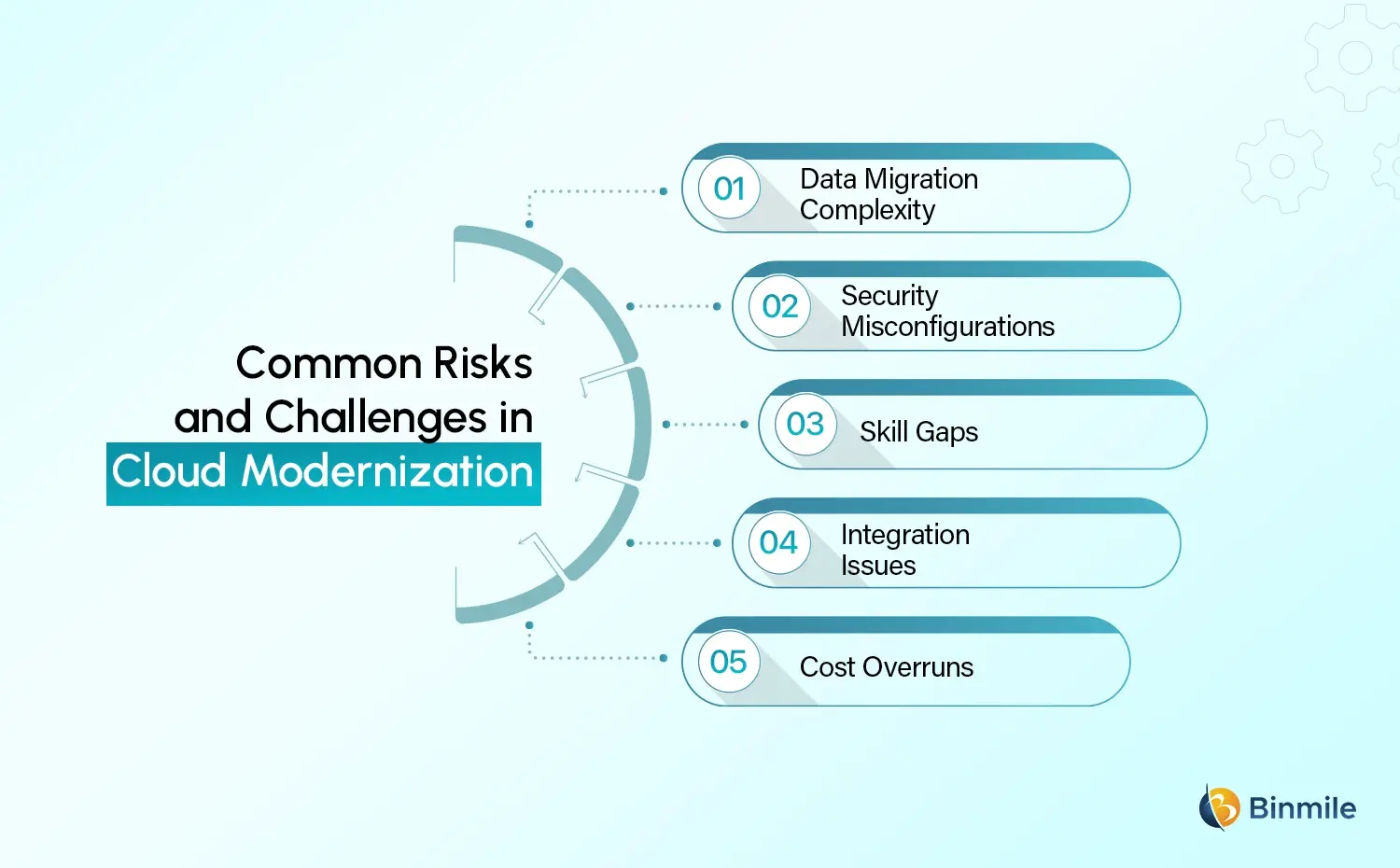
Data Migration Complexity
The migration of big data amounts to cloud environment systems poses the challenges of ensuring data integrity, minimizing any data loss, and ensuring the data is not corrupted as the transfer is taking place. If not executed properly, this can lead to delays in the entire modernization process.
-
Security Misconfigurations
While the cloud provider may provide a default system with strong features, the cloud system may come with insecure configurations and vulnerabilities. If access controls and permissions are mismanaged, sensitive data may be exposed, which is why it is important to take the configuration steps correctly.
-
Skill Gaps
The most recent cloud technology requires specialized knowledge, and this is why most organizations are having challenges due to the lack of people who are skilled in cloud architecture, as well as DevOps, and the security of the systems. This causes a slow implementation.
-
Integration Issues
The process of trying to integrate existing legacy applications with cloud systems is challenging. There is a frustrating combination of incompatibility and complex dependencies.
-
Cost Overruns
Some of the cloud costs may be out of control, and this is why the planners are out of control. If there is a misuse of resources and the time in the planners is extended, the costs will definitely be out of control.
How to Overcome These Challenges
A clear and organized strategy is necessary to overcome these challenges. Businesses can benefit from defining a cloud modernization process and setting specific objectives for each step. Automation is a useful strategy for reducing manual errors and im improving efficiency, which is especially true for deployment and monitoring tasks. Training investments increase team member familiarity with modern technologies and help to bridge existing skill gaps. Cloud consulting partners can help improve their expertise and simplify their guidance. Monitoring and optimizing is a continuous task that keeps control, performance, and costs in order to ensure long-term success.
The Role of DevOps in Cloud Modernization
Cloud modernization relies heavily on DevOps. With DevOps, you not only increase speed, but you also improve reliability and communication. Automated deployment strategies create consistent and speedier releases. With integrated continuous delivery and integration practices, system changes are made without delays. Collaboration is enhanced with the reduction of silos, and the overall added systems performance monitoring and management helps keep the organization without poor application performance. With DevOps, businesses are able to reap all the benefits of cloud modernization.
Looking to scale your systems that work for your business without compromising on security?
How Binmile Supports Cloud Modernization Journeys
Modernization is more than just technology updates; it’s a strategic overhaul that requires specialized knowledge and methodologies. Binmile’s approach to cloud consulting, application transformation, and AWS consulting services helps clients progress past fundamental cloud migration and develop advanced and secure infrastructure.
From the outset, the focus is on capturing the specific requirements of the business, and from there, tailoring an appropriate strategy for modernization. Whether it is lift and shift cloud migration, re-engineering applications to adopt microservices architecture, or undertaking large-scale complex legacy software modernization, the focus is always on building systems that are adaptable, robust, and prepared for the future.
Where modernization combines sound technology practices with a proven methodology, businesses are able to minimize risk, increase efficiency, and expedite transformation to the cloud while avoiding disruption.
Frequently Asked Questions
Yes, cloud modernization enhances security through advanced encryption, real-time monitoring, and automated updates. However, proper configuration and management are essential to fully benefit from these security improvements.
Yes, businesses can follow a phased approach. They can start with critical applications and gradually modernize other systems, avoiding disruption while improving performance and scalability over time.
DevOps enables faster deployment, continuous integration, and automated testing. It ensures smoother operations, quicker updates, and better collaboration between development and operations teams during modernization.
Yes, modernization typically improves performance by optimizing architecture, enabling faster processing, and reducing downtime. However, proper planning and testing are required to avoid temporary performance issues during transition.
Industries like healthcare, finance, retail, manufacturing, and media benefit significantly. Any sector that requires scalability, data security, and real-time performance can gain value from cloud modernization.