Cloud adoption brings flexibility and scalability, but costs can quickly spiral if not managed carefully. According to IDC, organizations waste an estimated 10–30% of their cloud spending due to inefficient resource utilization and a lack of cost control.
This is where working with an AWS consulting partner becomes critical. In this blog, we will break down what these partners actually do, why businesses struggle with rising costs, and how the right strategies can help reduce cloud expenses. We will also cover practical Cloud Cost Optimization Strategies, benefits, challenges, and what the future looks like for cost-efficient cloud management.
What does an AWS Consulting Partner do?
An AWS consulting partner plays a much broader role than just helping you set up your cloud infrastructure. Start by evaluating your existing business systems, objectives, and need for scalable future growth to develop a comprehensive multi-faceted cloud strategy. AWS consulting means that every cloud-related decision made favors either performance or cost savings.
Experts in AWS migration consulting develop strategies and implement the transition of cloud services and on-premises systems to AWS with the least downtime and cost. In addition to this, AWS DevOps consulting takes your business processes and puts them on autopilot. By implementing CI/CD frameworks and coding your infrastructure, your team’s manual labor is decreased, resulting in higher productivity and a reduction of costly mistakes.
With the addition of AWS managed services, they provide ongoing support for your services by making ongoing adjustments to improve efficacy. A part of this function is to monitor and adjust the costs related to cloud services. They analyze usage to identify waste and recommend changes to ensure a dependency on AWS consulting services is a value decision made by businesses relying on such software consulting services. AWS cloud consultants combine technical and fiscal understanding of cloud operations to provide optimal service for their clients.
Why Many Businesses Struggle with Rising AWS Costs
The biggest misconception about the cloud is that it is automatically cost-effective. While AWS Cloud offers a pay-as-you-go model, improper usage can lead to unexpected bills.
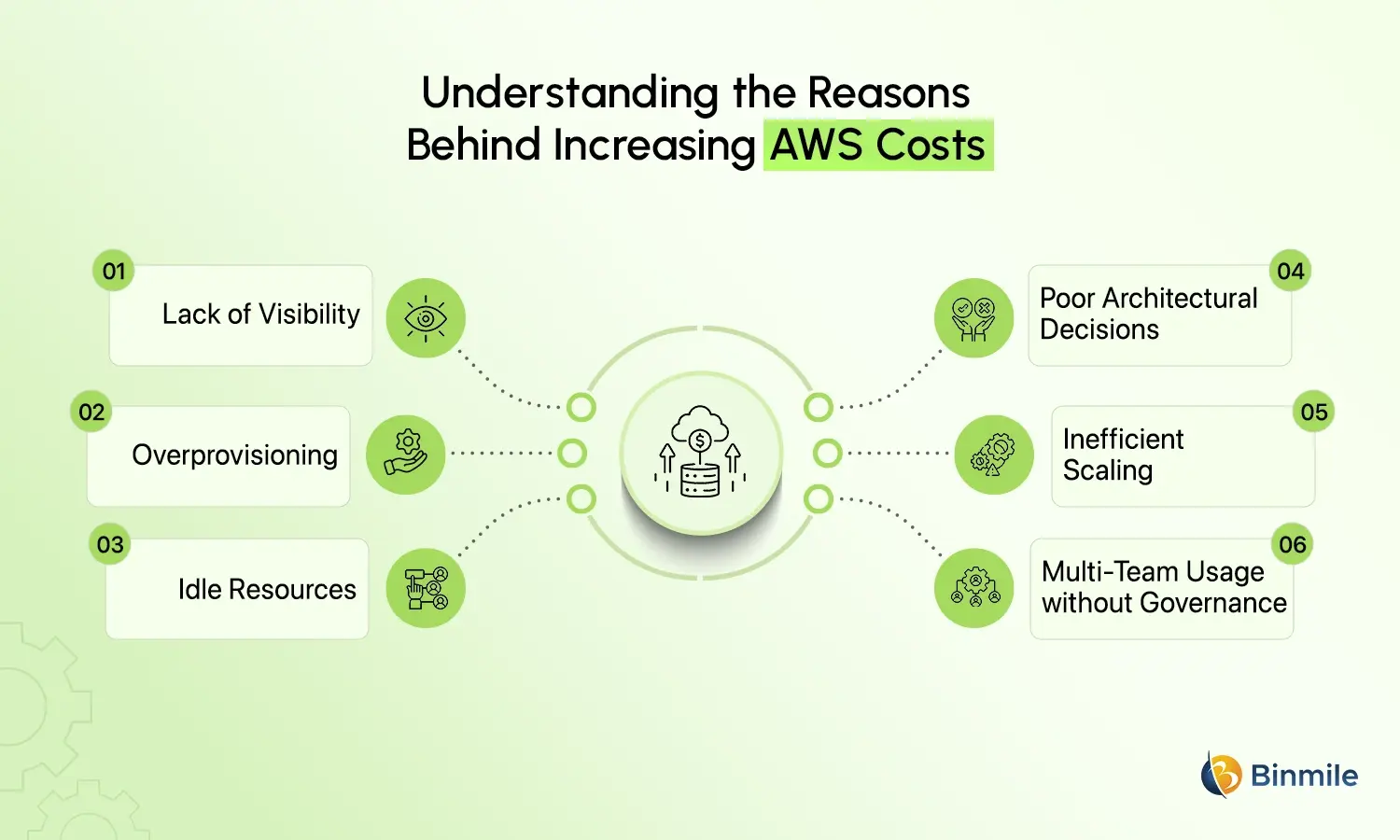
Here are some common reasons why costs increase
-
Lack of Visibility
Many organizations utilize various cloud services and have no view of their overall spending. Different teams utilize different services, and without dashboards or systems to track cloud spending, cloud budgets lack clarity. The absence of visibility can also result in the unnoticed growth of cost leaks.
-
Overprovisioning
To reduce the risk of performance problems, teams tend to provision more computing, storage, or database resources than are necessary. While such practices ensure systems withstand considerable stress, and while considerable overprovisioning occurs, costs rise without commensurate value.
-
Idle Resources
Unused resources are often considered the most common and most neglected resources, until the resource is needed. The unmonitored resources run costs, for example, older test environments, unmonitored load balancers, etc.
-
Poor Architectural Decisions
Inefficient infrastructure design is a common outcome of inadequate AWS consulting. An example includes using always-on virtual machines for workloads that can be handled using serverless architecture. Poor architecture often locks businesses into higher long-term costs.
-
Inefficient Scaling
Auto scaling is designed to maximize efficiency and reduce the overall costs of a system by increasing or decreasing the system resources available. However, if auto scaling is not configured exactly right, scaling can become more aggressive than desired by the users and can stay at a higher configured level for long periods of time through periods of low demand. Users are then charged for resources that are typically not necessary.
-
Multi-team Usage Without Governance
In larger organizations, multiple teams deploy and manage their own resources. Without governance policies, this leads to duplication, inconsistent configurations, and a lack of accountability. Over time, this decentralized approach creates significant cost inefficiencies.
These challenges highlight why businesses turn to AWS consulting and technology partners to bring structure and efficiency into their cloud usage.
How an AWS Consulting Partner Helps Reduce Cloud Costs
AWS Cloud Consulting Partners help businesses with proactive and controlled cost management instead of reactive cost management. Clients no longer deal with unforeseen issues and have enhanced visibility and sustained command of their cloud expenditures.
The process usually commences with a cost audit to pinpoint variables contributing to inefficiency, such as over-provisioned resources, large instances, and superfluous services. From there, right-sizing is undertaken to align the infrastructure to actual utilization, which cuts costs by ensuring that payment is only for resources that are actually in use. Furthermore, through AWS DevOps consulting, automation is also increased by taking over tasks related to scaling and the shutdown of unutilized resources.
Consulting partners also maximize the value of their pricing by using the optimal combination of Reserved Instances, Savings Plans, and on-demand usage. Additionally, architectural improvements through methods such as serverless computing reduce unnecessary costs tied to infrastructure. Ongoing containment of costs is made possible through continuous tracking, which detects and resolves issues that contribute to increased costs, which in the end fosters enhanced efficiency and reduced costs in cloud computing.
What are the Key Cloud Cost Optimization Strategies
Reducing cloud costs is not about cutting usage blindly. It is about using resources intelligently. Below are some proven Cloud Cost Optimization Strategies used by experts.
1. Right-sizing Resources
Right-sizing means analyzing CPU, memory, and storage usage per application, and adjusting resources to tiers that meet usage. Many workloads are overestimated, and without right-sizing, businesses are charged for resources they don’t need. By resizing their tiers based on actual usage data, businesses can make significant savings without sacrificing performance.
2. Use Reserved Instances and Savings Plans
AWS provides pricing models for workloads that are run consistently. These are reserved instances, where customers make a commitment to AWS for a specific period, and savings plans, where customers are billed at a specific rate. These cost customers less than on-demand pricing and can lead to significant savings over time if done correctly.
3. Auto-scaling
Auto-scaling allows AWS to optimize resources and cost based on user demand. During low usage, AWS resources are lowered to make cost savings, and during peak usage, resources are increased to maintain performance. This correction makes auto-scaling a very effective technique for optimization.
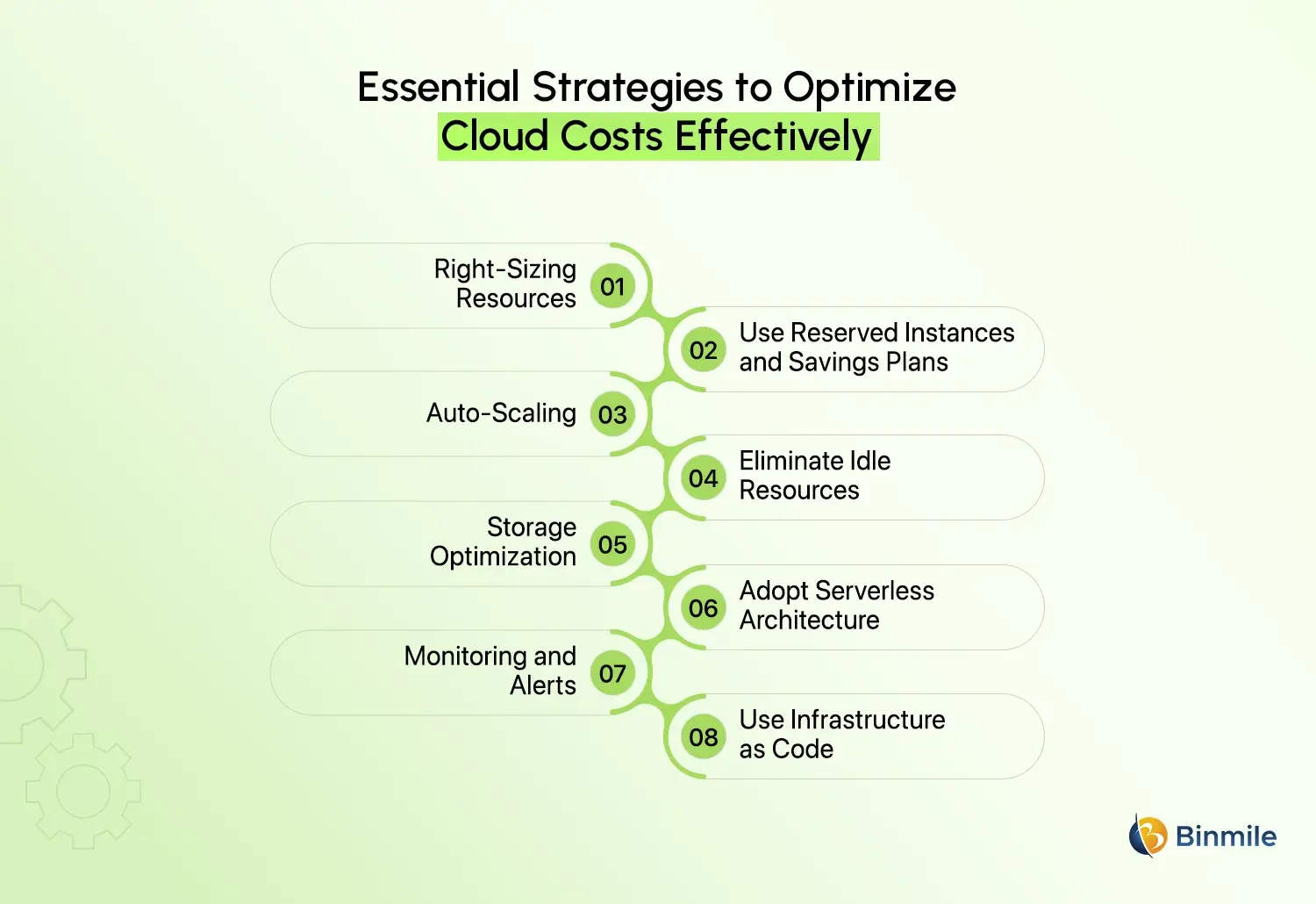
4. Eliminate Idle Resources
Your cloud environment should be audited frequently to determine if resources can be used elsewhere. Examples are old test environments, unused storage volumes, and inactive databases. Removing or shutting down resources ensures that the customer and cloud provider are not wasting money on a resource that is providing no value.
5. Storage Optimization
High-performance storage is not required for all data. For data impacted by performance, high-performance storage can be used; for data that is not frequently accessed, cradle or archival storage can be used. This tiered approach will help to minimize costs without negatively impacting access to data.
6. Adopt Serverless Architecture
Serverless computing lets you run your apps without having to spin up and maintain any servers. For example, with AWS Lambda, you only pay to run your code and not when your servers are idling. This flexibility is ideal for apps with unpredictable traffic.
7. Monitoring and Alerts
A budget, usage alert systems, and having dashboards available to monitor and set limits on costs help businesses keep control of their spending. Rather than getting a huge bill at the end of the month, your teams are able to see and control usage to keep costs from rising.
8. Use Infrastructure as Code
Tools such as AWS CDK and IaC (Infrastructure as Code) are able to create and manage resources in a consistent manner. This helps avoid duplication, misconfigurations, and unnecessary resources. Over time, this approach will help with cost savings and overall operational efficiencies.
Struggling with rising cloud bills and inefficient infrastructure? Let our AWS specialists help you build a cost-effective and scalable cloud environment.
What are the Benefits of Working with an AWS Consulting Partner
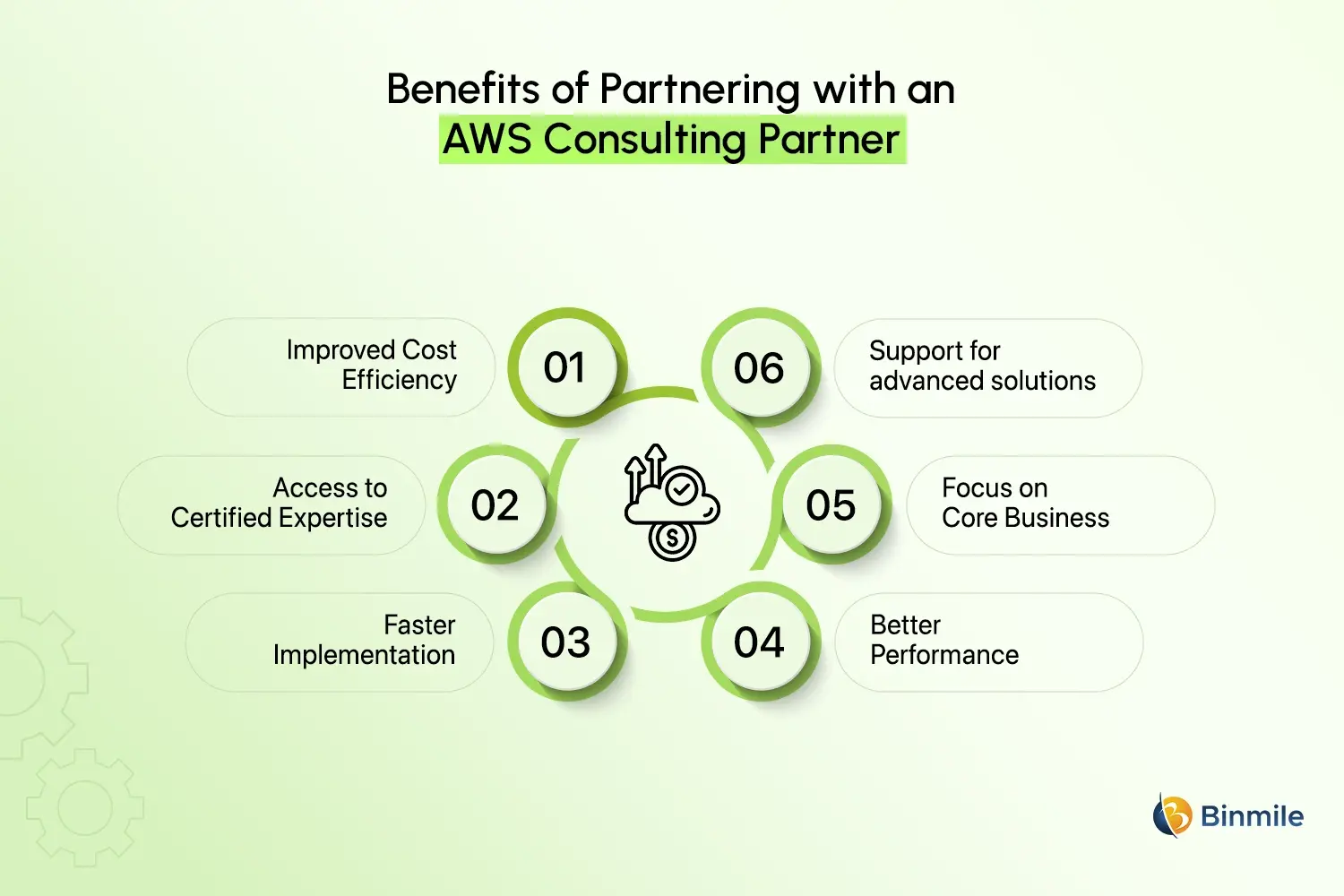
Choosing the right AWS consulting partner offers more than just cost savings. It creates a strong foundation for long-term growth.
-
Improved Cost Efficiency
As an AWS consulting partner, continuous tracking of your cloud environments to discover how money is wasted is done. Early investments are made to help create flexible mechanisms to sustain cloud environments’ growth over time as the business expands.
-
Access to Certified Expertise
Along with AWS proficiency in cloud consulting, they also have a wide-ranging technical understanding of various industries. Mistakes that could be extremely expensive to businesses and cost-cutting measures that are also extremely expensive to businesses are easily avoided, and made economic and also made economic.
-
Faster Implementation
Advisory partners based on established methodologies, integrated tools, and their expertise can put in place solutions far more swiftly than in-house teams being trained. Delays are minimized, and your cloud environment can deliver advantages in value more quickly.
-
Better Performance
An optimized cloud environment should deliver an exceptional experience through greater cloud speed, improved cloud reliability, and increased cloud effectiveness. Less cloud spending does not mean decreased cloud environment effectiveness.
-
Focus on Core Business
Cloud infrastructure management is complex and time-consuming. When this is outsourced to specialists, internal teams can concentrate on innovation, product improvement, and business growth rather than operational issues.
-
Support for Advanced Solutions
AWS consulting partners facilitate the incorporation of cutting-edge technologies like AWS AI Consulting, automation frameworks, and DevOps as a service, which serves as a pipeline into the business processes of the companies they assist. This enhances operational efficiency and provides clients with a significant market advantage.
Industries such as fintech, healthcare, eCommerce, and startups particularly benefit from working with AWS consulting companies due to their dynamic and scalable needs.
Future Trends in AWS Cost Optimization
Cost optimization methods for cloud computing are becoming more intelligent and automated. With the help of AI, businesses can analyze their consumption patterns, forecast their needs. Additionally, take measures to avoid unnecessary costs before the overconsumption of cloud services becomes a budget concern.
The Automation of FinOps makes it easier for engineers to crossteam collaborate between the finance, marketing, and operations teams for Cloud Governance for various use cases. This means that automation is still needed to simplify fast, unhindered, and seamless dynamic resource management.
Greater use of Serverless and containerized technology architecture aids in cost and infrastructure dependency reduction. The growth of businesses has positioned cost optimization as a continual process instead of a singular occurrence. This has made it possible for businesses to improve their operational and performance efficiency.
Looking to cut down your AWS cloud costs without compromising performance?

How the Right Expertise Can Make a Difference
Reducing cloud costs is not a one-time task. There must be monitoring and optimization, as well as strategic planning. This means, in most cases, businesses have to turn to external teams as internal teams do not have the capacity to optimize infrastructure effectively.
By collaborating with an experienced partner such as Binmile, organizations get the opportunity to work with an unparalleled level of sophistication when it comes to cloud management. With all the experience and specialization in the field of AWS Managed Services, AWS Cloud Migration, and DevOps as a service, the primary focus is to integrate the tools of cloud computing to facilitate service delivery while optimizing costs. From a high level, they combine the technical experience with the ability to execute the cloud strategy to create an environment that is efficient and maximally cloud-enabled.
Frequently Asked Questions
An AWS Consulting Partner is a certified organization that helps businesses design, deploy, and manage applications on AWS. They provide expertise in architecture, migration, optimization, and ongoing support to ensure efficient and cost-effective cloud operations.
They analyze usage, eliminate waste, right-size resources, and implement automation. By optimizing pricing models and improving architecture, they ensure businesses only pay for what they actually use, reducing unnecessary cloud expenses.
High costs often result from overprovisioning, idle resources, lack of monitoring, and poor architecture decisions. Without proper governance and optimization strategies, cloud usage becomes inefficient and leads to increased spending.
Companies should consider hiring a partner when migrating to AWS, facing rising cloud bills, scaling operations, or lacking in-house expertise. Early involvement helps prevent costly mistakes and ensures efficient cloud management.
They use techniques like auto-scaling, right-sizing, serverless architecture, and cost monitoring tools. These methods ensure workloads are efficient, scalable, and aligned with both performance and budget requirements.
Industries like fintech, healthcare, retail, and startups benefit the most. These sectors require scalable, secure, and cost-efficient cloud solutions, making expert consulting essential for managing complex and dynamic workloads.