Adoption of AI in eCommerce is no longer a futuristic idea; it is a reality shaping how online businesses operate and compete. By 2025, around 77 percent of eCommerce professionals are using AI tools daily, and 80 percent of retail executives expect widespread automation in their operations by year-end, according to industry data. This reflects a shift from experimentation to full integration of AI systems that drive revenue, improve efficiency, and enhance the customer experience.
In this blog, we explore what AI in eCommerce means for enterprises, the key technologies behind it, the benefits companies can realize, practical use cases, how to implement AI successfully, the challenges involved, and how AI can improve conversions and customer loyalty.
What is AI in eCommerce for Enterprises?
When we talk about artificial intelligence in eCommerce, we refer to systems that can process large amounts of data, identify patterns, and make decisions or predictions that traditionally required human intelligence. AI allows differentiation of services in real time, automating customer service, anticipating demand, setting prices, and controlling inventory on an enterprise level.
AI, in contrast to basic rule-based software, comes with algorithms that evolve. Machine learning is intertwined with eCommerce, as models in machine learning become sophisticated with every iteration, pulling from transaction histories, user behaviors, and customer interactions to fine-tune recommendations and predictions. Additionally, these technologies enable enterprises to grow their businesses without an exponential increase in operational costs.
The use of AI in eCommerce has an impact on how businesses operate, increasing operational agility while offering their customers a better and more streamlined experience across web, mobile, and PWA for eCommerce business environments.
Types of AI Technologies Used in eCommerce
AI for eCommerce covers a range of technologies, each serving specific purposes within online retail:
-
Personalization Engines
Predictive personalization recommends services or products by analyzing customer behavior, historical data, and preferences. By understanding statistically what products the shopper is likely to purchase, these systems enhance customer interaction; therefore, improving engagement, boosting average order value, and attaining higher conversion rates. Furthermore, this capability is also a core driver behind generative AI in eCommerce, where content, offers, and recommendations are dynamically created.
-
Natural Language Processing (NLP)
Natural Language Processing (NLP) is what enables virtual shopping assistants and chatbots to understand customer queries and answer them in real time. Furthermore, it allows businesses to achieve consistent support across various channels, including zero-click eCommerce experiences. Additionally, this facilitates accuracy and speed in customer service while ensuring a considerable reduction in support teams’ workload.
-
Predictive Analytics
Predictive analytics determines future trends by studying patterns in data (e.g., sales and customer behavior). This enables businesses to mitigate the potential negative impact of being overstocked or understocked (stockouts) by being able to better tailor their forecasted levels of inventory, a critical requirement highlighted in every eCommerce web development guide.
-
Computer Vision
Computer Vision enables the visual search, an area where customers can upload images and instantly find similar products. Additionally, this aids product discovery, eliminates friction for customers who may not know product names, and shortens the purchase timelines.
-
Speech Recognition and Conversational AI
Speech recognition and conversational AI support voice-based shopping experiences, enabling customers to search for products, place orders, and get assistance using voice commands. Additionally, this creates a more intuitive and accessible shopping experience as voice commerce continues to grow.
What are the Benefits of Using AI in eCommerce?
AI brings measurable value to online retailers, especially large enterprises managing complex operations and planning the cost of eCommerce MVP development efficiently.
-
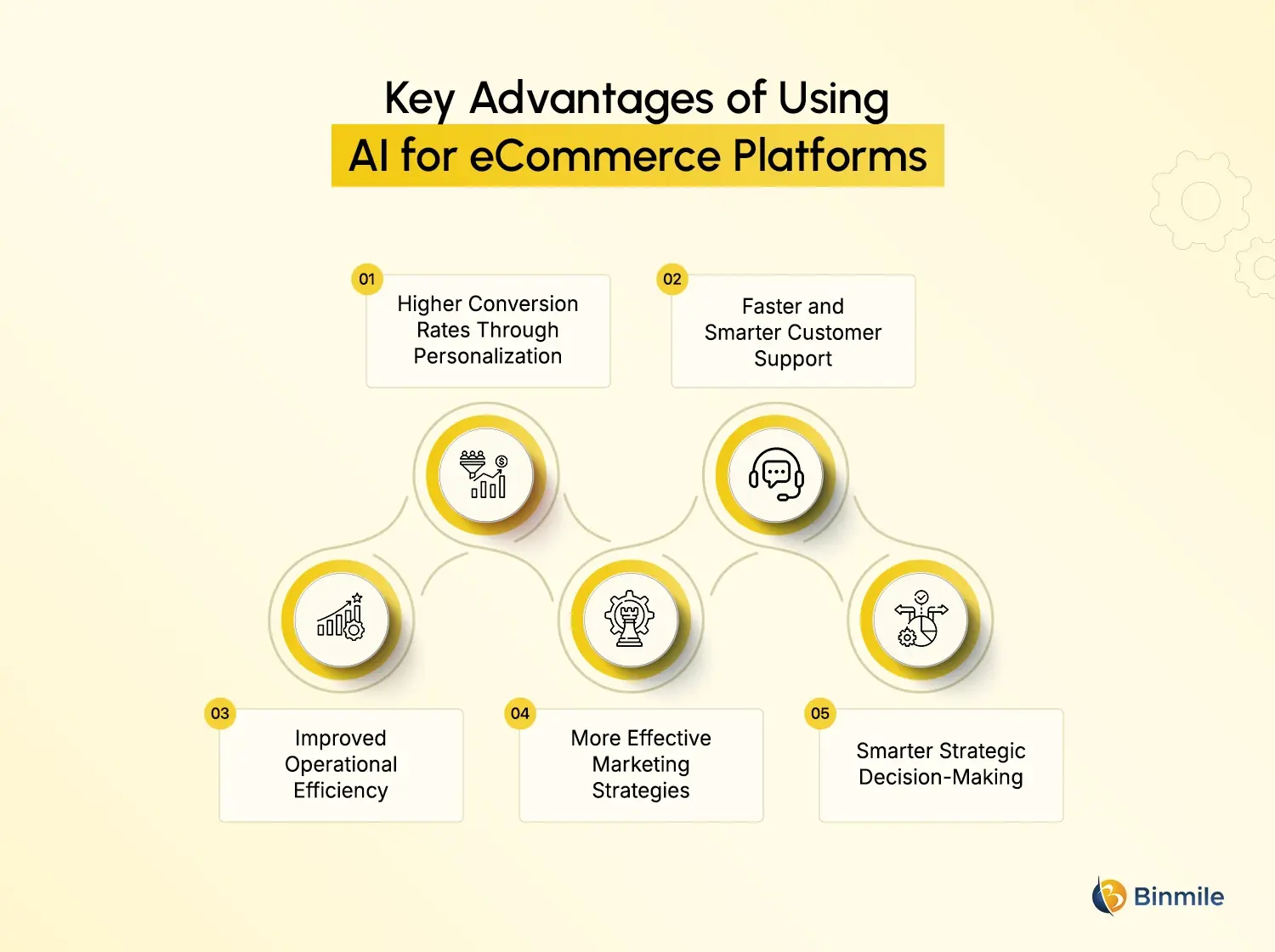
Higher Conversion Rates Through Personalization
The AI functionality promotes products and experiences that build shopper loyalty and generate spending. Because AI personalization tailors products that align with consumer interests, it increases conversion rates.
For example, when a customer browses running shoes, the platform suggests matching sportswear or accessories, increasing the chances of adding more items to the cart.
-
Faster and Smarter Customer Support
Automating customer service with machine learning and eCommerce chatbots answers shopper queries in seconds, decreasing wait times and improving satisfaction. Advanced bots issue resolution, while human agents are free to handle more complex requests.
For example, a chatbot can quickly answer questions about order status, return policies, or delivery timelines without human intervention.
-
Improved Operational Efficiency
AI predictive analytics, stock control, and mitigate overstock or stockouts to optimize efficiency. Enterprises sustain competitiveness since dynamic pricing algorithms adjust prices in real-time according to demand.
For example, during festive sales, AI can forecast higher demand for specific products and ensure enough stock is available while adjusting prices based on demand.
-
More Effective Marketing Strategies
AI customer and purchase behavior analytics enable businesses to build targeted marketing campaigns that improve audience connection.
For example, repeat buyers may receive loyalty discounts, while first-time visitors see introductory offers tailored to their interests.
-
Smarter Strategic Decision-Making
AI insights replace guesswork. Patterns and predictions from real customer behavior and market trends provide leaders with data to undertake informed decision-making.
For example, leadership teams can identify declining product categories early and shift focus to high-performing items based on sales trends and customer behavior patterns.
How to Use AI in eCommerce for Your Enterprise
By applying AI across operational functions, businesses can improve efficiency and reduce friction in a customer’s buying journey and drive consistent growth. Here are some of the use cases of AI in eCommerce
-
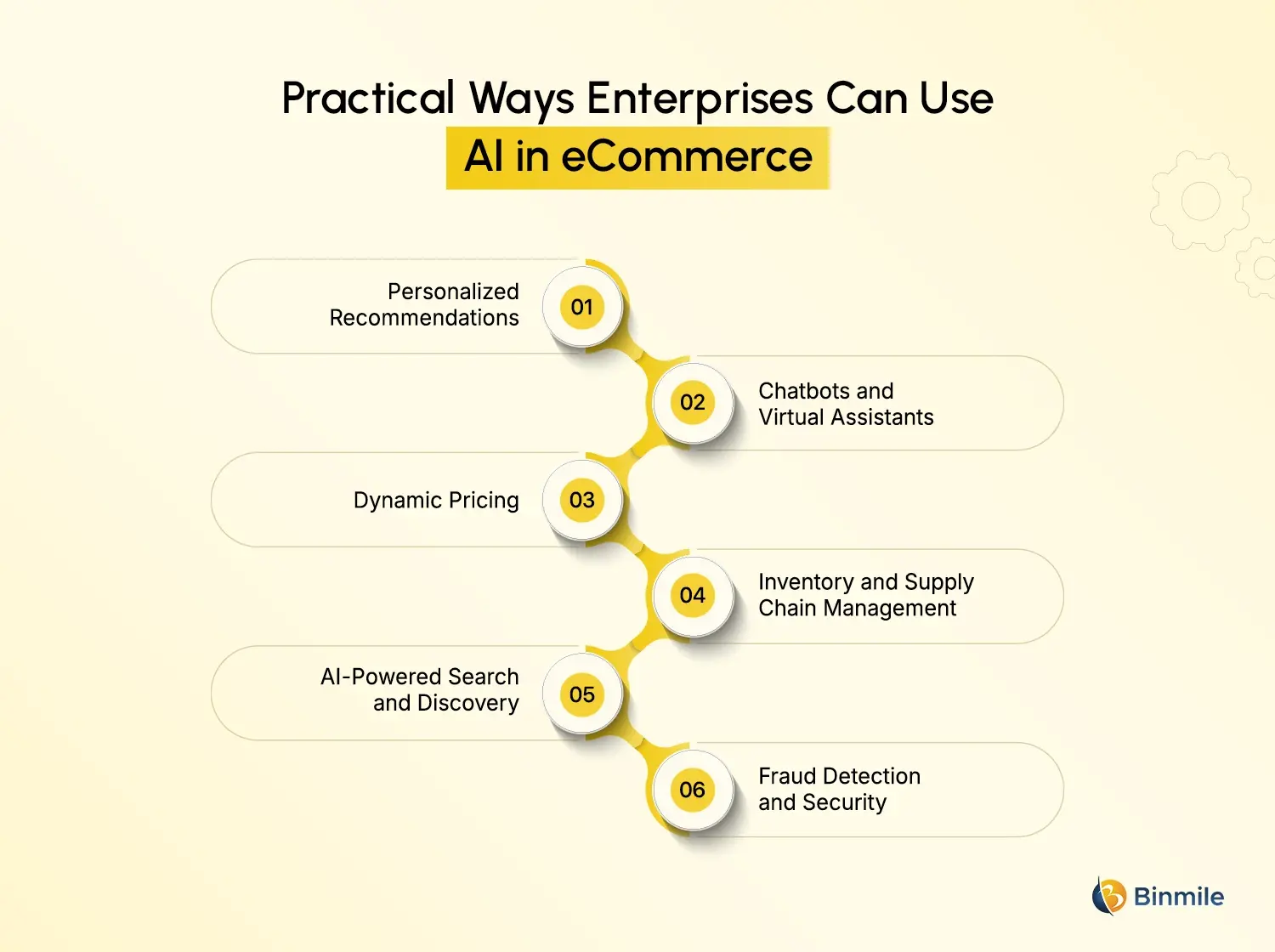
Personalized Recommendations
A crucial role of AI in eCommerce is product suggestions. Hence, as users browse online stores, these systems study users’ browsing history, prior purchases, and preferences to automatically display tailored products. This increases the odds of purchases and elevates average order values.
-
Chatbots and Virtual Assistants
AI-powered agents can answer customer inquiries at any time. These bots can provide information on products, track orders, and resolve queries, resulting in faster response times and heightened customer satisfaction.
-
Dynamic Pricing
AI can automatically change prices depending on demand, competitors’ prices, and the amount of stock available. Additionally, with flexible pricing, businesses can maximize profit margins while staying competitively priced.
-
Inventory and Supply Chain Management
Predictive models forecast demand trends, which reduces the risk of stockouts and excess inventory. This is advantageous during high-demand periods, such as peak seasons and promotional campaigns, when demand is usually unpredictable.
-
AI-Powered Search and Discovery
Online stores that incorporate AI into their search functions are able to comprehend natural language and the meanings of phrases. Additionally, this enables customers to locate products without the need for traditional keyword searches.
-
Fraud Detection and Security
AI can monitor transactions in real time to detect unusual patterns that may indicate fraud, especially when paired with agentic AI in payments for secure transactions.
Looking to harness the power of AI for your eCommerce growth and operational efficiency?

How to Integrate AI in eCommerce for Enterprise Successfully
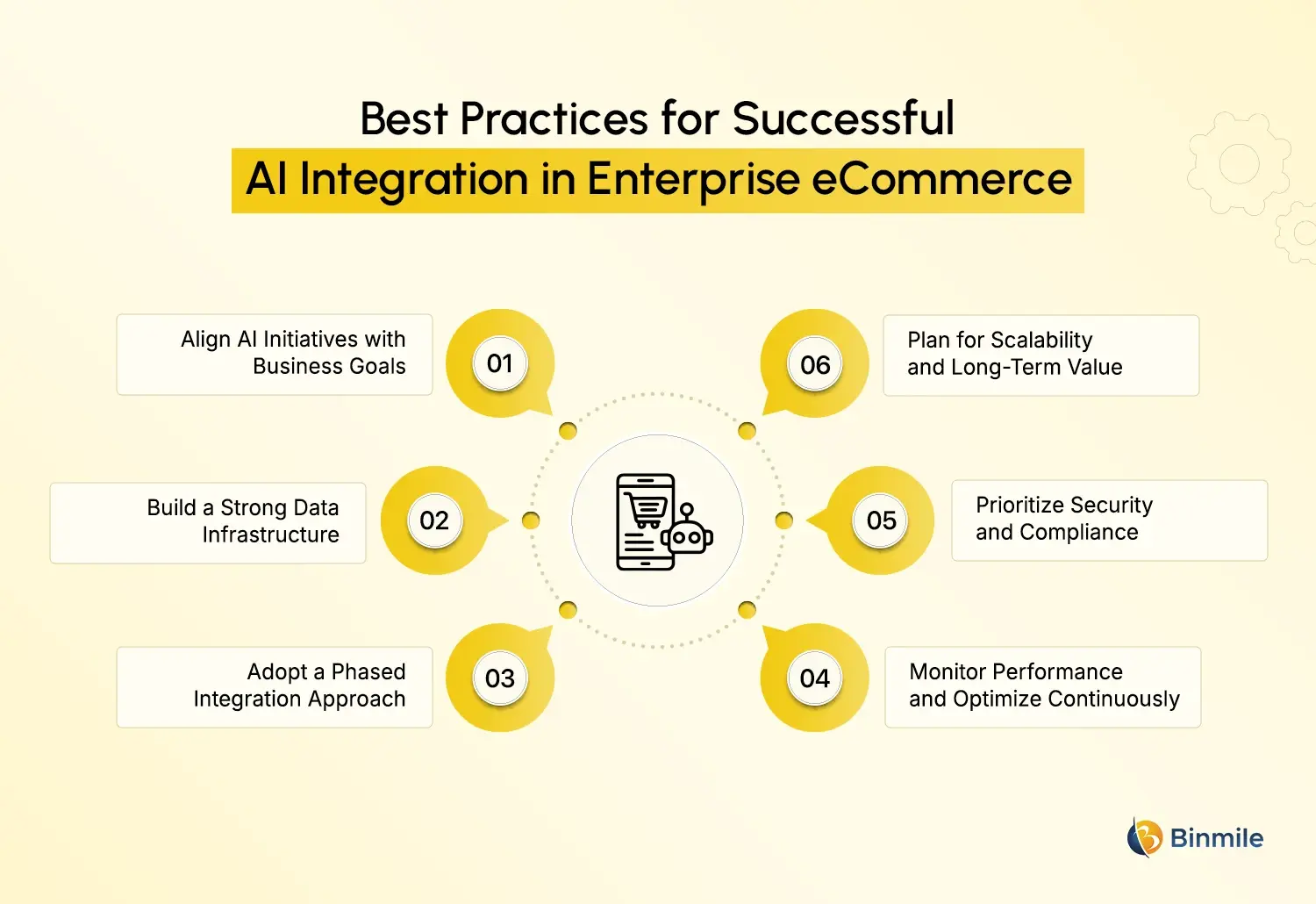
Implementing AI in an eCommerce industry setting requires careful planning and alignment with business goals.
-
Align AI Initiatives with Business Goals
It is important to have a plan before you incorporate AI into your business. Implement AI to support specific business functions like customer service or recommendation systems, where you can see goals achieved promptly.
-
Build a Strong Data Infrastructure
Quality data is the pillar of any AI system. Businesses should focus on the collection, cleansing, and organization of data, mainly customer and transaction data, especially when working with an AI development company. Experienced technology partners can aid in the development of data systems and ease the implementation of data systems.
-
Adopt a Phased Integration Approach
AI implementation across entire platforms is risky and should be approached in a stepwise manner. Start with proof-of-concept pilot projects to demonstrate value and build on the models and processes implemented. AI can then be integrated into several eCommerce use cases.
-
Monitor Performance and Optimize Continuously
AI systems are not static. In order to make them sustainable, organizations should establish a feedback loop where system outputs are continuously monitored in order to fine-tune the models, especially to meet the evolving system needs.
-
Prioritize Security and Compliance
AI should be integrated in a manner that does not compromise on legal and regulatory frameworks that address data privacy issues. Additionally, compliance is a minimal requirement and does not address the risks associated with AI. Providing transparent and responsible data practices can build customer trust.
-
Plan for Scalability and Long-Term Value
An AI system is a techno-organizational system that is capable of providing long-term operational value to a business. If designed correctly, AI systems will scale to meet the evolving needs of the organization.
What are the Challenges in deploying AI in eCommerce?
Despite its potential, integrating AI into eCommerce comes with challenges.
-
Data Quality and Consistency Issues
AI is high-quality data and models. Most companies struggle with piecemealed, fragmented, and inconsistent data sources, which hinder the accuracy and usability of AI systems.
-
Shortage of Skilled AI Talent
Hiring AI developers and data scientists is both costly and in high demand. With little AI expertise in-house, the selection of technology partners and eCommerce tools becomes critical.
-
Risk of Over-Automation
AI can improve efficiency in many processes, but over-automation can lead to more customer interactions or decisions being made without the human element. Trust is often built by keeping the balance.
-
High Implementation and Investment Costs
The cost of implementing AI systems can be quite high; allocating budget is often a necessary parameter. Companies need to consider relevant initiatives and assess the cost and value on a strategic basis.
-
Need for Strategic Planning
A proactive course of action on these issues helps to smooth the path for the incorporation of AI into an organization, fostering more robust and enduring business results.
Ready to transform your eCommerce platform with intelligent automation and personalization?

How Binmile Can Support Your AI eCommerce Goals
For enterprises looking to embed AI into their eCommerce strategy, selecting the right partner can make a meaningful difference. With experience across AI eCommerce tools and enterprise-grade digital solutions, Binmile supports businesses through the entire journey, from strategic planning to full-scale deployment. The focus remains on seamlessly integrating machine learning services with existing systems so capabilities like personalized recommendations, intelligent chatbots, and predictive analytics stay aligned with core business goals.
Beyond implementation, this expertise extends to optimizing eCommerce workflows and improving user experiences, which directly influence conversions and customer loyalty. With a strong understanding of the eCommerce landscape and industry-specific needs, Binmile helps organizations turn AI initiatives into practical, results-driven solutions that deliver measurable gains in sales performance and operational efficiency.
Frequently Asked Questions
AI is transforming eCommerce by automating repetitive tasks, enabling personalized shopping experiences, improving decision-making with data insights, and driving efficiency across operations from support to supply chain.
Machine learning analyzes customer data to predict trends, personalize recommendations, improve search relevance, forecast inventory needs, and automate pricing strategies.
AI enhances customer experience by delivering faster support through chatbots, personalizing product recommendations, enabling smarter search, and making shopping journeys more intuitive.
AI boosts sales through tailored product suggestions, dynamic pricing, and targeted promotions, while personalized interactions foster deeper customer loyalty and repeat purchases.
Enterprises with significant online traffic, complex inventories, high customer engagement goals, or aspirations to scale operational efficiency should consider investing in AI.
An experienced service provider brings technical expertise, integrates AI into existing platforms, ensures data quality, and aligns AI capabilities with strategic business goals, enabling smoother adoption and measurable impact.