
Healthcare organizations run on thousands of repetitive tasks every single day. Appointment scheduling, patient data updates, insurance eligibility checks, claims processing, medical billing, compliance reporting, and customer service requests all demand speed and accuracy. When these processes rely heavily on manual effort, delays, errors, and burnout become inevitable. According to a report by Grand View Research, the global Robotic Process Automation market is expected to reach USD 35.84 billion by 2033, driven largely by healthcare and BFSI adoption.
This growth highlights a clear shift. Healthcare leaders are no longer asking whether automation fits their operations. They are asking how fast it can be implemented and where it delivers the most value. In this blog, we explore what robotic process automation in healthcare really looks like, where RPA delivers the highest impact, real RPA use cases in healthcare, market trends shaping adoption, and how healthcare providers can implement RPA solutions effectively without disrupting patient care.
Understanding Robotic Process Automation in Healthcare
Robotic process automation for healthcare refers to the use of software bots that mimic human actions across digital systems. These bots log into applications, extract data, validate information, process transactions, generate reports, and communicate with other systems just like a human user would, but faster and without errors.
Unlike traditional automation, RPA for healthcare does not require deep system integrations or changes to existing infrastructure. This makes it especially suitable for the healthcare industry, where legacy systems, compliance requirements, and fragmented platforms are common.
In the healthcare sector, RPA applications focus on rule-based, repetitive, and high-volume processes that consume staff time but do not require clinical judgment. By automating these workflows, healthcare organizations, including those working with a custom healthcare app development company, can redirect human effort toward patient care and strategic initiatives.
What are the Key RPA Use Cases in Healthcare Operations
Not every healthcare process should be automated. The most successful RPA implementations focus on clearly defined workflows with measurable outcomes. Below are the most impactful RPA use cases in healthcare today.
-
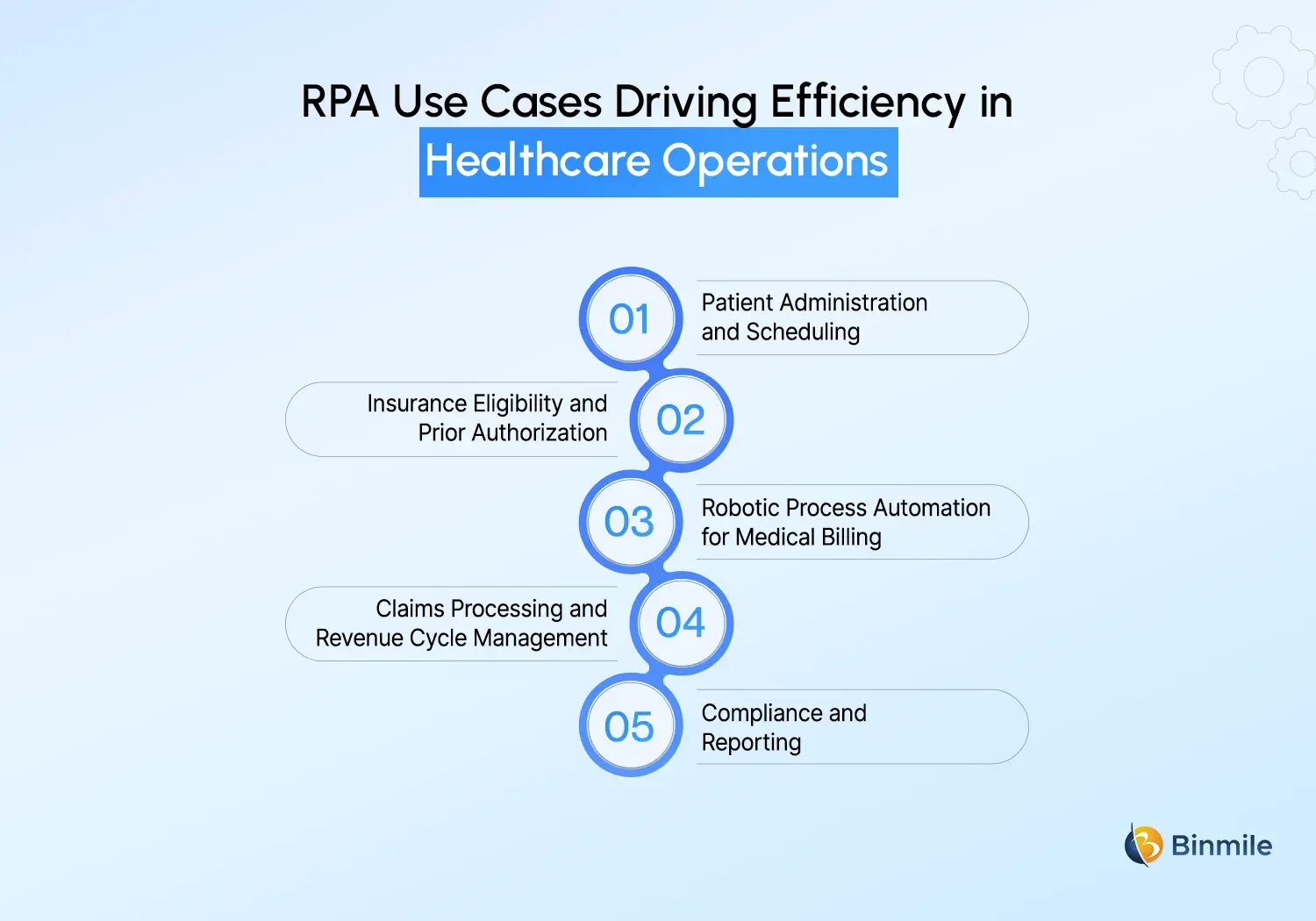
Patient Administration and Scheduling
RPA manages the patient check-in process, appointment scheduling, and demographic record updates by tracking information on patient forms, checking records, and synchronizing data with other systems. This improves the patient experience by reducing wait times at check-in and eliminating data entry.
-
Insurance Eligibility and Prior Authorization
Bots check the patients’ insurance eligibility, confirm relevant details, and flag discrepancies, which happen before the patient’s visit. This increases the chances of successful billing and decreases the chances of incorrect billing.
-
Robotic Process Automation for Medical Billing
In the area of healthcare where medical billing is performed, the use of RPA for automation is most applicable in the areas of charge entry, claim submission, payment entry, and the management of claims denials. RPA supports billing teams while integrating smoothly with existing HIPAA compliance software and payer systems.
-
Claims Processing and Revenue Cycle Management
RPA improves the revenue cycle by completing tasks such as data validation, document submission, and follow-up with insurance companies, leading to claims being completed in a more timely manner.
-
Compliance and Reporting
Healthcare organizations are often required to submit compliance reports to auditing and regulating agencies. RPA is used to collect data, create reports, and submit them across a variety of systems to eliminate the need for human effort.
RPA Applications in Healthcare Across Departments
This cross-functional impact is one reason RPA solutions deliver high ROI in healthcare environments, especially when combined with pharmacy management software, patient engagement platforms, and enterprise healthcare applications.
| Department | RPA Applications |
|---|---|
| Front Office | Appointment scheduling, patient onboarding, and data validation |
| Billing and Finance | Medical billing, claims processing, and payment reconciliation |
| Compliance | Audit reporting, policy checks, and regulatory documentation |
| IT Operations | System monitoring, data migration, and access provisioning |
| Customer Support | Ticket routing, response automation, case updates |
This cross-functional impact is one reason RPA solutions deliver high ROI in healthcare environments.
What are the Benefits of RPA in Healthcare That Matter
The benefits of RPA in healthcare go beyond cost reduction. When implemented correctly, automation directly improves patient experience and operational resilience.
-
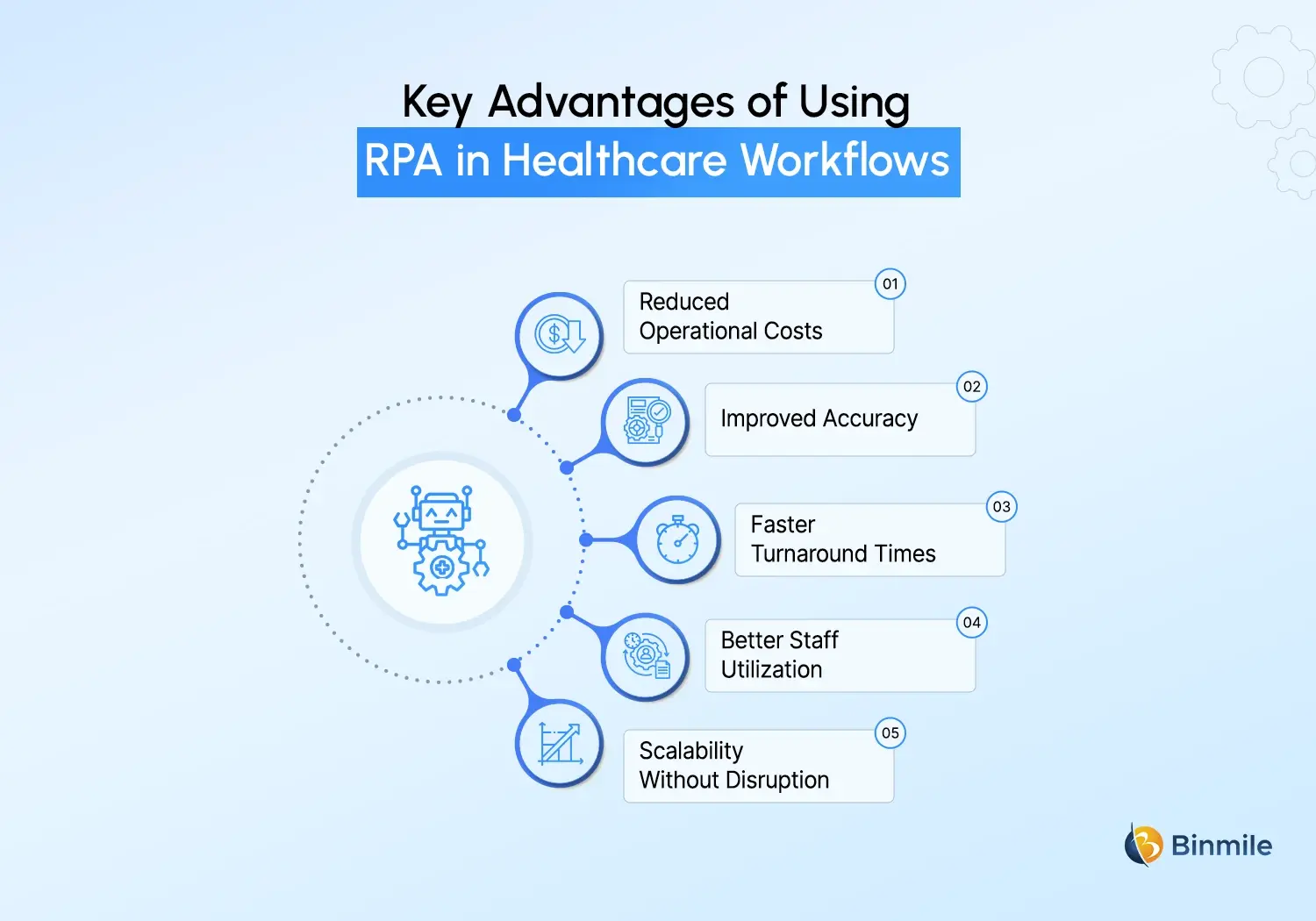
Reduced Operational Costs
Healthcare organizations deal with high, repetitive administrative processes, like data entry, billing, claims, and report generation. These processes can be manually completed, but it is inefficient and is an expensive operational cost. Instead of hiring more employees, organizations can invest in process automation and utilize bots to complete repetitive tasks at an optimal level with no compromise to service level.
-
Improved Accuracy
Manual processes can have errors, especially in high-pressure situations and high-volume data sets. Using an RPA bot, processes will be completed in the same way every time. This will result in fewer billing mistakes, claim denials, or inaccurate patient records across systems.
-
Faster Turnaround Times
Healthcare organizations deal with slow processes that depend on cross-system checks. Bots will improve these processes by completing tasks in an instant. Tasks that previously took hours, like claim submission or insurance verification, can be completed in minutes. This will improve patient service and billing cycles.
-
Better Staff Utilization
Administrative work often pulls healthcare professionals away from tasks that require human judgment and empathy. By automating routine paperwork and system updates, RPA allows staff to focus on patient care, complex problem-solving, and decision-making. This not only improves productivity but also reduces burnout among healthcare teams.
-
Scalability Without Disruption
Healthcare demand is rarely consistent. Patient volumes can spike during seasonal illnesses, emergencies, or policy changes. RPA bots can scale up instantly to handle increased workloads without the need for new hires or major system changes. When demand drops, bots can scale down just as easily, making operations flexible without disrupting existing workflows.
Build intelligent automation that improves efficiency, accuracy, and compliance across your healthcare systems.

RPA Market Trends Shaping Healthcare Automation
RPA market trends indicate a clear movement toward more intelligent, purpose-driven automation in healthcare. Organizations are now adopting RPA in a more comprehensive manner than just a means to cope with workload. RPA is being implemented to create more smart, connected operational capabilities that are responsive to evolving needs in healthcare.
One major trend is the adoption of intelligent RPA that integrates AI and ML development. With the ever-evolving automation systems, cost savings are no longer the primary focus of automation. Intelligent RPA systems can assist in decision-making by detecting outliers, such as in billing data, or by triaging cases to identify the more urgent ones. There is also a trend with healthcare providers’ preferred custom automation RPA solutions for specific workflows. Instead of generic automation solutions like reporting, prior authorization, or patient compliance, providing custom automation solutions lends more operational efficiency, accuracy, and return on investment.
Another noticeable shift is the growing reliance on RPA consulting services that focus on compliance-driven automation. With the volume of rules and regulations, there is a need for regulatory-compliant automated solutions in security, audit, and privacy from the very first day. As healthcare organizations modernize software for the healthcare industry, RPA increasingly serves as a bridge between legacy platforms and modern digital systems. Rather than replacing legacy systems, RPA acts as a bridge that automates workflows across old and new platforms, helping organizations modernize gradually.
Choosing the Right RPA Implementation Partner
Aligning automation with long-term digital strategy ensures that RPA supports initiatives such as healthcare IT modernization, AI development, data-driven decision-making, and scalable next-gen business automation rather than functioning as a standalone solution.
A capable RPA implementation partner helps healthcare organizations:
-
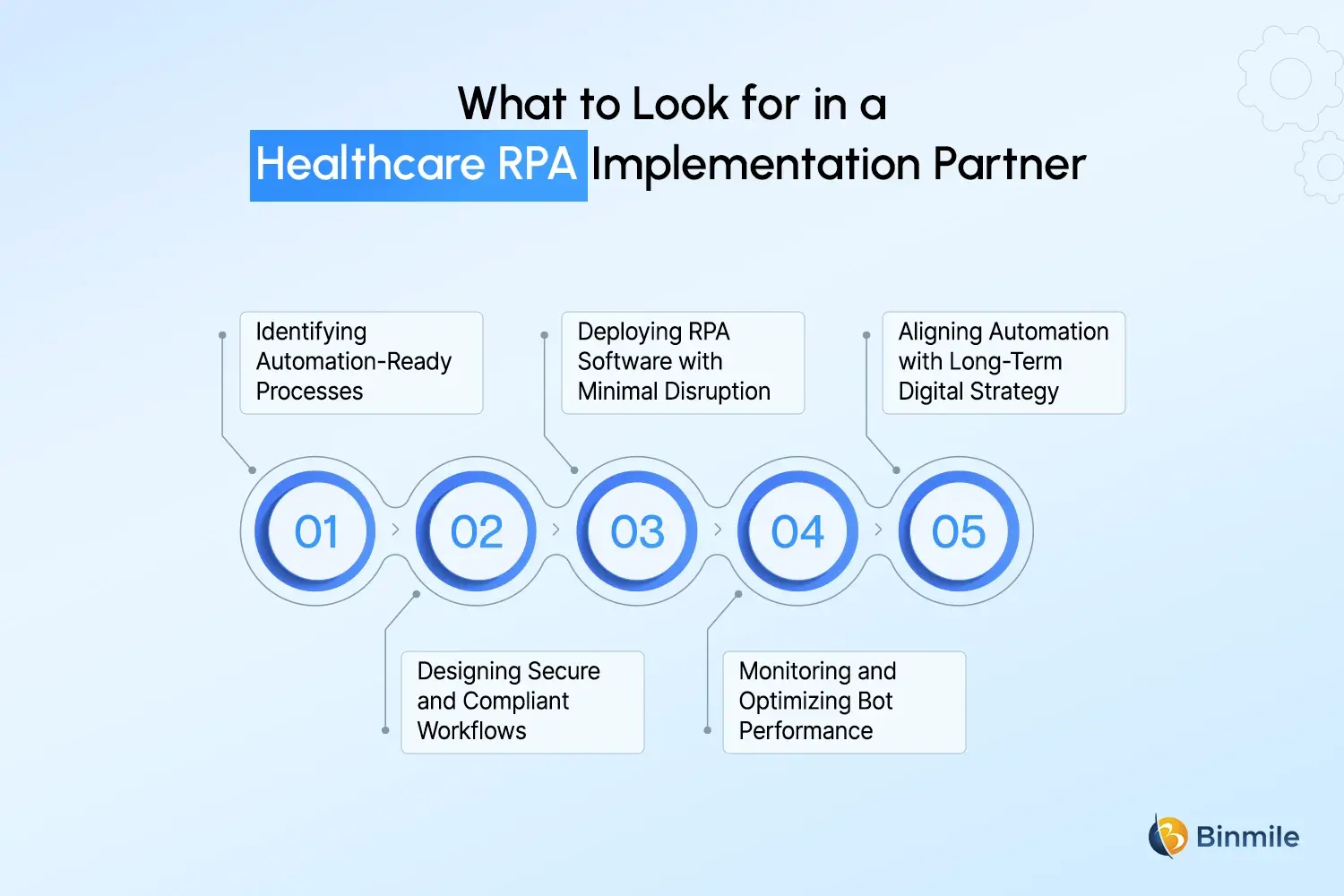
Identifying Automation-Ready Processes
An experienced partner assists healthcare organizations in evaluating current workflows and recognizing those that are repetitive and rule-based, which can be automated, ensuring that RPA initiatives are directed toward processes that will yield significant changes because of automation.
-
Designing Secure and Compliant Workflows
Automation in healthcare must be done in accordance with the data security and compliance requirements. A good partner builds RPA workflows to address data security access, auditing, and regulatory compliance, thus balancing the need for operational efficiency with reduced compliance risk.
-
Deploying RPA Software with Minimal Disruption
Healthcare systems are usually operational 24/7. The best implementation practices ensure RPA bots are integrated with no disruption to daily operations, patient interactions, or essential business processes.
-
Monitoring and Optimizing Bot Performance
Automation should not be a repetitive activity. It should be continuous. Monitoring helps address performance gaps, adjust to shifting requirements, and ensure improved efficiency of the bots. A good partner makes certain that bots are dependable and that efficiency is retained as operations change.
-
Aligning Automation with Long-Term Digital Strategy
RPA should support broader digital transformation goals rather than function as a standalone solution. A good partner aligns automation initiatives with long-term plans such as system modernization, AI adoption, and operational scalability.
Organizations that invest in RPA consulting services early see faster adoption and better outcomes.
Ready to modernize billing, compliance, and customer service with intelligent automation?

Where Strategic RPA Adoption Makes the Difference
Healthcare organizations often struggle with fragmented processes and siloed systems. Strategic adoption of robotic process automation in healthcare bridges these gaps by creating unified workflows that operate across departments. When automation is aligned with operational goals rather than isolated tasks, organizations achieve measurable improvements in efficiency, compliance, and patient satisfaction.
This is where experienced technology partners like Binmile quietly add value. By aligning RPA solutions with healthcare operations, compliance needs, and long-term modernization goals, automation becomes a sustainable capability rather than a short-term fix. The focus remains on building custom RPA solutions that fit existing systems while preparing organizations for scalable, intelligent automation across the enterprise.
Frequently Asked Questions
Robotic process automation in healthcare uses software bots to automate repetitive administrative and operational tasks such as billing, scheduling, claims processing, and reporting. It improves efficiency without replacing clinical decision-making.
Robotic process automation for medical billing automates charge entry, claim submission, payment posting, and denial management. This reduces errors, accelerates reimbursements, and improves revenue cycle efficiency.
Yes, when implemented correctly. RPA software follows strict access controls, audit trails, and encryption protocols, making it suitable for HIPAA-compliant healthcare environments.
Common RPA use cases in healthcare include patient registration, insurance verification, medical billing, claims processing, compliance reporting, and customer service automation.
Implementation timelines vary by complexity, but many healthcare organizations deploy initial RPA bots within weeks, especially when supported by experienced RPA consulting services.