Customer expectations have changed faster than most businesses anticipated. Buyers no longer want limited catalogs or single-brand experiences. They want variety, competitive pricing, verified reviews, and fast delivery in one place. According to research, global eCommerce sales are projected to exceed $8 trillion by 2027, highlighting how digital commerce continues to scale at an unprecedented pace. A significant portion of this expansion is driven by marketplace models rather than single-seller stores.
Businesses that once focused solely on selling their own inventory are now evolving into platforms that host multiple sellers. This shift is powered by multi-vendor marketplace software, which enables brands to move from being just a retailer to becoming a digital ecosystem. In this blog, we will explore what this software is, how it works, why traditional eCommerce models limit growth, key business benefits, revenue models, essential features, development strategies, future trends, and how the right technology partner can help you build a scalable marketplace.
What is Multi-Vendor Marketplace Software?
Multi-vendor marketplace software enables different sellers to register, list, and sell products and/or services through a single marketplace platform. This differs from a typical eCommerce website, where one brand sells all the products. In a multi-vendor marketplace, each seller is an independent vendor, and together they use one platform to sell their products.
In this case, the marketplace platform vendor is like a digital mall manager. Each seller or vendor on the marketplace has control over their product listings, prices, and quantities, while the platform vendor controls vendor branding, user experience, payment, commission, and regulation.
This model supports eCommerce sites for retail sectors, online marketplaces for services, and B2B eCommerce platforms, and includes eCommerce sites for specific niches.
Marketplace development offers a way for businesses to create a pathway to growth without the risk or commitment of holding or managing an inventory or warehousing.
Why Traditional eCommerce Models Limit Growth
Many businesses start with a single-seller eCommerce website. It works well initially, but eventually creates limitations.
-
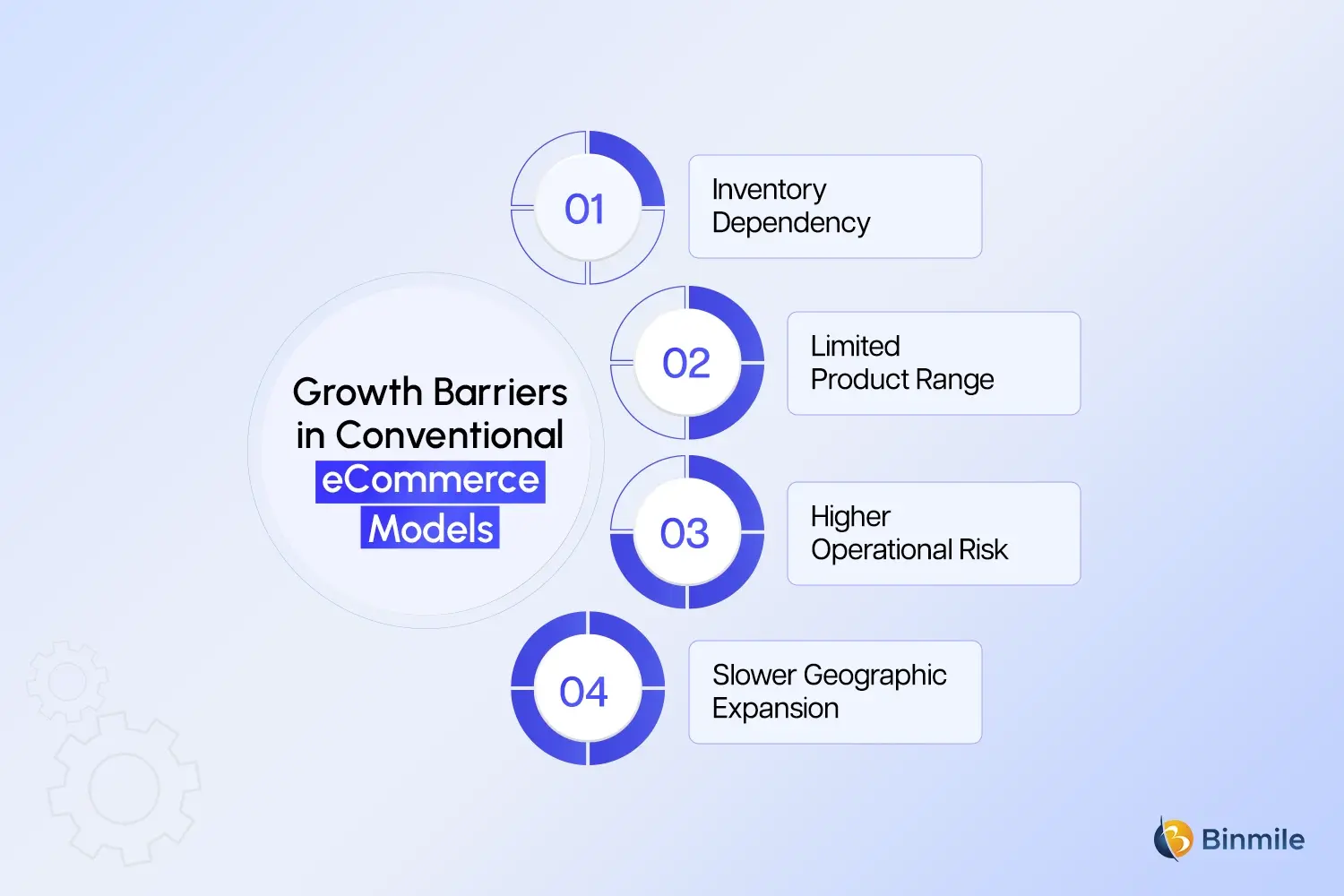
Inventory Dependency
Standard shops rely exclusively on the business’s own inventory. To grow the business, it will have to make continuous investments in storage and purchasing inventory. With a multi-vendor marketplace, this responsibility shifts to the vendors, who are now in control of their own inventory.
-
Limited Product Range
Customers are less likely to purchase from a retailer with a narrow product assortment and will instead gravitate toward larger competitors. A multi-vendor eCommerce shop increases the product assortment with no additional internal costs.
-
Higher Operational Risk
When a single supplier is unreliable, the entire business is affected. A multi-vendor eCommerce store shifts this risk to several vendors instead of just one.
-
Slower Geographic Expansion
New logistics and supply chains are needed for each region when using a traditional vendor model, but a multi-vendor online marketplace allows for rapid expansion by incorporating local vendors.
Business Benefits of Multi-Vendor Marketplace Software
Here are the benefits of multi-vendor marketplace software.
-
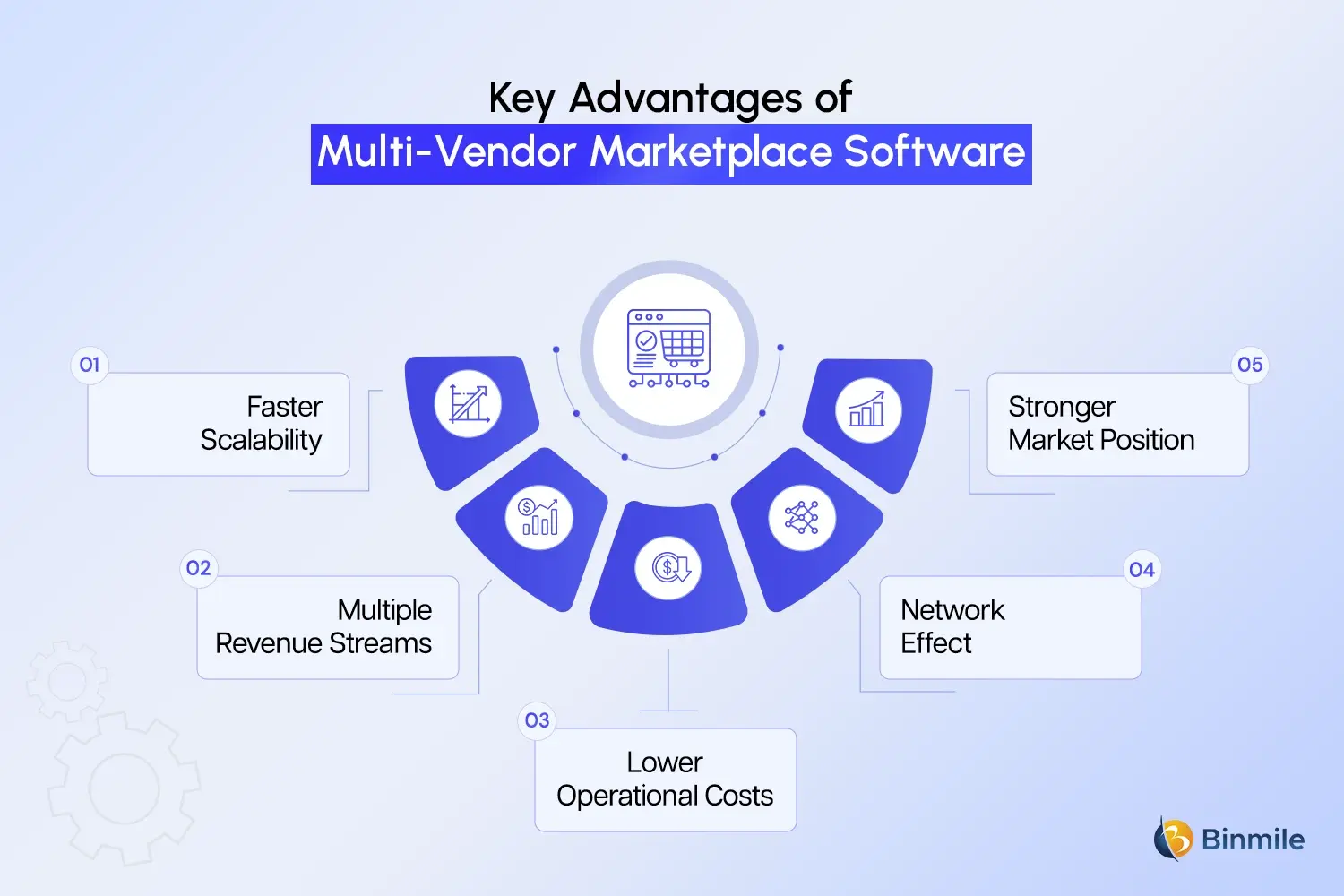
Faster Scalability
When vendors supply the inventory, growth becomes much more flexible. Rather than investing a lot of money into warehousing or procurement, the platform simply scales by adding more sellers. Every new seller enhances product variety and consumer interest without commensurate increases in operational expenses. This growth model, driven by the opportunity to add sellers easily, supports rapid growth.
-
Multiple Revenue Streams
Multi-vendor marketplace software enables diversified revenue sources. In contrast to typical eCommerce operations that rely only on product margins, platform owners can earn revenue through commissions on sales, vendor subscriptions, listing fees, featured listings, and advertising. These diverse revenue opportunities increase revenue stability and overall improved profitability.
-
Lower Operational Costs
Because vendors manage their own storage, packaging, and shipping, the central platform can significantly reduce operational infrastructure costs. Thus, operational overhead shifts from the management of physical inventory to the management of digital information, making the business model more scalable.
-
Network Effect
As the number of vendors on the platform increases, the variety of products available increases. This increased variety attracts more customers. This increased customer traffic attracts even more vendors. This self-reinforcing cycle fuels the rapid growth of the marketplace as well as strengthens the marketplace’s position over the long term.
-
Stronger Market Position
A multi-vendor eCommerce platform elevates a business from being a mere retailer to being an ecosystem. Businesses that operate as ecosystems have a much stronger brand dominance and a much higher level of interest from investors. Startups that are developing an MVP around marketplace app ideas can leverage this model and the marketplace’s growth potential, as well as the long-term value proposition, to capture even greater value.
Revenue Models in a Multi-Vendor Marketplace
A well-designed multi-vendor marketplace software can support multiple monetization strategies:
| Revenue Model | How It Works | Who It Suits |
|---|---|---|
| Commission-Based | The platform takes a percentage from each sale | Retail and product marketplaces |
| Subscription-Based | Vendors pay recurring monthly or yearly fees | B2B or specialized platforms |
| Listing Fees | Vendors pay per product listing | Classified or niche marketplaces |
| Featured Promotions | Vendors pay for higher visibility | Competitive categories |
| Advertising | Third-party ads displayed on the platform | High-traffic marketplaces |
When planning the cost of eCommerce MVP development, selecting the right revenue structure is critical to ensuring sustainable profitability.
Must-Have Features in Multi-Vendor Marketplace Software
Here are the features of multi-vendor marketplace software
-
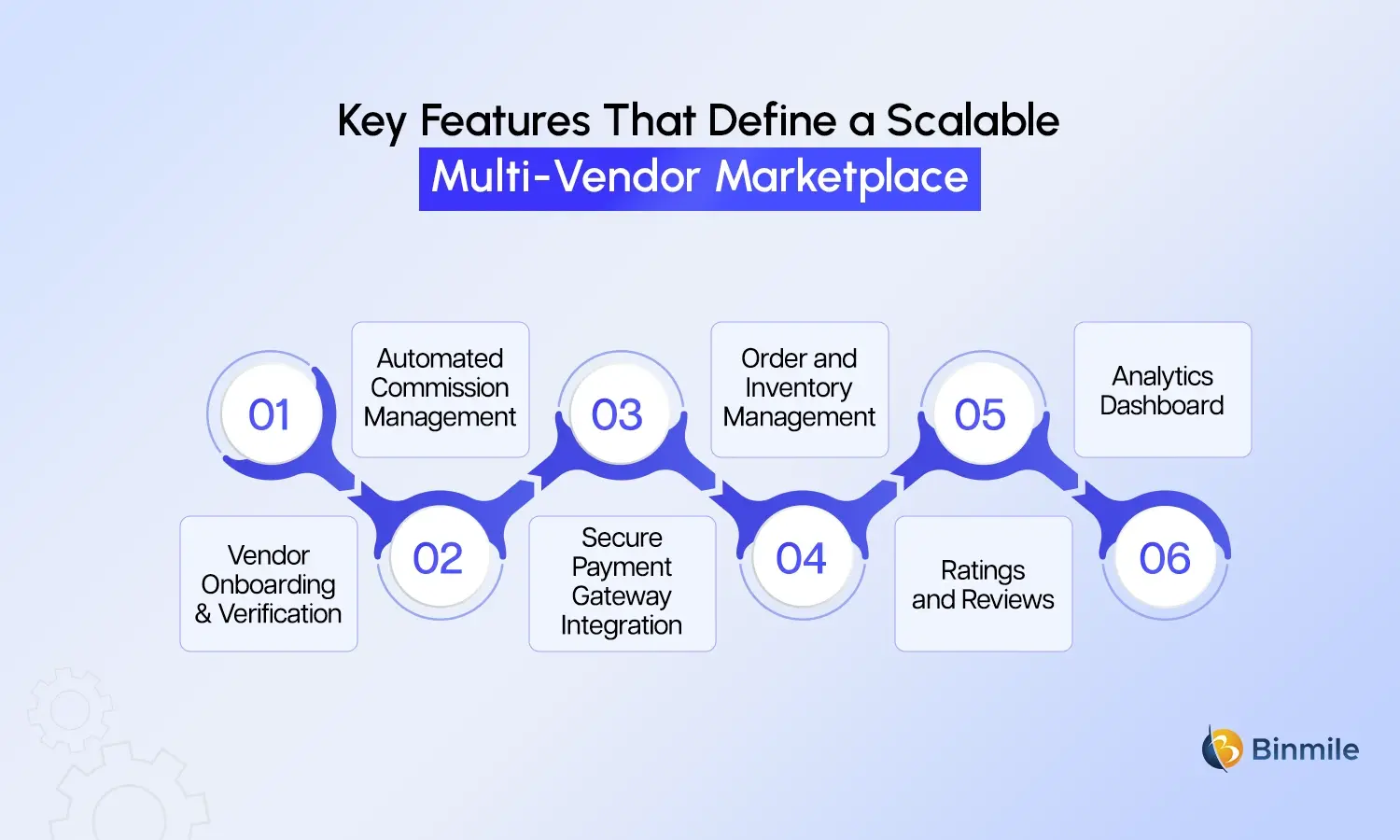
Vendor Onboarding and Verification
The registration and identity verification modules facilitate the onboarding of bona fide vendors and ensure the streamlined identity verification of valid vendor participants. The automated approval workflows refine the process and allow for the control of process quality.
-
Automated Commission Management
The automated and precise management of commission calculations allows for the elimination of conflicts related to revenue and facilitates the unambiguous financial relations between vendors and platform owners.
-
Secure Payment Gateway Integration
Payment gateways with revenue protection and automated revenue splitting functionalities provide protection to buyers and sellers and allow for the building of trust and enhancement of the platform’s image.
-
Order and Inventory Management
The real-time synchronization with the inventory serves to eliminate the risk of overselling and to enhance customer satisfaction. The streamlined order tracking improves operational transparency.
-
Ratings and Reviews
The customer reviews increase the accountability and trustworthiness of the multi-vendor marketplace and affect the purchase decisions of the customers. This makes quality control reviews vital.
-
Analytics Dashboard
The insights generated from the vendor’s data allow them to manage their pricing and inventory in an optimal manner. The platform owners use the data to manage trends and the system’s vendors and customers. When businesses seek custom software development, the security of data and the ability to scale must be prominent features of the architecture.
Need a scalable multi-vendor marketplace software solution designed around your business goals?
Challenges in Multi-Vendor Marketplace Development
The complexities involved in multi-vendor marketplace development can be overwhelming. The development team will need strong governance policies to maintain their quality bar with their contracted merchants. There will also be payment disputes that will need to be managed via transparent commission and refund systems in order to mitigate them.
UX is tied to the backend. The architecture and software integration must be seamless to make sure that the marketplace is built to scale. Getting marketplace merchants is as difficult as getting marketplace customers because potential merchants will want to know their counterparts. Lastly, the merchants will have their own regulatory obligations that need to be woven into the marketplace.
These issues can be addressed by working with an outsourcing software development firm that has domain expertise and relies on structured delivery to mitigate its development risks.
Build vs Buy: Choosing the Right Marketplace Strategy
When planning a marketplace, businesses must decide whether to adopt ready-made multi-vendor marketplace software or invest in custom development.
Pre-built solutions allow for faster initial setup and a lower cost for initial investment. These are ideal for early-stage startups attempting to validate demand for a product. However, these solutions also have a lack of flexibility in customizations, funnel architecture, and limitations for growth. Once an adequate amount of demand is captured, funnel performance may become a problem.
When developing a custom Multi-vendor Marketplace, complete flexibility is provided for patterns of user engagement, design, commission terms, and growth in additional features, payment systems, and integrations. These are also able to provide emerging technologies, such as AI in eCommerce, allow complex vendor and buyer analytics, and also provide enterprise security combined with other 3rd party services. Because custom solutions cost more in the beginning (developing), they allow more growth opportunities in the long-term.
For many businesses, the first step is developing an MVP. However, developing an MVP for a marketplace app enables them to measure user uptake, adjust functionalities, and improve/ enhance features based on real-world scenarios.
Future Trends in Multi-Vendor Marketplaces
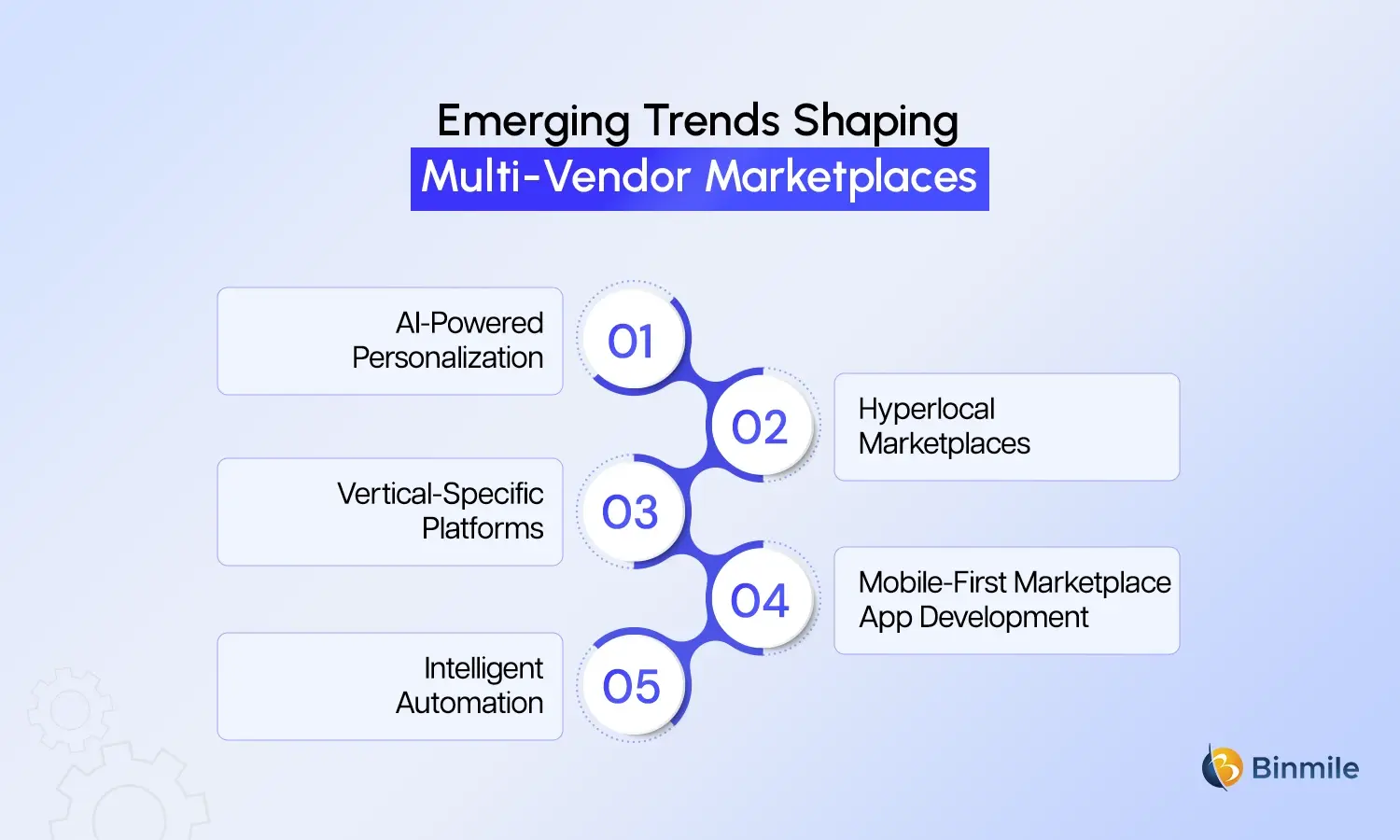
The next phase of marketplace growth will be driven by technology and personalization.
-
AI-Powered Personalization
AI technology applied to eCommerce delivers enhanced customer interactions, improves vendor performance, and increases marketplace conversions via smart product suggestions, dynamic pricing, and demand forecasting.
-
Hyperlocal Marketplaces
Multi-vendor eCommerce websites focused on specific regions improve logistics, vendor onboarding, and community engagement.
-
Vertical-Specific Platforms
Vertical eCommerce multi-vendor platforms capture niche markets and demand while outperforming generalist competitors.
-
Mobile-First Marketplace App Development
Marketplace Mobile App Development increases customer engagement, improves customer stickiness, and accelerates customer conversions across the board via enhanced click and purchase functionalities.
-
Intelligent Automation
Incorporating automated technology improves the management of commissions, vendors, fraud, and performance, enhancing the overall operational efficacy and profitability.
Planning to launch a high-performance multi-vendor e-commerce platform with future-ready architecture?
How the Right Technology Partner Can Accelerate Your Marketplace Vision
Building a multi-vendor eCommerce website is more than implementing several features. It requires additional strategic elements such as architecture, payment integration, infrastructure, and product roadmaps.
Binmile helps clients with custom software development, marketplace app development, and software integration. Whether it is enterprise-level multi-vendor marketplace software or MVP development for marketplace app ideas, we prioritize scalability, security, and performance. Our structured development and software development outsourcing experience helps clients move from idea validation to marketplace launch with peace of mind.
The right technology partnership is critical whether you want to hire eCommerce developer teams for specific projects or you want to shift entirely to a multi-vendor online marketplace model. Your platform will be prepared for a transition to a sustainable and profitable digital ecosystem.
Frequently Asked Questions
Multi-vendor marketplace software enables multiple sellers to list and sell products on one platform. Vendors manage inventory and pricing, while the platform owner handles payments, commissions, and customer experience through centralized dashboards and automated workflows.
Yes. Startups can launch with an MVP for a marketplace app to validate demand. SMEs benefit from reduced inventory risk and diversified revenue streams without heavy upfront investment in stock and warehousing.
Modern multi-vendor eCommerce platforms integrate secure payment gateways, encrypted data storage, and compliance protocols to protect transactions and personal information, provided they are developed with strong security standards.
Retail, B2B wholesale, healthcare services, education platforms, food delivery, and local services can all benefit from multi-vendor marketplace platforms by connecting multiple sellers to a unified customer base.
Yes. Custom software development allows businesses to tailor commission structures, vendor workflows, UI design, integrations, and automation features based on unique industry requirements.
Security depends on architecture and development practices. Secure coding, payment encryption, role-based access control, and compliance integration ensure safe transactions and vendor data protection.
Revenue is generated through sales commissions, vendor subscriptions, listing fees, advertising, and promotional placements. The platform owner earns without managing product inventory directly.
Choose a partner with experience in marketplace app development, software integration, scalable architecture, and proven delivery in custom software development projects.
Costs depend on features, customization level, integrations, payment systems, security standards, vendor management automation, and whether you build an MVP or a fully scaled multi-vendor eCommerce platform.