
As application landscapes grow more complex and customer expectations continue to rise, businesses are rethinking how their software systems are structured and scaled, especially within modern Mobile Application Architecture and SaaS Architecture models. According to Gartner, over 74% of organizations have adopted or plan to adopt microservices. As systems evolve and user demand grows, how applications scale becomes a strategic decision. If a business depends on a microservices application, scalability is not optional; it is necessary to compete, deliver seamless user experiences, and ensure reliable performance under load.
In this blog, we will explore what microservices architecture is, how it enhances application scalability, the challenges involved, when businesses should adopt it, the tools and technologies that support it, and best practices to follow. We will also examine real-world patterns, such as ecommerce microservices architecture and how migrations from monolithic to microservices models are managed.
What is Microservices Architecture?
Microservices architecture is a software design approach that breaks down a large application into smaller, independent services. Each service focuses on a specific business function and can be developed, deployed, scaled, and maintained independently. These services communicate with each other through APIs rather than being part of a tightly coupled system. In contrast to a monolithic architecture where every component is interconnected, microservices allow for decentralization of functions, which brings flexibility and resilience.
Core Features of microservices architecture are that each small service is autonomous and helps the team to release updates without disrupting the entire system. Additionally, each service can manage its own databases, which reduces bottlenecks and improves data handling efficiency. Moreover, each service communicates through API, making this model well-suited for both functional programming or microservices based development strategies.
By focusing on small, targeted services rather than a unified bulk of code, microservices create a structure that matches real-world business processes more naturally.
What are the Advantages of Microservices Architecture For Organizations
Scalability refers to an application’s ability to handle increased load by efficiently using resources. Microservices-based architecture improves scalability at multiple levels.
1. Independent Scaling of Services
Due to microservices architecture, specific services are able to scale independently, as long as it does not affect services that are integral to the rest of the application. For instance, a payment processing microservice can be scaled independently of a catalog microservice in an ecommerce microservices architecture. Consequently, scaling can be limited to areas that require it rather than scaling the entire application.
In the case of migrating from a monolith architecture to a microservices architecture, this is the most significant advantage. Instead of scaling an entire application at once, businesses are able to scale specific components that are under a heavier load.
2. Isolation Improves Fault Handling
Design patterns that microservices architecture incorporates help to improve the isolation of services, in turn, adding fault tolerance. When one service in a microservices architecture fails, it does not negatively impact the other services, making the entire architecture collapse. When there is a problem with one service, it will allow other services to continue their functions, resulting in stability and availability.
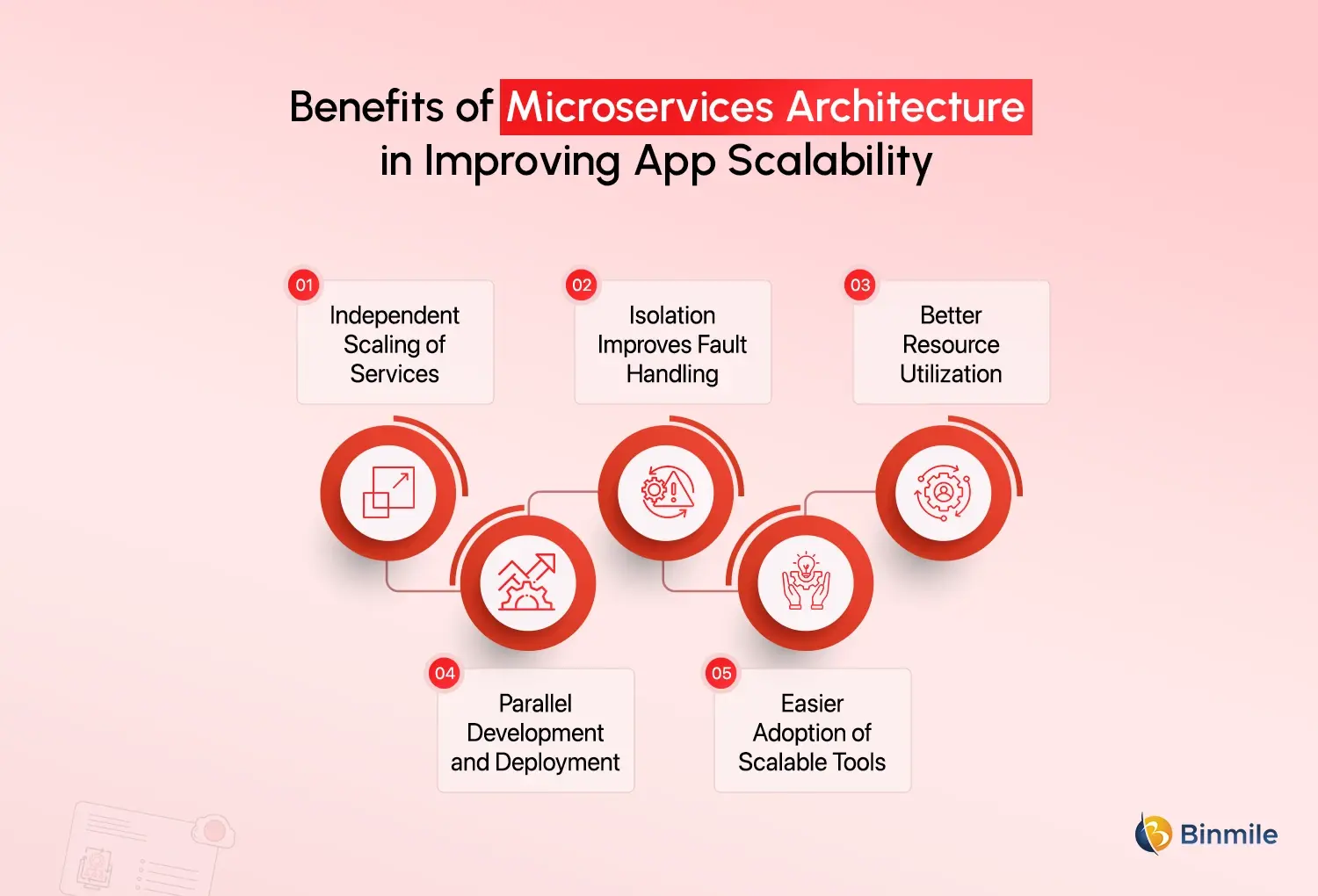
3. Better Resource Utilization
In a microservices architecture, resource allocation can be containerized. Through containerisation vs virtualisation, containers offer lightweight, efficient resource usage. Each service can be assigned the right microservice container that includes the appropriate allocation of CPU, memory, and storage, which provides added resource optimization. This continues to add to the overall performance of the application as the load continues to change over time.
4. Parallel Development and Deployment
Smaller, isolated services allow multiple teams to work in parallel. This reduces development time and accelerates release cycles. This is valuable in large enterprises and GenAI app development. When new features need to be scaled rapidly, microservices accelerate time to delivery.
5. Easier Adoption of Scalable Tools
Microservices software architecture naturally integrates with technologies such as Kubernetes and service meshes. These tools automate scaling and management across distributed services.
What are the Challenges in Implementing Microservices Architecture
While microservices architecture brings significant benefits, it also introduces new challenges.
-
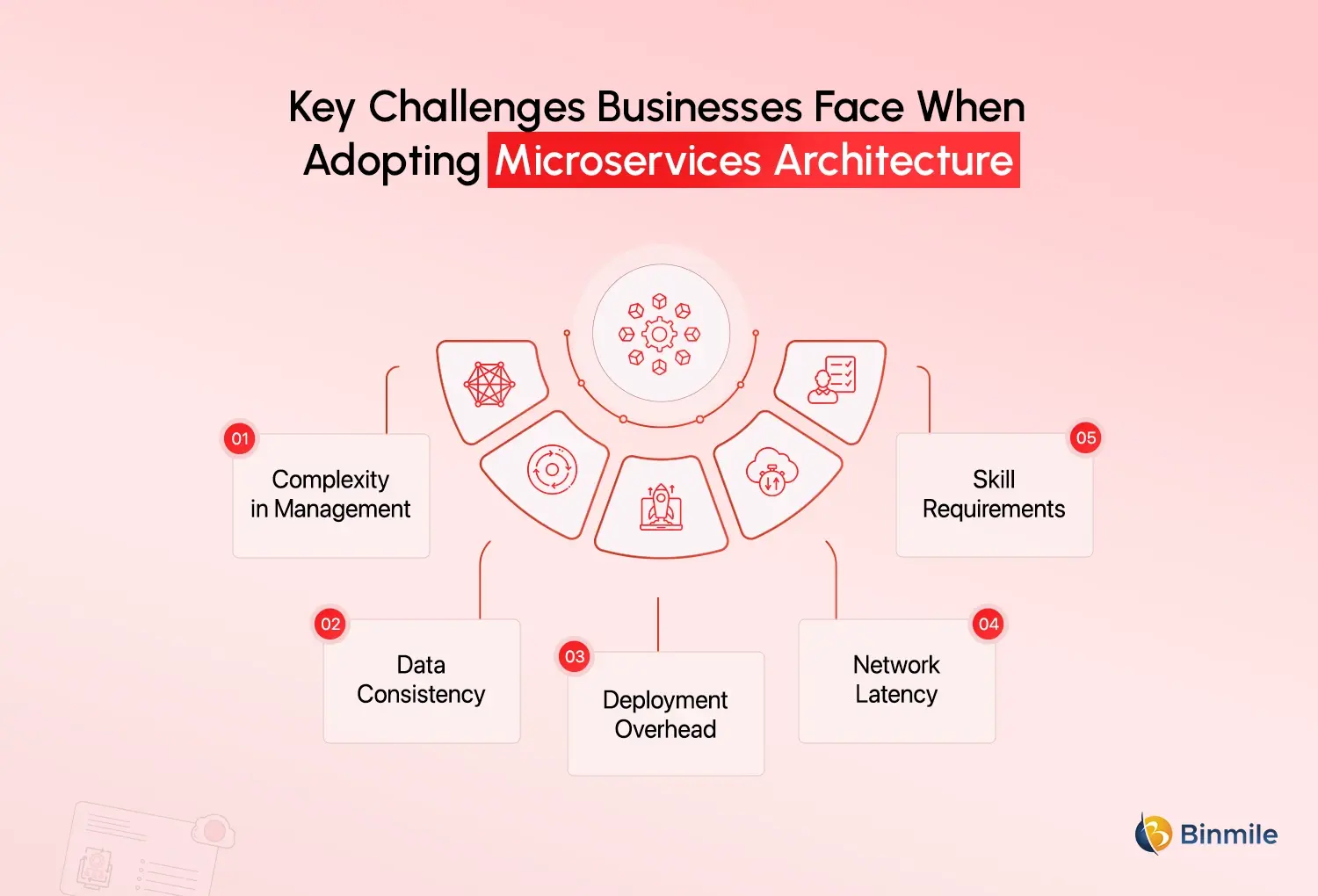
Complexity in Management
A microservice system is designed to function as multiple, individually deployed services. Managing the services requires strong governance and orchestration. Without monitoring, logging, and management service practices, determining and resolving issues will be a time-consuming process and will diminish the system’s response time.
-
Data Consistency
In microservice architectures, individual services are typically responsible for individual databases. While this service independence is an improvement, the reduction of dependence comes at the cost of service coherence complexity and even loss of coherence. Real-time transactions could impact the business either through the service individually or through the collective transactions that cross services.
-
Deployment Overhead
In contrast to monolithic applications, which utilize a single deployment pipeline, microservices use multiple workflows. This presents an increase in operational imitation as well as maturing of the DevOps structure. Teams are encouraged to utilize advanced tracking and management through the automation, continuous integration, and continuous delivery processes while maintaining a consistent structure.
-
Network Latency
Microservices communicate over networks rather than internal function calls. This can introduce latency if services are not designed efficiently. Poorly optimized inter-service communication may slow down user-facing processes, making performance tuning and API efficiency critical for scalability.
-
Skill Requirements
Microservices application development requires more than just coding skills. Teams must understand distributed systems, cloud infrastructure, containerization, and failure handling. For organizations without this expertise, the learning curve can slow adoption and increase early implementation risks.
Planning for growth, but worried your application will not scale with demand?
When Should Businesses Adopt Microservices Architecture?
Microservices bring value to businesses, defeating large, complex applications with slow deployments, scaling issues, and a lack of agility. Deploying microservices frameworks means that for small projects, the overhead will outweigh the benefits, though, in mature applications, high flexibility and autonomous team development are needed. Startups typically begin with monoliths and transition to microservices when they hit scale and complexity.
Implementing basic microservices architecture in your system is right when the codebase is huge, such that there is a risk of making small changes and deployments becoming slow and/or difficult, there is an inability to efficiently scale specific parts of the app, and there is a need to scale the whole system. Additionally, there is a slow time-to-market, difficulty innovating, and there is long coordination time between teams.
Which Tools and Technologies Support Microservices Architecture?
A robust microservices application depends on a strong ecosystem of tools. Below is a table that highlights relevant technologies and their roles:
| Category | Tools | Purpose |
|---|---|---|
| Containerization | Docker, Podman | Package services for predictable execution |
| Orchestration | Kubernetes, Docker Swarm | Manage service deployment and scaling |
| Service Discovery | Consul, Eureka | Enable services to locate each other |
| API Management | Kong, Apigee | Control and monitor API traffic |
| Message Brokers | Kafka, RabbitMQ | Support asynchronous communication |
| Monitoring | Prometheus, Grafana | Track performance and health |
| CI/CD | Jenkins, GitHub Actions | Automate testing and deployments |
These tools ease common issues such as deployment overhead, performance monitoring, service discovery, and scaling. Choosing the right combination depends on team expertise, cloud strategy, and project demands.
Best Practices for Building a Scalable Microservices Architecture
To fully realize microservices architecture benefits, adopt these best practices.
-
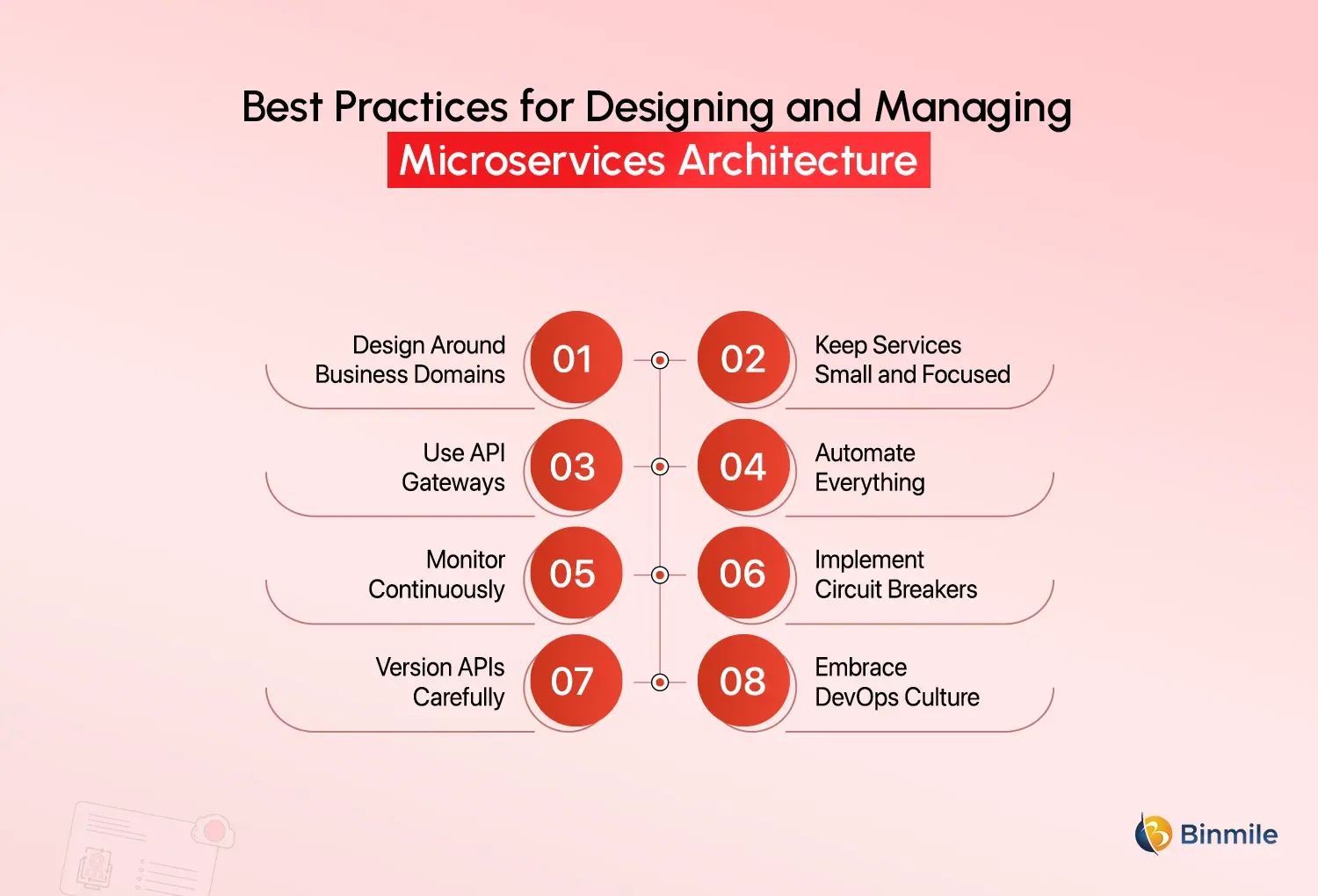
Design Around Business Domains
Each service should encapsulate a specific business capability and not merely a technical function. Aligning services with business domains can provide ownership, reduce cross-team dependencies, facilitate more seamless business growth, and make scaling easier and practical as the business grows.
-
Keep Services Small and Focused
A simple microservices architecture is easier to develop, scale, and maintain. Conversely, undertaking a large number of responsibilities with one service leads to mismanagement and the issue of monolithic systems being repeated within a distributed system.
-
Use API Gateways
For clients interacting with multiple services, API gateways provide a single entry point. They simplify client interaction and improve security and traffic control by managing authentication, request routing, and logging.
-
Automate Everything
In microservices environments, the automation of testing, deployment, monitoring, and recovery processes is essential. Less manual work is performed, leading to fewer errors. Systems will maintain reliability, even as they grow, with the use of auto-scaling policies and CI/CD pipelines.
-
Monitor Continuously
Monitoring and observability across all services can provide enough visibility to understand the performance, errors, and overall health of the system. With robust observability, teams can identify problems early, understand system behaviors, and mitigate the risks of system degradation from user interactions.
-
Implement Circuit Breakers
Avoid allowing failures from one service to cascade to the entire system. When service degradation occurs, implement circuit breaker controls to limit the request flow to the service and allow the system to stabilize instead of suffering from a complete collapse.
-
Version APIs Carefully
To manage and reduce potential breaking impacts on the dependent services and external consumers, implement some API versioning to support backwards compatibility as the services evolve.
-
Embrace DevOps Culture
Microservices epitomize the best systems when developers and operations teams work closely together. Shared service ownership drives accountability, increases response time, and facilitates the release of systems that are more predictable and quicker.
Explore how a scalable microservices approach can future-proof your application to expand your user base.
How Binmile Helps You Scale with Microservices
Choosing the right partner to architect and implement microservices solutions can make a significant difference in how effectively your application scales. With experience in handling complex distributed systems, Binmile helps businesses evaluate whether a transition from monolithic to microservices is appropriate. They assist in identifying modular boundaries, defining the right microservices architecture design patterns, and guiding development from strategy to execution.
Their expertise extends to designing ecommerce microservices architecture and enterprise-grade Mobile Application Architecture that supports fluctuating traffic loads and high transaction volumes. By leveraging containerization tools and orchestration platforms such as Kubernetes, they ensure that each microservice component can scale independently while maintaining performance and stability. What sets Binmile apart is its ability to align technology with business goals rather than applying a one-size-fits-all approach. Whether you are building a brand new microservices model or modernizing an existing application, they help you unlock the full potential of scalable software architecture.
Frequently Asked Questions
Microservices break an application into independent services, allowing each part to scale based on its specific demand instead of scaling the whole system.
Cloud platforms provide on-demand resources and orchestration tools that make it easier to deploy, scale, and manage microservices across distributed environments.
Containers package services for consistent deployment, and Kubernetes automates scaling, load balancing, and recovery to meet demand changes.
It isolates services so traffic spikes on one function do not overload the entire system, enabling targeted scaling and faster response times.
Ecommerce, finance, healthcare, media, and logistics benefit especially due to variable workloads and the need for frequent feature updates.
Initial costs can be higher due to more components, but optimized scaling and efficient resource usage often reduce long-term operational expenses.