
Modern software teams are under constant pressure to deliver features faster without compromising stability or security. According to a report by Gartner, by 2026, 80 percent of large software engineering organizations will establish platform engineering teams to improve developer experience and delivery speed.
This shift signals a bigger change in how enterprises approach application delivery. In this blog, we will explore what Platform Engineering is, how it differs from traditional DevOps practices, and how platform engineering services help organizations achieve faster application deployment, scalable application delivery, and improved engineering efficiency.
What is Platform Engineering?
Platform Engineering is a discipline focused on building and maintaining reusable internal platforms that enable development teams to ship software faster and more reliably. Instead of every engineering team solving infrastructure and tooling challenges independently, a dedicated platform engineering team creates standardized solutions that developers can easily consume.
The developer experience is the focal point of every aspect of platform engineering. As as-a-product engineering, it balances self-service, automation, and actionable workflows. Internal Developer Platforms, or IDPs, unite disparate experiences of CI/CD, cloud, security, and observability.
Platform engineers partner with engineering functions to diagnose and remediate friction points in the workflows with the intent of creating platforms that allow developers to shift the balance of their time from managing environments, deployments, and compliance to writing business logic.
Key Benefits of Platform Engineering for Modern Engineering Teams
Platform engineering reduces complexity by standardizing environments and workflows, enabling engineering teams to deliver faster, more reliable software while maintaining control and consistency.
-
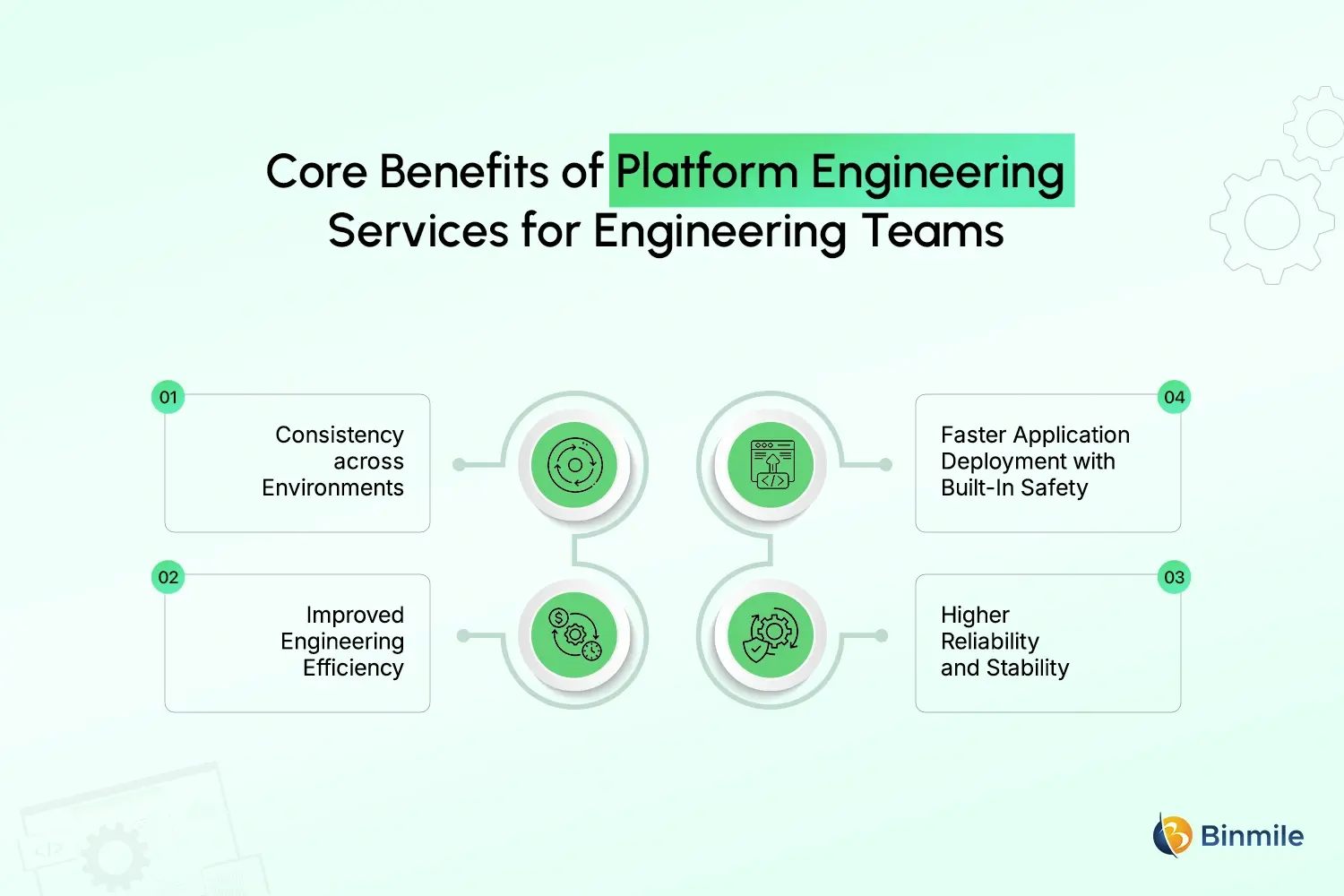
Consistency across Environments
Standardized development, testing, and production environments ensure consistency and configuration drift is avoided, solving the problem of applications working in one environment but not another.
-
Improved Engineering Efficiency
Teams no longer have to do the same work multiple times by consolidating shared services like data platforms, CI/CD pipelines, and engineering tools for the cloud platform, enabling engineers to do the actual work of developing features as opposed to having to manage infrastructure.
-
Higher Reliability and Stability
The addition of automated testing, deployment, and rollback in platform engineering for enterprise increases the predictability of releases and helps build confidence in the delivery process by reducing risk and control.
-
Faster Application Deployment with Built-In Safety
Speed of delivery is increased because security, compliance, and best practice guardrails are integrated into the platform, enabling teams to go faster without adding additional risk or needing time-consuming manual approval processes.
Why Enterprises Are Moving from DevOps to Platform Engineering
| Aspect | DevOps at Scale | Platform Engineering |
|---|---|---|
| Ownership model | Ownership of pipelines, tools, and infrastructure is shared across multiple teams, which often leads to confusion during failures or upgrades. | A dedicated platform engineering team owns and maintains the platform, while product teams use it without worrying about underlying complexity. |
| Tooling | Different teams manage different tools, creating inconsistency and tool sprawl that increases maintenance effort. | Tools are centralized, standardized, and integrated into a single internal developer platform for easier management. |
| Developer focus | Developers split time between writing application code and handling infrastructure or deployment tasks. | Developers focus mainly on building applications, while the platform handles infrastructure, security, and deployments. |
| Delivery speed | Delivery slows down as complexity grows due to manual steps and dependency issues. | Automated workflows and standardized pipelines enable faster and more predictable application delivery. |
| Governance | Security and compliance are often enforced manually through reviews or approvals. | Governance is built into the platform through automated policies and security controls, ensuring speed with safety. |
What are the Platform Engineering Capabilities That Accelerate Deployments
Platform engineering accelerates deployments by combining automation, self-service, and cloud-native practices into a unified platform that removes delivery bottlenecks.
-
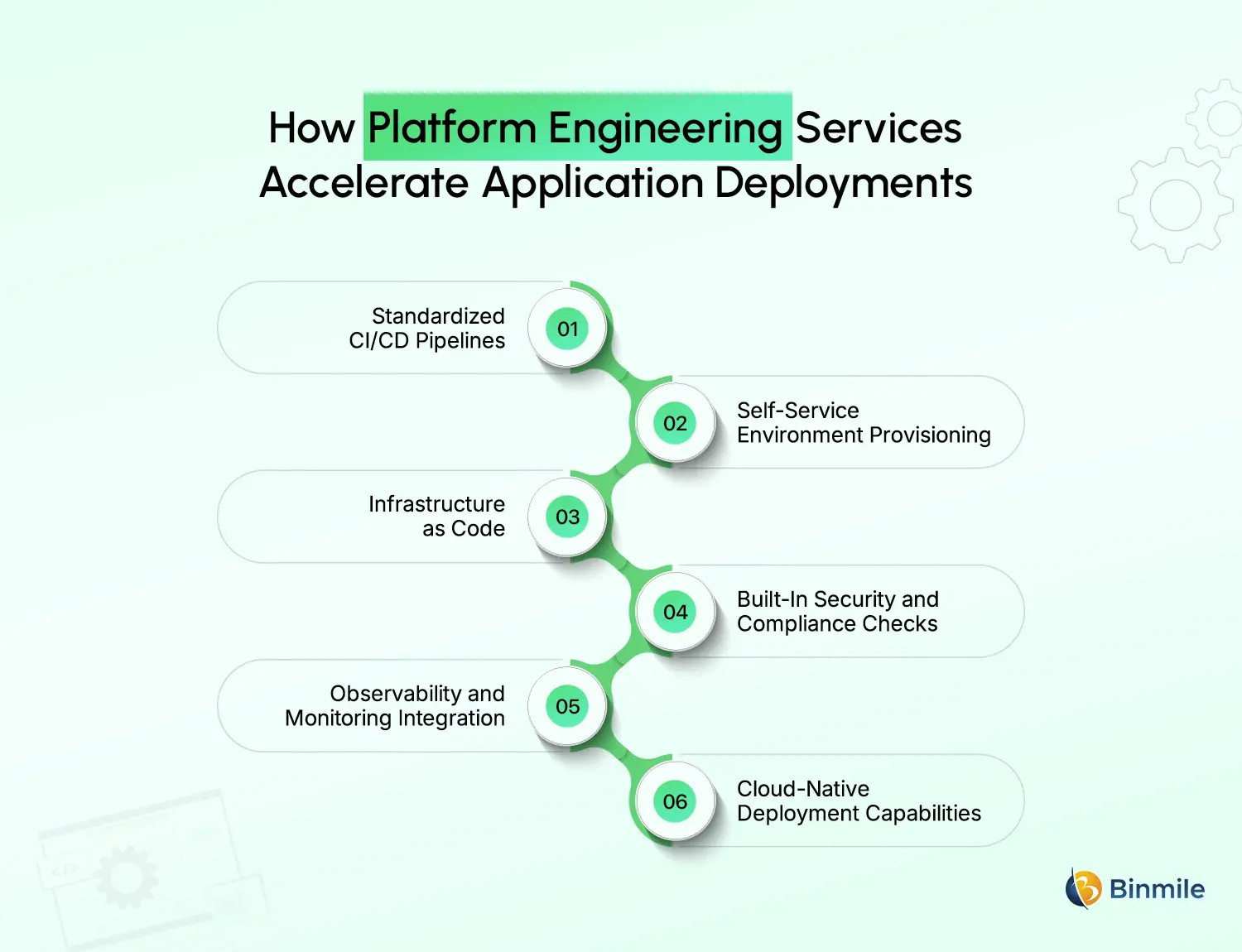
Standardized CI/CD Pipelines
The engineering team is enabled to effortlessly configure build, test, and release pipelines created in advance by platform engineering. This streamlines the deployment process and allows engineering teams to make updates faster and with fewer failures.
-
Self-Service Environment Provisioning
Employing pre-defined templates, developers can create the necessary environments for dev, test, or staging anytime they want without having to wait for manual provisioning, which decreases the cloud infrastructure teams’ workload.
-
Infrastructure as Code
Cloud resources are managed using code, making environments repeatable and easy to version. This ensures faster setup, consistent configurations, and quicker recovery in case of failures.
-
Built-In Security and Compliance Checks
Security policies and compliance rules are embedded directly into the platform. Automated checks run during deployments, allowing teams to move fast without introducing security risks.
-
Observability and Monitoring Integration
Logging, monitoring, and alerting tools are integrated into the platform. Teams can quickly detect issues, analyze performance, and resolve deployment failures before they impact users.
-
Cloud-Native Deployment Capabilities
Support for containers, orchestration, and auto-scaling enables applications to deploy and scale efficiently. These cloud platform engineering features ensure stability even during high traffic or frequent releases.
Struggling with slow releases and fragmented DevOps workflows?

The Role of Internal Developer Platforms in Scalable Application Delivery
Internal developer platforms simplify how teams build and deploy applications, enabling scalable application delivery while preserving governance and consistency across the enterprise.
-
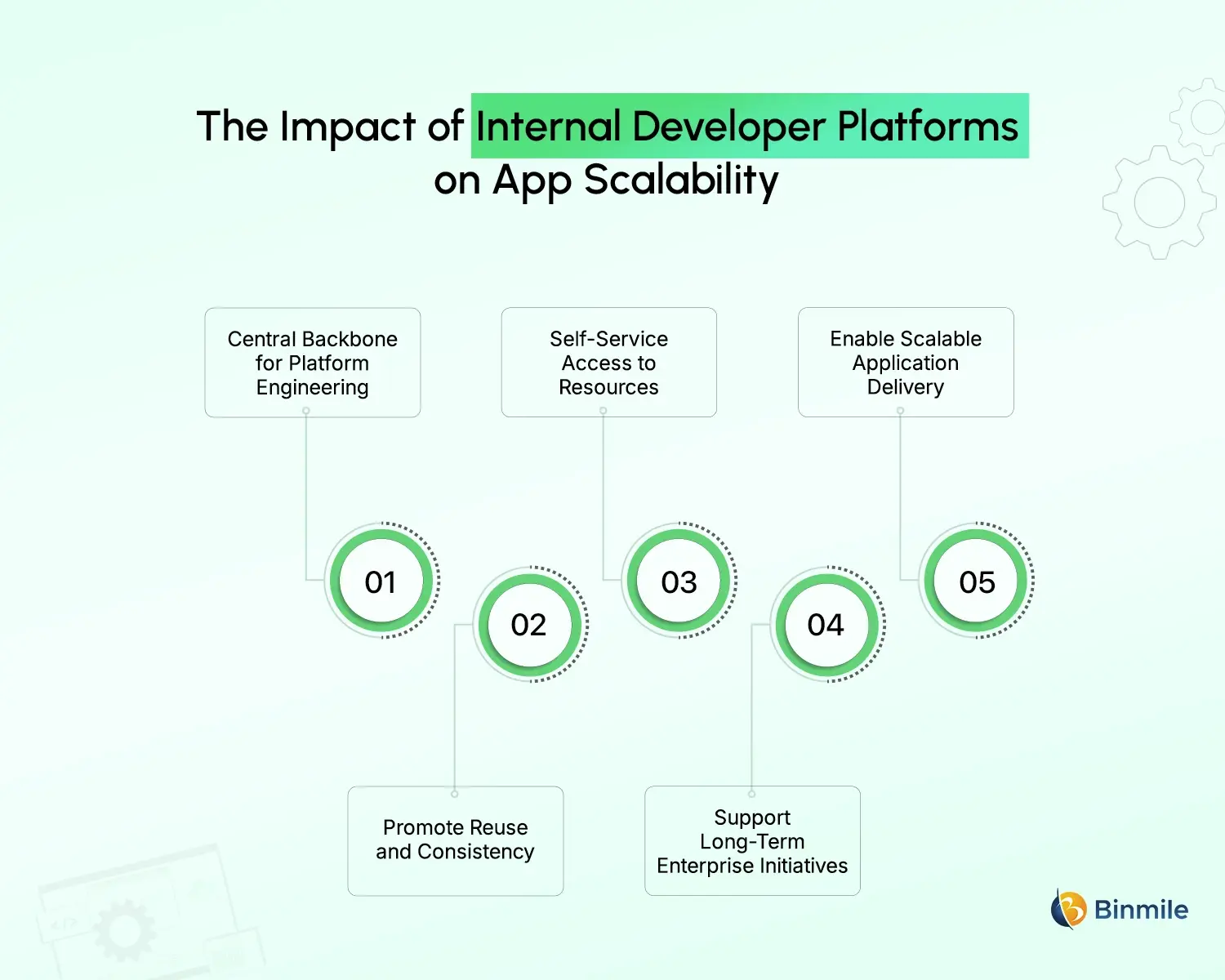
Central Backbone for Platform Engineering
For enterprise platform engineering, the IDP provides the integration of tools, services, and workflows, in turn, providing a one-stop resource for the users.
-
Self-Service Access to Resources
Developers can provision environments and deploy applications or services without the need for a service desk ticket or approval workflows. This helps in delivering services faster while maintaining control over the processes.
-
Enable Scalable Application Delivery
With the developer platform, maintaining the same configuration across teams and enabling scalable application delivery is possible, even with the increase in complexity.
-
Promote Reuse and Consistency
Commonly utilized components, such as deployment templates, data access layer, and authentication services, aid in maintaining the same structure across different applications.
-
Support Long-Term Enterprise Initiatives
Developer platforms aid in the creation of various applications and a data platform, which boosts an organization’s digital initiatives and improves a developer’s productivity.
Platform Engineering and Engineering Efficiency at Scale
As engineering teams grow, coordination becomes harder. Platform engineering addresses this challenge by creating a common foundation that all teams can rely on.
Engineering efficiency improves because teams spend less time solving the same problems repeatedly. Platform engineers focus on optimizing shared workflows while product teams concentrate on delivering value to users.
This approach also supports evolving software development trends. Whether adopting microservices, serverless architectures, or data modernization strategies, the platform provides a stable base that adapts to change without disrupting delivery speed.
In large enterprises, this alignment between platform engineering and business goals leads to faster innovation cycles and better overall outcomes.
Need a scalable platform engineering solution that helps your teams release software faster and with confidence?

How Binmile Helps Build Scalable Platform Engineering Solutions
Building an effective platform requires more than tools. It requires a deep understanding of enterprise needs, cloud-native architectures, and developer workflows. This is where experience in digital product development, cloud platform engineering, and DevOps and platform engineering practices makes a real difference.
With a strong focus on enterprise platform engineering, Binmile helps organizations design platforms that align with business priorities while remaining developer-friendly. By treating the platform as a product and focusing on long-term scalability, teams deliver faster without compromising quality.
Rather than pushing generic solutions, the approach centers on understanding existing engineering teams, identifying delivery bottlenecks, and implementing platform engineering solutions that integrate seamlessly with current systems. This results in measurable improvements in delivery speed, reliability, and engineering efficiency across the organization.
Frequently Asked Questions
Platform engineering sits at the core of cloud-native application development by abstracting infrastructure complexity. It enables developers to build, deploy, and scale cloud-native applications using standardized platforms without managing underlying cloud services directly.
Platform engineering improves productivity by reducing cognitive load. Developers get self-service tools, automated CI/CD pipelines, and consistent environments, allowing them to focus on writing code instead of managing infrastructure or deployment processes.
Yes, platform engineering services are especially valuable for enterprises with multiple engineering teams. They bring standardization, governance, and scalability, helping large organizations achieve faster application deployment without sacrificing security or compliance.
Platform engineering delivers business value through faster time to market, improved engineering efficiency, reduced operational costs, and higher reliability. These outcomes directly support growth, innovation, and long-term digital transformation goals.
Binmile combines platform engineering expertise with cloud-native and DevOps experience to build scalable, developer-centric platforms. The focus is on long-term value, seamless integration, and measurable improvements in application delivery speed.