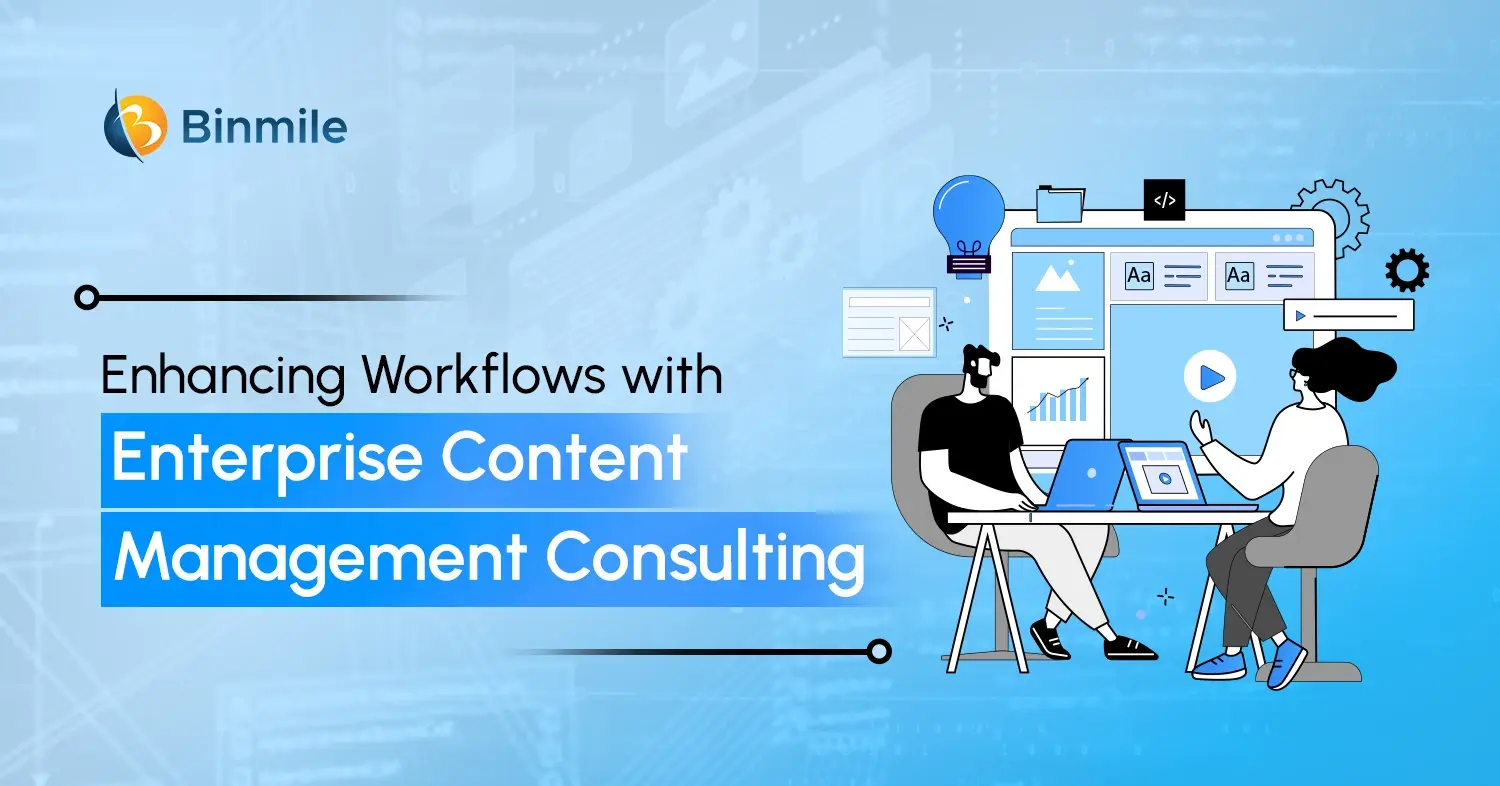
Organizations today generate an enormous volume of documents, emails, media files, and operational records every single day. Managing this growing content ecosystem has become a serious operational challenge for enterprises. According to a study, the global datasphere is expected to reach 175 zettabytes, highlighting the massive growth of enterprise data and content assets.
This blog explores what enterprise content management consulting actually involves, how it helps modernize workflows, the strategic benefits it brings, and the challenges organizations may face during implementation. We will also look at how to choose the right consulting partner and examine emerging trends shaping the future of enterprise content management.
What is Enterprise Content Management Consulting
Enterprise content management consulting provides planning, implementation, and optimization of systems managing digital content across the enterprise. These services include reviewing current practices, suggesting appropriate enterprise content management services, and managing implementation.
An enterprise content management software system enables businesses to capture, store, organize, and retrieve documents and digital assets systematically. However, choosing the right ECM system and integrating it with business processes demands specialized knowledge. ECM consulting works with business leadership, IT, and operations to determine the appropriate enterprise content strategy.
How Enterprise Content Management Consulting Modernizes Business Workflows
A well-designed enterprise content management system transforms the way organizations handle information and workflows.
-
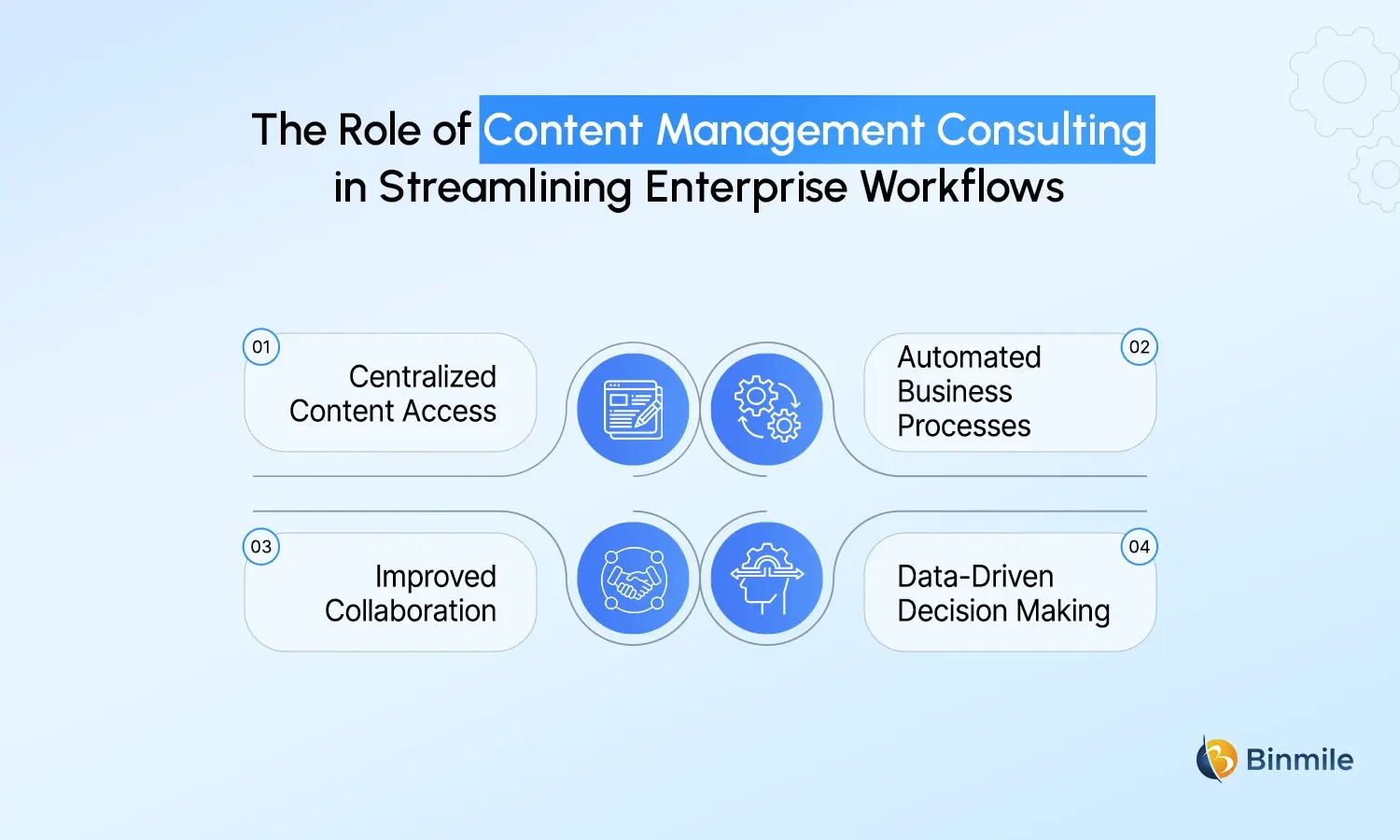
Centralized Content Access
Oversights caused by antiquated storage solutions, ranging from email systems to departmental drives, can be fully avoided by choosing ECM software to centralize your organization’s enterprise content into a single digital repository. With such a system, teams can prioritize time savings and rapid access to the needed content over navigating disparate systems. ECM will also mitigate duplicated digital assets, maximize accuracy with version control, and help ensure all staff access the latest and greatest revisions to documents.
-
Automated Business Processes
Inefficient, delayed, and erroneous business processes are a direct result of manual document workflows. ECM software enables critical workflows such as invoice approvals, contracting, compliance, and onboarding to be automated. Automated workflows replace the processes of email approvals by guiding a document through the necessary stages. With this automation, ECM features the ability to improve the time needed to complete a process while increasing the consistency and transparency.
-
Improved Collaboration
Centralized digital content storage improves collaboration, and ECM solutions take this to the next level. Many ECM platforms include the ability to annotate documents, assign access privileges, and monitor work progress from a single dashboard. This helps to increase inter-departmental collaboration and keeps teams coordinated while working on the same content.
-
Data-Driven Decision Making
When enterprise content is organized and accessible, it becomes a valuable strategic asset rather than just stored information. Structured enterprise content solutions allow organizations to analyze documents, track workflow performance, and extract insights from stored data. This enables leadership teams to make more informed decisions while improving operational efficiency across departments.
Strategy for Implementing Enterprise Content Management Consulting
Successful ECM adoption requires more than simply selecting a software tool. Here are the strategies to implement enterprise content management consulting services
1. Content Audit and Assessment
The first stage consists of reviewing all content and assessing the current workflow. Considerations of the consultants include the state of the document repository, workflow bottlenecks, the mitigating factors of data security, and the regulatory and compliance restrictions. These findings are used to formulate the inefficiencies that exist systemically and the needs that exist to create practices that improve the current system of content management.
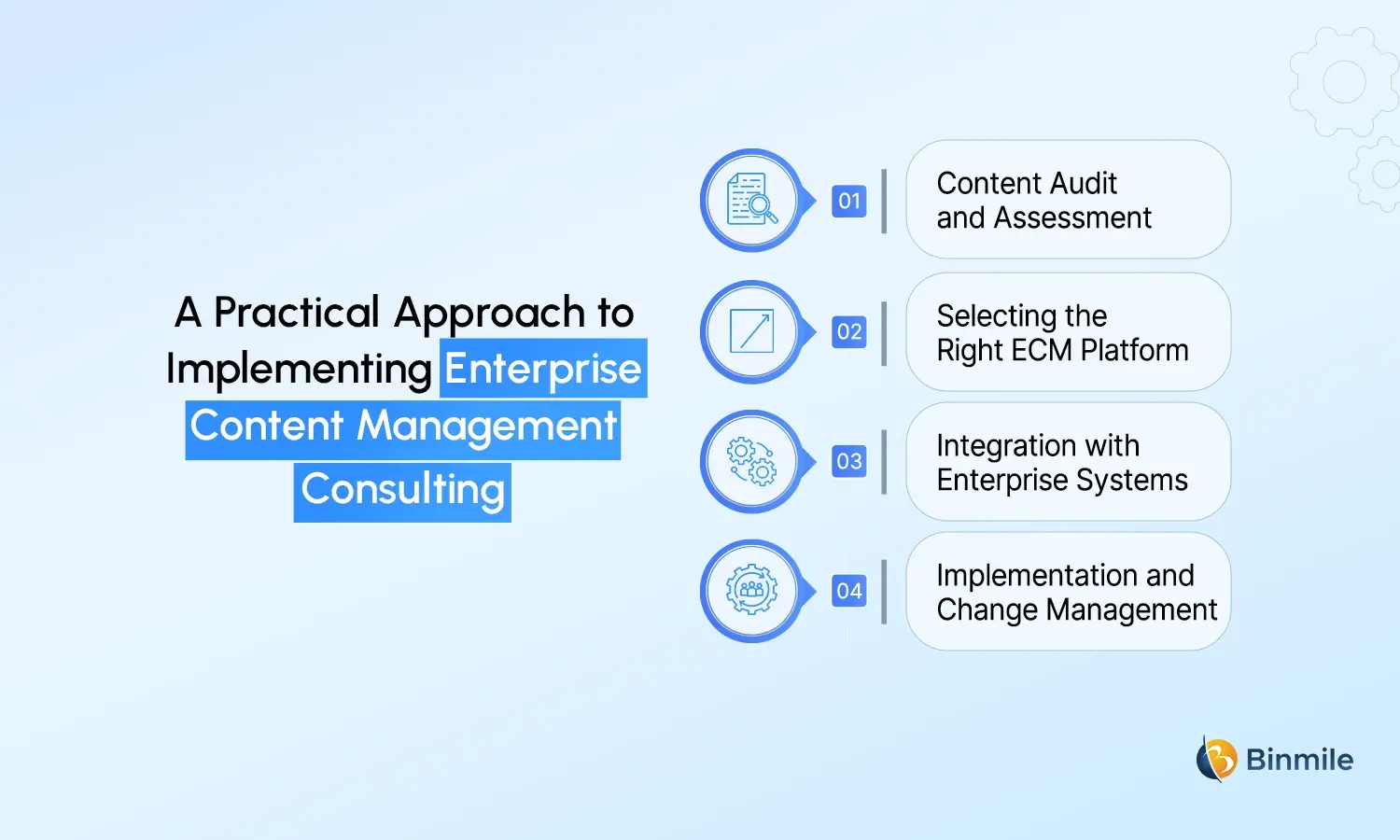
2. Selecting the Right ECM Platform
Choosing the right enterprise content management software depends on several factors.
| Evaluation Factor | Why It Matters |
|---|---|
| Scalability | Ensures the system grows with the business |
| Integration Capabilities | Supports ERP integration and other enterprise tools |
| Security Features | Protects sensitive business data |
| User Experience | Improves adoption across teams |
The goal is to implement an ECM platform that aligns with the organization’s operational structure while supporting future scalability and system integrations.
3. Integration with Enterprise Systems
An ECM implementation is incomplete without integration with the enterprise systems of the organization. Integration ensures that the ECM maintains linkage with the operational data documents of the organization. For instance, ERP integration facilitates the linkage of transactional records to their corresponding documents, which enhances operational and financial visibility. CMS for business enterprise integration improves the management of customer data, and the integrated collaboration tools improve team interactions.
4. Implementation and Change Management
The introduction of a new content management system is an exercise that necessitates systematic and thorough organizational readiness. Implementation is usually accompanied by the configuration of the system, migration of data, and the training of employees. Change management is an approach that consultants use to the end that it encourages system adoption and minimize dissent. Well-prepared training improves the rate of adoption and the overall success of the implementation.
What are the Key Benefits of Enterprise Content Management Consulting
Organizations that invest in enterprise content management consulting often experience significant operational improvements.
Below are some of the most impactful benefits.
-
Operational Efficiency
Workflow automation and content centralization streamline processes and save time. Employees no longer spend time searching for documents and can devote more time to more strategic work.
-
Better Compliance and Risk Management
Document controls and audit trails are critical in regulated industries. ECM software systems support document security and compliance with industry standards.
-
Improved Customer Experience
Customer service teams can access information quickly and provide better service.
-
Cost Reduction
The costs associated with managing unstructured data are frequently underestimated. An organized enterprise content management system reduces costs related to document storage, manual processing, and compliance.
-
Stronger Collaboration Across Teams
Enterprise content solutions allow for seamless collaboration across teams without delays from document sharing.
Looking to streamline document workflows and eliminate content silos across your organization?

What are the Common Challenges in Enterprise Content Management Implementation
While there are benefits to having software for managing enterprise content, businesses run into challenges when trying to implement it. A key challenge is legacy systems. Most businesses are still using older systems, and older systems are especially hard to integrate with new ECM systems. Because of this, migrating content is also very tedious and difficult.
The process of migrating data can also be very difficult, especially when trying to move large quantities of data into a new ECM. One of the most important aspects to be considered during this process is the mapping of data, the transfer of which must be both secure and proper in order to ensure that the data is not lost along with its associated metadata.
User adoption is also a challenge on its own. Employees are likely to fight new workflows if systems are onerous in nature and require a lot of training to get accustomed to, but there are also likely to be very specific security requirements to ensure that sensitive business content is not made available to those not intended. This data must also be well-protected in order to ensure that proper compliance is in place.
How to Choose the Right Enterprise Content Management Consulting Partner
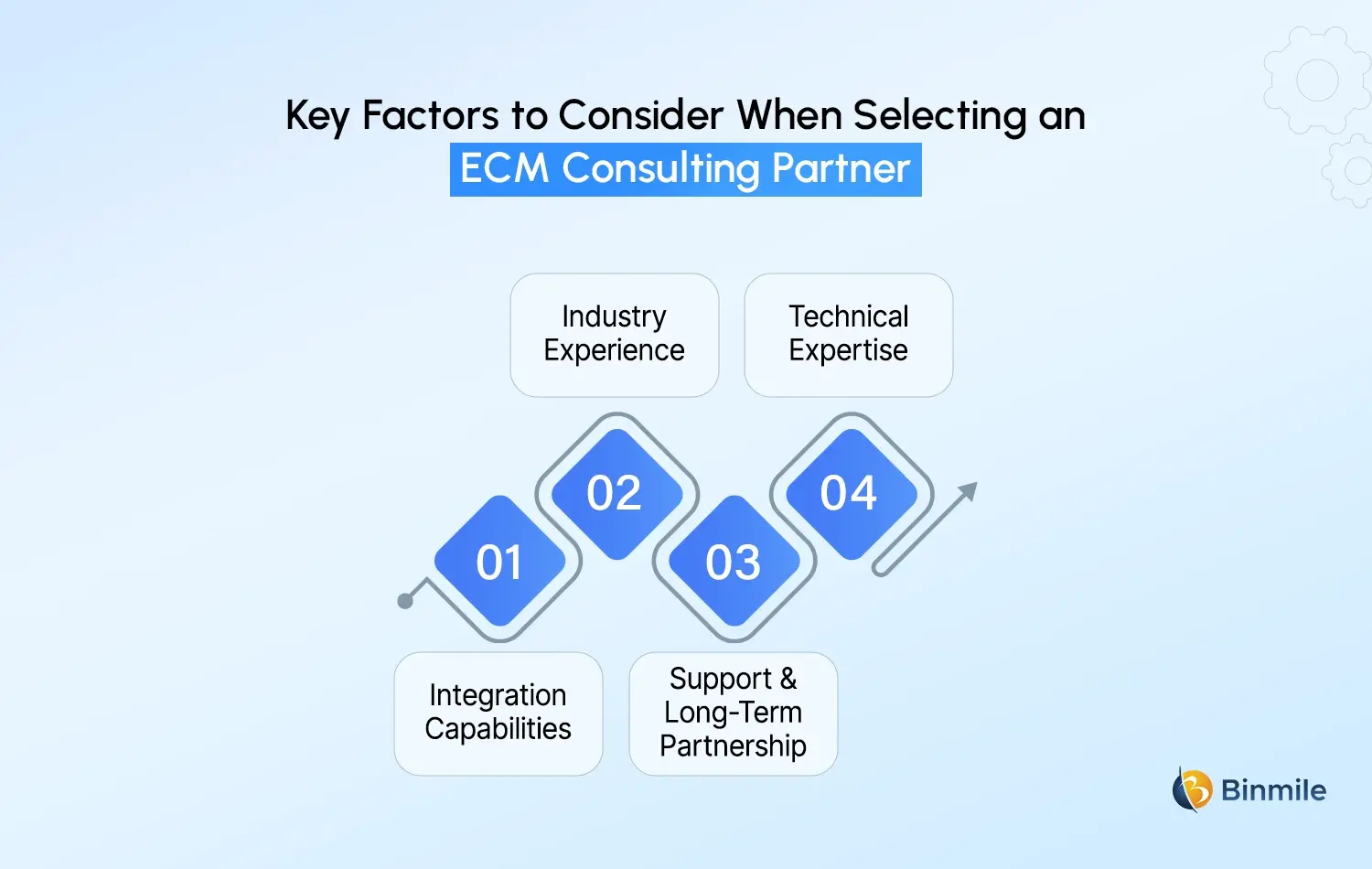
Selecting the right enterprise content management company plays a crucial role in ensuring a successful ECM implementation. Organizations should evaluate potential consulting partners carefully based on experience, technical expertise, and long-term support capabilities.
-
Industry Experience
Consultants with proven industry experience can create enterprise content solutions that fit particular operational needs more accurately. Individual industries have specific needs regarding content management. For example, organizations in the healthcare industry deal with documents that are regulated by specific compliance standards, and in the case of the banking industry, highly sensitive financial data and records, as well as transactions, need to be stored in protected systems.
-
Technical Expertise
A trustworthy ECM consultant needs to have high-level technical skills across more than one enterprise technology and platform. Their knowledge must go beyond ECM solutions to include software consulting, artificial intelligence consulting, custom software development services, and bespoke software development. This way, the ECM system can be positioned to address the needs of the enterprise, and the ECM system can be utilized in conjunction with other enterprise technologies.
-
Integration Capabilities
Consultants need to assess if legacy ECM systems are capable of transforming enterprise systems to enable a content-driven operational framework and other operational systems to help add value to the legacy ECM systems. Effective integration leads to the ECM content being connected with operational data and other digital systems of the enterprises.
-
Support and Long-Term Partnership
Enterprise content management is not a one-time project. As organizations grow, their content strategies and system requirements evolve. A dependable enterprise content management consulting partner provides ongoing support, system optimization, and technology updates to ensure that the ECM platform continues to deliver long-term value.
Future Trends in Enterprise Content Management
Continuously changing for the better, enterprise content management software is better suited for the needs of the organization as they undergo digital changes. Modern ECM systems become more intelligent as they incorporate more advanced features.
Artificial Intelligence optimizes enterprise content management systems by helping automatically classify documents, extract key information, and streamlining workflows.
Enterprise content management software and cloud-based ECM systems are also becoming more widely used. Compared to traditional systems, cloud-based ECM systems move the ECM systems from the organization to the cloud, and as such, ECM systems become more flexible and more cost-effective.
Furthermore, workflow automation and integration with the most popular CMS platforms are allowing organizations to better combine the management of internal documents with the management of digital content within a single content management system.
Planning to implement a powerful enterprise content management system for smarter operations?

How Binmile Helps Organizations Modernize Content Management
Modern enterprises need more than just software implementation. They require a structured strategy that connects content, workflows, and business systems in a cohesive ecosystem.
This is where specialized expertise becomes valuable. With strong capabilities in software consulting, AI consulting, and enterprise software development, Binmile helps organizations design scalable enterprise content management solutions that align with operational goals. Their approach focuses on understanding existing workflows, identifying inefficiencies, and building structured systems that improve collaboration and productivity.
Organizations implementing an enterprise content management system often need seamless ERP integration, workflow automation, and scalable platforms that support future growth. Through its experience as a web app development company and provider of custom software development services, the team supports businesses in implementing modern enterprise content solutions that integrate smoothly with enterprise applications and support long-term digital transformation initiatives.
Frequently Asked Questions
Enterprise content management consulting helps organizations design, implement, and optimize systems that manage documents and digital assets across departments. Consultants analyze workflows, recommend suitable ECM platforms, and ensure secure and efficient content management aligned with business goals.
Enterprises generate massive volumes of content daily. Content management consulting helps organize this data, streamline workflows, reduce operational inefficiencies, ensure regulatory compliance, and improve collaboration by implementing structured enterprise content management systems.
Yes, cloud migration is often included in enterprise content management consulting. Many organizations shift from on-premise ECM systems to cloud-based platforms to improve scalability, accessibility, and cost efficiency while maintaining secure document management.
Industries with high document volumes benefit significantly, including healthcare, banking, insurance, legal services, manufacturing, and government organizations. These sectors rely heavily on secure document management and regulatory compliance.
Enterprise content management systems centralize documents, automate approval processes, and streamline collaboration. This reduces manual tasks, improves information accessibility, and accelerates decision-making across departments.
Modern ECM solutions include document capture, secure storage, workflow automation, metadata management, advanced search capabilities, integration with enterprise systems, and AI-powered content classification.
Implementation timelines vary depending on organization size, data migration complexity, and integration requirements. Small deployments may take a few months, while large enterprise implementations can take six months to a year.