AI has evolved beyond just a research tool. It is now greatly influencing enterprise decision-making, customer engagement, and operational efficiency daily. Simultaneously, companies are using AI through the use of predictive analytics and automation across their entire operation, and therefore, as these organizations increasingly rely upon AI, they are facing more questions regarding their AI systems from various perspectives, including data quality, data bias, data security, and data compliance. Additionally, the answer to these growing problems can be found through the use of a structured AI Governance Framework, which allows businesses to establish guidelines and policies to continue developing new and innovative ideas while still being in control of their business operations.
This blog will analyze what constitutes an AI governance framework, why enterprises require it, and the steps to take to realize it. Additionally, we will also discuss its fundamental principles, recurring issues, and effective methods to assist organizations in developing responsible and scalable AI systems.
What is an AI Governance Framework
AI Governance Framework will provide organizations with a structured method by which to fairly manage, assess, and maintain oversight of an organization’s AI systems. Additionally, it provides AI systems with a framework to ensure they operate ethically, legally, and operationally.
Furthermore, an AI Governance Framework operates like a rule book and a monitoring system to ensure all AI systems and processes are built and run with transparency, fairness, and accountability.
Governance for AI intersects with many different systems, such as IT Governance Frameworks and Data Governance Frameworks. Additionally, this ensures that all AI processes and systems align with organizations’ respective policies.
Simultaneously, AI Governance also intersects with Governance, Risk, Compliance (GRC) frameworks to help organizations remain compliant with emerging regulations while protecting their brand’s reputation and legal risks.
Why Enterprises Need a Structured AI Governance Strategy
Here is why enterprises need a structured enterprise AI governance framework:
1. Managing AI Risks in Business
Without adequate oversight, AI risks in the business of producing outputs that are biased or factually incorrect. Create a governance structure that utilises an AI Risk Management Framework to deal with risks in a timely manner by addressing them early.
2. Ensuring Ethical AI Models
AI and ethics are intertwined. Furthermore, a powerful and developed framework translates into the construction of Ethical AI Models that are fair, transparent, and accountable.
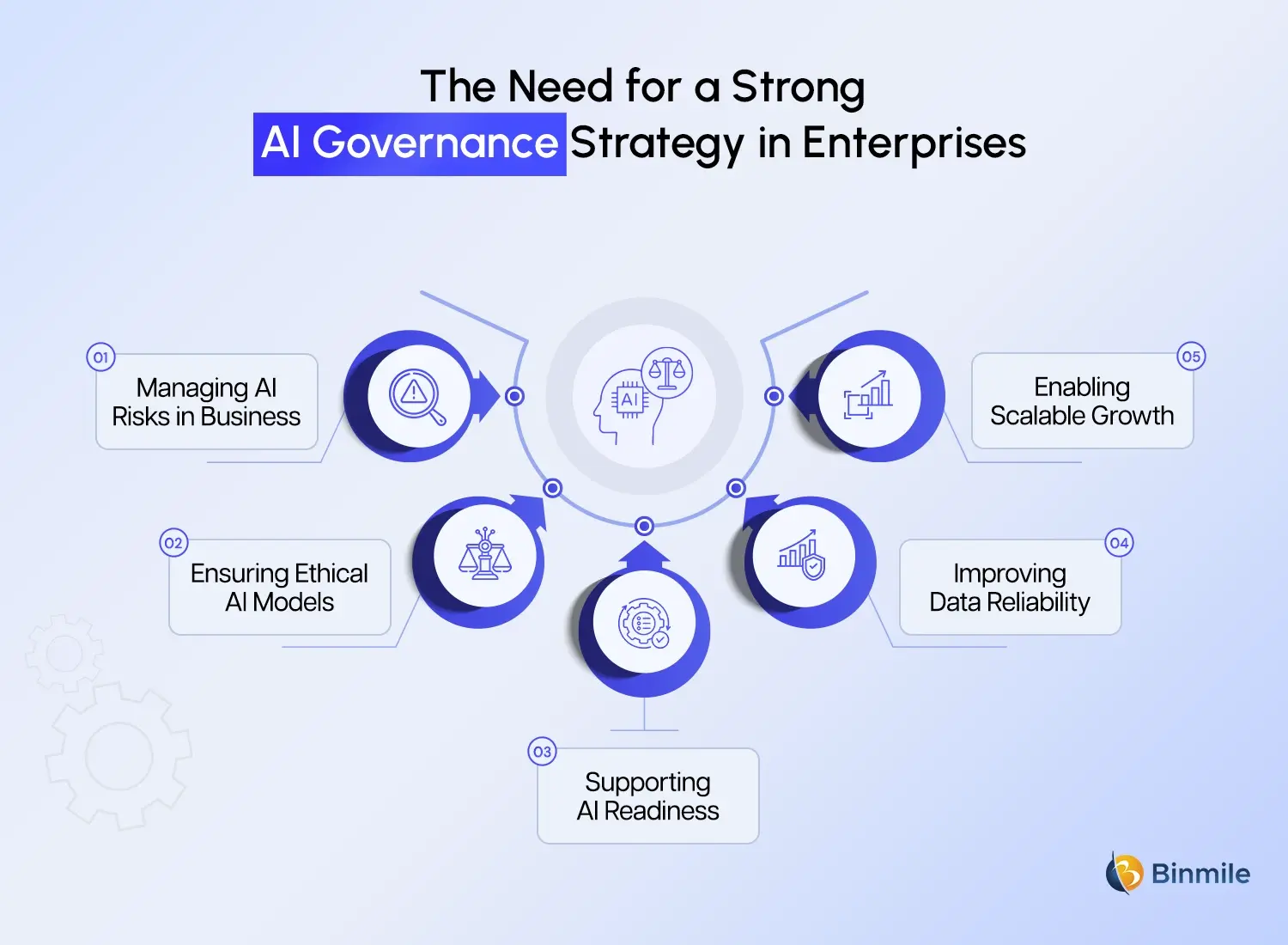
3. Supporting AI Readiness
Lack of clarity usually leads to organizations failing to adopt AI. Additionally, governance and AI Readiness strategies are integrated to provide a cohesive approach to optimizing the organizational structures, personnel, and policies.
4. Improving Data Reliability
AI operates on the data it has. Meanwhile, Data Governance Strategies are complemented by the addition of governance to data pipelines that have been cleaned, streamlined, and secured.
5. Enabling Scalable Growth
AI can not scale in an orderly manner without governance. Additionally, the chaotic place is where scalable growth exists. Controlled and sustained growth of various AI initiatives is achieved through the application of an organized AI strategy.
Key Components of an Effective AI Governance Framework
The best AI governance is composed of a multitude of integrated components, which lead to reliability, compliance, and alignment with organizational objectives. Additionally, it begins with comprehensive policies and consistent standards that detail the various AI systems that can be built, operationalized, and assessed, combined with ethical and regulatory restraints.
When combined with a data governance framework, model lifecycle management assures the quality, security, and management of data. Additionally, also provides continuous oversight of the AI systems. Meanwhile, organizations often use AI governance tools to enhance oversight and operational effectiveness.
The integration of risk and compliance management with AI initiatives and a governance, risk, and compliance framework facilitates the identification and mitigation of risks. Additionally, monitoring and auditing provide transparency, and well-defined responsibilities promote accountability across the teams.
Step-by-Step Guide to Implementing AI Governance
Below is a practical step-by-step guide to building an enterprise AI governance framework
Step 1: Define Your AI Strategy Framework
Initiate the AI framework by aligning the AI initiatives to the business goals. Additionally, an AI strategy framework gives clarity on the objective, use cases, and outcome to be expected.
Step 2: Assess Current Maturity
Assess the current capability using the AI Governance Maturity Model. Additionally, this outlines the gaps within the process, tools, and policy.
Step 3: Establish Governance Policies
Establish governance around data, model, and ethics policies such that they mirror the AI governance principles.
Step 4: Integrate Data Governance
Your data governance framework should facilitate the AI requirements around data quality, confidentiality, and accessibility.
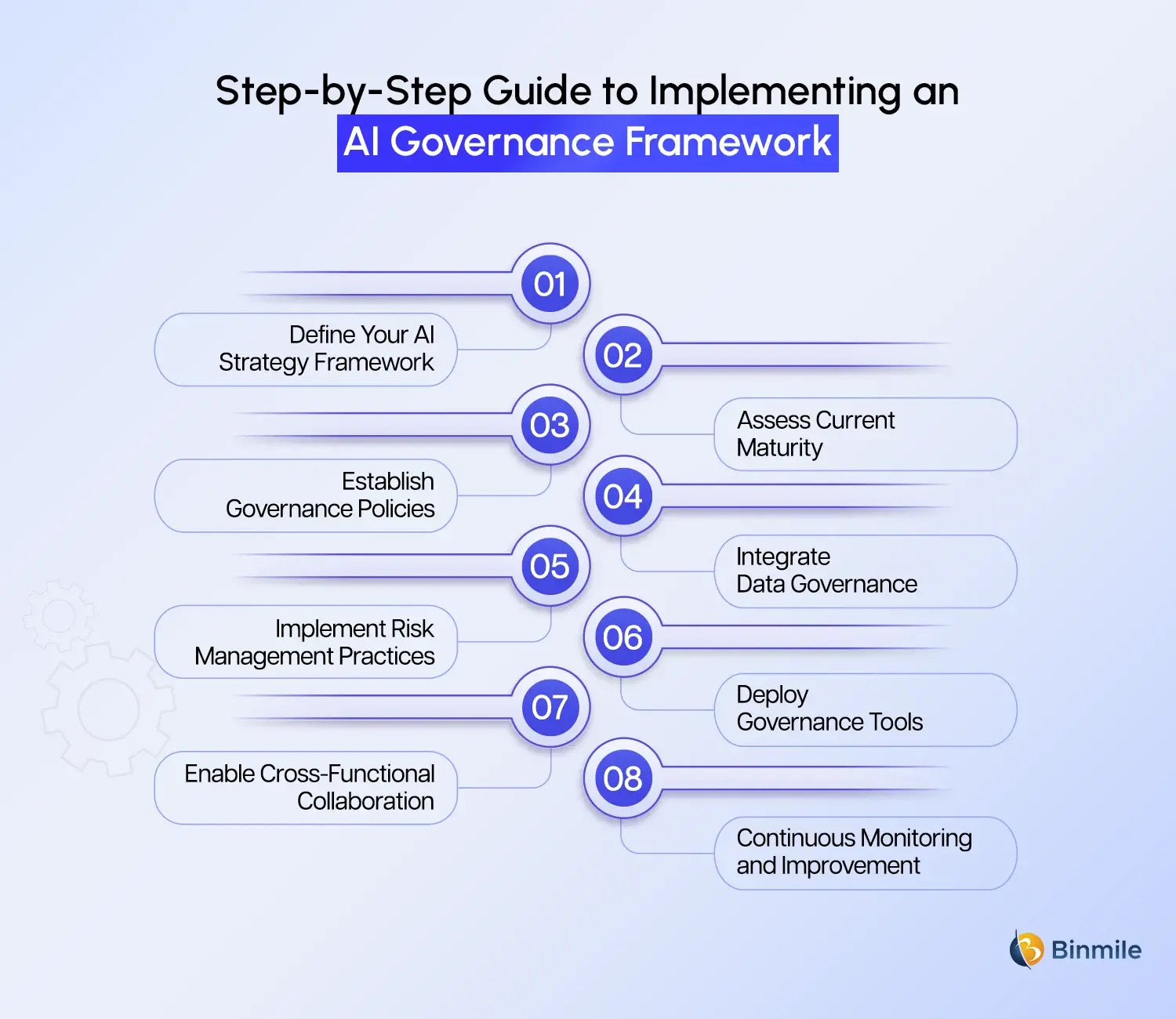
Step 5: Implement Risk Management Practices
Implement the AI Risk Management Framework to acknowledge the risks and the adjustments to be made to control those risks.
Step 6: Deploy Governance Tools
Use AI Governance tools to govern and automate the processes of monitoring, reporting, and compliance.
Step 7: Enable Cross-Functional Collaboration
AI governance is mainly a collaborative effort that extends to the legal, compliance, and business teams.
Step 8: Continuous Monitoring and Improvement
The framework is bound to evolve, hence regular audits and reporting should be done to govern the framework to comply with the business.
What are the Challenges in AI Governance Implementation
Introducing AI involves multiple real-world difficulties. Additionally, one strong point is the absence of decisive ownership; organizations not having the means to pinpoint the accountability for governance creates more ambiguity in accountability.
In addition to this, the fast pace of new rules and regulations means that compliance is a perpetually moving target. Furthermore, in a disjointed and siloed system, creating a cohesive data governance strategy framework can be nearly impossible.
It is reasonable to assert that a significant expertise deficit exists in this exact space. Additionally, organizations need to find the right balance between enabling creativity and maintaining control. Furthermore, strong governance can stifle innovation, while insufficient governance can create a backlog of unrealized potential.
Want to ensure your AI systems are compliant, ethical, and future-ready?

Best Practices for Building a Strong AI Governance Framework
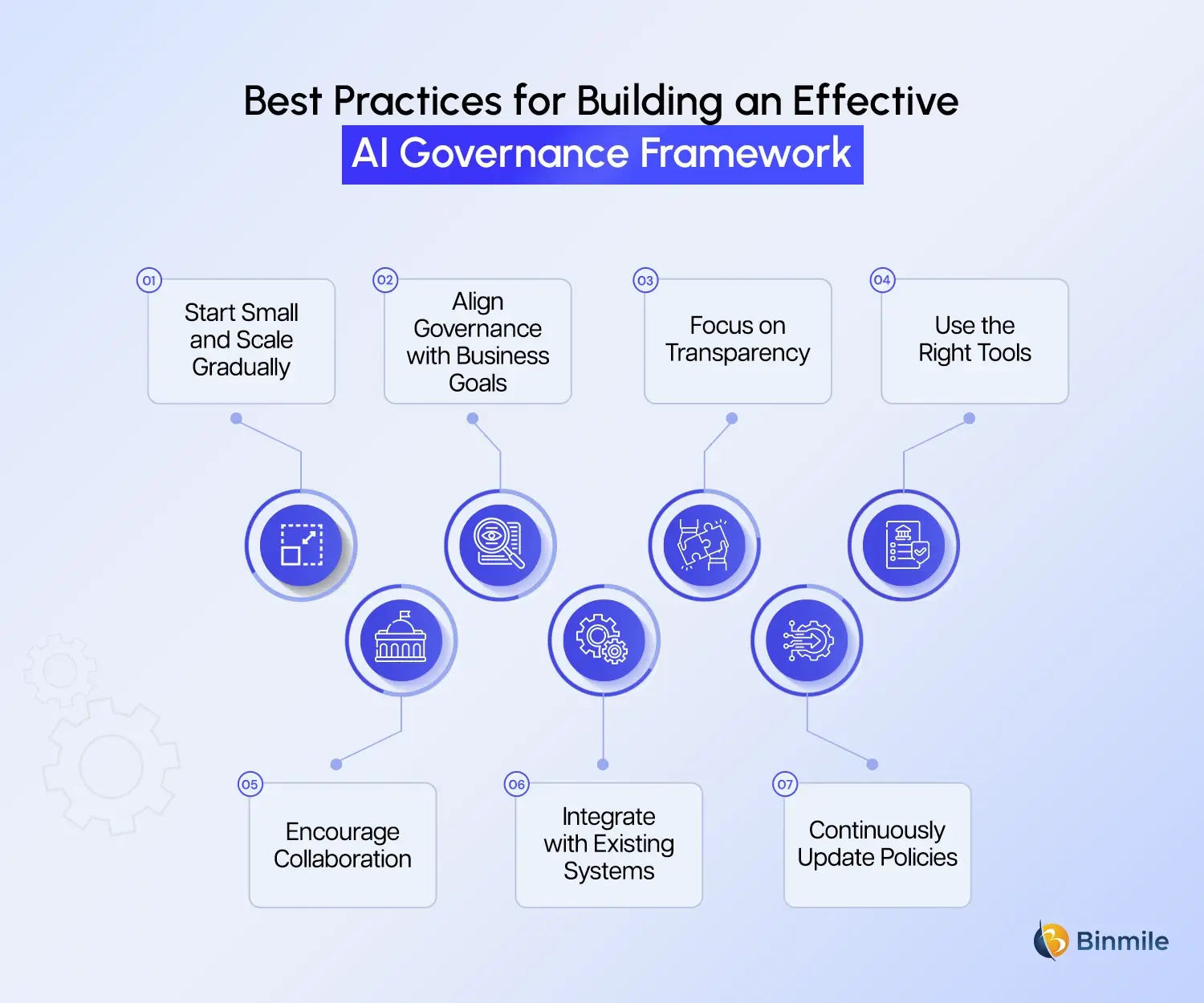
To make your governance framework effective and sustainable, it is important to focus on practical execution:
-
Start Small and Scale Gradually
Instead of attempting to govern everything at once, start with impactful use cases. Additionally, this will help you fine-tune processes to better govern issues as you expand.
-
Align Governance with Business Goals
Ensure that the enterprise AI governance framework fits within the overall strategy so that governance enables creativity rather than curbing it.
-
Focus on Transparency
Make audits and AI decisions clear and easy to understand to make compliance easier and create trust.
-
Use the Right Tools
Choose trustworthy AI governance tools to automate the tasks of monitoring, reporting, and tracking compliance.
-
Encourage Collaboration
Effective governance will come from the collaboration of business, compliance, legal, and IT.
-
Integrate with Existing Systems
For better alignment, make sure the IT Governance Framework and data engineering solutions align with the existing governance.
-
Continuously Update Policies
Update governance policies to keep them effective as AI advances.
How the Right Technology Stack Supports AI Governance
Technology plays a key role in enabling effective governance.
Modern enterprises that combine services for AI development, machine learning, and DevOps consulting create a powerful ecosystem for effective governance and efficient AI model development.
Other examples include Agentic AI Architecture, which is beginning to receive attention as it offers autonomous decision-making technologies, which will require even greater governance.
At the same time, the Data Management Trends offers organizations insights to keep up with innovations in practice around the management and governance of data.
How Enterprises Can Reduce Risks Through AI Governance
A well-implemented AI Risk Management Framework helps organizations proactively manage risks across multiple areas:
-
Operational Risks
Governance frameworks are built to monitor and validate the operational risks associated with AI systems to reduce the risks associated with improperly trained or faulty systems.
-
Compliance Risks
AI systems must comply with an emerging regulation. Meanwhile, a governance framework greatly reduces the occurrence of legal penalties.
-
Reputational Risks
AI Governance Frameworks are built to mitigate the bias and unethical impacts of AI Governance systems to help maintain a brand’s reputation.
-
Security Risks
AI depends on data and can be compromised by data breaches. Additionally, the combination of data governance and information governance can provide a layer of protection to sensitive information.
Looking to build a secure and scalable AI ecosystem for your enterprise operations?

How Binmile Can Support Your AI Governance Journey
The right strategy, an appropriate technology stack, and competent execution are crucial for developing a strong governance structure. This is where the right partner can provide significant impact.
Binmile, with advantages in Data Governance Services, AI development services, and data engineering services, helps organizations build governance frameworks in line with the organizational objectives. Additionally, the primary focus is on designing frameworks that are scalable and interlace seamlessly with the existing systems. Thus, the AI systems are governed, controlled, and future-ready.
With this approach, simultaneously, organizations can transcend the surface level of compliance and build AI systems that are designed for dependability and are development-ready.
Frequently Asked Questions
An AI Governance Framework helps manage how AI systems are built and used. Enterprises need it to ensure ethical practices, reduce risks, maintain compliance, and build trust while scaling AI initiatives effectively.
It includes policies, data governance, lifecycle management, risk and compliance systems, monitoring mechanisms, and defined roles. Together, these ensure AI systems remain reliable, transparent, and aligned with business goals.
Start with a clear strategy, assess maturity, define policies, integrate data governance, adopt risk management practices, and use governance tools. Continuous monitoring and collaboration are essential for long-term success.
It reduces operational errors, compliance violations, security threats, and reputational damage. Governance ensures AI systems produce accurate, fair, and explainable results, improving overall reliability.
It should involve data teams, IT, compliance officers, and leadership. A dedicated governance team or committee ensures accountability and alignment across departments.
It provides structure and risk control, allowing organizations to scale AI confidently. With clear policies, businesses can expand AI use cases without compromising compliance or performance.
Healthcare, finance, retail, and manufacturing benefit the most, as they rely heavily on data-driven decisions and require strong governance to ensure compliance, accuracy, and trust.