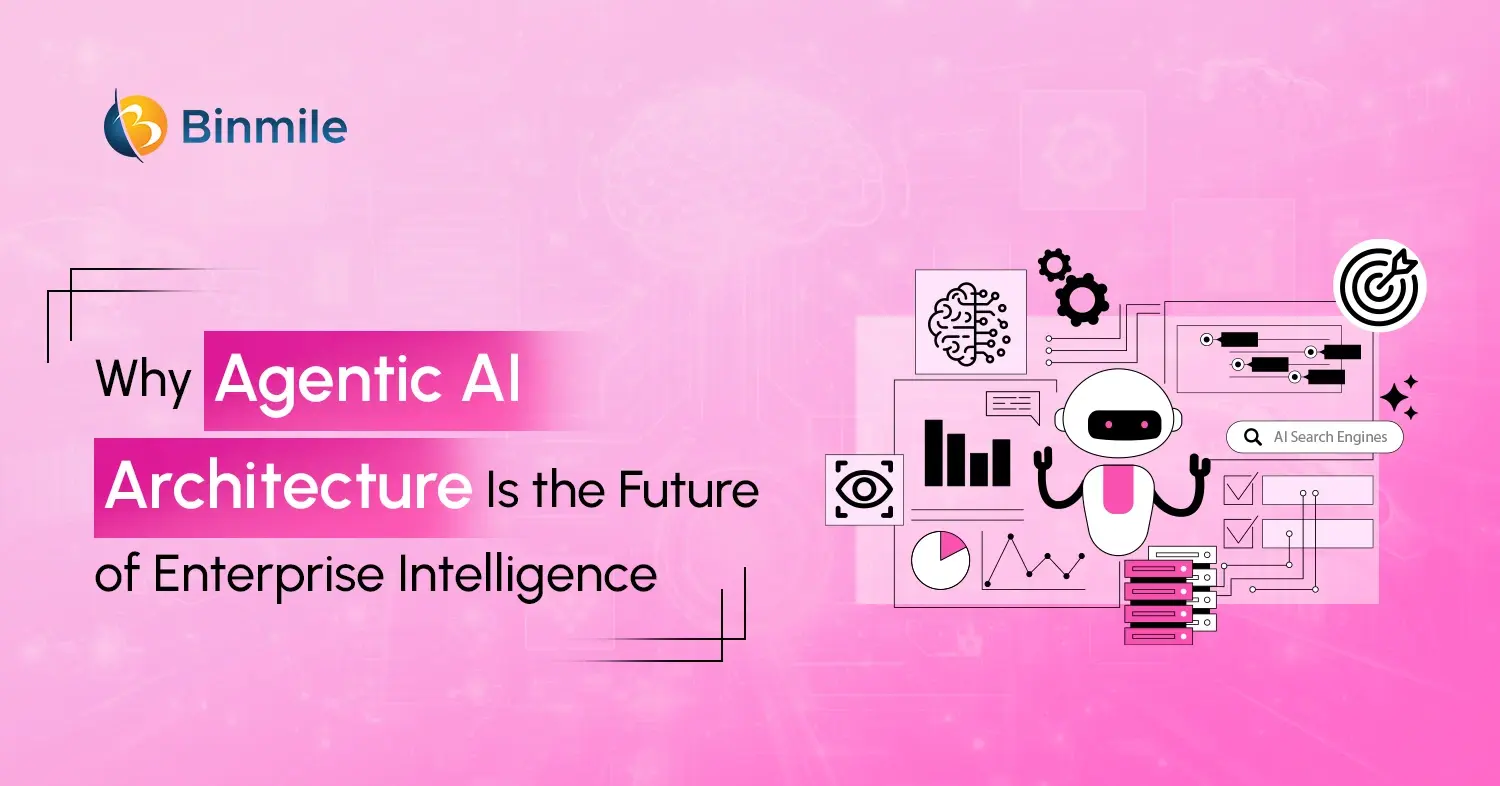
Organizations are now moving toward a stage where automation transcends scripts and workflows. There is an expectation that systems will be able to reason, plan, and act to attain business objectives. This expectation is contributing to the emergence of agentic AI, where intelligent agents make decisions, use tools, and work with other agents to accomplish multi-step undertakings. According to a recent Gartner report, by 2028, nearly 33% of enterprise software applications will include agentic AI capabilities, up from less than 1% in 2024. This rapid transformation highlights how critical Agentic AI Architecture is becoming for modern enterprises.
With the advent of intelligent automation, understanding the underlying mechanisms of these systems is becoming increasingly critical. This posting describes Agentic AI Architecture, how it differs from more conventional AI architectures, and the fundamental constituent parts that provide autonomous systems the ability to operate independently. We will also assess the benefits to enterprises, the industries that are implementing it, obstacles to implementation, and the principles that should guide the construction of Agentic AI Architecture. I will conclude by discussing how organizations can ready themselves to take on the challenges of this transformative technology.
What is Agentic AI Architecture
Agentic AI Architecture is the framework that enables artificial intelligence systems to function as independent agents capable of perceiving information, reasoning about it, and taking actions toward specific goals.
Most AI systems today are only able to respond to common inputs. This leads to limited interactivity. However, the agent-based architecture allows AI systems to become much more self-interactive. AI agents can autonomously understand the context, use the surrounding tools, interact with other agents, and learn from the results.
Central to the agent-based systems is the notion of decision-making. Instead of relying on human input to complete a task, agents can interpret commands, subdivide the work to be done, and execute the parts of the work autonomously.
Most of the AI agent-based systems will usually include task planning and execution, context and memory management, tool revision, learning from goals, and cooperation with other agent systems.
This unique architecture enables a wide range of industries, from Finance to Supply Chain, to build smart digital ecosystems with low to no oversight, infused with self-management and agentic AI.
What are the Key Components of Agentic AI Architecture
To understand how agentic AI systems operate, it is important to explore the core components of agentic AI architecture. Each component plays a specific role in enabling AI agents to function autonomously.
1. Perception Layer
This layer offers agents the ability to access data from a variety of sources: databases, APIs, sensors, enterprise software, etc. It allows the system to contextually situate information streams.
2. Reasoning Engine
The reasoning system is what allows the agents to make decisions. It takes into account the data that is observable, logically combines them, and selects a course of action. This is the most critical reasoning element of any agent architectural design since it allows for the agent to have a preemptive reasoning ability.

3. Planning Module
This component is the Planning System. It deconstructs the overall objectives into smaller constituent parts that are easier to manage. Instead of the agent performing a single command, a series of tasks is designed to be carried out to achieve the objective more optimally.
4. Action and Tool Integration
It enables the agent to interact with the real world, such as calling API’s, querying databases, running code, and controlling software applications. As a result, it helps AI to perform actions, retrieve real-time data, execute computations, and interact with external systems.
5. Memory and Learning Layer
This allows the agents to accumulate the results of their historical interactions and use them to improve their decision-making. This is how they learn and gain context.
6. Collaboration Layer
Today’s multi-agent AI systems are designed with the ability to communicate and work cooperatively with one another. They can be designed to allow one agent to perform data gathering, another to perform data analysis, and then a third to perform the action.
What are the Types of Agentic AI Architecture
Enterprises can implement different types of agentic AI architecture depending on their operational requirements. The following table outlines the most common structures used in modern AI systems.
| Architecture Type | Description | Enterprise Use Case |
|---|---|---|
| Single-Agent Architecture | A single AI agent handles tasks independently. | Simple automation and personal AI assistants |
| Multi-Agent Architecture | Multiple agents collaborate and coordinate actions. | Supply chain management and enterprise workflows |
| Hierarchical Agent Architecture | Agents operate in structured layers with supervisory agents managing others. | Large enterprise decision systems |
| Collaborative Agent Networks | Independent agents interact dynamically across systems. | Financial trading platforms and real-time analytics |
Among these, multi-agentic AI architectures are gaining strong traction because they enable specialized agents to collaborate on complex processes.
How Agentic AI Architecture Transforms Enterprise Operations
Enterprises are selecting Agentic Architectures because they transcend automation as simple rule-based systems. Traditional automation systems carry out set tasks, whereas agentic AI architectures allow systems to assess scenarios, determine means, and take actions autonomously. This transforms enterprise workflows into being more intelligent and purpose-oriented.
AI agents also facilitate adaptive workflows by changing processes according to current contextual information. For instance, AI trading agents adjust their strategies as needed to improve market outcomes, based on their ongoing assessment of the market at that particular instance. Such agents enhance an organization’s ability to adapt to dynamic market conditions.
Likewise, the ability to integrate systems quickly is a plus. An architected AI agent system that is able to integrate with CRM, ERP, and analytics systems allows agents to communicate with and improve data flows and operational efficiency. In areas like Agentic AI in Payments, this means optimized decision-making and the ability to monitor transactions in real time.
Combining automation within a singular agentic systems architecture, enterprises can enhance scalability and simplify operational complexity.
Ready to move beyond traditional automation and adopt next-generation AI agents?

What are the Industries Benefiting from Agentic AI
Many sectors are already embracing the rise of agentic AI and implementing agentic AI solutions to improve efficiency and reduce operational costs.
-
Financial Services
Banks and other financial companies leverage AI trading agents in market analysis, trade execution, and risk management. Agentic AI also facilitates fraud detection and advanced payment systems.
-
Healthcare
AI agents in the healthcare sector can organize and manage patient records, schedule patient visits, and evaluate diagnostic tests. This reduces the workload of administrators and increases the quality of patient care.
-
Manufacturing
Digital agents are increasingly being used in the manufacturing sector for the supervision and management of production lines, identification of production equipment malfunctions, and optimization of supply chain management.
-
Retail and E-commerce
Retailers use AI agents to personalize recommendations, manage inventories, and automate customer support.
-
Software Development
Applying Generative AI in Digital Product Development empowers AI agents to aid in writing, testing, and managing project-related code.
These industries are only the beginning. As AI transformation accelerates, more sectors will adopt agentic AI architecture for enterprise applications.
What are the Challenges in Implementing Agentic AI Architecture
While the potential is immense, enterprises must carefully address several challenges before implementing agentic AI architecture types.
-
Integration Complexity
Most enterprise systems are not integrated. In relation to legacy systems, integrating AI agents requires new planning and new architectural designs.
-
Data Governance
Compliance, along with privacy and data protection, becomes critical for enterprises, as the volume of enterprise data used by AI agents is substantial, and the data is subject to governance.

-
Security Risks
If not controlled, autonomous agents communicating with other systems may pose potential damage by creating new security risks.
-
Lack of AI Readiness
Many enterprises are still not AI-ready. While the implementation of agentic systems is possible at some level of AI readiness, the right data, data structures, and systems are necessary at the enterprise level.
-
Cost and Infrastructure
Investment in data infrastructure, AI operationalizing capacities, and talented hands is required to develop agentic AI systems.
What are the Best Practices for Designing Agentic AI Architecture
Creating an agentic AI architecture for enterprise systems involves beginning with clear business goals. AI agents should be designed for particular problems, including optimizing processes, workflow automation, or operational efficiency.
Another best practice for designing agentic AI architecture is applying modular AI agent architecture patterns. Modular systems build flexibility into their architecture, enabling enterprises to add or change agents as AI capabilities grow, without hindering the overall system.
Strong governance is equally important. Organizations should build controls and processes to ensure agents stay within defined guidelines and decisions are transparent.
Finally, integrating AI agents with RPA software and building an expanding agentic systems architecture allows enterprises to grow their AI capabilities as adoption increases.
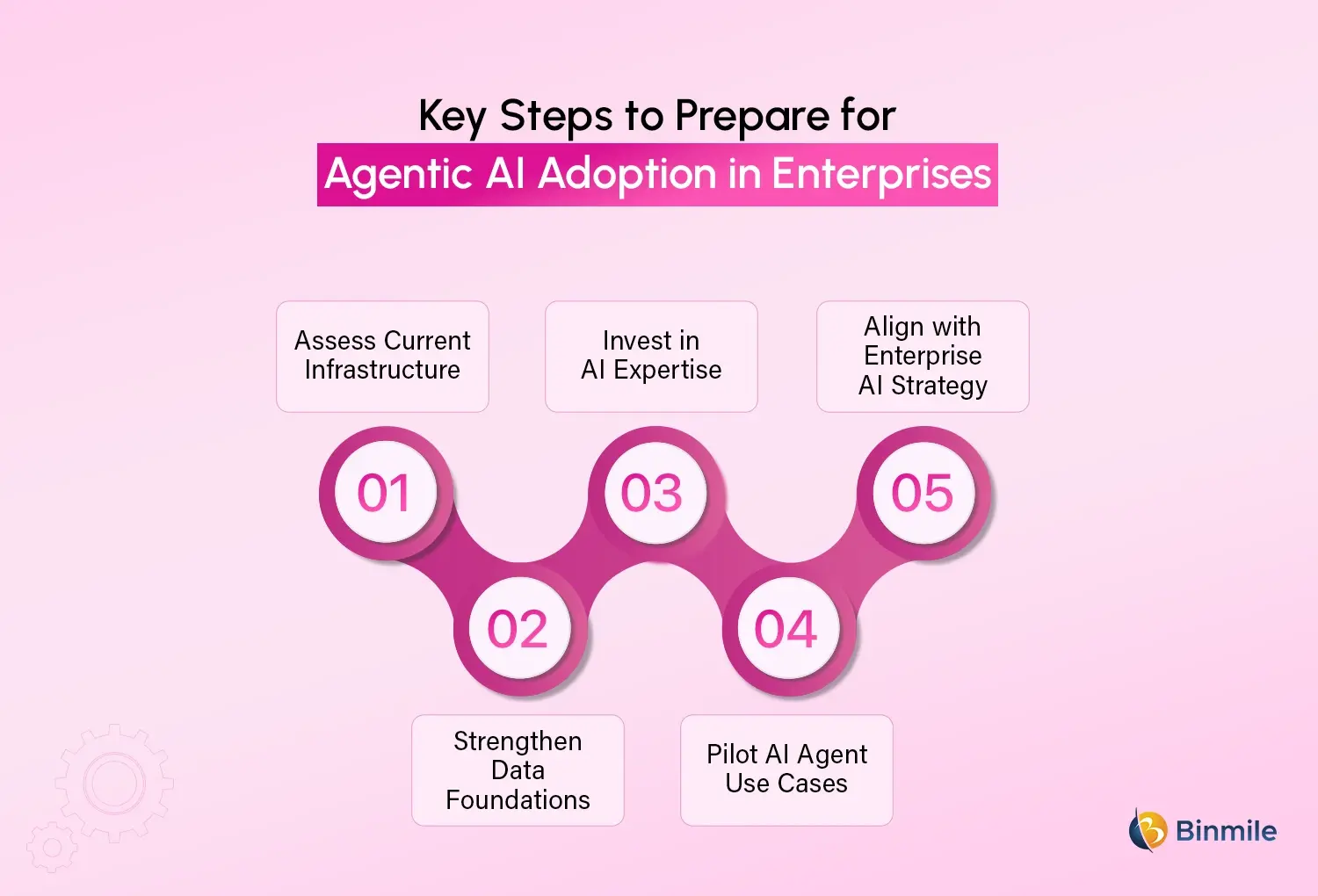
How to Prepare Your Enterprise for Agentic AI Adoption
Preparing for agentic AI solutions requires a strategic approach rather than a simple technology upgrade.
-
Assess Current Infrastructure
Companies need to determine if their IT infrastructures, such as cloud services, data storage, and processing and integration, support workloads related to AI.
-
Strengthen Data Foundations
High-quality data and well-structured data pipelines are critical for the success of AI agents. Therefore, enterprises need to ensure they have these structures.
-
Invest in AI Expertise
The development of agentic AI systems requires knowledge in automation, enterprise architecture, and machine learning.
-
Pilot AI Agent Use Cases
Rather than going for large-scale implementations, enterprises should initiate small-scale pilot projects, for instance, Agentic AI in Payments, or workflow automation.
-
Align with Enterprise AI Strategy
Agentic AI should be part of broader digital transformation efforts, including the development of Generative AI and Artificial Intelligence as a Service (AIaaS) solutions.
Organizations that approach adoption strategically will gain the most value from agentic AI architecture components.
Looking to build intelligent systems that automate decisions and workflows across your enterprise?

Enabling Enterprise Transformation with the Right Technology Partner
Building reliable agentic AI architecture requires deep expertise in enterprise software, data engineering, and AI-driven automation. Enterprises often struggle to design scalable systems that combine intelligent agents with existing business platforms while maintaining security, compliance, and operational stability.
This is where experienced technology partners play a critical role. Organizations like Binmile help enterprises design and implement scalable agentic systems architecture that integrates advanced AI capabilities with enterprise workflows. By combining expertise in AI development company services, Generative AI solution development, and enterprise automation, businesses can accelerate their AI transformation journey while minimizing risks.
With the right technical guidance, enterprises can build intelligent ecosystems powered by agentic AI architecture types, deploy multi-agentic AI architecture frameworks, and unlock new levels of operational efficiency. This approach allows organizations to move beyond traditional automation and build truly autonomous digital systems capable of adapting, learning, and delivering long-term value.
Frequently Asked Questions
Agentic AI Architecture is a framework that enables AI systems to act as autonomous agents capable of analyzing data, making decisions, and executing tasks independently. It combines reasoning, planning, and automation capabilities to create intelligent systems that operate with minimal human intervention.
Traditional AI systems typically respond to predefined inputs or perform rule-based tasks. Agentic AI Architecture allows AI agents to reason, plan tasks, collaborate with other agents, and interact with tools, enabling more dynamic and autonomous decision-making.
Enterprises adopt Agentic AI Architecture to automate complex workflows, improve decision speed, and enhance operational efficiency. AI agents can analyze large volumes of data, coordinate across systems, and perform tasks independently, helping organizations scale operations more effectively.
Yes, Agentic AI Architecture is designed to be scalable. Modular architecture patterns allow enterprises to add new AI agents or capabilities without disrupting existing systems, making it suitable for large organizations with evolving digital ecosystems.
Industries such as finance, healthcare, manufacturing, retail, and logistics benefit greatly from Agentic AI Architecture. These sectors use AI agents for tasks like trading automation, patient management, supply chain optimization, and intelligent customer service.
Agentic AI does not completely replace human roles. Instead, it automates repetitive or data-intensive tasks while allowing humans to focus on strategic decision-making, creativity, and problem-solving.
Enterprises should consider integration complexity, data governance, security risks, infrastructure costs, and overall AI readiness. Proper planning, skilled expertise, and strong architectural design are essential for successful implementation.