Organizations today are surrounded by data, but very few are truly using it to guide decisions. According to a study by McKinsey, companies that leverage data-driven decision-making are 23 times more likely to acquire customers and 19 times more likely to be profitable. The real challenge is not data availability. It is clarity, structure, and direction. This is where data strategy consulting becomes critical.
In this blog, we will explore what data strategy consulting really means, when businesses need it, why it is becoming a deciding factor in 2026, its benefits, the role of data strategy consultants, frameworks, ROI impact, and how it differs from data management, analytics, and AI. We will also examine core components, common implementation challenges, and how the right consulting partner can turn data into confident, measurable decisions.
What is Data Strategy Consulting and Why It Matters Now
Data strategy consulting is a structured approach to aligning business goals with data capabilities. It ensures that organizations collect, manage, analyze, and use data in ways that directly support strategic objectives and long-term growth.
It includes more than just dashboards or reporting tools. Rather, it is involved in defining what data is necessary, how it should be managed, how it aids in the decision-making process for the leadership team, and what the organization’s readiness is for more sophisticated initiatives such as AI. Top players in data strategy consulting develop long-term solutions, as opposed to offering quick fixes. They develop long-term strategies that consider technology infrastructure, the maturity of governance, process, talent readiness, and the overall culture. A robust data strategy and consulting engagement bring the business and technology teams together, so insights move beyond mere reporting and transform into action.
Organizations that seek big data strategy consulting tend to have cascading and unstructured data. A larger volume of data leads to lower visibility and more confusion without a clearly defined strategy.
Why is it a Deciding Factor in 2026?
For many businesses, 2026 is expected to be a defining year. The combination of AI Transformation, automation, and real-time analytics will be able to facilitate faster and more accurate decision-making. Companies are evaluated based on how well they adjust to shifts in the market. AI systems function optimally on data that is well structured and carefully managed. Data sovereignty and privacy have never been as regulated as they are in the present era. The personalization of the customer experience is dependent on data visibility. The market is in a use-and-throw situation when it comes to insights and analytics; a predictive approach is necessary instead of historical analytics.
Without a clear data strategy framework, organizations risk heavy technology investments without measurable business returns.
What are the Key Benefits of Data Strategy Consulting
A well-defined data strategy directly improves the quality and confidence of decision-making. The impact is visible across multiple areas.
1. Clear Alignment Between Business and Data
Most data initiatives fail because they do not integrate with business objectives. Consultants integrate strategic goals with achievable data goals. These goals foresee revenue increase, cost reduction, operational effectiveness, or retention of customers. Thus, the strategy ensures reporting analytics efforts prioritize business needs as opposed to just reporting for the sake of reporting.
2. Improved Data Quality
Poor quality data makes decision-making a challenge. Through data governance and policy structure, businesses reduce duplicates and inconsistencies and can enhance trust in their reporting systems. Clean data engenders trust in the executives and facilitates accurate predictions.
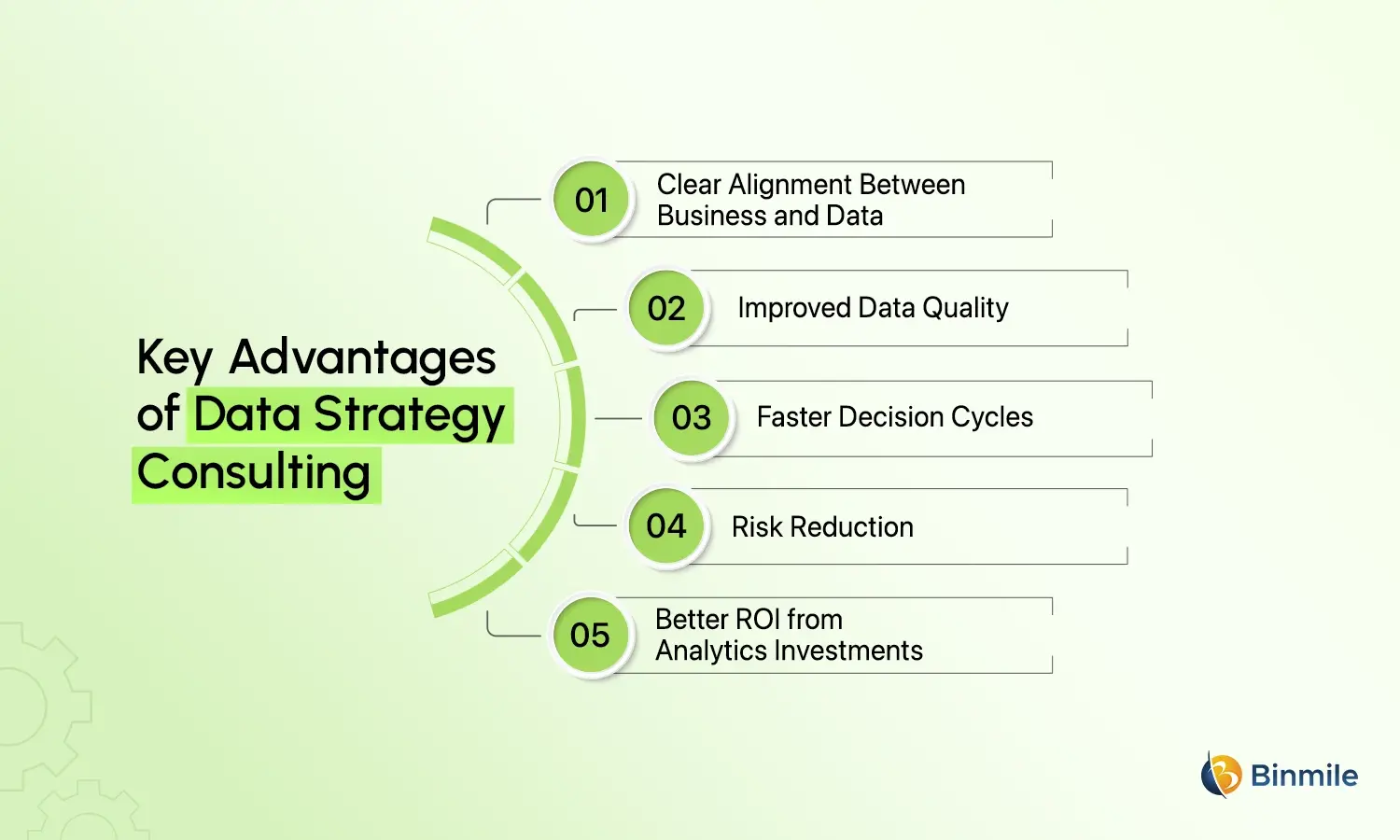
3. Faster Decision Cycles
Modern organizations need not wait for insights for weeks. With the right data engineering and data stream processes, organizations can obtain near-real-time or real-time insights. This allows leadership to respond to newly identified opportunities or emerging risks.
4. Risk Reduction
Systems that are still fragmented and manual reporting increase compliance and financial risks. A strategy introduces accountability, governance, and validation processes. This minimizes guesswork and shields organizations from regulatory or operational risks.
5. Better ROI from Analytics Investments
Many companies already use Power BI or other analytics platforms, but fail to unlock full value. Strategic alignment ensures these tools are implemented correctly, integrated properly, and tied directly to measurable business KPIs. The result is sustainable Data-Driven Decision-Making rather than occasional reporting improvements.
Looking to build a future-ready data ecosystem that strengthens every business decision?

How to Build a Practical Data Strategy Framework
An effective data strategy framework creates structure and long-term clarity. Each component plays a defined role.
1. Business Alignment
The first step is outlining strategic goals and constructing definable KPIs in order to maintain focus, as scattered initiatives will hinder progress. In order for growth, profitability, and/or operational performance to be achieved, an initiative needs to be supported by an alignment of the business and purpose.
2. Data Architecture
The first focus of success is building a foundation for the strategy and scalable infrastructure. This will allow the organization to create systems that will be able to endure the modern guide of data engineering by handling both structured and unstructured data and multiple integrations of sources.
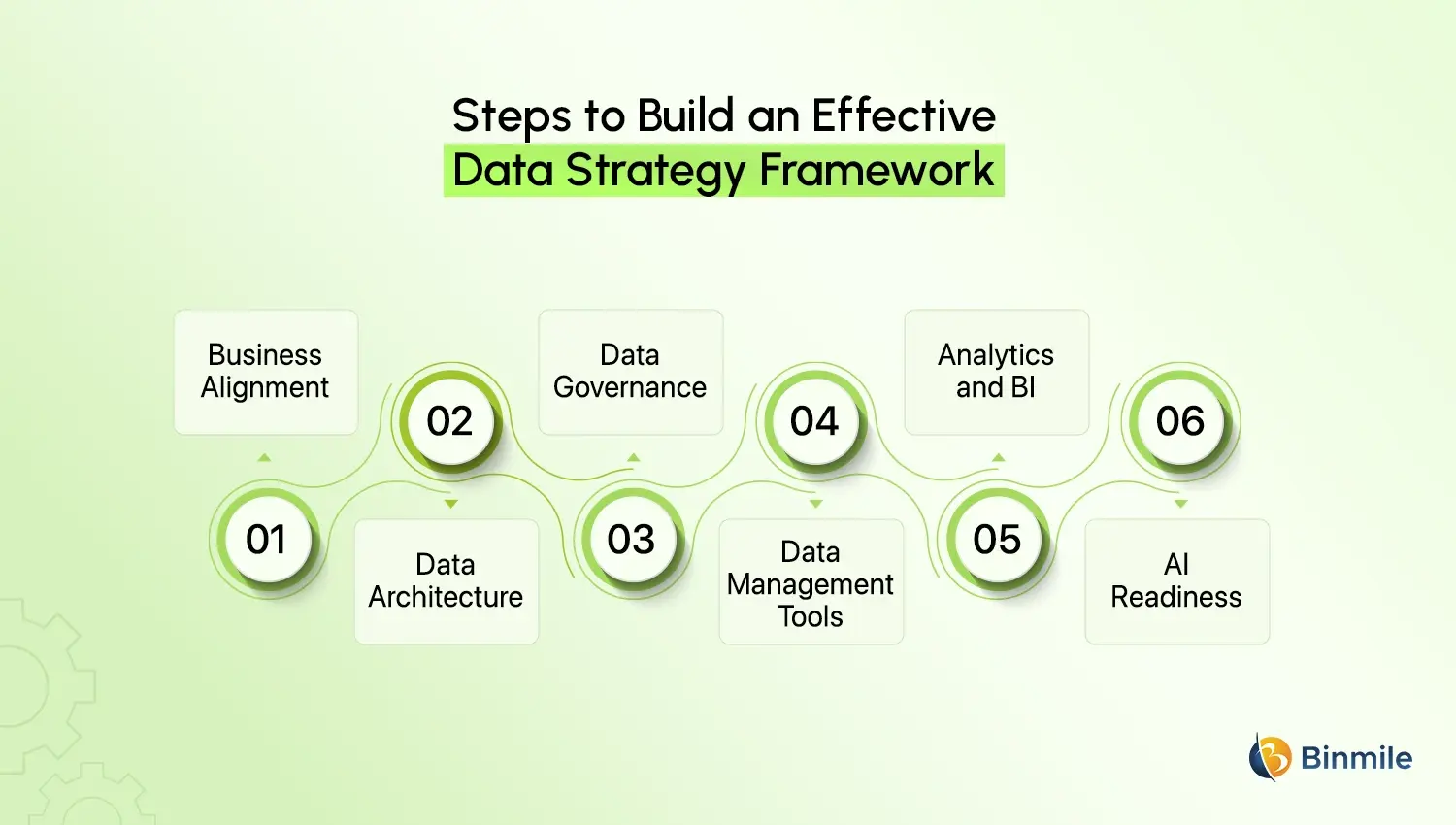
3. Data Governance
Understanding data governance vs data management is important as governance lays the foundation of ownership, accountability, security, and risk policies. Trust in enterprise data is strengthened, and compliance risk is decreased.
4. Data Management Tools
The right data management tools ensure consistency, integration, and accessibility. They eliminate manual processes and ensure teams across departments work with unified datasets rather than conflicting reports.
Conflicting reports are eliminated. This is ensured by the right data management tools, which provide the necessary systems and controls to ensure the right data is collected and accessible to the right people, in the right system.
5. Analytics and BI
Business intelligence strategy consulting ensures the executive goals and analysis of data and structured dashboards are aligned, as this will ensure better reporting and system adoption, and improved usability of the system.
6. AI Readiness
AI initiatives require clean, structured, and well-governed data. Preparing datasets, ensuring integration, and validating quality create the foundation for successful machine learning and predictive systems.
When implemented correctly, this framework ensures every data initiative connects directly to measurable business outcomes.
Data Strategy vs Data Management vs Data Analytics vs AI and ML
Many organizations confuse these terms. The differences are strategic and operational.
| Aspect | Focus | Primary Goal | Outcome |
|---|---|---|---|
| Data Strategy | Long-term roadmap | Align data with business goals | Informed decision-making |
| Data Management | Operational handling of data | Ensure accuracy and accessibility | Reliable datasets |
| Data Analytics | Analyzing data for insights | Identify patterns and trends | Actionable insights |
| AI and ML | Advanced predictive systems | Automate and optimize decisions | Intelligent automation |
What are the Core Components of Effective Data Strategy Consulting
A robust data strategy engagement typically includes the following core components:
1. Enterprise Data Assessment
This is the first step. It appraises prevailing systems, sources of data, clouds of reports, the state of governance, the level of maturity, and the gaps in the level of maturity. It does the same for the prevailing systems, the clouds of the report, the governance, and the maturity of the systems. Furthermore, it attempts to capture the gaps, the inefficiencies, and the available opportunities before building the state of the roadmap in the future.
2. Data Governance Services Implementation
They put in place models relating to ownership, sets of compliance requirements and standards, and data quality control, which in turn allows for the lowering of the risks relating to data collection. It also establishes the level of trust in the data in the enterprise.
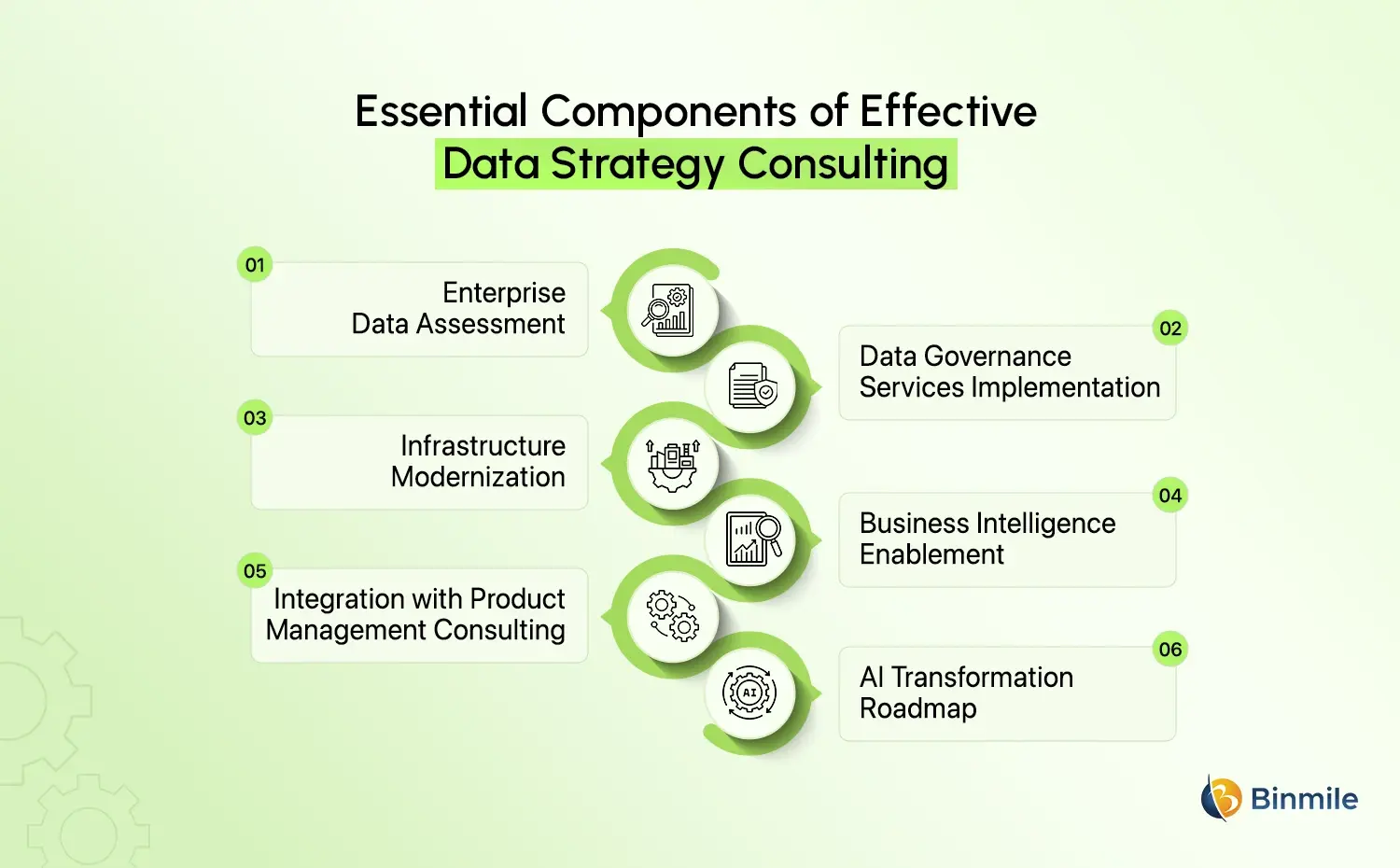
3. Infrastructure Modernization
This allows for the upgrading or replacement of the legacy systems with modern hardware. The result is cloud elastic systems to be applied to real-time processing, higher ability to integrate, and an increase in future ability to scale.
4. Business Intelligence Enablement
Current leadership priorities are the main factors considered in the alignment of the reporting systems. In the place of the old generic dashboards, organizations are now designing decision support systems that are endearingly incorporated with the ability to seamlessly provide real-time actionable insights to the system users, thus endearingly increasing the level of use of the systems by the members of the organization.
5. Integration with Product Management Consulting
The integration with product management consulting results in the embedding of the data insights into the strategy and the innovation plan of the products, which are, in turn, mobile. The mobile product decisions then become influenced by the data that inferred customer behavior, the results of the data, the performance data, and the market-influencing data, as opposed to the non-data assumptions.
6. AI Transformation Roadmap
Organizations create an AI and machine learning adoption plan to develop it in a structured manner, which consists of preparing clean datasets, defining use cases, and ensuring that they are ready with cloud infrastructure. Organizations that also undertake big data strategy consulting are developing cloud architectures that are also scalable, along with the ability to support real-time data.
What are the Common Challenges in Implementing a Data Strategy
Implementing a data strategy involves overcoming structural, technical, and cultural barriers.
1. Organizational Silos
Each department keeps its own dataset to itself, resulting in dispersed reporting and inconsistent decisions. To break silos, we first need unified governance and cross-departmental collaboration.
2. Legacy Systems
Outdated systems have poor integration and scale. Modernization is slowed when legacy systems cannot support advanced analytics, real-time reporting, or AI.
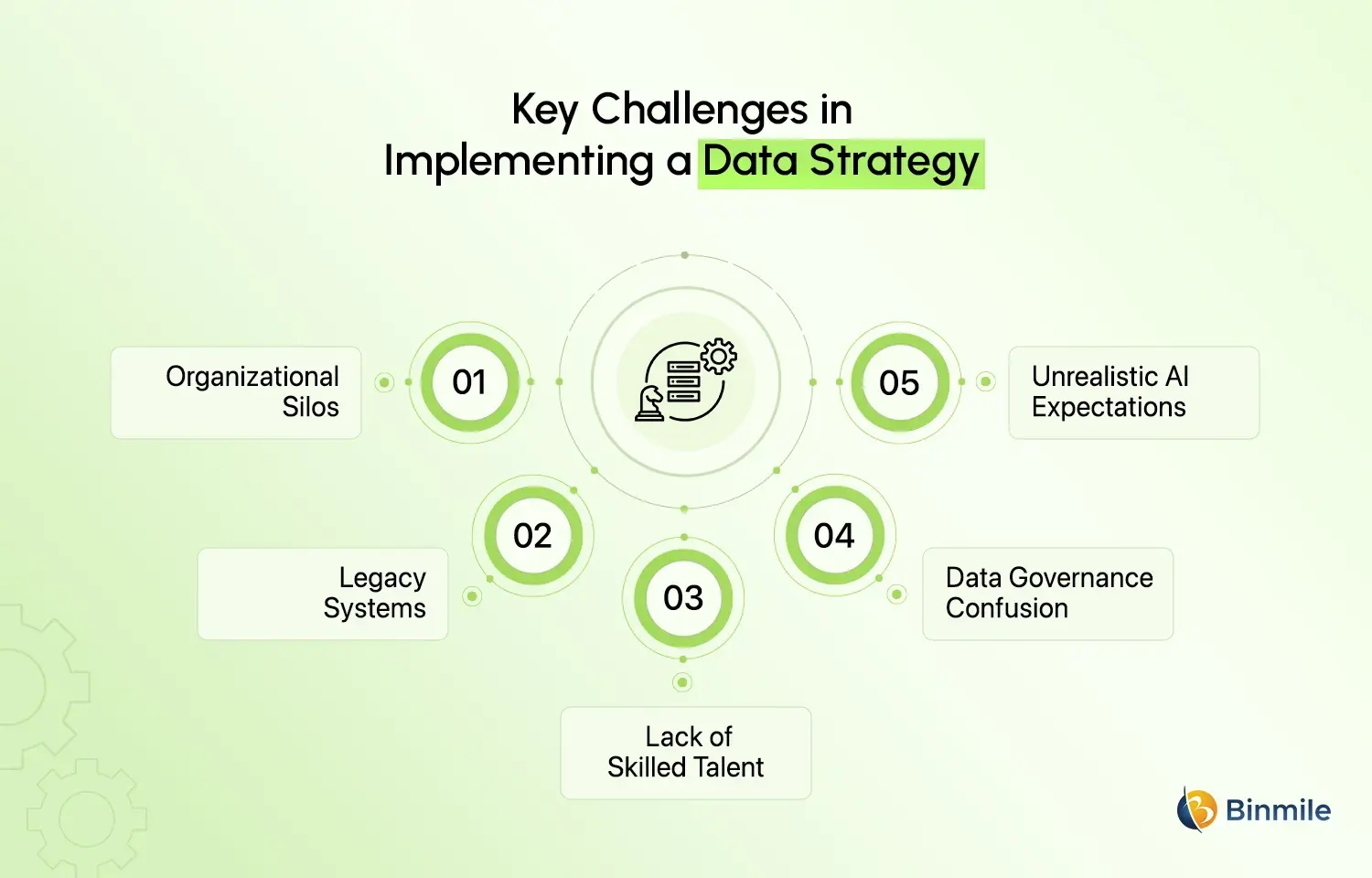
3. Lack of Skilled Talent
Not every organization may have in-house talent for governance, architecture, or analytics. Without skilled personnel, execution of the strategy is apt to be inconsistent.
4. Data Governance Confusion
Data governance and data management are often muddied and lead to unclear accountability. Risks from noncompliance and poor data are the result of a lack of ownership and policies.
5. Unrealistic AI Expectations
Many companies start AI projects without preparing their data. When data is of poor quality, so are the results, creating failed initiatives. A well-defined strategy and governance are critical to AI.
These challenges highlight the necessity of seasoned data strategy consulting firms. With structured strategy and expert oversight, firms can prevent mistakes and cost-effectively accelerate meaningful outcomes.
Ready to transform scattered data into a strategic advantage?

Turning Strategy into Action with the Right Partner
Improved decision-making relies on disciplined governance, scalable frameworks, aligned leadership, and continuous refinement. Businesses that utilize data as a strategic resource dominate over those that regard data as an operational byproduct.
Experienced partners such as Binmile aid in turning strategy into action. Binmile’s knowledge of data engineering services, data governance services, data modernization strategy, and analytics implementation enable to assist businesses in developing effective and sustainable data roadmaps. There is an emphasis on building long-term AI readiness, improving ROI, and addressing technology upgrades holistically.
The result is not just improved reporting, but smarter, faster, and more confident decisions across the enterprise.
Frequently Asked Questions
It aligns data initiatives with business goals, ensures data quality, and builds structured analytics frameworks. This enables leadership to rely on consistent, real-time insights rather than fragmented reports or assumptions.
A defined strategy improves governance, eliminates inconsistent data sources, and introduces validated predictive models. This reduces guesswork, prevents compliance issues, and increases confidence in strategic decisions.
The purpose is to create a roadmap that connects business objectives with data capabilities. It ensures organizations invest in the right tools, governance structures, and data analytics processes for measurable outcomes.
AI systems depend on structured, high-quality data. Data strategy consulting prepares infrastructure, governance, and datasets to ensure AI initiatives deliver accurate and scalable results.
It addresses data silos, inconsistent reporting, lack of governance, inefficient systems, and poor analytics adoption. This enables scalable growth and more confident executive decision-making.
Yes. Without a clear data strategy, AI initiatives often fail due to poor data quality, governance gaps, and misaligned objectives. Strategy creates the foundation for successful AI implementation.
Finance, healthcare, retail, manufacturing, logistics, and technology sectors benefit significantly. Any industry managing large volumes of data can improve efficiency, compliance, and strategic clarity through structured consulting.