Customers’ expectations today have rapidly changed, and people want quick feedback, personalization, and easy ways to deal with businesses at each interaction point. According to Salesforce’s research, 73% of consumers believe that their unique needs and expectations should be met by companies. Because of this shift, the use of AI in CRM systems has become a critical requirement for many modern businesses now, rather than just another option.
This blog article will clarify what is meant by AI in CRM, how AI works in today’s world, and how organizations can implement an effective model for AI usage with their customers to deliver a smarter approach to establishing long-term partnerships between them and their clients/customers.
Additionally, we will look at real-world examples of current uses of AI within CRM systems, along with the advantages and disadvantages associated with each example, and the best practices for creating future uses of AI within an organizational setting in order to develop a smarter solution for building long-lasting customer relationships.
What is AI in CRM?
AI in CRM refers to the integration of artificial intelligence technologies into customer relationship management systems to automate tasks, analyze data, and improve decision-making.
A traditional CRM stores customer information. An AI-driven CRM takes this a step further, interpreting patterns, forecasting future states, and providing real-time recommendations.
An AI-driven CRM system integrates, at a minimum, machine learning with predictive analytics; natural language processing for chat/email conversation; workflow automation; and advanced analytics to synthesize data into actionable customer insights. The combination of these technologies enables the transformation of unprocessed data into real-world insights.
Unlike traditional lead-tracking systems, AI-powered CRM platforms allow companies to anticipate customer buying habits, determine the best time to reach out, and craft the ideal message for the expected outcome.
What are the Key Use Cases of AI in CRM?
The real value of AI in CRM becomes clear when you look at practical applications. Here are some of the most impactful use cases:
1. Predictive Lead Scoring
Using prediction models, AI is capable of scoring leads based on historical customer data, customer engagement, and customer behavioral data. This gives insight for sales teams to focus on leads that bring more value to an organization and remove leads that do not qualify to bring value.
2. Customer Segmentation
With an AI sales CRM tool, businesses can create customer segments based on customer behaviors, demographics, customer purchase history, and customer interactions. This allows for highly customized marketing campaigns.
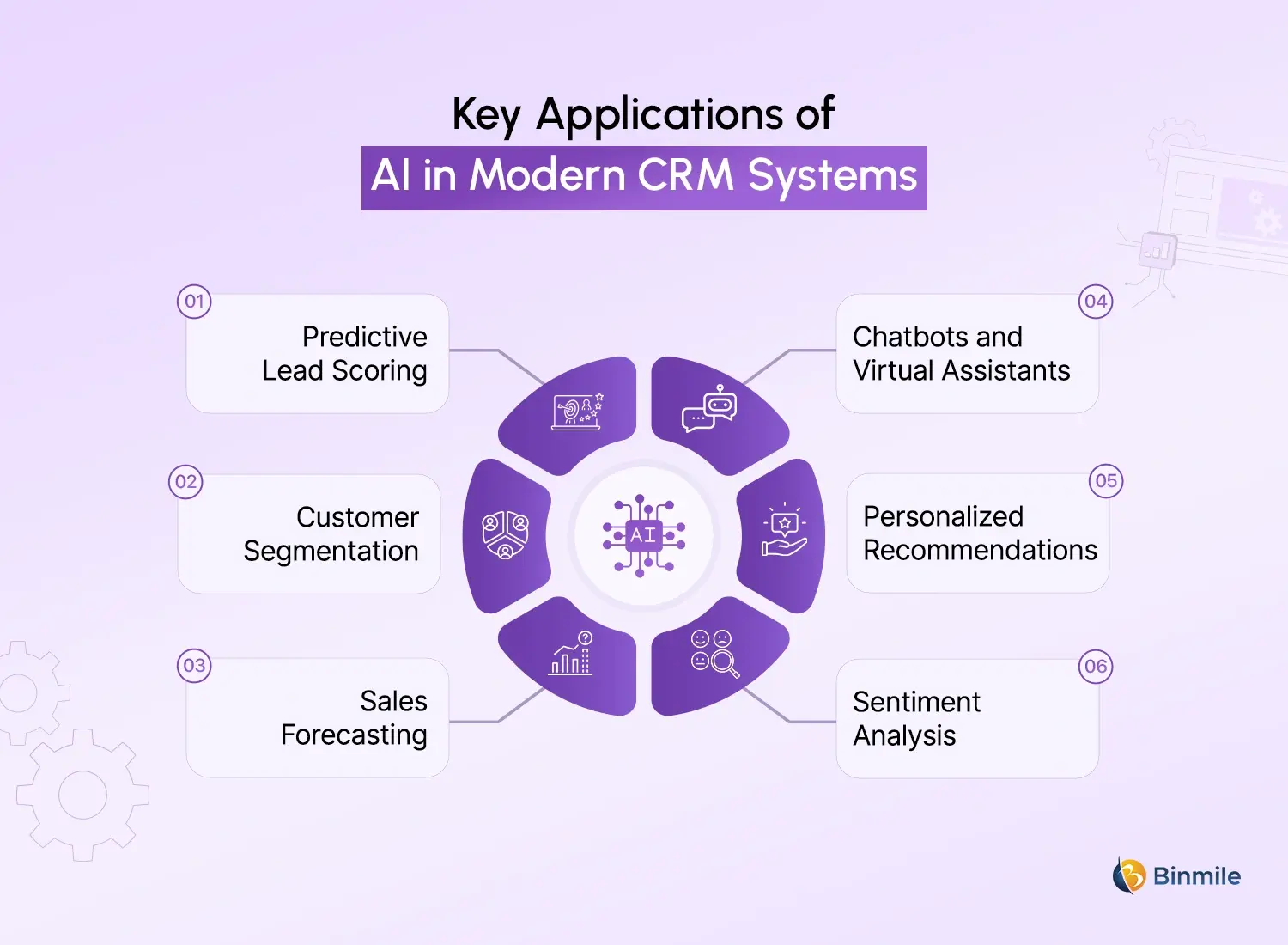
3. Sales Forecasting
AI is capable of analyzing historical sales data, trends of a season, and other external metrics to predict the upcoming sales with a high level of accuracy. Data-driven sales forecasting closes the gap between planning and actual sales.
4. Chatbots and Virtual Assistants
AI-powered bots are capable of bypassing the human stages of interaction to provide instant and around-the-clock customer service. This improves automation in customer service and reduces the work stress on customer support teams.
5. Personalized Recommendations
AI is able to analyze customer data to make offers of products and services that are related to the customer, which improves upselling and cross-selling.
6. Sentiment Analysis
AI technologies are able to read customer comments, chat, and email messages to find and analyze a customer’s feelings. This allows businesses to find and assist unhappy customers as early as possible.
These AI CRM use cases clearly show how businesses can shift from reactive customer management to a more proactive and intelligent approach.
What are the Benefits of AI in CRM?
The Benefits of AI in CRM go far beyond simple automation. It brings value and increases performance on multiple facets of your business.
With AI in charge of conducting repetitive actions, such as handling data entry, follow-ups, and reminders, the sales team can spend more of their work time on building relationships and closing deals, significantly boosting sales efficiency. Not to mention, AI’s ability to discover patterns in your customer data that no one else can discover, strengthening the overall role of AI in CRM.
The data allows businesses to personalize customer engagement, allowing the business to maintain engagement and solidify its relationships with customers. The ability to analyze data in real-time allows the team to respond to data quickly and avoid making decisions using data that is no longer applicable.
Improved customer retention is a powerful benefit of AI. The AI is able to spot the signs of a customer looking to leave, and can recommend actions to keep the customer. Automation has the ability to cut spending, and the quality of output can be improved or maintained. The AI CRM systems take the CRM systems from a collection of data to being a true asset to the business.
Looking to turn customer data into real business growth with AI-driven strategies?
How to Implement AI in CRM
Implementing AI is not just about adding new technology. It requires a clear strategy and structured execution.
Step 1: Define Clear Objectives
What do you want to accomplish from the AI integration? Is it the improvement of the lead conversion rate? Is it the improvement of customer support experience? Additionally, is it the automation of repetitive processes in the sales workflow? State all of your goals straightforwardly to help your team select the right AI CRM platform to help your team accomplish your goals in alignment with your organization’s priorities.
Step 2: Assess Your Current CRM System
Some customer relationship management (CRM) systems were made to work in AI systems, and some were not made to be AI systems. If your CRM does not have the required flexibility to be AI-compatible, a CRM development company can help, particularly with the intention of being AI-compatible. This will help you not have to work with some systems while others will work with other CRM Development Companies to be made AI compatible.
Step 3: Choose the Right AI CRM Software
Different organizations require different solutions, so selecting the right CRM system for your business is critical. Why is the right organization important? This is because your AI CRM will be based on no other organization, which means it will be tailored for your needs. It will have the estimated analytics that will help your organization to predict work processes. It will have redundancy minimization features. In addition, it will have copious integration abilities. It will have all of the features designed for the adoption by all of your organization’s employees.
Step 4: Clean and Organize Your Data
The accuracy and structure of your CRM data are critical for ensuring the effectiveness of your AI systems. So ensure that the data you provide them is free of duplicates and inconsistent data formats. AI models are only as good as the data they are trained on, so ensure your data is organized and relevant.
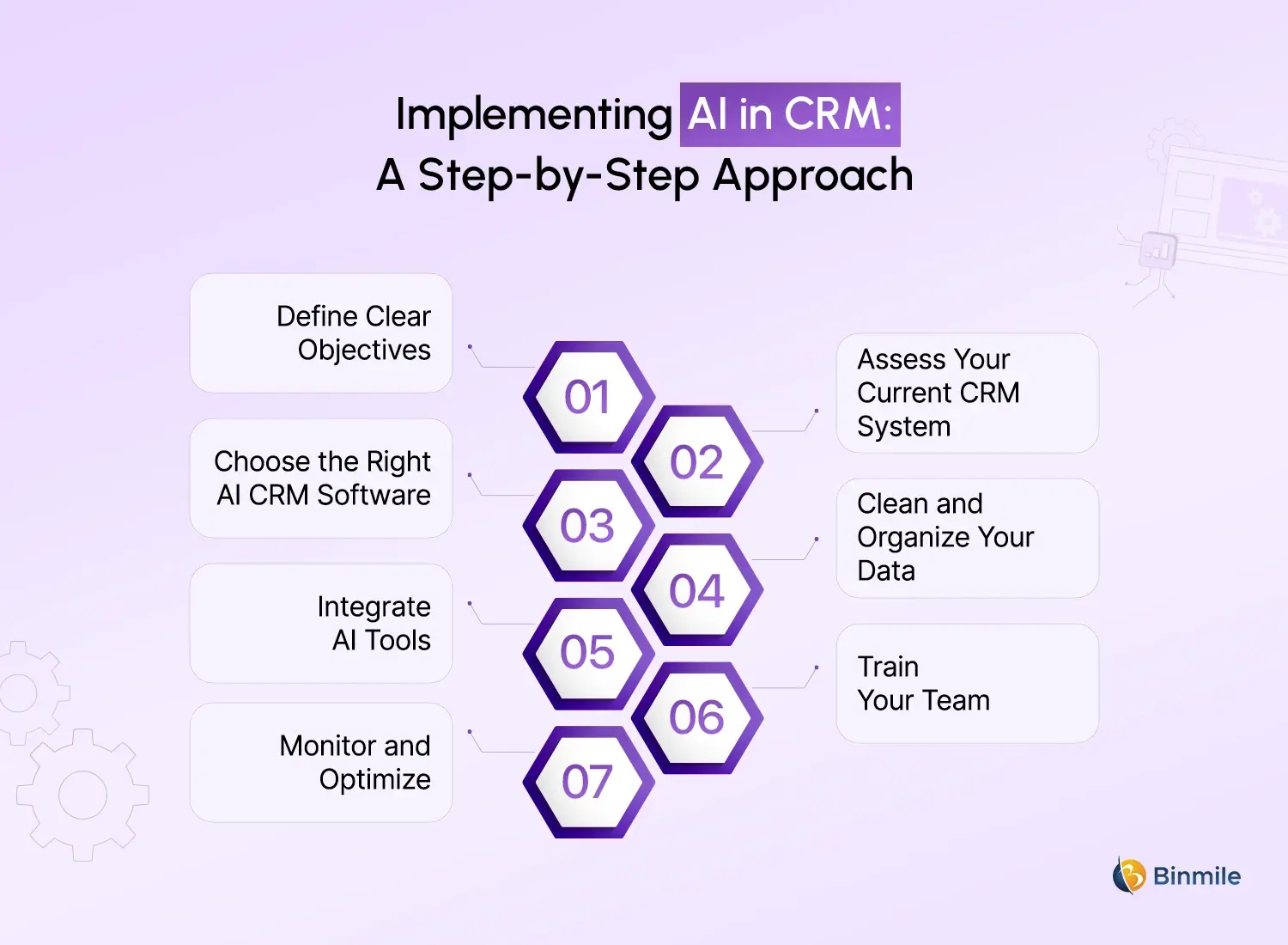
Step 5: Integrate AI Tools
After preparing your data, the next step will be integrating AI tools into your CRM. This can consist of AI Customer Service Agents for support query handling, AI Assistant development for Businesses for operational coordination, and Artificial Intelligence as a Service for your business’s evolving AI needs.
Step 6: Train Your Team
Success is not guaranteed by implementing technology. Your team must be trained on the full range of capabilities of the AI tools. Training must be done using AI-generated insights and automation features. Employees must be able to manage AI-driven workflows. Hence, so that they feel comfortable enough to use these tools in their everyday tasks.
Step 7: Monitor and Optimize
AI implementation is an ongoing process. You must constantly monitor the performance of the system, evaluate the most relevant metrics, and determine what changes should be made. Your AI-powered CRM must be optimized on a continuous basis to improve performance.
What are the Best Practices for Implementing AI in CRM
To get the most out of AI systems in CRM, businesses need to follow certain best practices that ensure smooth implementation and maximum value.
-
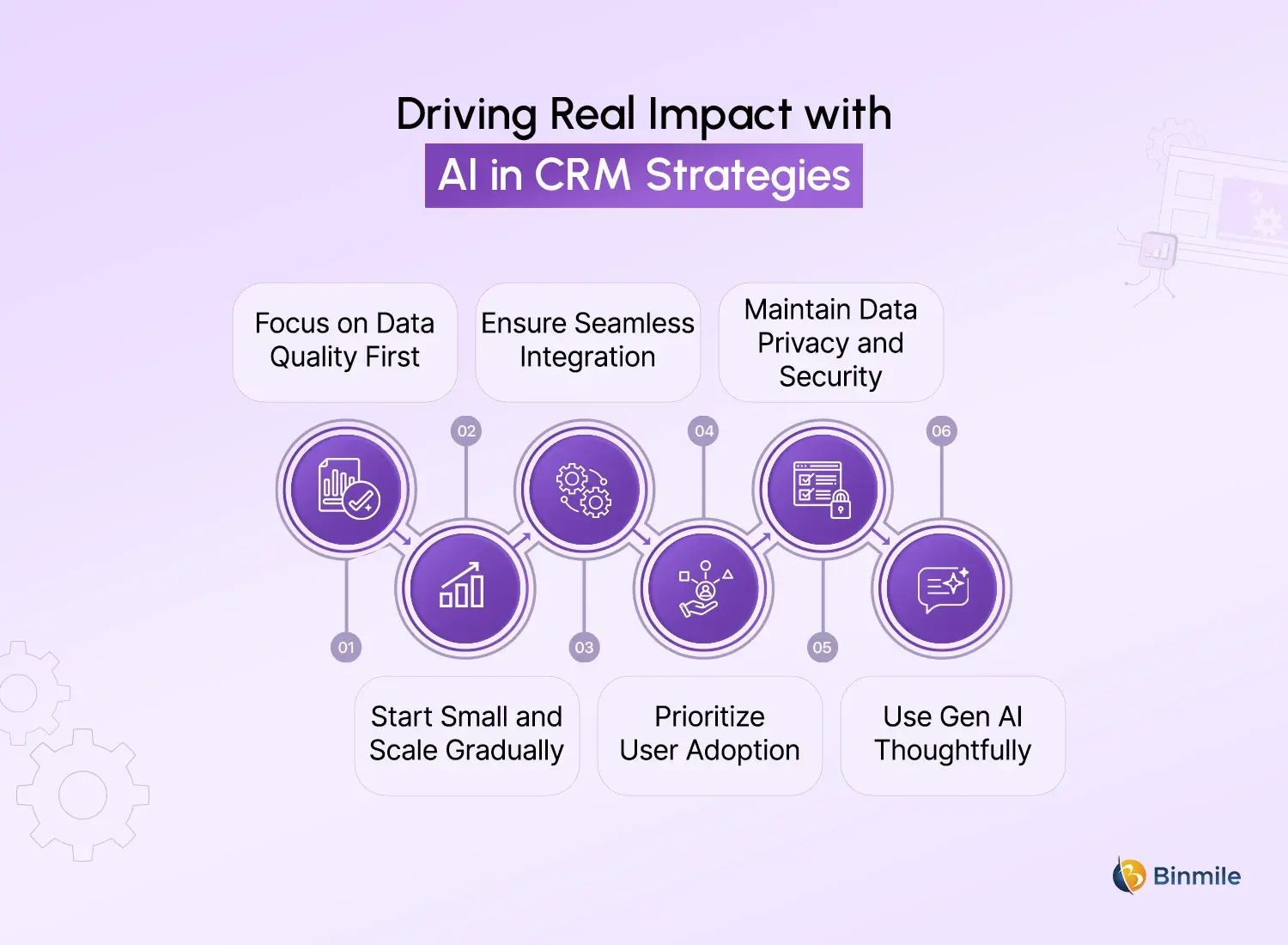
Focus on Data Quality First
The fundamental requirement for AI systems is data quality, which underpins the quality of the insights produced. If the data is partial, old, and/or inconsistent, the trustworthiness of the insights is compromised. Therefore, businesses need to prioritize the scrubbing, organizing, and maintaining of data quality before the implementation of AI.
-
Start Small and Scale Gradually
Instead of using AI for all business functions at once, it is more worthwhile to implement AI across the business functions one at a time, starting with one business function, lead scoring, and/or chatbots. It allows the business to evaluate impact and understand how to navigate challenges. Additionally, expand AI capabilities incrementally to avoid overwhelming employees.
-
Ensure Seamless Integration
AI is only of value if it is fully integrated into other existing systems in the business, including the ERP and CRM systems. Proper integration of the systems allows for the optimized flow of data across business units. This allows for improved collaboration and more reliable and precise insights.
-
Prioritize User Adoption
AI tools in a business supply a process, but if the employees do not or are not able to fully engage with the process, the tool fails to meet its purpose. Additionally, the business will not get the benefits of the tool. To avoid this, businesses need to focus on building systems to make such tools user-friendly. Additionally, develop training to educate employees and develop their confidence in the use of the tool.
-
Maintain Data Privacy and Security
If a business has an AI system in place to process customer data. Additionally, it has to ensure compliance with data protection-related laws and support the regulations with additional data safety measures. If a business puts AI tools to evaluate and process data. Thus, it should ensure the protection of the data and the safety of the data.
-
Use Gen AI Thoughtfully
Gen AI in CRM is available to produce quick emails, summaries, and insights, and provides useful tools for people. However, it is important to have oversight of a human to ensure the generated content is relevant, accurate, and appropriate to the business.
What are the Future Trends of AI in CRM?
AI in CRM will get smarter, more embedded within business processes, and integrated into core business workflows.
AI will create hyper-personalized experiences for the masses. It will create the ability to speak to millions of customers and develop personalized experiences for customers in real-time.
AI will take on a more autonomous role and will take autonomous action beyond just recommending actions. Future AI-driven CRM tools will recommend and take actions for you.
Integration across business processes will deepen. CRM will integrate with Marketing, Finance, and Operations. Connectivity will provide a unified business framework.
AI will track shifting customer behavior and will provide real-time predictive analytics. Businesses will shift from a reactive to a proactive business model. Custom AI development will grow, and businesses will seek personalized AI development services to meet their unique business needs and long-term goals.
Need a smarter CRM that actually drives sales and insights instead of just storing data?
How Binmile Can Support Your AI CRM Journey
AI technologies in CRM systems mean more than just advanced tools. They require the integration of advanced systems to monitor user activity. Additionally, to predict and adapt to user needs as they evolve, and to help achieve the organization’s goals.
Based on solid expertise in such areas as Custom CRM Development Guide, CRM Integration Services, and advanced AI solutions, Binmile assists companies in developing more sophisticated and intelligent CRM systems, including for more than just basic automation, as well as building systems for AI-driven CRM solutions to assist in user activity to predict and help achieve the organization’s goals.
Combining technological and business expertise, the approach gives the organization the ability to achieve productive and successful AI technologies in CRM systems. Additionally, strengthen the organization’s ability to retain clients to achieve the organization’s goals.
Frequently Asked Questions
AI in CRM refers to integrating artificial intelligence into customer relationship systems to automate tasks, analyze customer data, and provide insights. It helps businesses improve sales processes, personalize communication, and make data-driven decisions more efficiently.
AI analyzes large volumes of customer data to identify patterns, preferences, and behaviors. It provides actionable insights such as buying trends, engagement levels, and churn risks, enabling businesses to make more informed and proactive decisions.
Key features include predictive analytics, automation, customer segmentation, chatbots, sentiment analysis, and real-time insights. These features help businesses streamline operations, improve customer interactions, and enhance overall efficiency.
AI automates tasks like lead scoring, follow-ups, email responses, and data entry. It also recommends next actions based on customer behavior, helping sales teams focus on high-value activities and close deals faster.
Businesses should adopt AI in CRM to improve efficiency, enhance customer experiences, and gain a competitive advantage. It helps in better decision-making, reduces manual effort, and enables personalized engagement at scale.
AI improves sales by identifying high-potential leads, predicting customer needs, and suggesting personalized strategies. It helps sales teams prioritize efforts, optimize communication, and increase conversion rates effectively.
Benefits include improved productivity, better customer insights, enhanced personalization, reduced costs, and increased revenue. AI also helps businesses respond faster and build stronger relationships with their customers.