Businesses today are under constant pressure to scale faster, reduce operational costs, and respond quickly to changing market demands. According to a report by Statista, global spending on cloud computing is expected to surpass $1 trillion by 2028. This rapid growth highlights how essential virtualization in cloud computing has become for modern organizations looking to stay competitive.
This blog explores how cloud computing virtualization works, why it has become a game-changer, and how it helps reduce costs while improving business agility. It also covers types of virtualization in cloud computing, real-world use cases, virtualization strategies, challenges, and future trends to help businesses make informed decisions.
What Is Virtualization in Cloud Computing
Virtualization in cloud computing refers to the creation of virtual versions of physical resources such as servers, storage systems, networks, and operating systems. Additionally, virtualization allows multiple operating systems to be run on one piece of hardware, as opposed to multiple applications on one machine.
Virtualization frameworks manage the distribution of physical resources to workloads. This allows companies to fully utilize the physical infrastructure they have, as well as create scalable environments within the modern architecture of cloud computing.
Why Virtualization in Cloud Computing Is a Game Changer
Virtualization has fundamentally shifted the way companies deal with their IT infrastructure. Companies used to be required to spend huge amounts of money on physical servers and had to maintain them, even when they were hardly being used. With the combination of virtualization and cloud computing, that problem has been eliminated.
New resources create an environment that can be utilized in a way that responds to user demand. This allows for rapid innovation and change in response to fluctuating markets. In addition to this, it allows for cloud-native virtualization, which promotes the rapid and modern application development that uses containers and microservices.
Virtualization has made the IT infrastructure less rigid and expensive, and made it more flexible and efficient.
How Virtualization in Cloud Computing Reduces Cost
Cost reduction is one of the strongest advantages of cloud computing virtualization, and it impacts multiple areas of business operations.
-
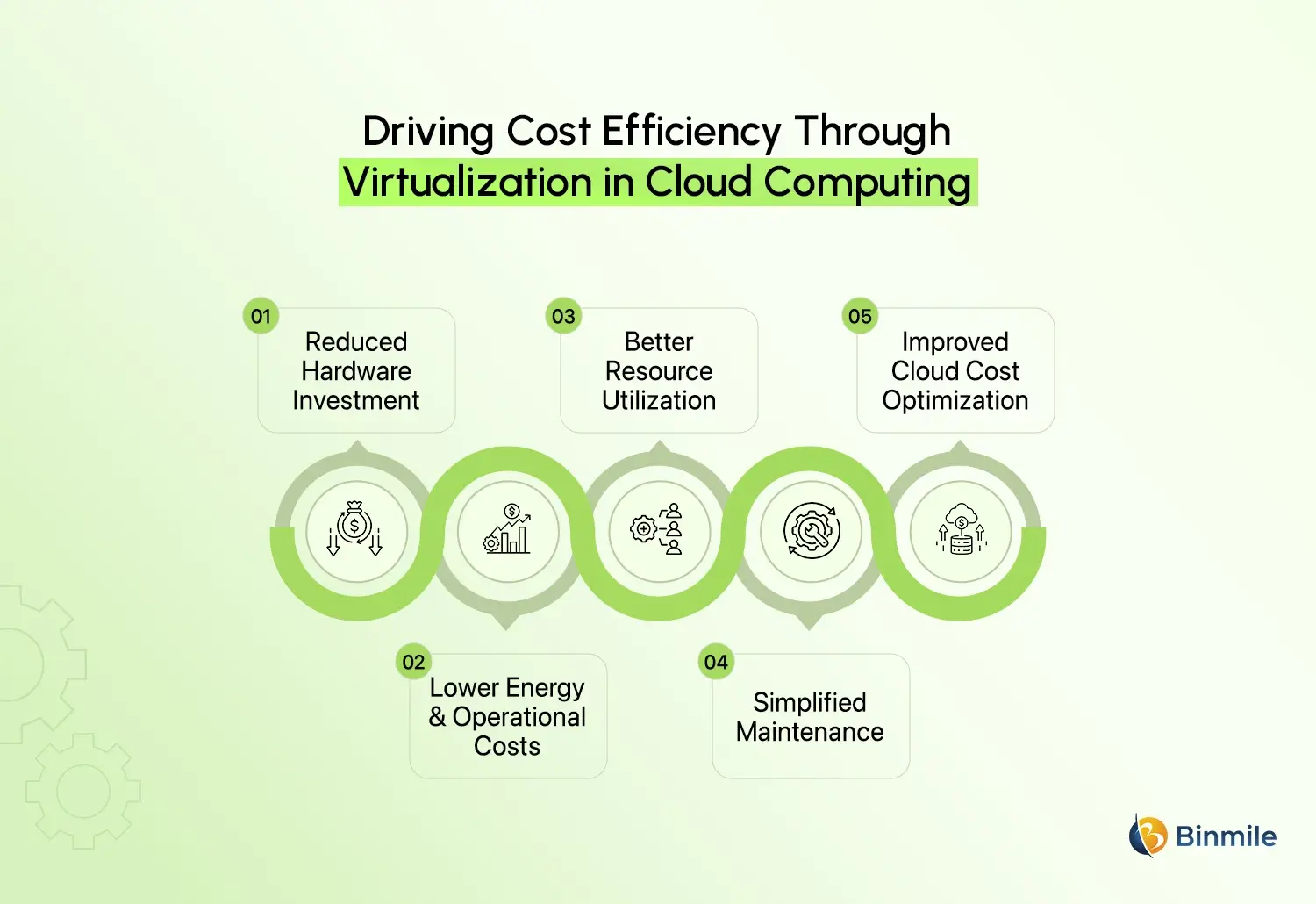
Reduced Hardware Investment
With virtualization technology, a single host machine can perform multiple workloads, thus removing the need for multiple physical machines. This allows businesses to save money, as they do not need to purchase additional hardware.
-
Lower Energy and Operational Costs
Having fewer physical servers translates to a decrease in the amount of energy used, as well as the need for operational cooling. Because of this, businesses save money operationally when virtualization is first implemented.
-
Better Resource Utilization
Virtualization also improves the efficiency of the computing resources (CPU, memory, storage, etc.) that are used. Resources that could have gone to waste are allocated to different virtual machines that need them, thus improving the system’s efficiency and minimizing waste.
-
Simplified Maintenance
With virtualization, physical systems are reduced, and this means that the maintenance for those systems is reduced as well. Because virtual environments can be managed and monitored from a single location, the IT teams save time and money.
-
Improved Cloud Cost Optimization
Virtualization allows businesses to adjust the resources that they utilize so that they only pay for those resources when needed. Cloud cost optimization improves the predictability of the cloud computing cost and allows cost control to be more enforced.
How to Improve Business Agility Through Virtualization
Virtualization is not just about cost savings. It plays a major role in improving business agility and responsiveness.
-
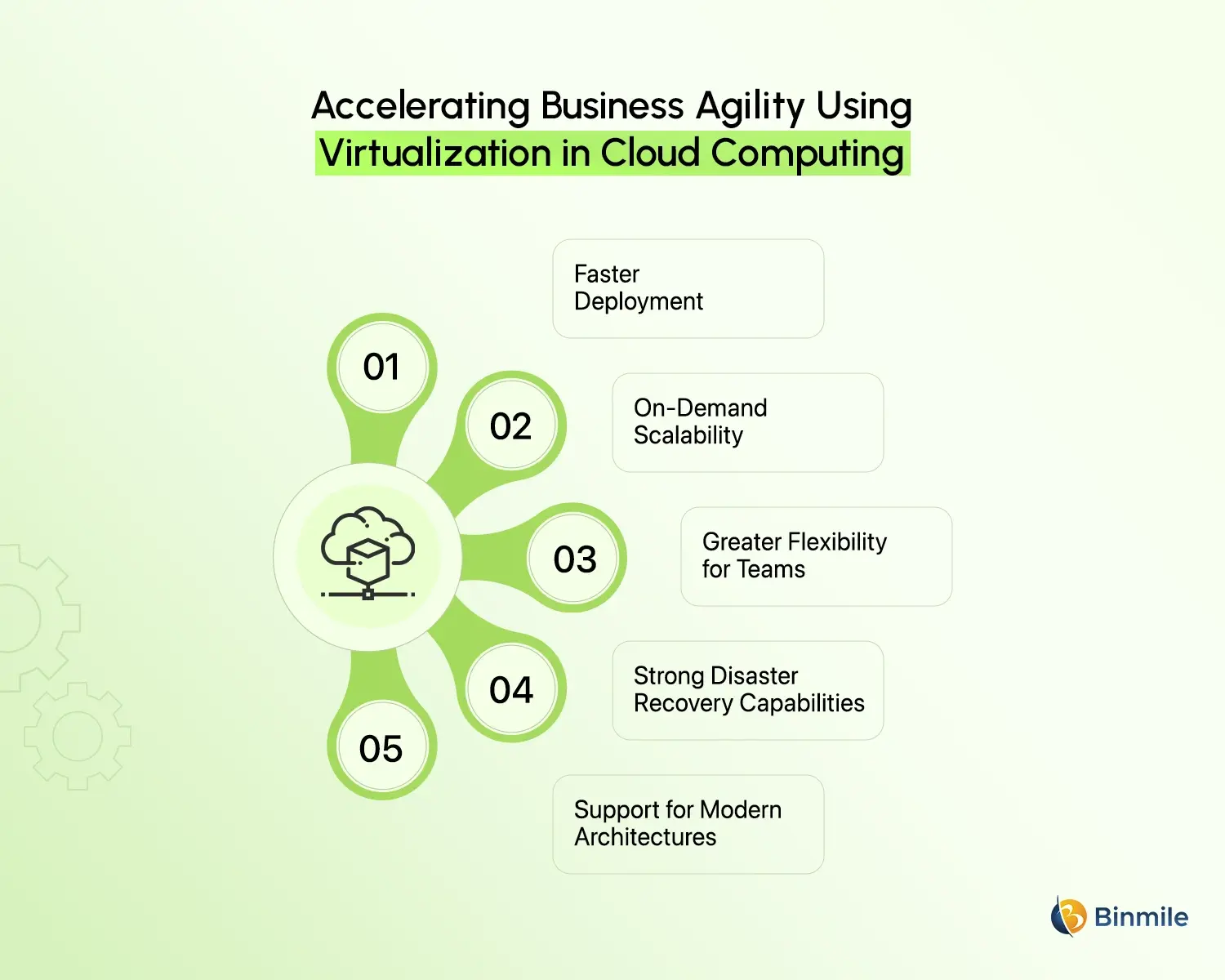
Faster Deployment
Organizations may need to deploy new applications or services, and virtualization allows them to do so in a matter of minutes due to its ability to create and deploy virtual machines extremely quickly. This reduced their time to market, as their competition may be experiencing delays.
-
On-Demand Scalability
Businesses can enhance their infrastructure to meet peak demands without having to buy new hardware. This allows them to meet changing workloads swiftly.
-
Greater Flexibility for Teams
Members of development and testing teams can operate in separate environments that do not disrupt production. This promotes creative risk-taking and faster development.
-
Strong Disaster Recovery Capabilities
Virtual systems can be quickly backed up and restored. In the event of a failure, systems can be recovered quickly, and business can continue uninterrupted.
-
Support for Modern Architectures
Virtual environments also include a cloud-native approach to container systems, enabling seamless integration and allowing companies to develop applications that are scalable and robust.
Leverage virtualization to unlock efficiency, performance, and improve agility.
What are the Use Cases of Virtualization in Cloud Computing
Enhancing efficiency and scalability remains the main goal of businesses globally, and the use of virtualization technology helps in achieving that invaluable goal. Virtualization creates the ability to drive and host many businesses and support networks’ infrastructure. This rapidly creates multiple and varied environments with a cloud system to foster continuous and improved efficient development cycles and testing accuracy to facilitate seamless operations.
Managing resource requirements to scale instant systems remains of utmost importance to e-commerce businesses through virtualization. Virtual environments and generic use systems are pivotal to the development of the augmented and virtual reality (AR/VR) development systems applications.
Both of these examples depict the great value of cloud computing and virtualization and their ability to achieve varied business requirements.
Types of Virtualization in Cloud Computing
Different use cases require different approaches. Here are the most common types of virtualization in cloud computing:
-
Server Virtualization in Cloud Computing
The most common type divides one physical server into several virtual servers that operate independently. This creates savings in hardware costs and increases resource efficiency.
-
Storage Virtualization
The pooling of disparate storage resources into one consolidated storage. This creates a more efficient and simpler data management system.
-
Network Virtualization
The ability to create virtual networks so that the networks operate independently from the physical hardware that provides connectivity.
-
Desktop Virtualization
Enables the ability to remotely access desktops, which allows users to work from anywhere.
-
Application Virtualization
Applications operate in seclusion and are not installed directly on the physical devices.
Each of these plays a crucial role in building efficient cloud computing technology ecosystems.
What are the Best Practices for Virtualization in Cloud Computing
The virtualization technology in cloud computing should remain directly applicable for use to aid a business in its achievement.
The first step towards achieving a goal should be to provide a thorough, systematic, and comprehensive vision towards evaluating the target objective, in this case. Additionally, this is an indispensable step in evaluating workloads; in this case, e.g., systems with applications that are unsuitable for developing and operating virtualization frameworks. </span>
Virtualization frameworks selected should remain compatible to ensure their systems are scalable over the long haul. Security must always remain tight. Planning seamless integration with existing cloud platforms is crucial to avoid disruptions. Additionally, continuous optimization is essential. To sustain efficiency, businesses must routinely analyze performance, consumption, and costs.
Virtualization vs Traditional Infrastructure
Understanding the difference between virtualization and traditional infrastructure helps in making better decisions.
| Aspect | Virtualization | Traditional Infrastructure |
| Resource Usage | Optimized and shared | Often underutilized |
| Scalability | High and flexible | Limited and slow |
| Cost | Lower operational cost | High hardware and maintenance cost |
| Deployment | Fast and automated | Time-consuming |
| Flexibility | Highly adaptable | Rigid structure |
What are the Challenges of Virtualization
The possible benefits of virtualization and cloud computing are merged with many challenges. One challenge surrounds resource allocation. Additionally, without effective resource allocation, performance overhead can occur. If the isolation of the environments is not managed, there can be security concerns.</span>
Increased complexity of the systems will require increased skill and the right tools to manage the systems. Additionally, licensing of the virtualization software can add to the expenses. Some legacy applications will also encounter issues to fit in the virtual environment.</span>
The challenges can be tackled with a focused virtualization plan combined with ongoing evaluation.
What are the Future Trends in Virtualization and Cloud Computing
Here are the future trends in virtualization and cloud computing:
-
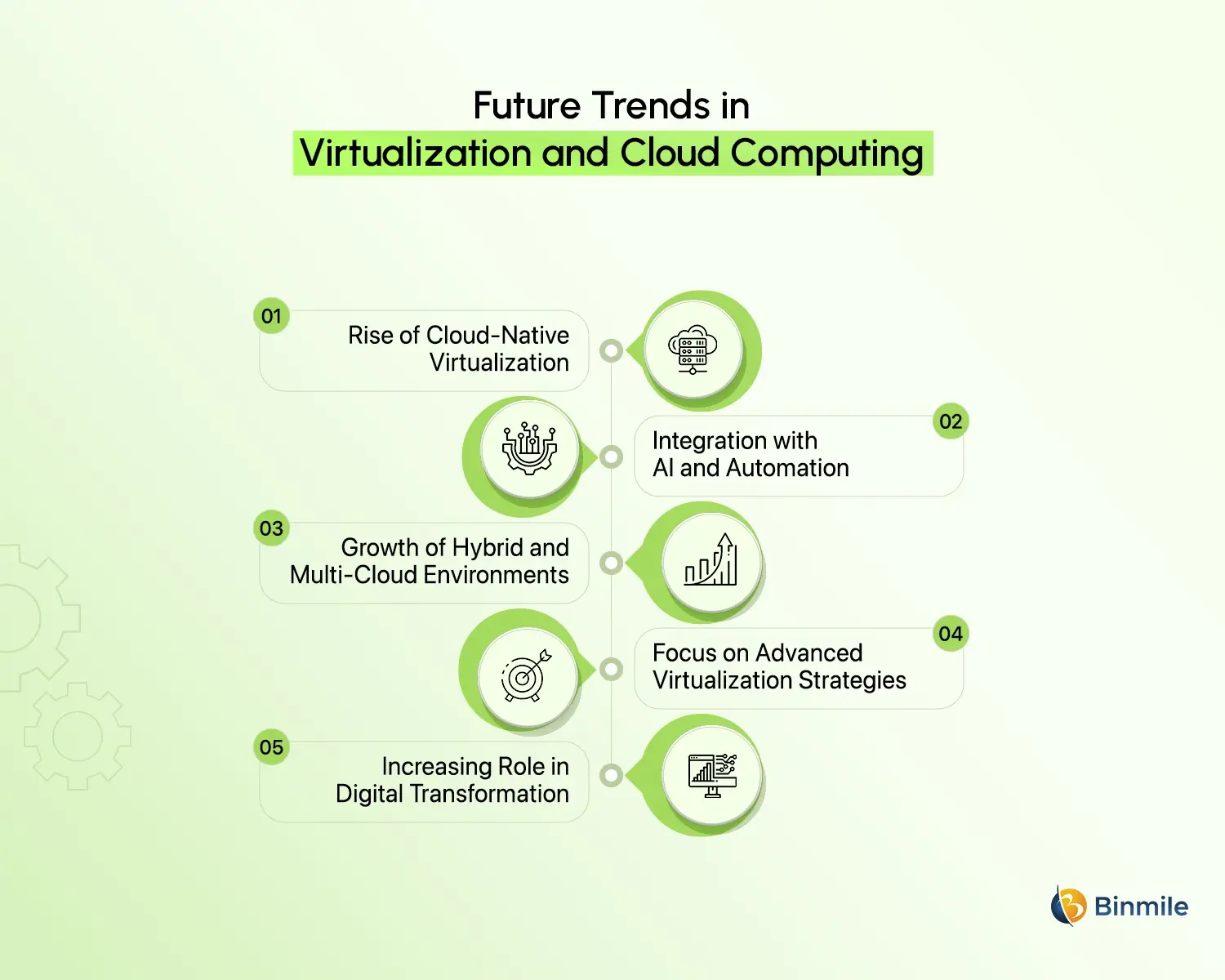
Rise of Cloud-Native Virtualization
Cloud-native virtualization is a growing trend championed by the transitioning of businesses to a microservices and container-based cloud computing architecture. Additionally, this results in more effective application performance in a distributed environment as well as increased scalability, flexibility, and manageability.</span>
-
Integration with AI and Automation
Virtualization with the merger of AI and Automation is a growing trend as they work in tandem to improve operational flexibility and reduce manual work by using intelligent resource allocation, performance monitoring, and predictive maintenance technologies.
-
Growth of Hybrid and Multi-Cloud Environments
Organizations are beginning to use multiple cloud service providers. Hybrid and multi-cloud methods are becoming more popular. Additionally, virtualization is central to managing workloads across different cloud service providers while maintaining performance and consistency.</span>
-
Focus on Advanced Virtualization Strategies
As IT environments become more complex, organizations start to use advanced stigmatization. These methods are designed to optimize performance, provide better security, and ensure effective integration across systems and cloud service providers.
-
Increasing Role in Digital Transformation
Virtualization is a key technology in the digital transformation journey. Additionally, with virtualization, organizations can upgrade their infrastructure, gain better flexibility, and leverage new technologies; thus, virtualization is key to modern cloud computing systems.</span>
Build a smarter virtualization strategy that aligns with your business goals and scales faster.
How Binmile Can Simplify Your Virtualization Journey
Building a successful virtualization strategy is about more than just having the right tools. It is about device alignment with business objectives, optimizing for performance, and accommodating scalability. With considerable Cloud Consulting Services expertise, Binmile helps businesses create virtualization environments that are economically designed and ready for the future.
About system evaluations and the application of sophisticated virtualization frameworks, the goal is to improve efficiency without adding layers of complexity. Additionally, from enabling cloud-native virtualization and supporting Cloud Modernization, to enhancing cloud cost optimization, the strategy is intended to help organizations adopt, scale, and improve operating in changing digital ecosystems.</span>
Frequently Asked Questions
Virtualization in cloud computing is the process of creating virtual versions of physical resources like servers, storage, and networks. It allows multiple systems to run on a single machine, improving efficiency and reducing infrastructure costs.
Yes, virtualization enables faster deployment, easy scalability, and flexible resource allocation. Businesses can quickly adapt to changing demands without investing in additional hardware, making operations more agile and efficient.
Virtualization is generally secure when implemented with proper isolation, monitoring, and access controls. Enterprises must use advanced security practices to protect virtual machines from vulnerabilities and unauthorized access.
Businesses should evaluate workload requirements, compatibility, security needs, cloud computing cost, and scalability goals. Choosing the right virtualization frameworks and having a clear strategy is essential for successful implementation.
Any business with growing IT needs can benefit from virtualization. It is especially useful for enterprises, startups, e-commerce platforms, and companies managing large-scale data or applications.
Look for scalability, security features, compatibility, cloud cost optimization, and ease of management. A good solution should integrate well with existing systems and support future growth.
Kubernetes plays a key role in managing containerized applications within cloud-native virtualization. It automates deployment, scaling, and management, making systems more efficient and flexible.
Virtualization is a technology that creates virtual environments, while cloud computing delivers services over the internet. Virtualization is the foundation that enables cloud computing platforms to function effectively.