Many software projects fail or face major challenges due to unclear requirements and technical feasibility gaps. This highlights a critical issue businesses continue to face. Many ideas look promising on paper but collapse once real development begins. This is where a proof of concept in software development becomes essential. It helps validate assumptions early, reduce risks, and ensure resources are invested wisely.
In this blog, we will explain what a Proof of Concept (POC) really means in software development, why it matters, the different types of POC software, its benefits, the step-by-step process, and how organizations can confidently transition from idea validation to scalable product development.
Define Proof of Concept (POC) in Software Development
Proof of concept in software development is a structured approach used to test whether an idea, technology, or feature is technically feasible before full-scale development begins. It focuses on answering one core question: Can this idea actually work in a real-world environment?
The POC meaning in software is not about building a complete product. Instead, it is about validating functionality, integrations, performance assumptions, or technology choices. A proof-of-concept software project is typically small in scope, time-bound, and designed with the intention of learning rather than launching. Organizations often use POC for software development to test new architectures, cloud environments, Cloud & DevOps Services, AI capabilities, or complex integrations. By validating feasibility early, teams can avoid expensive redesigns later in the development lifecycle.
What is the Purpose of a Proof of Concept?
A primary aim of the proof of concept in software development is to lessen ambiguity and uncertainty. New business concepts can routinely become risky when combining new technologies, workflows, or performance goals, especially during legacy application modernization or platform upgrades.
Well-executed proof of concept software services help decision-makers figure out if the concept is viable with business objectives, technology, and budget. They clarify the development work required, timelines, potential bottlenecks, and system limitations.
A software development POC also promotes alignment among diverse stakeholders, beyond just technical confirmation. Product leaders, engineering, and business sponsor teams align on the possible and the avoidable before larger investment commitments.
What are the Types of Proof of Concept in Software Development
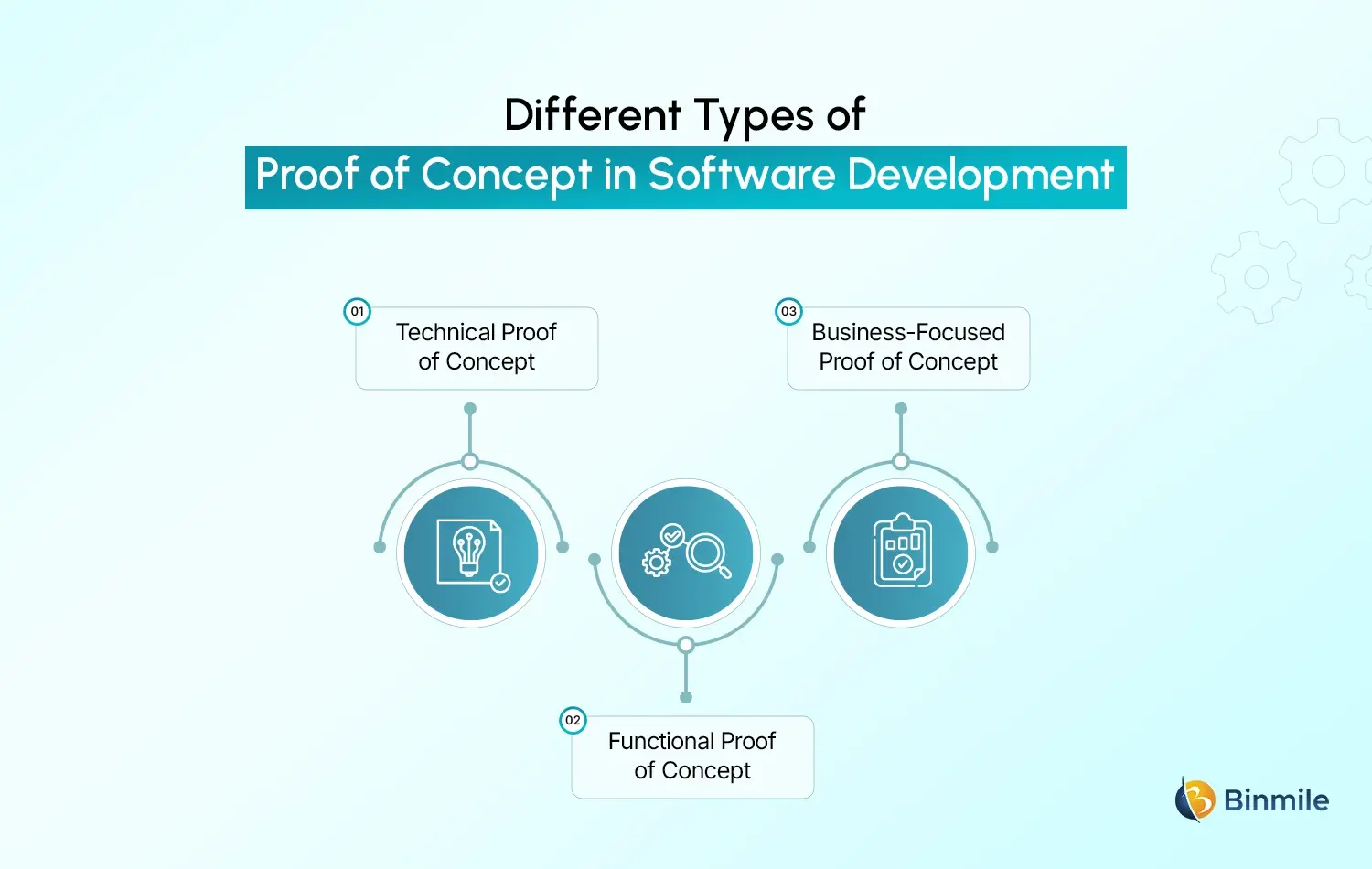
Different projects require different types of proof of concept software solutions, depending on the problem being solved.
-
Technical Proof of Concept
This type focuses on assessing the validation of possible cloud-native architectures and likely modernizations of legacy applications to the cloud, DevOps automation for enterprises, AI, and other tools of high technical uncertainty.
-
Functional Proof of Concept
A functional proof of concept focuses on a particular critical feature or workflow and assesses if the core functionality works as intended. Before full development, the solution is intended to be assessed on outcomes. Outcomes may be on real-time processing, authentication, and overall system logic to ensure the system functions as designed.
-
Business-Focused Proof of Concept
This kind of approach focuses on assessing if a software idea is poised to accomplish the business goals, user requirements, and the expectation of the value of the investment. In digital transformation in business projects, it addresses the need to ensure that the solution is intended to provide manageable business outcomes/benefits on the earliest implementation.
Each type of proof of concept software implementation serves a specific purpose, but all aim to reduce risk, validate assumptions, and support informed development decisions.
What are the Benefits of Proof of Concept in Software Development
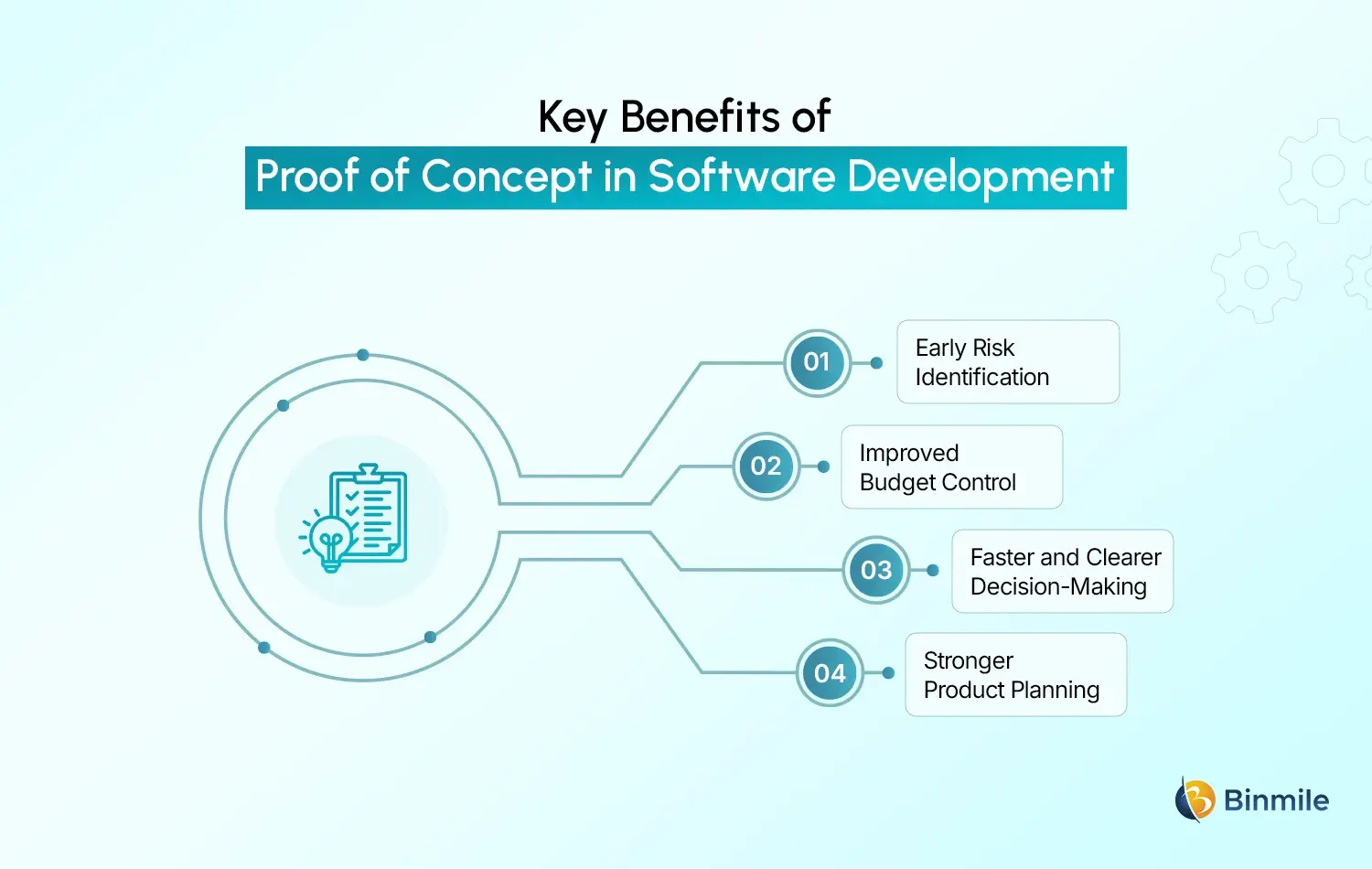
A proof of concept helps organizations move forward with clarity by validating ideas early and minimizing uncertainty. Here are some of the key benefits of proof of concept in software development.
-
Early Risk Identification
In the proof of concept programming, risks of any sort, i.e., technical, functional, or integration, can be uncovered in advance. This is especially critical when implementing an AI implementation strategy or modern DevOps pipelines, where architectural errors can be costly. If rework or delays can be prevented during the development stage, these risks must be identified in advance.
-
Improved Budget Control
Financial resources can be kept under better control with POC development. Ideas can be validated for proof of concept for software without going all in with big investments.
-
Faster and Clearer Decision-Making
With POC software, stakeholders can make evidence-based decisions rather than speculation. They can choose to halt a project, to change course, or to push forward with suggested changes.
-
Stronger Product Planning
Better strategies for the development of the MVP, better estimates of the architecture, and better timelines can be achieved using the insights from the POC phase. This will make execution smoother in the later stages.
Ready to move from idea validation to a scalable digital solution for feasible, long-term growth?

What is the Proof of Concept Process in Software Development
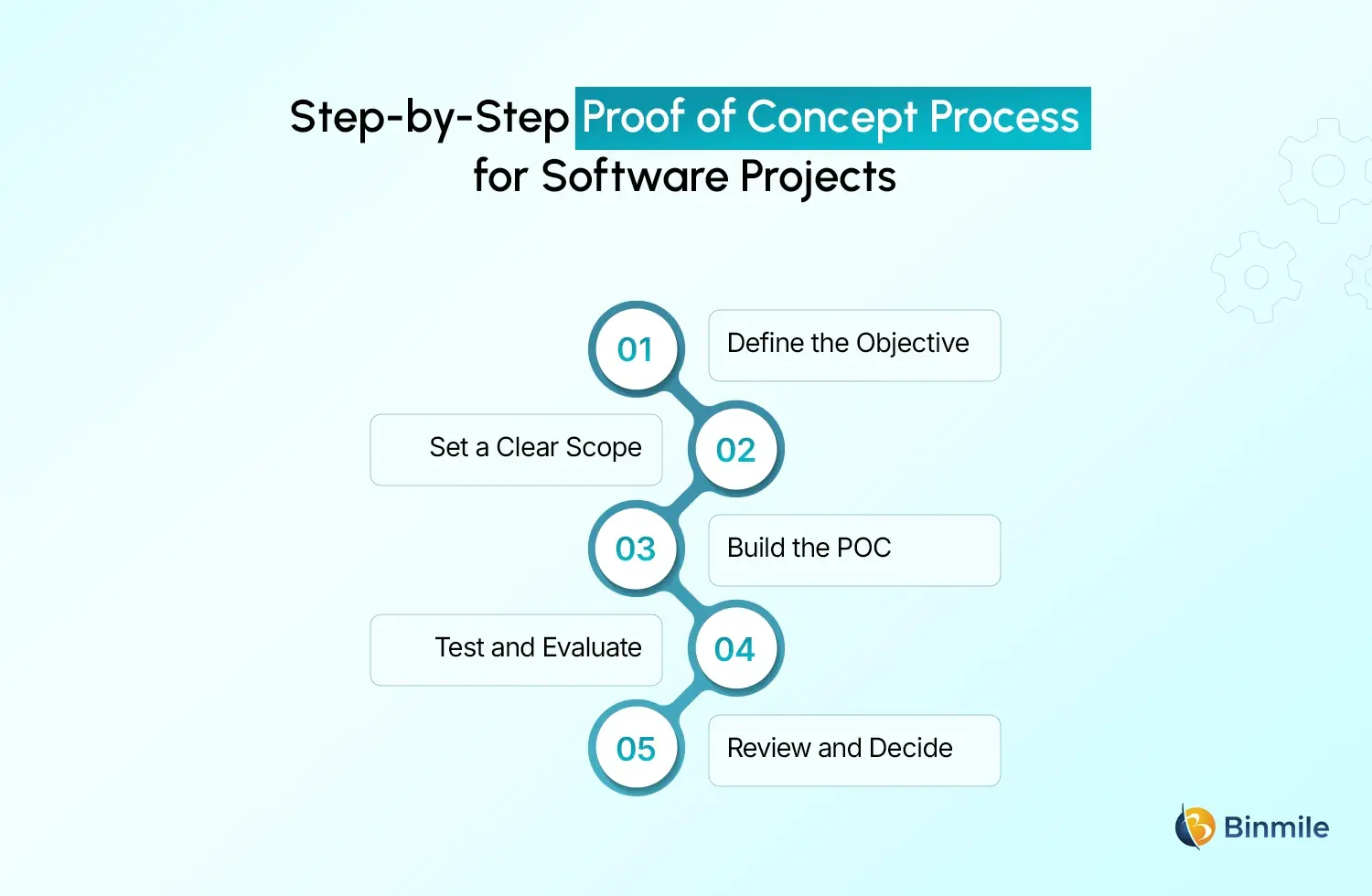
The proof of concept process provides a structured way to test feasibility and validate assumptions before moving into full development. Here is a step-by-step process for proof of concept in software development.
Step 1: Define the Objective
The first step is to identify the problem in detail and specify which assumptions should be validated. This helps in ensuring that the POC caters to the problem areas that require the most attention in the bigger picture of the POC.
Step 2: Set a Clear Scope
Software projects based on proof of concept should have a precisely defined scope in order to address the most critical issues at hand. This allows teams to focus on the most important aspects of the project and paves the way for the most rapid feedback without the confusion of more complexity.
Step 3: Build the POC
At this stage, proof of concept construction begins. This is the stage where the POC is built, committing to full product engineering services. It should be rough, having the bare minimum. In Proof of concept for software development, there are usually rapid development techniques employed, and there is a minimum viable product.
Step 4: Test and Evaluate
The POC is assessed based on a checklist of success criteria predetermined and agreed to by the stakeholders. These can be performance, scalability, compatibility with other systems and integrations, user experience, and so on.
Step 5: Review and Decide
The collected data is analyzed to determine whether the team will continue with full development, tweak their framework and process, or pursue a different line of development altogether.
A Brief Guide to Proof of Concept vs Prototype vs MVP
A proof of concept differs significantly from a prototype and a minimum viable product.
| Aspect | Proof of Concept (POC) | Prototype | Minimum Viable Product (MVP) |
|---|---|---|---|
| Primary Focus | Focuses on validating technical feasibility by testing whether the idea, technology, or approach can work in real-world conditions. | Focuses on visual design and user interaction to demonstrate how the product will look and feel. | Focuses on delivering real value to users while validating market demand with a functional product. |
| Purpose | Helps teams determine if an idea is technically possible before committing resources to full-scale development. | Helps stakeholders visualize the product and gather feedback on usability and design direction. | Helps businesses test product viability in the market and refine features based on real user feedback. |
| Functionality | Includes limited functionality built only to test core assumptions or technical challenges. | May include clickable screens or partial flows, but often lacks complete backend functionality. | Includes essential, working features required for users to interact with the product meaningfully. |
| Audience | Intended for internal stakeholders such as technical teams, product managers, and decision-makers. | Used by internal teams and stakeholders to validate design concepts and user experience. | Intended for real users, customers, or early adopters in the target market. |
| Outcome | Provides clarity on whether to move forward, modify the approach, or discontinue the idea. | Provides design and usability insights that shape future development decisions. | Provides market validation, adoption insights, and data to guide product scaling and enhancement. |
How the Right Technology Partner Helps Turn POCs into Scalable Solutions
Once a proof of concept confirms feasibility, the next challenge is translating insights into a reliable, scalable product. This transition requires strong engineering practices, domain understanding, and alignment with long-term business goals. Teams that succeed at this stage typically combine technical validation with product engineering expertise, cloud and DevOps capabilities, and a clear roadmap for growth.
This is where experienced technology partners quietly make a difference. By building on validated concepts and refining them into production-ready solutions, organizations can move faster without compromising quality. With its experience across custom software development, MVP development, DevOps automation, and digital transformation initiatives, Binmile supports businesses in turning validated ideas into impactful software products that scale with confidence.
Frequently Asked Questions
A proof of concept in software development is a small-scale project designed to test technical feasibility or validate a specific idea before committing to full product development and larger investments.
A POC identifies technical risks, integration challenges, and feasibility gaps early, helping teams avoid costly rework and ensuring informed decisions before full-scale development begins.
A proof of concept should be built when an idea involves new technologies, complex workflows, or uncertain feasibility that needs validation before product or MVP development.
Startups, enterprises, product teams, and innovation leaders benefit from POC software development when testing new ideas, modernizing systems, or exploring digital transformation initiatives.
Proof of concept software enables faster innovation, smarter investments, reduced risks, and better alignment between business objectives and technical capabilities.
Examples include testing AI algorithms, validating cloud migrations, assessing system integrations, or evaluating performance capabilities before building full applications.