Satisfying new-age customers using traditional service delivery methods has become almost infeasible these days. Yes, each consumer expects to be provided with personalized products and services to encourage them to become repeat buyers. However, since the insurance industry caters to such a gigantic number of patrons, it is a bit hard to know how to offer impressive pre-sales and post-sales services to policyholders. Still, you should not fret about offering customized services to your potential customers, as insurance app development automation can do the trick.
Some cutting-edge technologies like AI and ML can enable your firm to react to changes in the market and consumer behavior pretty quickly, resulting in reduced operational expenses and improved customer experiences down the line. Let’s see how insurance app development with automation features can transform your business.
How Automation in Insurance Will Transform the App Development Industry?
The Hyper Automation market has been growing at an extremely fast speed and as per a renowned insights delivery company in the US, it is predicted to rise to almost US $600 billion in 2022. Although the banking and financial services domain adopted this trend years ago, the implementation of automation in the insurance industry has been a bit lethargic.
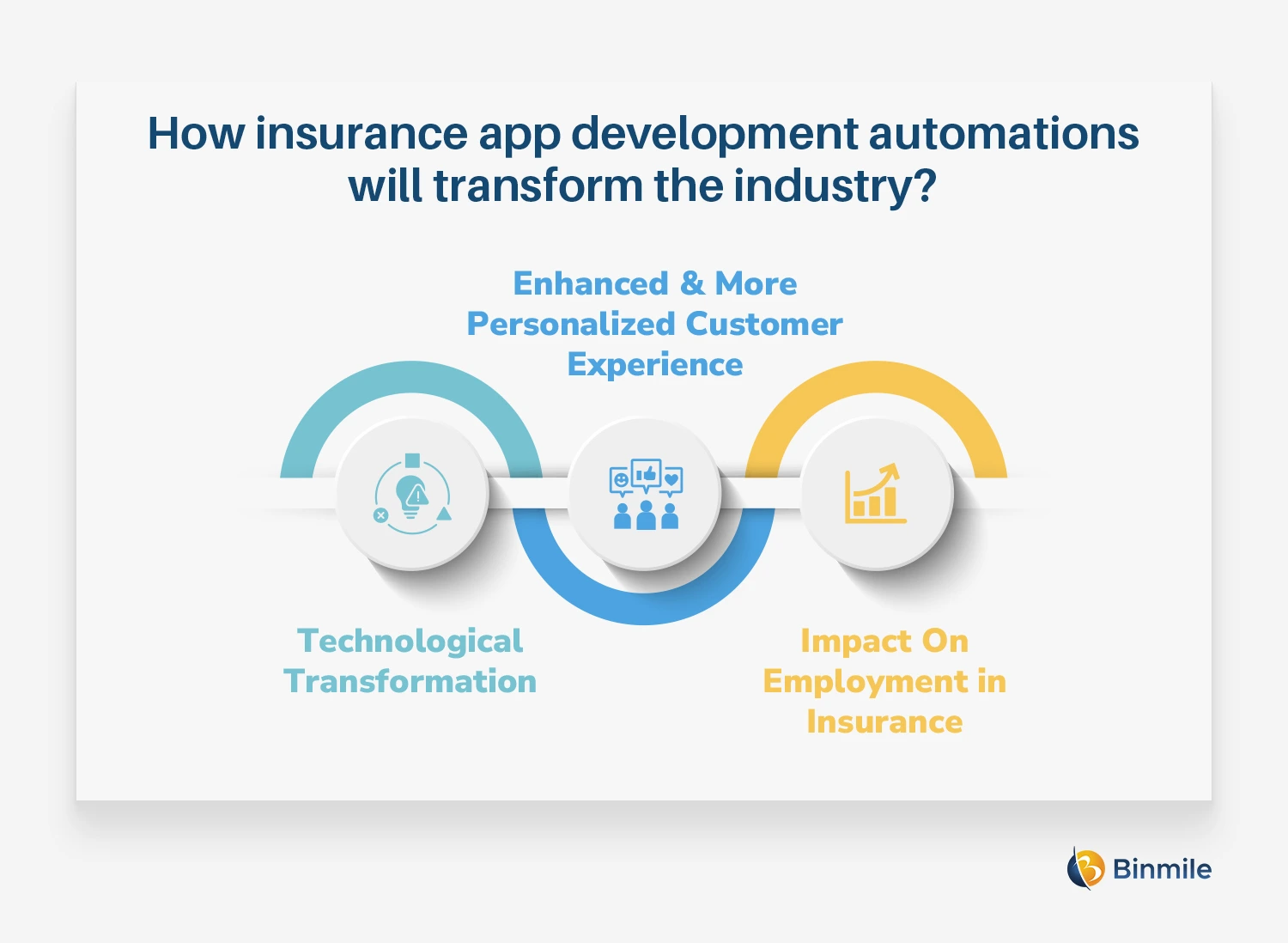
Insurance entities are only commencing to launch pilot automation programs with both Robotic Process Automation and Intelligent Automation. Some experts believe that these state-of-the-art technologies will have a tremendous impact on the insurance sector. Thus, if you want to know what insurance app development automation can lead to, below are some forecasted outcomes:
-
Technological Transformation
According to a leading insurance mobile app development company, organizations will integrate automation tools into their existing IT infrastructure to ensure better integration across multiple systems mobile app development company.
-
Enhanced and More Personalized Customer Experience
Take, for instance, customer onboarding will be improved big time as bots will be able to execute time-consuming activities, like anti-money laundering. This technology will shorten the gap between employees and consumers and pave the path for more personalized service.
-
Impact on Employment in Insurance
Automation will remove a myriad of jobs, while also creating new ones. Insurance personnel freed from monotonous copy-paste and data-entry jobs will be able to render more personalized and optimal-quality customer services.
In case you are not familiar with Hyper Automation, we must let you know that it involves the combination of a wide range of tools, including Robotic Process Automation and Artificial Intelligence, to improve business decisions to a great extent. The utilization of this technology in the insurance sector can assist organizations in transforming their business, becoming more profitable, and adjusting to market changes in a better way. However, these goals can only be accomplished when you choose the most valuable insurance app development automation out there.
Use Cases of Insurance App Development with Automation
For those unfamiliar with it, automation enables insurance agencies to accelerate the claims process, improve customer satisfaction, ensure regulatory compliance, and allow key staff members to focus on more strategic projects. Some notable examples are discussed below:
1. Customer Service
Insurance firms can deploy digital assistants powered by Artificial Intelligence to boost work productivity and enhance customer experience. These AI-driven solutions can process data, analyze buyer profiles, and deliver personalized information, ensuring customers receive accurate assistance when needed. By leveraging AI, insurance companies can streamline operations and create a seamless, customer-centric approach.
2. Customer Onboarding
Conversational AI can help desk agents to automate the establishment of new policies and data collection to help in onboarding new customers. Clientele information is automatically provided by linking with existing policy systems, translating into detailed and accurate client records.

3. Claim Processing
Claim processing can be a time-consuming task as insurance agents are required to collect relevant papers and validate information manually. Doing this continuously can contribute to the emergence of some human errors, resulting in a delay in the whole process. However, the good news is that insurers can confidently use insurance app development automation. It automates the entire claims workflow, from claim acceptance to evaluation and settlement. Just to let you know, you can use automation in processes, such as:
- Gathering information about a claim
- Investigating a claim
- Checking the claim
4. Policy Management
Insurance app development automation simplifies policy management by automating the entire policy issuance process. It also sends customers timely policy renewal notifications automatically.
5. Underwriting
Digital agents with Natural Language Processing and Natural Language Understanding capabilities can analyze data from multiple sources to assess risk. Underwriters can use this analysis to determine a customer’s policy eligibility, monthly premium, and coverage level. This improves the accuracy and speed of the underwriting process.
Some cases in point here are:
- Financial Limits: If the net worth of an applicant is X dollars at present, his insurance coverage cannot be more than X $ 10, depending on the conditions of insurance companies.
- Mortality Charges: If the potential policyholder smokes, insurance premiums will soar because of health risks, considering their age at the same time.
Average Insurance Mobile App Development Cost
Without the inclusion of Artificial Intelligence, the cost of an insurance mobile app development would be somewhere between $70,000 and $90,000. However, if you are deeply interested in building an insurance app powered by automation and along with all the use cases we discussed above, it is in your best interest to consult a prominent AI software development company.
Conclusion
One thing you must understand is that convenience comes with a price. No one can truly understand the real meaning of the above statement. Only service providers that have already adopted insurance app development automation can fully appreciate its impact. In today’s evolving landscape, keeping up with the latest trends of insurance app development is crucial. Your customers want your services at their fingertips. Hence, it is your responsibility to invest adequately in insurance app automation and leverage insurance development services to meet their service-level expectations while achieving high revenue in return. By delighting your customers with the quality of experience delivered through well-designed apps, you can ensure aggressive growth, higher client satisfaction, and maximum chances of repeat business in the future.
Frequently Asked Questions
Automation in Insurance App Development uses AI, machine learning, workflow automation, and intelligent technologies to streamline policy management, claims processing, underwriting, customer support, and other insurance operations while improving efficiency and accuracy.
Automation can improve claims processing, policy administration, underwriting, fraud detection, customer onboarding, document verification, premium calculations, compliance management, and customer support services.
Although automation may require an initial investment, it significantly reduces long-term operational costs by minimizing manual work, improving productivity, accelerating workflows, reducing errors, and enhancing customer experiences.
Common technologies include artificial intelligence, machine learning, robotic process automation (RPA), optical character recognition (OCR), predictive analytics, cloud computing, APIs, and workflow automation platforms.
A specialized development partner can build secure, scalable, and compliant insurance applications, integrate automation technologies, modernize legacy systems, and accelerate digital transformation while ensuring regulatory compliance.