Healthcare businesses in the United States face constant pressure to safeguard patient data. A recent report shows that by mid-2025, the United States had already recorded more than 508 healthcare data breaches, highlighting a continued surge in patient record exposure. This rising threat has pushed hospitals, clinics, therapists, and insurers. Additionally, digital health startups need to adopt stronger controls across every touchpoint of their digital ecosystem. The need for secure, reliable, and compliant systems has increased significantly. This is exactly where HIPAA compliance software becomes essential.
In this blog, we will understand what HIPAA-compliant systems actually mean, the challenges healthcare organizations face while maintaining compliance, how the right development approach can solve these challenges, and what types of solutions you can build. Additionally, understanding how a trusted partner can support the complete development journey.
What HIPAA Compliance Software Means
HIPAA compliance software ensures that any system handling Protected Health Information follows the rules defined under the Health Insurance Portability and Accountability Act. Its purpose is to keep patient data secure during storage, access, sharing, and billing activities. Different solutions, such as HIPAA-compliant EHR software, HIPAA-compliant billing software, HIPAA compliance CRM, and HIPAA-compliant task management tools. They serve different functions but share one goal: preventing unauthorized access. They use access controls, encrypted communication, secure hosting, audit logs, and authentication checks supported by a structured HIPAA compliance software checklist.
Organizations also rely on HIPAA risk assessment software or a HIPAA security risk assessment tool to identify vulnerabilities and manage risks. HIPAA encryption software plays a crucial role because encryption is required for protecting data at rest and in transit. To build these systems correctly, businesses often work with teams experienced in HIPAA compliance software development. This ensures all privacy and security safeguards are included from the very beginning.
What Are The Common Compliance Challenges Healthcare Organizations Face
Building or modernizing digital solutions in the healthcare sector is not as straightforward as launching a normal business app. There are several compliance challenges that organizations frequently encounter.
1. Understanding Complex HIPAA Regulations
Healthcare teams often struggle to interpret what is HIPAA compliant because the rules cover many technical and administrative areas. Access controls, data auditing, secure data integrations and reporting, and data encryption are some of the other areas of focus. Without adequate technical knowledge, healthcare organizations can miss requirements for compliance.
2. Relying on Outdated or Legacy Systems
Old technologies and software from years past do not meet today’s security standards. Old legacy systems often have weak encryption and other unpatched security gaps. However, these are incompatible with modern integrations. Because of this, healthcare software modernization is a must before any new features related to compliance can be implemented.
3. Managing Multiple Digital Channels and Remote Operations
The remote work settings of the teams (and, more recently, the telehealth systems, mobile applications, and cloud technologies) have exacerbated the number of digital touchpoints for patient data. Each touchpoint added entails new compliance requirements. Without a compliance framework to address the risk of exposure, the possibility of information disclosure is far more probable.
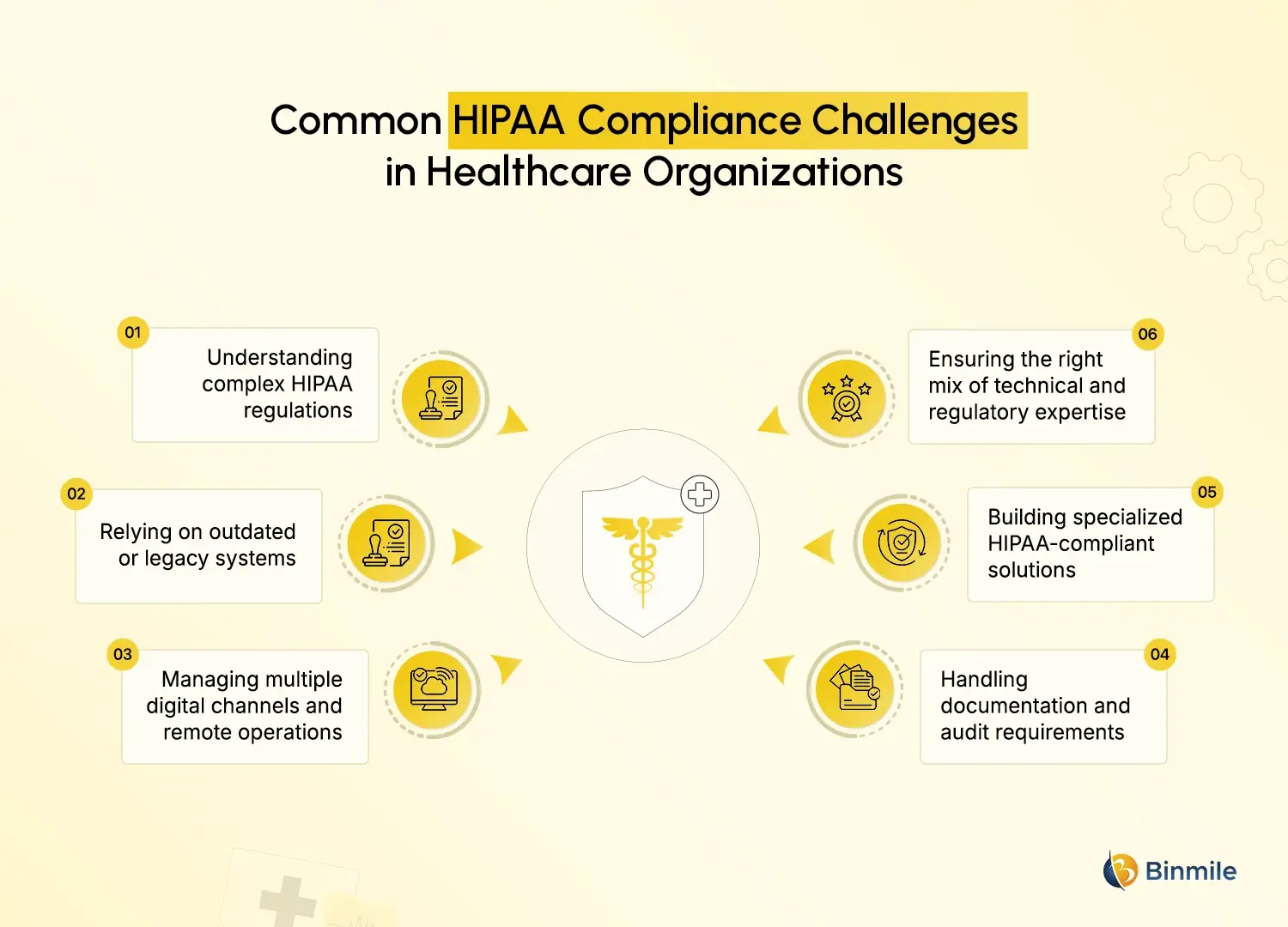
4. Handling Documentation and Audit Requirements
A complete compliance checklist for HIPAA software development that covers documentation and audit requirements should cover audits, risk assessments, security updates, and ongoing employee training, in addition to other things. Maintaining documentation is burdensome for many organizations, particularly when using a HIPAA risk assessment tool that does not provide the documentation required by the assessment.
5. Building Specialized HIPAA-Compliant Solutions
Different tiers of protection are required for different healthcare services. Various applications, such as HIPAA-compliant texting software, building HIPAA-compliant software for therapists, and HIPAA-compliant task management software. Hence, each has different rules related to the handling of data. This leads to a more customized approach to the development of these solutions, as each workflow must not only remain compliant but also optimized.
6. Ensuring Technical and Regulatory Expertise
Well-resourced healthcare organizations still often struggle with the balance between technical improvements and increasing regulatory burden. Compliance is not simply a matter of building a secure system. It demands the system to be actively monitored, controlled, and assessed at such depth that the very core of the system’s operations is understood, and how they correlate to the regulatory landscape.
These challenges make it clear that businesses must fulfill HIPAA compliance software requirements for a deep regulatory understanding to build and maintain compliant systems.
Looking to build secure, scalable, and completely HIPAA-compliant software for your Healthcare business?
What Are The Types of HIPAA Compliance Software To Build
Healthcare businesses today need a wide range of digital solutions that follow HIPAA regulations. Here are some of the most common software for HIPAA compliance that can be developed depending on your organization’s needs.
1. HIPAA-Compliant EHR and EMR Systems
The support of HIPAA EHR Software to health professionals to maintain the history of the patient, secure payments, and manage prescriptions and treatment schedules helps import the health history of a patient into a safe vault. For HIPAA EHR Software to function and integrate with pharmacies, diagnostic labs, and financial insurers, robust API management and encryption to protect against loss are important.
2. HIPAA-Compliant Billing and Finance Tools
HIPAA-compliant billing software helps maintain and control workflows of payments on the software in relation to medical coding and assists in the automation of the processing of claims for billing purposes. Payment information is transmitted through a variety of mechanisms and channels, and HIPAA-compliant billing software closes the window to unauthorized access for claims and reimbursements.
3. Therapist and Counseling Platforms
HIPAA-compliant software for therapy also has secure capturing of videos, secure storage of preferences, and documentation of therapy sessions. Secure messaging is also a basic requirement for many therapists, and this messaging should be a HIPAA-compliant texting software to enable the safe passage of communications with clients.
4. Task Management Solutions for HIPAA Compliance
HIPAA-compliant software for task management allows healthcare staff to assign responsibilities with the assurance of having shared sensitive information. HIPAA-compliant task management allows organizations to simplify their internal workflows while remaining secure and audit-trailled.
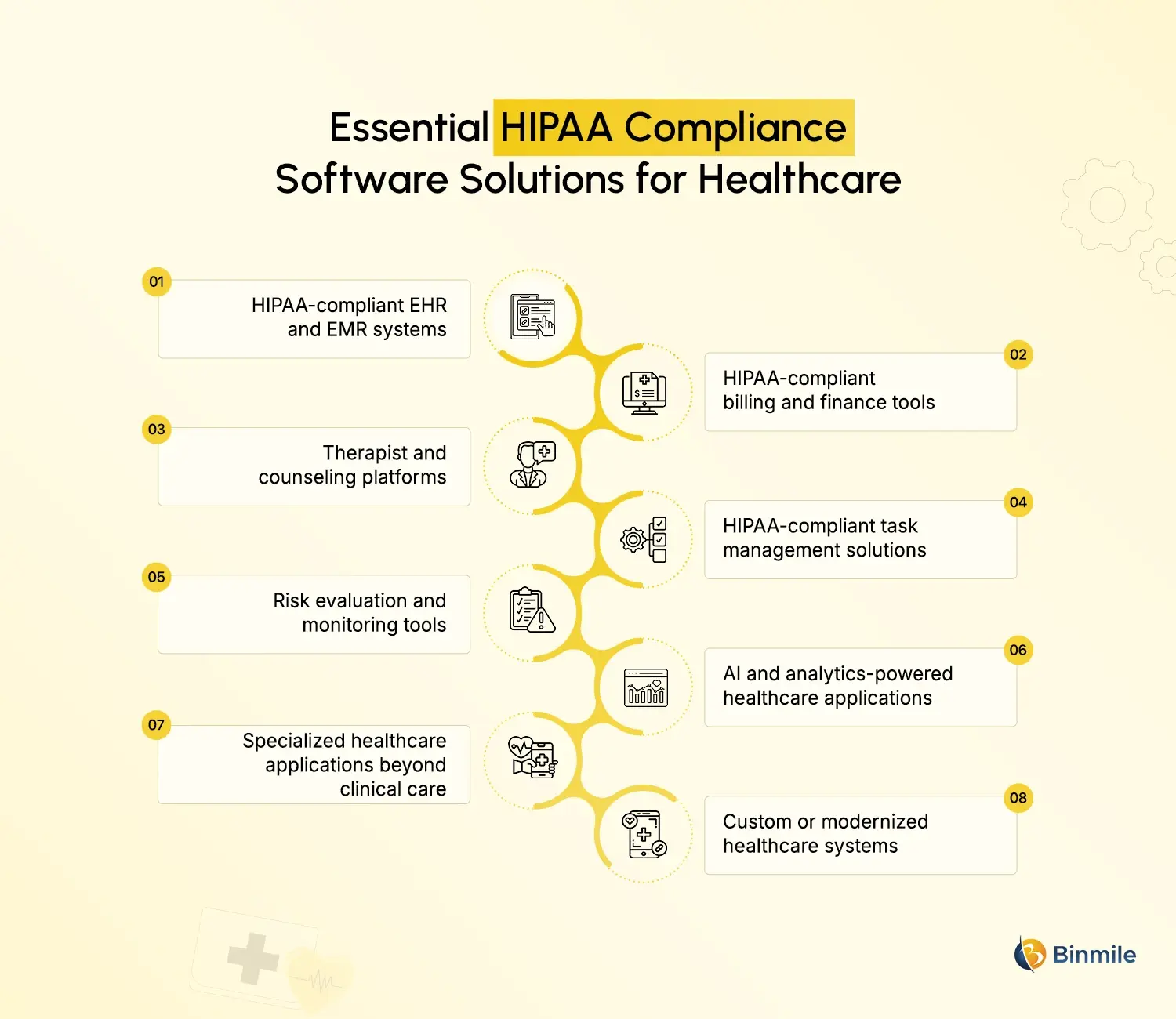
5. Risk Evaluation and Monitoring Tools
Tools like HIPAA risk assessment software and the HIPAA security risk assessment tool show organizations the weaknesses they have and help with tracking high-risk compliance. These tools are helpful during an audit since they help with compliance documentation.
6. AI and Analytics-Powered Healthcare Applications
Healthcare might be the most sensitive field where data is used. While using AI in Healthcare, developers need to comply with de-identification, access restrictions and secured retention, and other measures to make sure the analytics platform stays compliant throughout the various stages of the data lifecycle.
7. Specialized Healthcare Applications Beyond Clinical Care
HIPAA-compliant tools may also be required in other healthcare business applications such as stem cell therapy, remote patient monitoring, workflow automation, and custom dashboards. In every case, the solution is still regulated by the HIPAA compliance software checklist.
8. Custom or Modernized Healthcare Systems
Clients of custom health app development companies enjoy the flexibility of building new HIPAA-compliant systems or choosing to upgrade their old ones. This achieves better optimised performance and security, as well as an architecture that allows for further scalability in the future.
A trusted custom health app development company can guide you on whether you need a new HIPAA compliance application development or to modernize existing systems, how to optimize costs, and which architecture is best suited for your business model.
Need a trusted custom software development partner to upgrade or build your software with HIPAA compliance?

Why Choosing the Right Partner Matters for Building HIPAA Compliance Software
Most healthcare organizations understand that compliance is not optional. What they really need is the right expertise to build applications that not only meet regulations but also work smoothly for clinicians, patients, and operational teams. This includes designing secure systems, integrating reliable encryption, conducting frequent audits, and maintaining a strong documentation process.
This is where a partner like Binmile becomes valuable. The team follows a structured and research-backed approach for building HIPAA-compliant app development projects. Additionally, provide custom software development services, ensuring that every component meets regulatory standards. They evaluate risks, design scalable architectures, support integration with existing tools, and offer continued monitoring to keep systems secure long after launch. Their understanding of healthcare workflows and hands-on experience with different types of healthcare software help businesses move from outdated or insecure systems to modern and compliant digital platforms without disrupting operations.
Whether you need to build HIPAA-compliant software from scratch or upgrade existing healthcare systems, choosing the right development partner is the most reliable way to ensure compliance, performance, and long-term data protection.
Frequently Asked Questions
HIPAA compliance software protects patient data and helps healthcare organizations navigate HIPAA requirements. It provides tools to mitigate data breaches and maintain compliance when providing access to, storing, communicating, or billing data.
Binmile uses secure architecture design, risk assessment, encryption controls, and continuous monitoring to create end-to-end compliant systems. Their team understands healthcare workflows and builds customized solutions based on each organization’s needs.
Any system containing or transmitting PHP must adhere to HIPAA, including EHRs, billing software, apps for therapists, communication systems, telemedicine, analytics solutions, patient portals, etc.
The team focuses on regulatory alignment from the earliest design stage. They integrate security controls across the entire development lifecycle, perform regular assessments, and ensure smooth scalability as the system grows.
Timelines vary depending on project size, features, integrations, and modernization needs. Most solutions take a few months, while more complex systems may take longer.