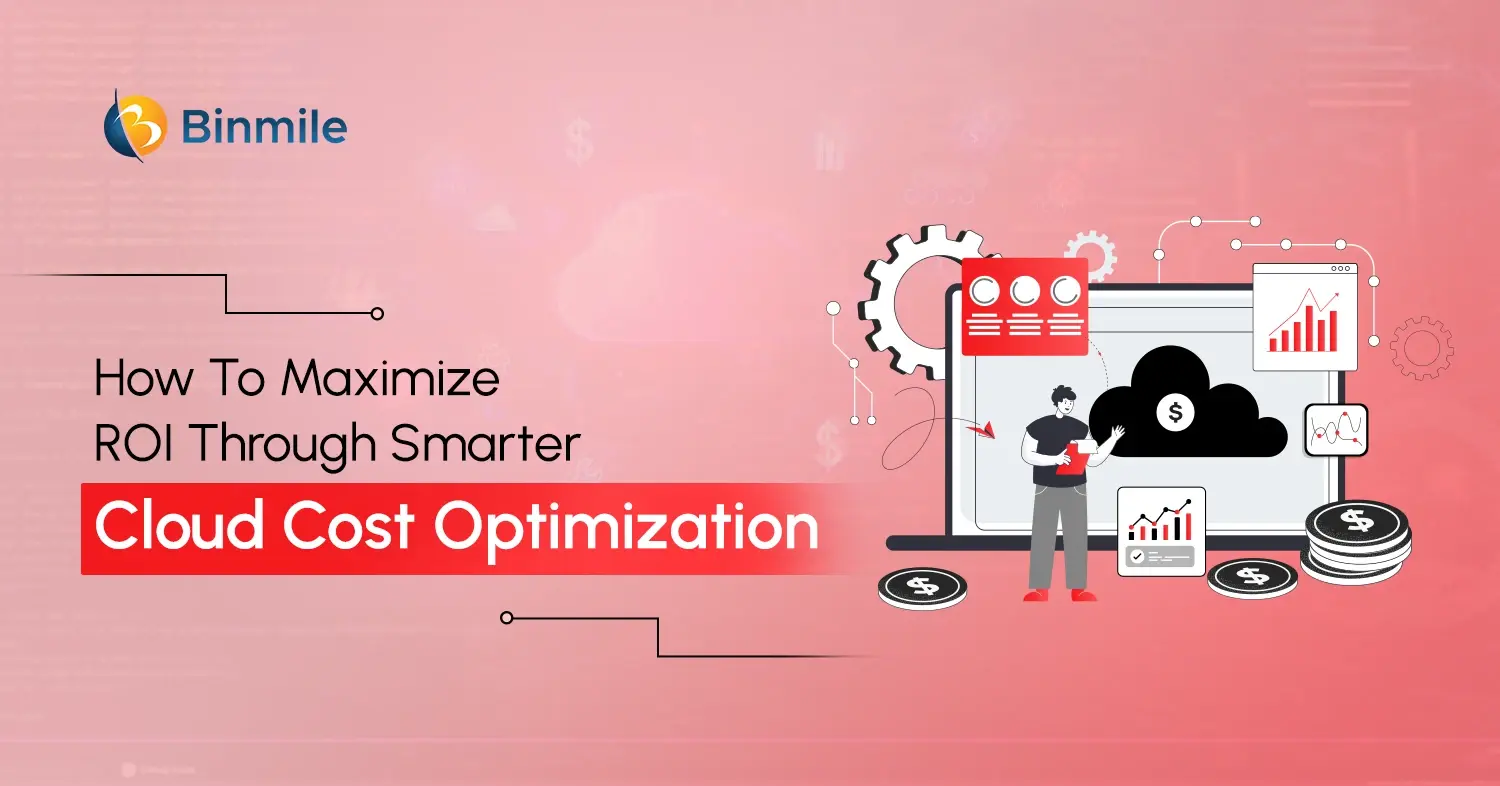
Cloud spending has quietly become one of the biggest operational expenses for modern enterprises. According to the 2025 Flexera State of the Cloud Report, 84 percent of organizations say managing cloud spend is their top cloud challenge, with cloud budgets already exceeding limits by 17 percent and expected to grow by 28 percent next year.
As businesses scale their cloud adoption, controlling costs without slowing innovation becomes critical. This blog explores what cloud cost optimization really means, proven cloud cost optimization strategies, best practices, tools, pricing models, and future trends that help enterprises reduce cloud waste and improve business returns. For organizations following a cloud-first strategy, cost optimization becomes even more essential, ensuring that cloud investments remain sustainable as digital transformation accelerates.
What is Cloud Cost Optimization?
Cloud cost optimization is the continuous process of monitoring, managing, and reducing cloud expenses while maintaining performance, security, and scalability. Unlike simple cost-cutting, it focuses on aligning cloud usage with actual business needs.
Key aspects of cost optimization in cloud environments include right-sizing resources, usage visibility and accountability, and balancing cost with performance. A strong cloud cost optimization framework helps enterprises turn cloud investments into measurable business value instead of unpredictable monthly bills.
What are the Key Strategies for Cloud Cost Optimization
Successful cloud cost optimization strategies focus on proactive control rather than reactive cost reviews.
1. Resource Right-Sizing
For many workloads, provisioning optimally means possible performance risks. However, this means spending excessively on unused capacity. Looking at reasonable provisioning, evaluating scheduled usage each month, and adjusting storage and compute resources to fit actual demand streamlines services and saves money.
2. Intelligent Workload Scheduling
Not every workload needs to be done every day. Non-critical activities, for instance, testing, reporting, analytics, and some batch jobs, can be scheduled for cloud off-peak hours, and cloud cost savings can be achieved without impacting day-to-day activities or customer-facing services.
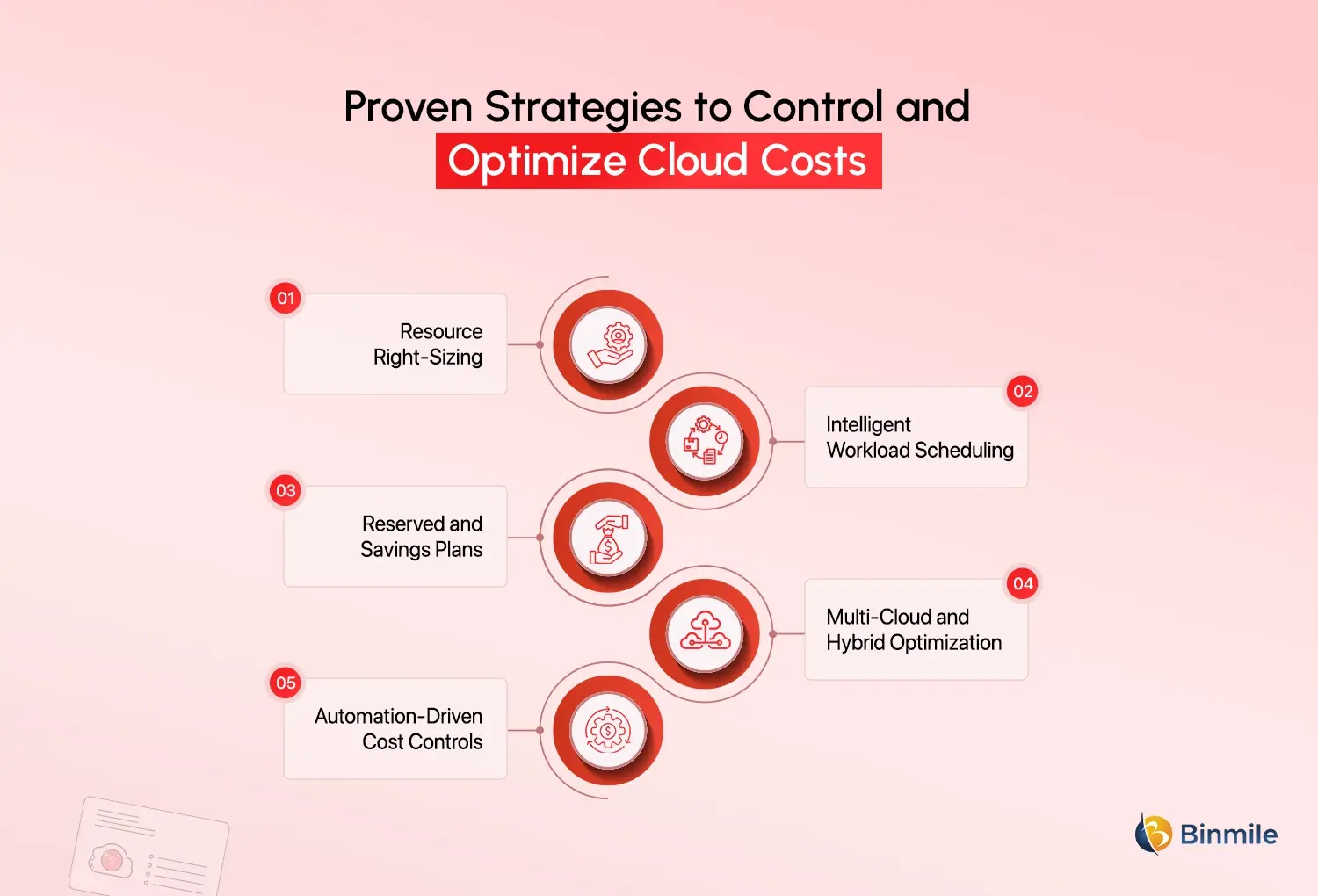
3. Reserved and Savings Plans
Long-term commitments to stable apps get significant savings versus on-demand prices. Additionally, this works best in conjunction with good usage forecasting.
4. Multi-Cloud and Hybrid Optimization
Organizations can prioritize workloads across multiple cloud providers based on price, performance, and availability. This means there is improved use of chargeable resources, reduced reliance on a single vendor, and better control over costs.
5. Automation-Driven Cost Controls
Automated scaling, scheduled shutdowns, and policy-based governance help prevent idle resources from running unnecessarily while ensuring performance is maintained during peak demand.
What are the Best Practices to Optimize Your Cloud Costs
Cloud cost optimization best practices focus on discipline, visibility, and continuous improvement.
-
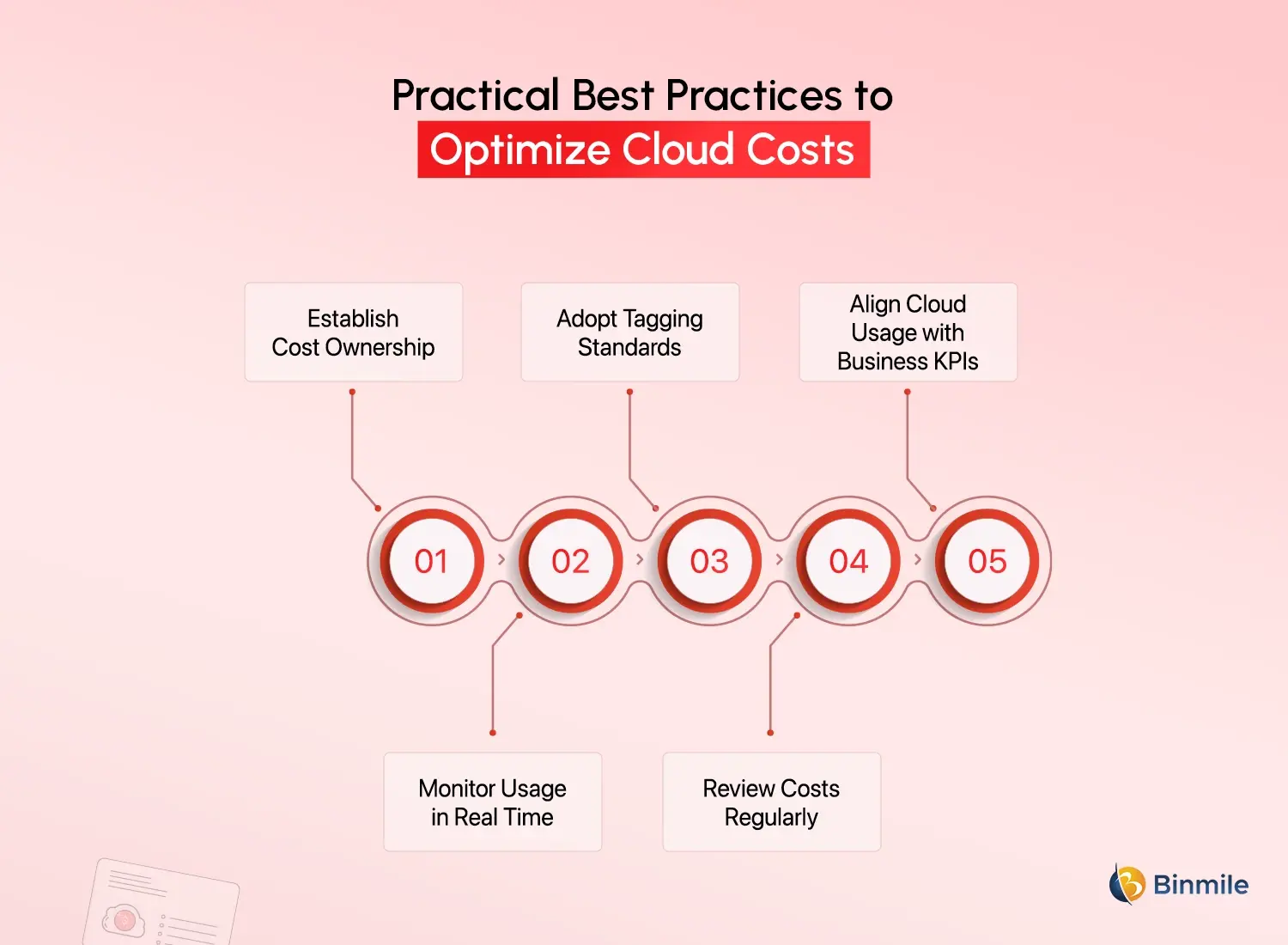
Establish Cost Ownership
With cloud cost ownership, teams and departments learn to resource provision and use more smartly. They make better choices, resource decisions, and become encouraged to make wise use of resources.
-
Monitor Usage in Real Time
Employees recognize missing resources, anomalous resource utilization, and unexpected billing surges. They avoid accruing large expenses.
-
Adopt Tagging Standards
Cost transparency across business unit projects is enhanced. Spending is easier to allocate, budgets are easier to track, and cost analytics across the organization is improved.
-
Review Costs Regularly
Cloud cost optimization techniques are refined as usage patterns evolve. Identifying inefficiencies and evaluating efforts is possible through the practice of review and optimization.
-
Align Cloud Usage with Business KPIs
With cloud usage measured against business KPIs, efforts are sure to support revenue growth, improve customer experience, and attain operational objectives. When cloud investments are gauged against business outcomes, optimization efforts are less disposable and more impactful.
These best practices ensure cost optimization remains an ongoing process rather than a one-time effort.
What are the Essential Tools for Cloud Cost Optimization
Choosing the best cloud cost optimization tools plays a major role in controlling spend and improving ROI.
-
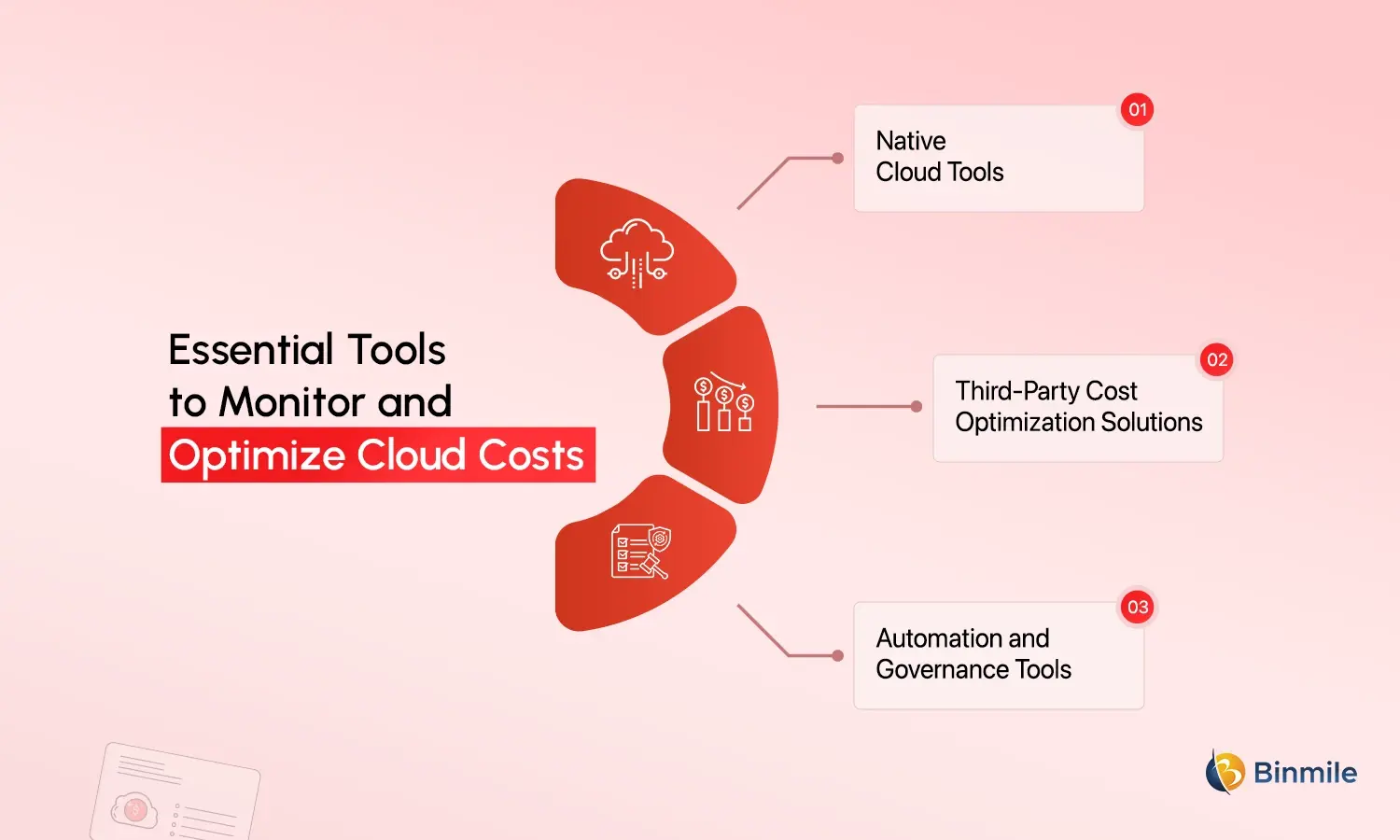
Native Cloud Tools
Major cloud service providers have their own native cloud tools that provide basic functionalities like usage tracking, cost management alerts, simple forecasting, and built-in cloud data migration tools. These capabilities help organizations migrate workloads efficiently, gain early visibility into cloud spending, and identify basic cost inefficiencies during and after migration.
-
Third-Party Cost Optimization Solutions
Third-party cloud cost optimization solutions provide more sophisticated tools, including advanced analytics, cross-cloud integration, and AI-optimized suggestions. Additionally, such solutions are important for large organizations that have progressed to complex multi-cloud or hybrid computing environments.
-
Automation and Governance Tools
These tools reduce administrative overhead and the potential for human error by automating cloud compliance and cost control. Cloud automation tools manage resource scaling, scheduled shutdowns, policy enforcement, and flexible cloud cost controls, ensuring consistent optimization without manual intervention.
When combined, these tools enable better financial governance and smarter decision-making across cloud environments.
Looking to design a smarter cost optimization strategy that delivers real business impact?
Understanding Cloud Pricing Models
Cloud pricing models directly influence cost optimization outcomes. Selecting the right model ensures businesses pay only for what they truly need.
| Cloud Pricing Model | How It Works | Best Suited For |
|---|---|---|
| On-Demand Pricing | Resources are billed per hour or second based on actual usage, with no long-term commitment. Organizations can scale resources up or down instantly and stop paying when usage ends. | Short-term workloads, development and testing environments, proof-of-concept projects, and unpredictable or experimental workloads where flexibility is more important than cost savings. |
| Reserved Instances / Savings Plans | Organizations commit to a specific usage level for a fixed term, usually one or three years, in exchange for significantly discounted rates compared to on-demand pricing. | Stable, predictable workloads such as production applications, databases, and enterprise systems that run continuously and have consistent resource requirements. |
| Spot Instances | Unused cloud capacity is offered at deeply discounted rates. Instances can be interrupted when capacity is needed elsewhere, requiring workloads to tolerate sudden shutdowns. | Non-critical, fault-tolerant workloads such as batch processing, data analytics, CI/CD pipelines, rendering jobs, and background processing tasks. |
| Pay-As-You-Go Models | Costs are based entirely on consumption with no upfront commitment. Charges increase or decrease depending on real-time usage, offering flexibility but requiring close monitoring. | Variable workloads with fluctuating demand, seasonal applications, customer-facing platforms with traffic spikes, and businesses in early growth stages. |
Understanding and combining pricing models is a foundational part of any cloud cost optimization framework.
What are the Future Trends and Innovations in Cloud Cost Optimization
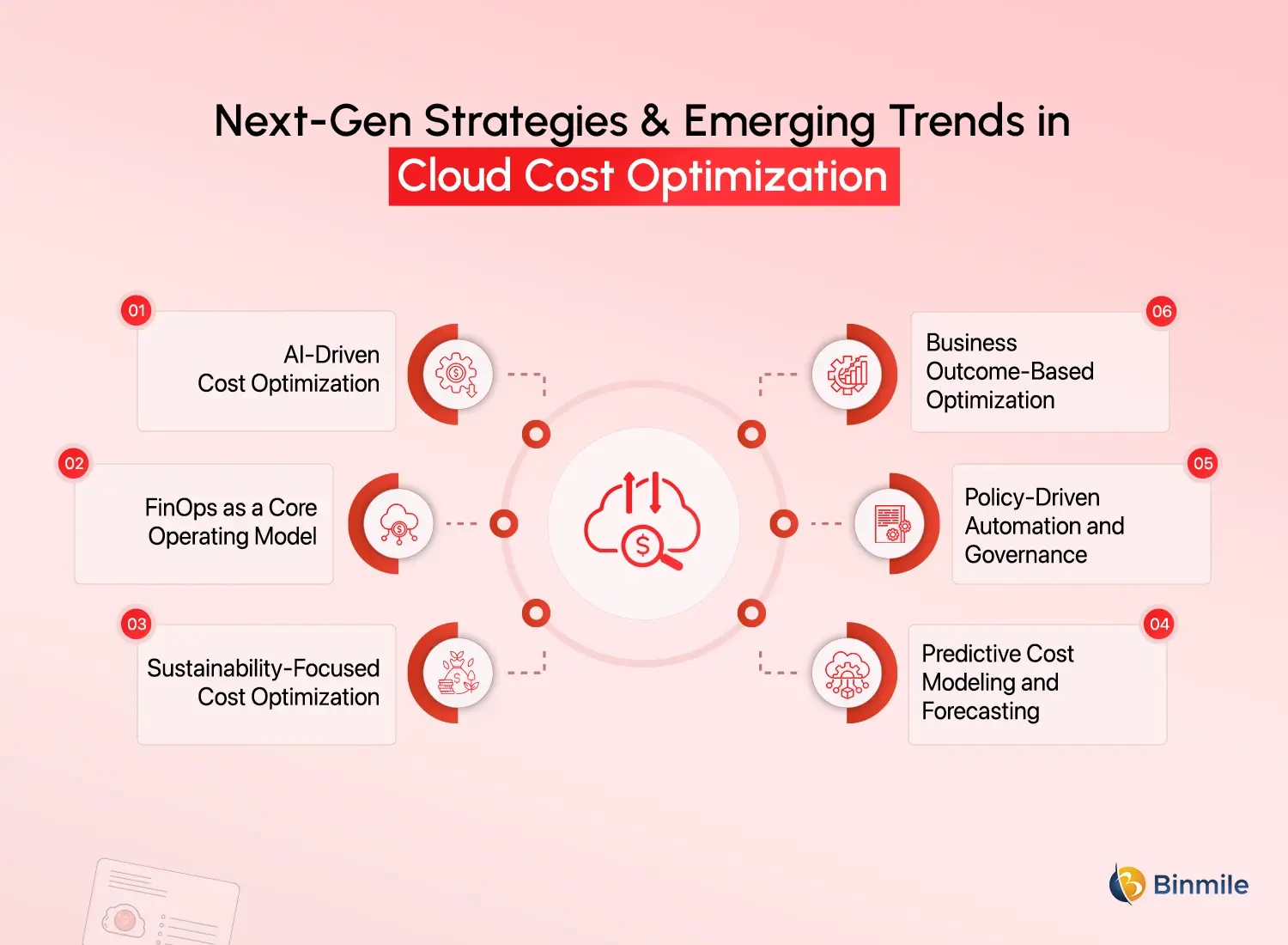
As cloud environments become more complex and deeply embedded into business operations, cloud cost optimization is shifting from manual monitoring to intelligent, business-aligned decision-making. The future of optimization is driven by automation, collaboration, and predictive insights, with cloud automation tools playing a central role rather than relying on reactive cost controls.
-
AI-Driven Cost Optimization
Artificial intelligence and machine learning are transforming how organizations manage the costs of using the cloud. Rather than using static reports, AI models can use the historical patterns of cloud usage, the behavior of applications, and any fluctuations in demand to forecast future needs. Additionally, these systems make automatic suggestions to the user to make adjustments such as scaling limits, policies, or moving workloads to less costly services. Over time, AI-driven systems are able to improve the optimization process by reducing the reliance on humans, decreasing errors, and maintaining cost efficiency as workloads are continuously scaled.
-
FinOps as a Core Operating Model
Cloud-driven organizations are reporting FinOps as a best practice that is beginning to set an operating model. FinOps puts finance, engineering, and operations together to construct a collaborative model for cloud spend. FinOps empowers teams to model cloud costs as a variable and understand the fiscal impact of their design decisions, allowing cloud spend to address business challenges such as increasing revenue, reducing time to market, or improving customer experience.
-
Sustainability-Focused Cost Optimization
Organizations are linking cost optimization and sustainability more often. Reducing cloud waste can mean reducing energy and environmental impact. Optimizing workloads, eliminating idle resources, and improving efficiency across cloud platforms means lower operational costs and lower carbon emissions. As sustainability regulations and ESG requirements increase, the need for optimization becomes more and more of a strategic necessity instead of just a secondary benefit.
-
Predictive Cost Modeling and Forecasting
Predictive cost modeling enables a shift from reactive budgeting to more strategic financial planning. Organizations can utilize historical data and growth projections to estimate cloud expenses due to new product releases, geographic growth, seasonal demand, and more. Additionally, this reduces budget costs, avoids cost surges, and improves investment planning within cloud resources.
-
Policy-Driven Automation and Governance
The optimization frameworks of future cloud costs will be focused primarily on policy-driven automation. Organizations will set and automate the enforcement of cost, usage, and compliance policies across cloud environments. With more restricted costs across teams and regions, there will be fewer manual adjustments, and more consistent policies will be put in place.
-
Business Outcome-Based Optimization
In today’s world, optimization focuses on outcomes. Instead of viewing the customer cloud cost as merely an expense that must be reduced, companies look for ways to enhance cloud-derived revenue, customer retention, and overall organizational performance and scalability. Additionally, this realignment ensures that cost optimization is ultimately supportive of organizational growth.
Together, these trends are reshaping cloud cost optimization into a strategic, intelligent, and continuous discipline. As innovation accelerates, organizations that adopt these approaches early will gain stronger financial control, higher ROI, and a more resilient cloud operating model.
Get clarity with a smarter cloud cost optimization strategy tailored to your growth goals.

Driving Smarter Cloud ROI with the Right Partner
Achieving sustainable cloud cost optimization requires more than tools and dashboards. It demands a deep understanding of cloud platforms, business priorities, and long-term scalability goals. Organizations that treat optimization as a strategic initiative consistently see stronger ROI, better performance, and improved financial governance.
This is where experienced cloud consulting teams like Binmile quietly add value by aligning cloud strategies with real business outcomes. From cloud migration and automation to ongoing optimization and governance, the focus remains on helping enterprises scale efficiently without unnecessary cloud spend. When cost optimization becomes part of your cloud DNA, the cloud stops being an expense and starts becoming a growth engine.
Frequently Asked Questions
Cloud cost management focuses on tracking and reporting expenses, while cloud cost optimization actively reduces spend through right-sizing, automation, and strategic planning to improve efficiency and ROI.
Without optimization, cloud costs can spiral quickly due to unused resources. Optimization ensures businesses pay only for what they use while maintaining performance, security, and scalability.
Cloud setup costs vary based on workloads, storage, security, and usage patterns. Costs can range from minimal for startups to significant for enterprises, making optimization essential for budget control.
Cloud cost management improves budget visibility, prevents overspending, supports financial planning, and lays the foundation for effective cloud cost optimization initiatives.
It eliminates idle resources, right-sizes workloads, automates scaling, and enforces governance policies to ensure cloud resources are used efficiently and responsibly.
Enterprises benefit from cost assessment, FinOps implementation, automation, usage monitoring, and continuous optimization services to manage complex cloud environments effectively.