
Cloud adoption is no longer a side initiative led by IT teams. It has become a boardroom priority. According to Gartner, worldwide end-user spending on public cloud services is projected to cross $1 trillion in 2027, reflecting how aggressively enterprises are investing in digital transformation. Yet despite this massive spending, many organizations fail to achieve the expected returns. The reason is simple. Moving workloads to the cloud is not the same as building the right cloud computing architecture.
When moving servers to a cloud environment, lacking a clear architectural plan usually results in adding complexity rather than solving it. Those enterprises that methodically plan their cloud computing architecture enjoy better scalability, security, consistent performance, and managed costs. In contrast, those that move forward without a plan struggle with gaps in their integrations, compliance issues, and runaway cloud costs.
In the blog, we will define what cloud computing architecture is, and its importance to enterprise cloud computing, the issues organizations encounter without it, the support it provides in optimizing costs, the various types of cloud architectures and enterprise cloud computing frameworks, real-world examples of its application, and the structured approach needed to build the right architecture.
What is Cloud Computing Architecture?
Cloud computing architecture refers to the structured design of components and services that enable cloud environments to function efficiently. It consists of front-end user interfaces, back-end systems, cloud delivery models, networks, storage, and security.
In other words, cloud architecture explains how everything links together and how systems can be enhanced. It allows cloud platforms to efficiently manage services, apps, and databases.
When we talk about cloud architecture, we are referring to the storage, networking, and operational components of the cloud, along with other resources like compute resources (such as VMs and containers), Identity and Access Management (IAM) systems, and monitoring systems.
Well-defined cloud service architecture translates the technology into the business. It optimizes the distribution of cloud workloads across the infrastructure to meet the required Availability and Reliability (AR) levels.
This is the primary purpose of the cloud architect. The professional oversees the design and implementation of the cloud platform, addressing key issues related to growth, compliance, scalability, and performance. The complexity of enterprise cloud computing environments increases due to the need for cloud solution architecture to merge legacy systems with new cloud-native services with minimal disruption.
Why Cloud Computing Architecture is Crucial for Enterprises
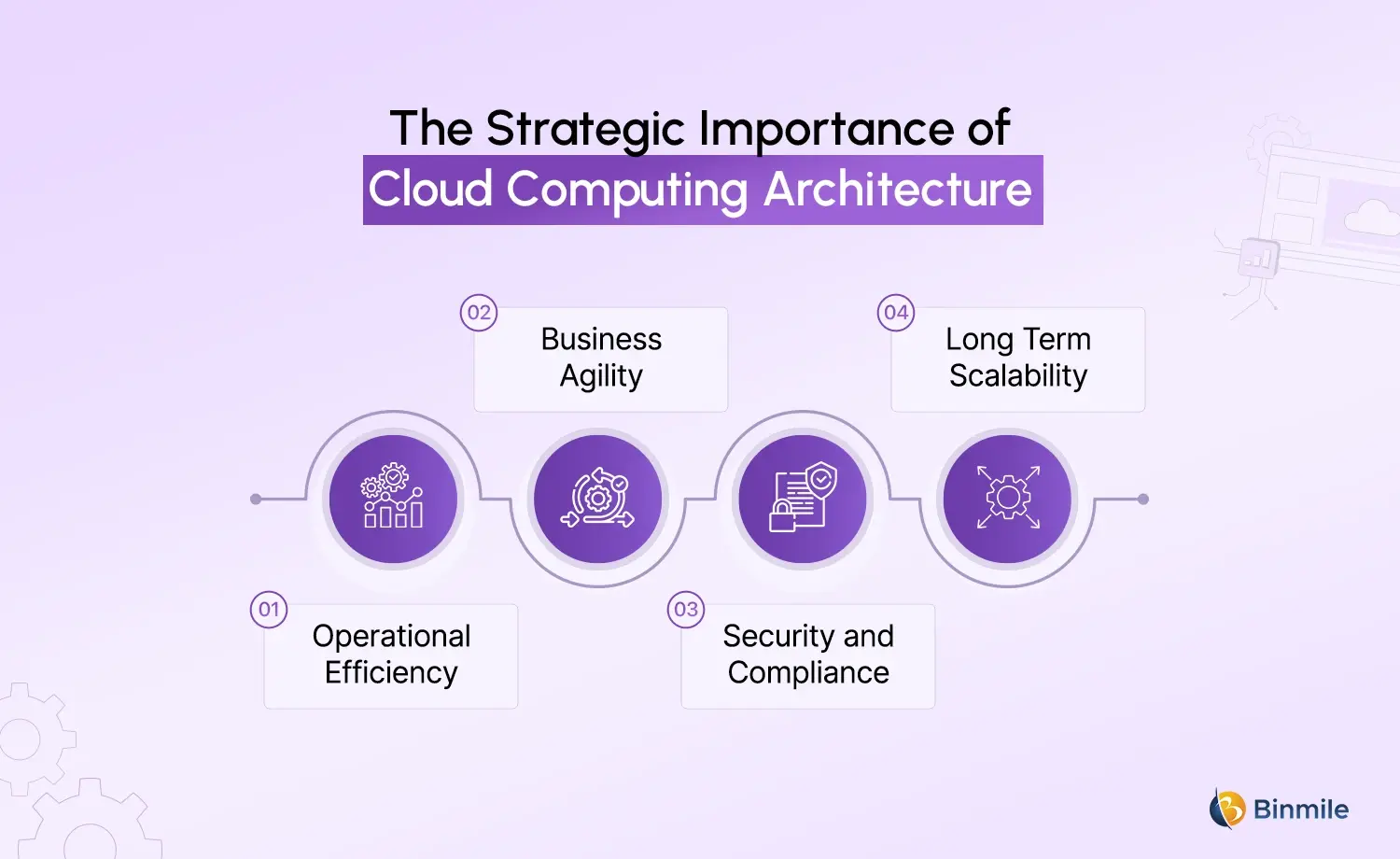
The right cloud computing and architecture strategy enables enterprises to operate efficiently and scale confidently. Here are the benefits of cloud computing in enterprises.
-
Operational Efficiency
Well-structured cloud server architecture minimizes latency and maximizes application performance and redundancy in infrastructure.
-
Business Agility
Cloud infrastructure’s elasticity allows businesses to innovate freely without high initial costs, launch products, scale into new territories, and test new ideas.
-
Security and Compliance
Data protection, encryption, and access controls are integrated into the cloud computing system design instead of being bolted on afterward.
-
Long Term Scalability
A cloud architecture that is well designed will accommodate growth without the need for redesign in the short term.
What are the Common Challenges Enterprises Face Without the Right Architecture
Many enterprises adopt a cloud-first strategy but overlook the importance of structured architecture. This leads to recurring operational and financial challenges.
-
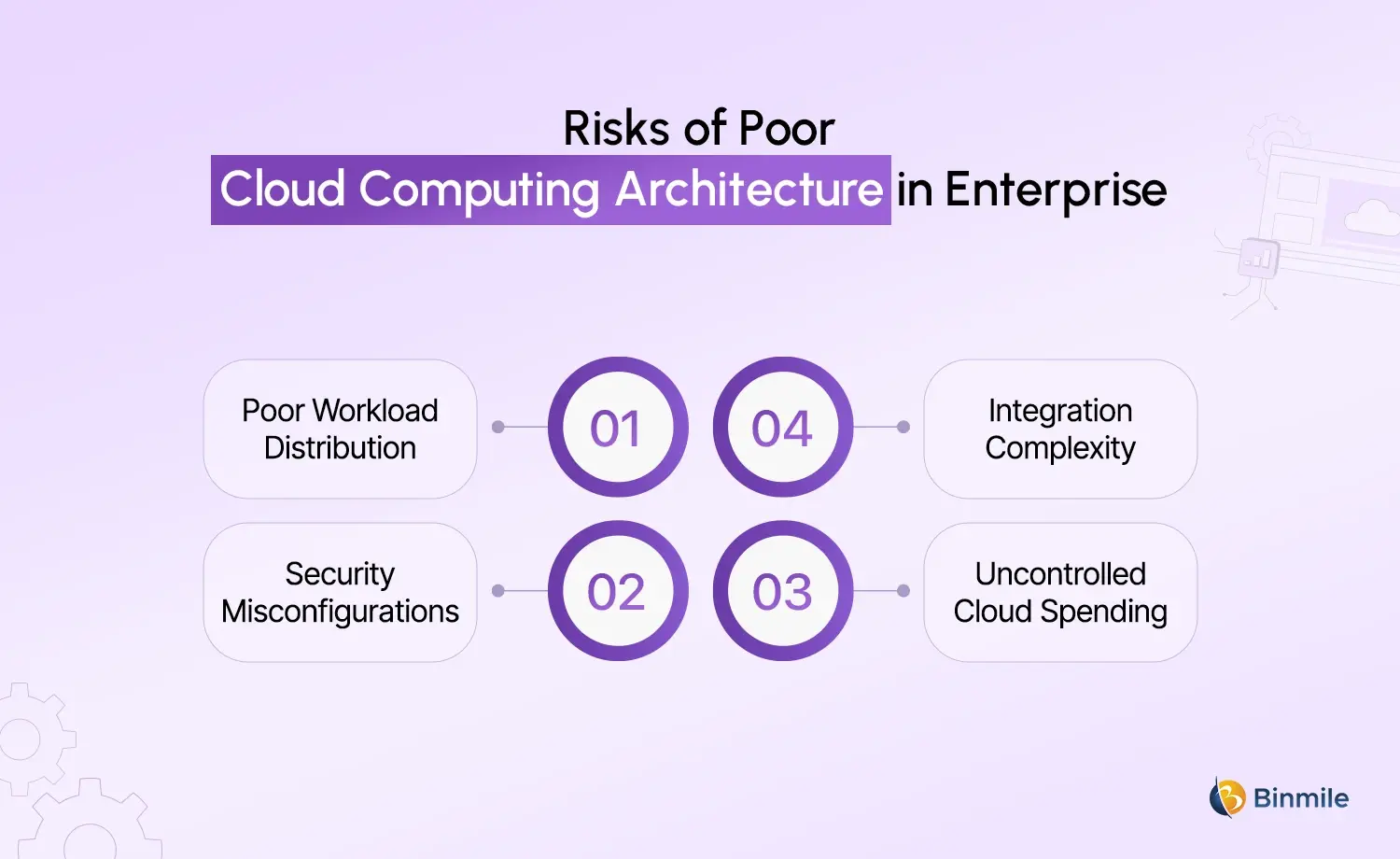
Poor Workload Distribution
Some applications may perform poorly within cloud native architectures despite being designed for traditional data centers. Due to the lack of architectural redesign, workloads are distributed unevenly, worsening performance and increasing compute costs.
-
Security Misconfigurations
Enterprises are exposed when there is no security architecture defined for cloud computing. Identity management, weak encryption, access permissions, and other factors may lead to data breaches and violations of compliance.
-
Uncontrolled Cloud Spending
Poorly allocated resources, no cloud cost management, and a lack of cloud cost management lead to instances that are not being utilized, over-provisioning, and monthly bills that are impossible to predict. Without discipline, cost management is impossible.
-
Integration Complexity
Many enterprises have hybrid environments. If the cloud solution architecture ignores legacy systems, integration becomes problematic. Teams find themselves with disconnected data, inconsistent reports, and disrupted workflows.
Planning a cloud migration or optimizing your existing cloud infrastructure?

What is the Role of Cloud Architecture in Cost Optimization
Cloud adoption is frequently justified by expected savings. However, without a structured design, costs can quickly escalate.
A well-planned cloud computing architecture supports cost optimization in practical ways.
The right-sizing of resources allows workloads to utilize the proper compute and storage capacity so as to avoid over-provisioning and cut down on waste. Cloud-native services offer auto-scaling, meaning the infrastructure can expand and/or contract depending on real-time needs. Enterprises only pay for what they use. Multi-cloud architecture allows users to compare costs and offers flexibility in choosing providers. This means that a well-structured multi-cloud strategy can lessen reliance on one provider and enhance pricing control.
The alignment of Cloud Financial Governance allows for the tracking, reporting, and accountability to occur across various units. The architecture must provide the means for tracking resource allocation and spending. Event-driven and Serverless models reduce the burden of managing infrastructure. This means that with serverless architecture, enterprises can refocus on business logic instead of hardware.
When the Cloud architecture and infrastructure are aligned with the financial goals of the organization, there is the attainment of predictable and measurable cost efficiency instead of varying costs.
What are the Types of Cloud Architecture and Enterprise Models
Enterprises can select from various types of cloud architecture depending on business goals and regulatory requirements.
| Model | Description | Suitable For |
|---|---|---|
| Public Cloud Architecture | Shared infrastructure managed by a provider | Rapid growth and scalable workloads |
| Private Cloud Architecture | Dedicated environment for a single organization | Regulated and compliance-heavy industries |
| Hybrid Cloud Architecture | A combination of public and private environments | Enterprises managing legacy systems |
| Multi Cloud Architecture | Multiple cloud providers are used simultaneously | Organizations seeking flexibility and risk distribution |
Enterprise cloud computing models often blend these approaches. For example, a financial enterprise may store sensitive records in a private cloud while using public cloud platforms for analytics.
Decisions around cloud agnostic vs cloud native approaches also shape architecture. Cloud native architectures leverage microservices, containers, and cloud native services optimized for specific cloud platforms. Cloud-agnostic strategies focus on portability across environments.
Selecting the right model is a strategic component of enterprise cloud strategy and long-term digital planning.
Industry Use Cases of Enterprise Cloud Architecture
Different industries require tailored cloud computing architecture based on operational needs and regulatory demands.
-
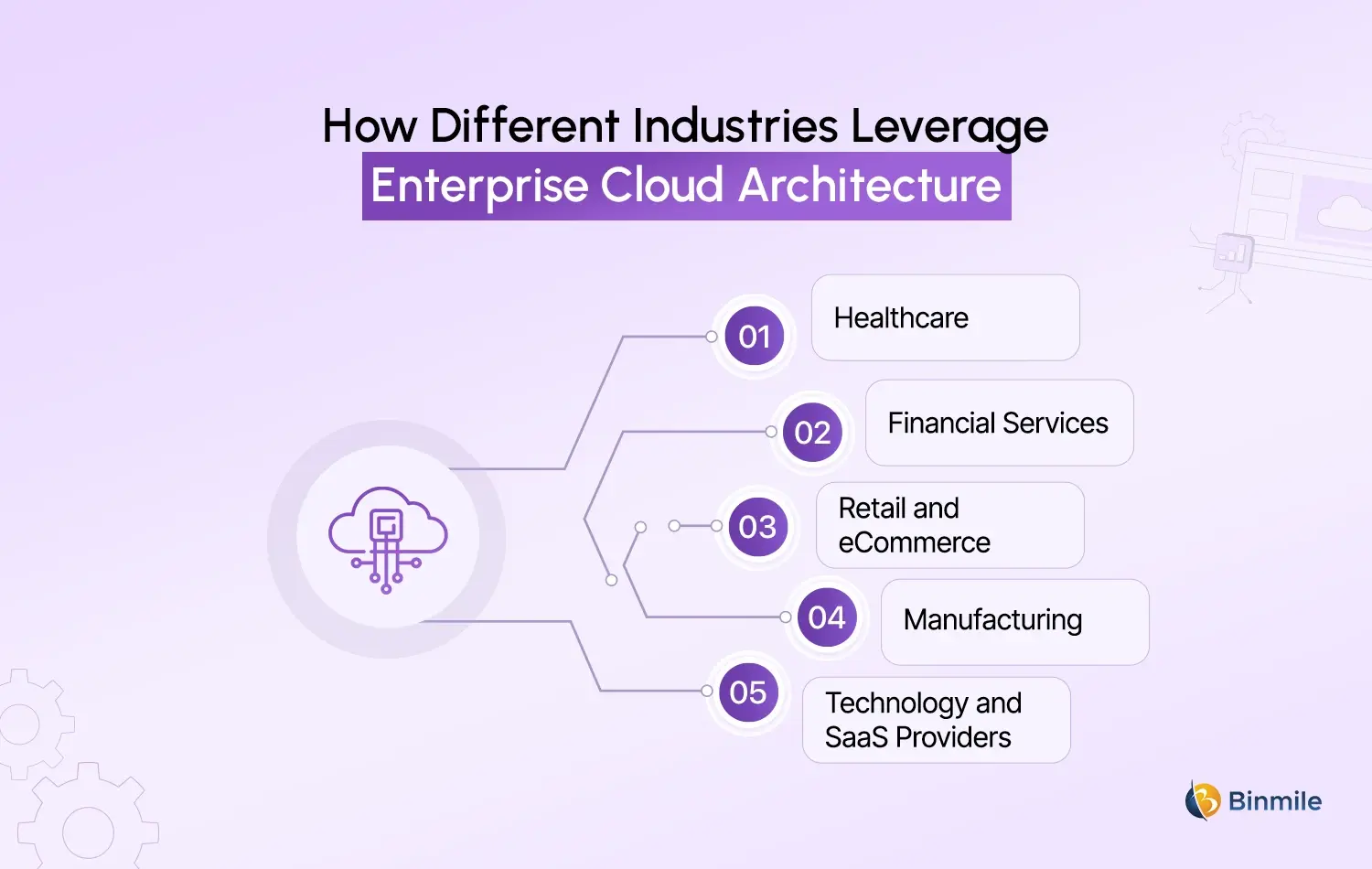
Healthcare
Hospitals use secure cloud databases as well as compliance-focused cloud computing security frameworks to safeguard patient information. All architecture frameworks must support high availability as well as compliance and security requirements.
-
Financial Services
Hybrid and multi-cloud use for risk management, fraud detection, and compliance and regulatory reporting is utilized by banks. The cloud server architecture must process large amounts of data and transactions and transmit data with little to no delays.
-
Retail and eCommerce
Retailers use an adaptive cloud platform architecture to control the increased traffic during busy seasons. Cloud-native services that offer customized buying suggestions and real-time stock availability are integrated with edge computing vs cloud computing solutions to process data from IoT devices.
-
Manufacturing
Manufacturers use integrated edge computing vs. cloud computing solutions to process data from IoT devices. This necessitates a strong cloud ecosystem that joins production units to centralized analytics.
-
Technology and SaaS Providers
Organizations providing SaaS architecture must create a resilient multi-tenant cloud architecture. Reliability and performance are top priorities.
What is the Process of Building the Right Cloud Computing Architecture
Designing enterprise cloud computing architecture requires a structured and disciplined approach.
-
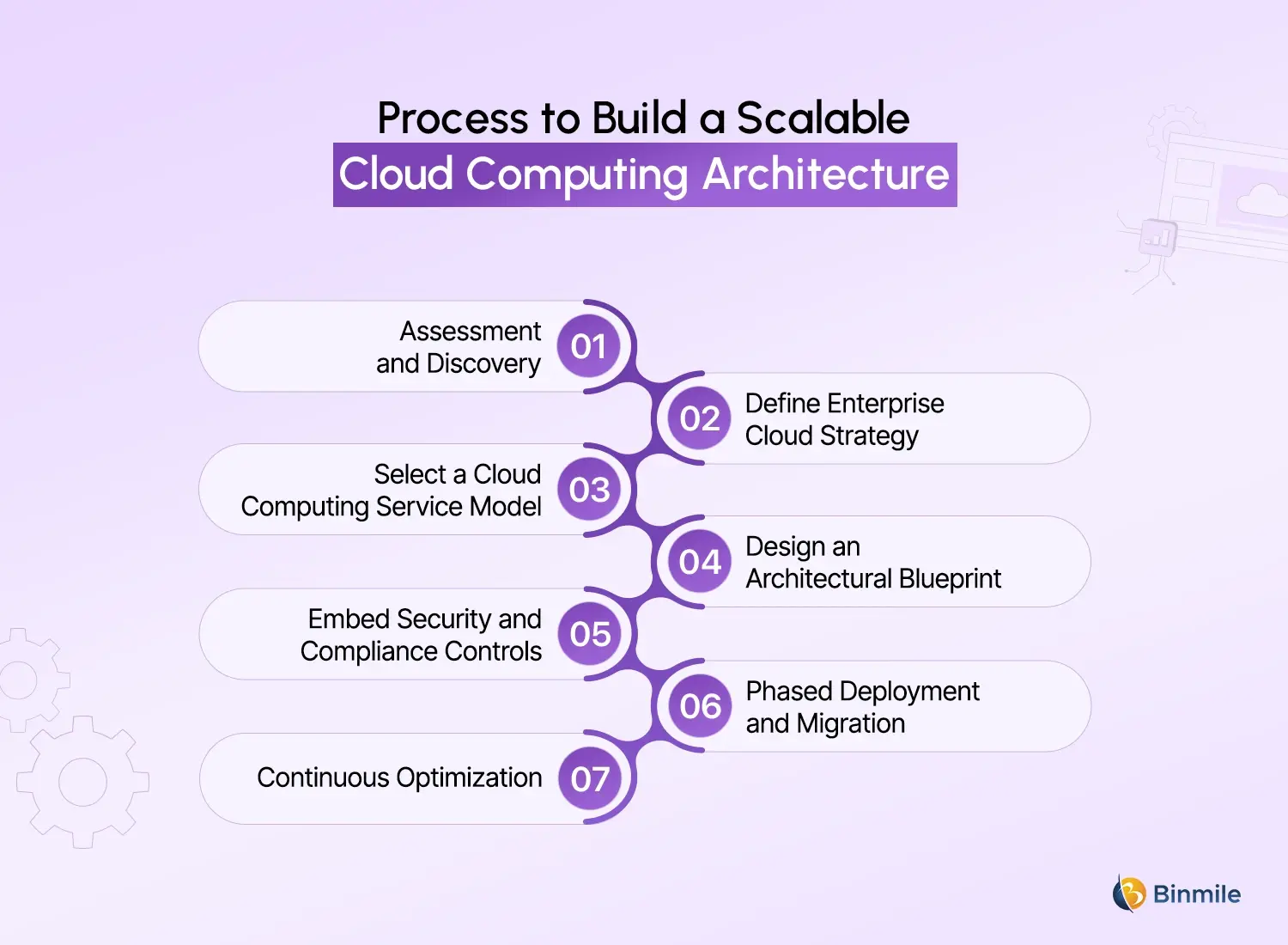
Assessment and Discovery
A cloud migration checklist integration risks and readiness gaps provides a framework for gaps and risks.
-
Define Enterprise Cloud Strategy
Well-defined business objectives provide direction for the architecture. The strategy is dictated by design.
-
Select a Cloud Computing Service Model
Control and flexibility determine the tiers, such as IaaS, PaaS, SaaS, or broader XaaS, and the cloud computing services model of choice for enterprises.
-
Design an Architectural Blueprint
The cloud architects blueprint all the layers of networking, cloud infrastructure, identity, and security.
-
Embed Security and Compliance Controls
The security of cloud computing is built in from the beginning. The policies of governance, monitoring, and encryption are designed early.
-
Phased Deployment and Migration
Systematic migration of applications. The first cloud strategy may leave the legacy systems to be modernized in a later step.
-
Continuous Optimization
Measurement of the compliance, spending, and performance is the responsibility of the cloud operations staff. This is in the interest of efficiency in the long run.
Looking to build a scalable and secure enterprise cloud computing architecture that aligns with your growth plans?
How Binmile Can Support Enterprise Cloud Transformation
Enterprises navigating complex cloud journeys benefit from experienced architectural guidance. With deep expertise in software architecture, cloud consulting, cloud migration planning, and cloud financial governance, Binmile supports organizations in building secure and scalable enterprise cloud computing environments.
The focus remains on understanding business priorities before designing cloud solution architecture. By aligning cloud computing service models with operational objectives, enterprises gain performance improvements while maintaining compliance and cost discipline. Whether the requirement involves hybrid models, multi-cloud strategy, modernization initiatives, or optimizing cloud infrastructure, structured architectural expertise helps reduce risk and accelerate transformation.
A thoughtfully designed cloud ecosystem strengthens agility and resilience. With the right architectural foundation, enterprises can innovate confidently and scale sustainably without compromising control or efficiency.
Frequently Asked Questions
Enterprises operate complex systems with strict compliance and scalability requirements. The right cloud computing architecture ensures performance, security, cost control, and seamless integration across departments, reducing operational risks and supporting long term growth.
A well-designed architecture enables auto scaling, distributed workloads, and efficient resource allocation. This ensures applications can handle sudden traffic spikes without downtime or performance degradation.
Choosing the wrong architecture can lead to high costs, security vulnerabilities, compliance issues, and integration failures. It often results in rework, delayed innovation, and operational inefficiencies.
Yes, cloud architecture can be tailored to meet industry-specific requirements such as healthcare compliance, financial regulations, or retail scalability needs, ensuring operational alignment and regulatory adherence.
Core components include compute resources, storage systems, networking, identity and access management, security frameworks, monitoring tools, and cloud native services that enable application deployment and management.
Cloud architecture defines the design and interaction of cloud components, while cloud infrastructure refers to the underlying hardware and virtual resources that power the cloud environment.
It embeds security controls, access policies, encryption standards, and monitoring tools within the system design, ensuring enterprises meet regulatory requirements and maintain audit readiness.