Every business leader eventually asks the same question before approving a technology investment: What measurable value will this create? Efficiency sounds good. Innovation sounds impressive. But without a clear financial impact, technology becomes an expense rather than an asset. According to McKinsey, organizations that implement automation at scale can reduce operational costs by 20 to 30 percent while improving quality and speed of execution. That is not incremental improvement. That is structural transformation.
The importance of impact is what drives business process automation to be a board-level priority. In this blog, we will define business process automation, its importance in driving the ROI of automation, how to measure that ROI, actionable strategies to improve ROI using the right technologies, and finally, we will discuss the role of intelligent automation, AI, and consulting in sustaining value.
What is Business Process Automation
Business process automation is the technology used to complete tasks in work processes where the input of a human can be replaced. The goal is to improve speed, increase efficiency, and reduce errors, all while keeping compliance and maintaining quality.
Software for business process automation is aimed at the improvement of business functions in the various departments of a company, such as finance, HR, operations, procurement, customer service, etc. Instead of using spreadsheets, emails, and repetitive data entry, companies use business automation software to build workflows that operate automatically based on a set of rules.
With the automation of business processes, there is a greater need for the integration of artificial intelligence and machine learning. The fusion of these two allows for the automation systems to not only follow rules, but they are also able to learn from the data, predict outcomes, and improve over time.
Why Business Process Automation is Critical for ROI
Technology investments must prove their value. ROI in automation is not only about cost reduction. It includes productivity, accuracy, compliance, scalability, and customer satisfaction.
1. Direct Cost Reduction
Operational costs associated with labor hours, error correction, penalty compliance, and delays are eliminated through the use of business automation. The initial investment negates the ongoing costs of operational overhead, creating long-term savings by automating business processes. Invoice processing, for instance, is financially beneficial through automation, as there are industry cases of processing cost savings by over 50%. These costs, savings, and redundancies compound in regard to high-volume areas of automation, like finance and procurement.
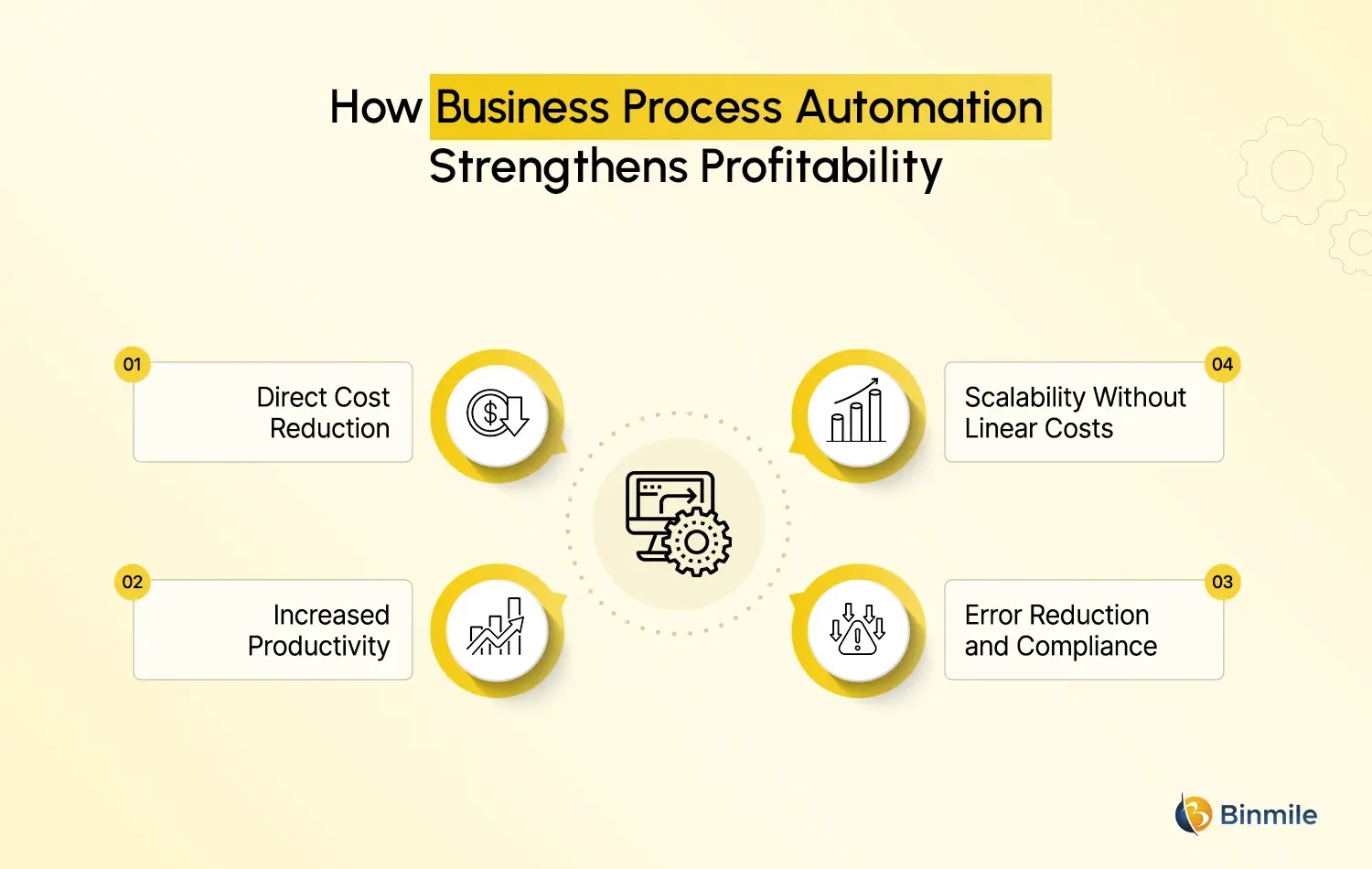
2. Increased Productivity
The productivity of employees is increased when the menial activities are automated. Strategically, this approach promotes the value of managing without increasing the number of employees in the organization. The value of automation is reflected in the speed of the cycles, the increased collaboration at all levels, and the enhanced service delivery. At the end of the approval processes within the systems, analysis, innovation, and customer engagement are reserved for the employees.
3. Error Reduction and Compliance
Manual error is associated with rework, regulatory non-compliance, and financial loss. BPA eliminates the risk of non-compliance from the systemic incorporation of standard operating procedures, automated compliance validation, and compliance audit trails. There are regulated industries, such as those where even slight alterations to accuracy improve the profitability and reputation of the institutions, hence the banking, health, and insurance ones.
4. Scalability Without Linear Costs
As businesses grow, manual operations require proportional increases in workforce and infrastructure. BPA allows scaling operations without matching cost growth. This is one reason the business process automation market continues to expand rapidly, driven by the need for efficiency at scale.
How to Measure ROI in Business Process Automation
Measuring ROI requires both quantitative and qualitative evaluation. Many companies make the mistake of looking only at cost savings. A structured approach gives a clearer and more reliable picture.
Key Metrics to Track
Below is a simplified framework for measuring ROI in automation:
| Metric | What It Measures | Impact on ROI |
|---|---|---|
| Cost Savings | Reduction in manual labor and errors | Direct financial return |
| Process Cycle Time | Time taken to complete a process | Faster revenue realization |
| Error Rate | Reduction in rework | Lower operational risk |
| Employee Productivity | Output per employee | Better resource utilization |
| Customer Satisfaction | Faster response and fewer mistakes | Revenue growth and retention |
What is the Step-by-Step ROI Calculation Approach
-
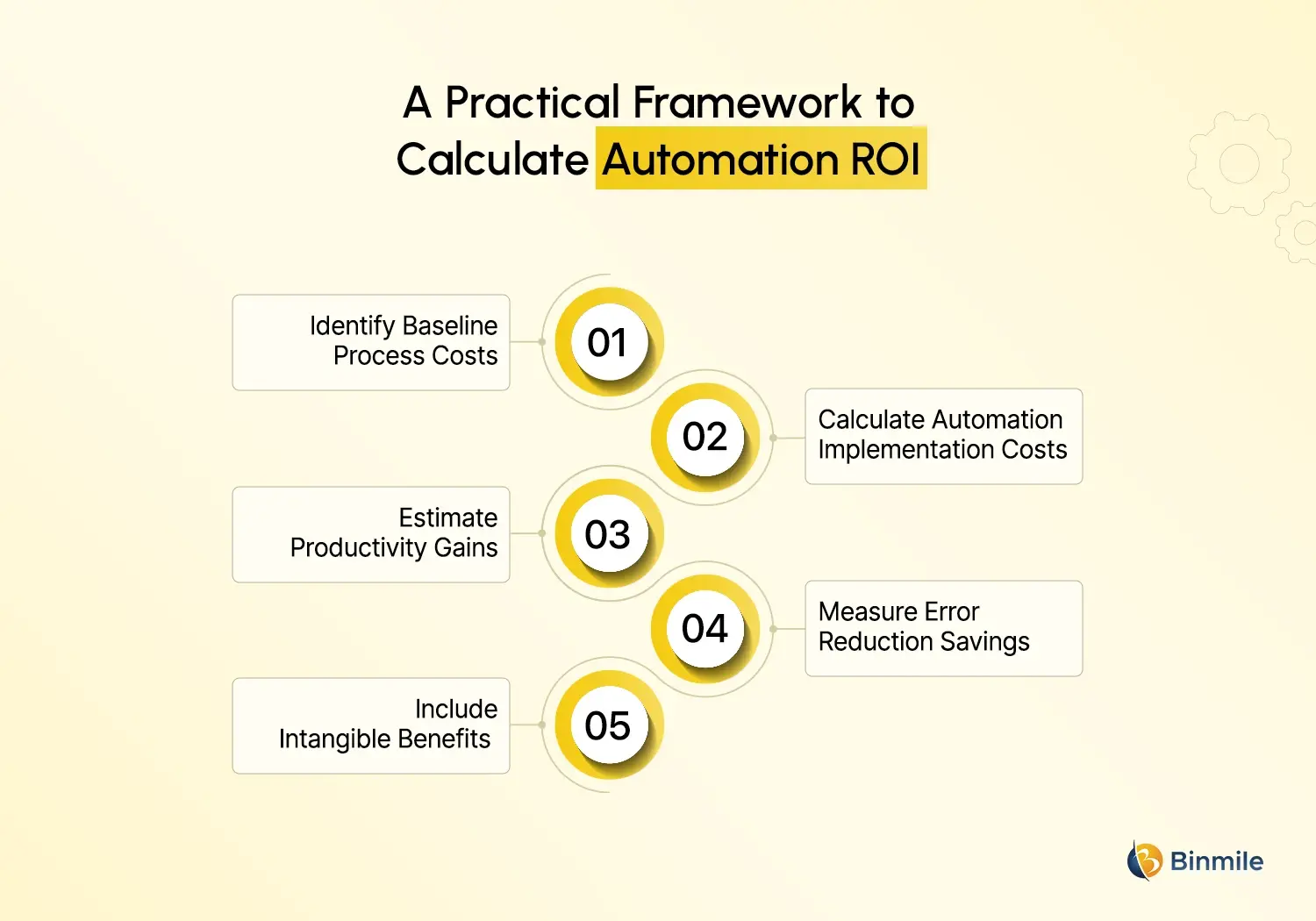
Identify Baseline Process Costs
Start by determining costs associated with employee time, mistakes that need correcting, penalties for non-compliance, delays, and opportunity costs. Without a baseline, measuring improvements will be guesswork.
-
Calculate Automation Implementation Costs
From the sale of software and its licensing to development and customization, integration, training, and ongoing maintenance, all of this should be calculated. Business process automation solutions will demand an initial investment ¡but knowing these variables will help improve the cost of potential ROI.
-
Estimate Productivity Gains
How much time do automated processes save employees? Converting saved time to a dollar amount is necessary, as well as determining if the expedited process increases revenue generation or improved quality of service.
-
Measure Error Reduction Savings
What are the savings attributable to the fewer mistakes? Fewer mistakes result in less rework, less need to compensate customers, lower penalties for non-compliance, and improved metrics.
-
Include Intangible Benefits
Enhancements to the customer’s experience will result in an improved brand image, improved morale among employees, and increased customer satisfaction. All of these will have an impact on the ROI over time.
Practical Business Process Automation Use Case Examples
Understanding real-world applications helps clarify value. Every business process automation use case demonstrates measurable ROI when properly implemented.
-
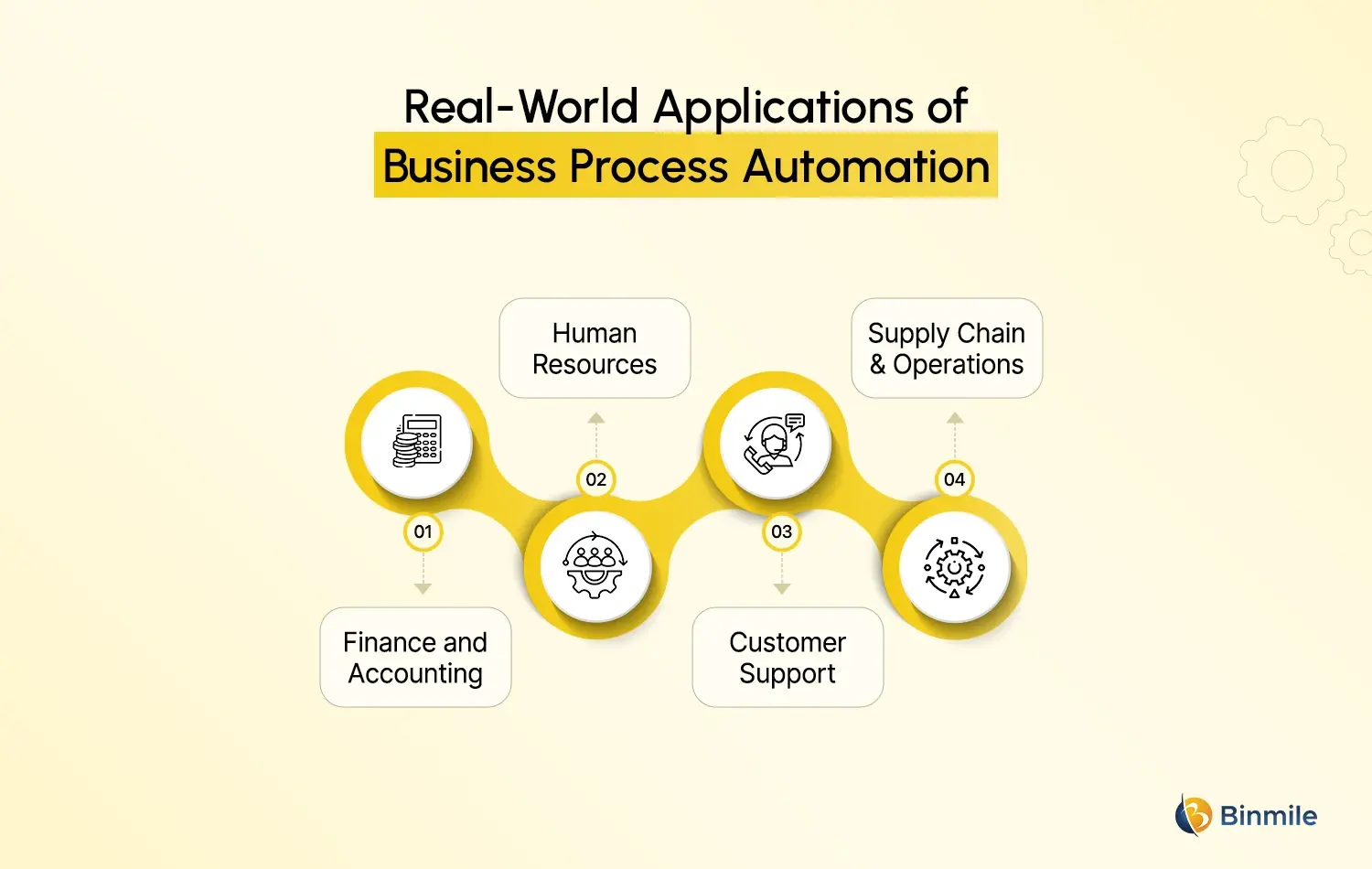
Finance and Accounting
Automated invoice processing removes manual data entry, instantly validates information, and automatically routes approvable information. Expense approval is now quicker and more transparent. Financial reporting is also quicker and more accurate. Improvements mentioned increase cash flow visibility while enhancing compliance and reducing processing time.
-
Human Resources
New Employee Onboarding documentation workflows minimize administrative delays and paperwork. Post Payroll processing is efficient, consistent, and error-free. As leave management units track requests, admin personnel can engage more and process paperwork less, as process automation software increases focus on that.
-
Customer Support
Based on priority and expertise, ticket assignments for query routing are automatic, and for frequently asked questions, chatbots are available for instant responses. Timely met service level goal tracking, improves response times, and directly increases retention and revenue.
-
Supply Chain and Operations
Order processing is now instant as a result of approval and validation automation. Defined rule roadblocks are fewer because procurement approval assignments follow set roadblocks. As process management automates real time synch of data, ERP management streamlines vendor processes.
Ready to integrate intelligent automation and AI into your core business processes?

What are the Challenges That Impact ROI
While BPA offers significant benefits of automation, organizations must address common challenges to achieve measurable returns. Not optimizing and documenting processes before automation leads to the automation of inefficiencies, loss of potential ROI, and the creation of additional bottlenecks. Process capture must be done before automation.
Secondly, Employees may be concerned about losing their jobs or may find it challenging to adjust to new processes. Insufficient communication and training can result in high resistance to new systems and tools, resulting in low adoption and high impacts on ROI as the systems are essentially unused.
Without KPIs, it is impossible to measure success. Before implementing process automation, organizations should measure expected outcomes such as reduced costs, decreased cycle times, and lower error rates. Furthermore, if a business process automation tool is not integrated with other ERP, CRM, or other enterprise automation systems, data silos will be created, and the business process automation tool will be underutilized.
A well-defined RPA implementation guide combined with a broader BPA strategy reduces these risks and ensures smoother deployment.
What are the Ways to Improve ROI Through BPA
Simply implementing tools does not guarantee results. Maximizing returns requires strategy, execution, and continuous optimization.
1. Start with High-Impact Processes
Repetitive, rules-based, and high-volume workflows are the biggest return opportunities in the shortest amount of time. These processes help improve the organization’s confidence in automation. Early success will help explain the automation and IT investment that will be made in the organization.
2. Combine BPA with AI and Machine Learning
Added to automation, artificial intelligence, and machine learning, develop greater accuracy and adaptability in automation. AI-powered test automation tools, for example, help to improve the quality of software by finding problems early and reducing the effort required for testing.
Agentic process automation tools facilitate and fully execute step-wise complex processes while reducing the need for human input and ensuring that decisions are made consistently. This increases the ROI of automation significantly.
3. Invest in Business Process Automation Consulting
Good business process automation consulting ensures that workflows are redesigned, not just digitized. Consultants analyze workflows, find gaps in the processes, and give recommendations for business process automation tools. They also work to align the automation process to specific business goals that can be measured.
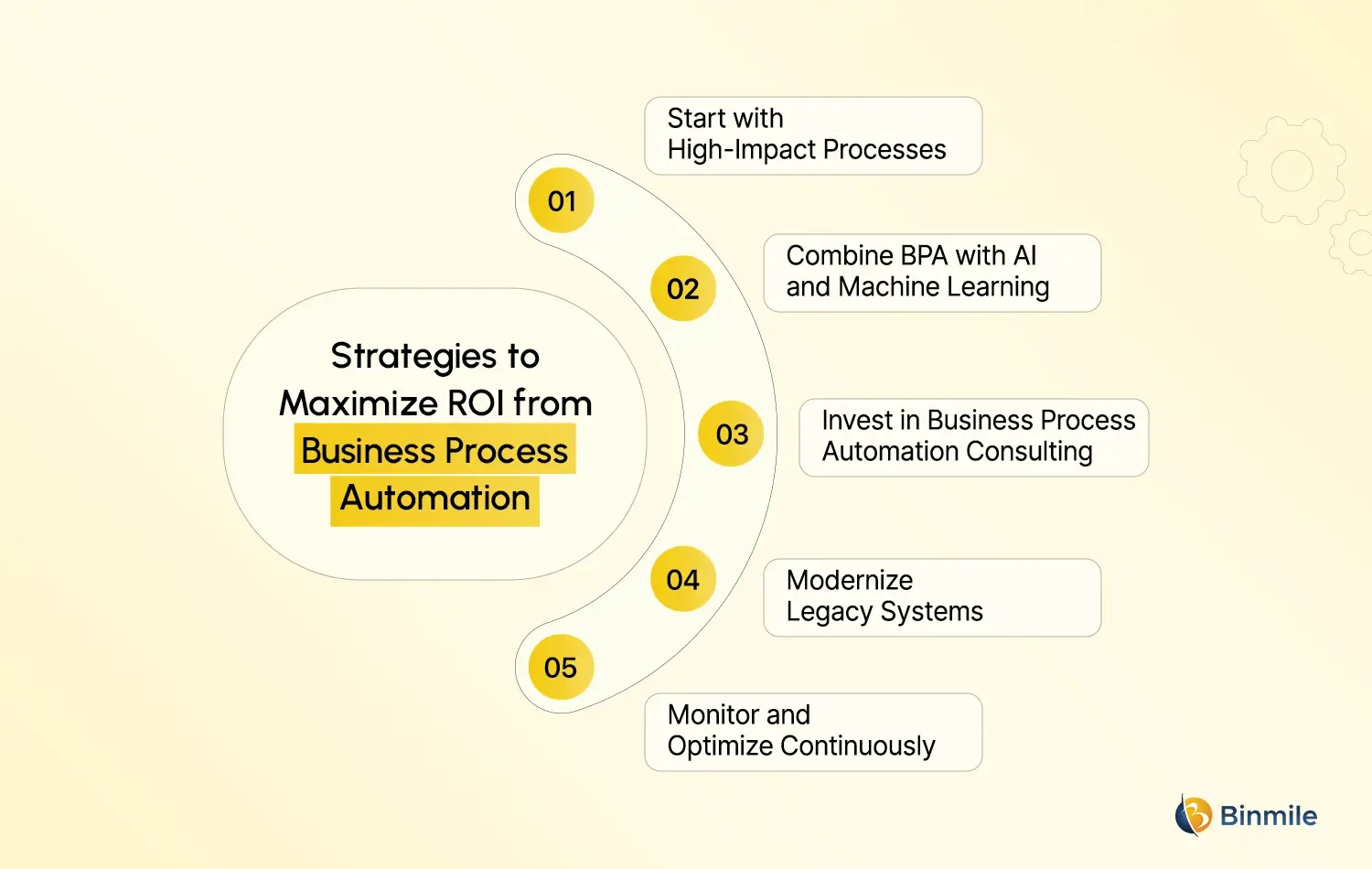
4. Modernize Legacy Systems
Legacy software modernization is important for the organization, but most people overlook the integration framework that is outdated. Systems that are integrated and modernized in the organization ensure that business automation can be used to its fullest.
5. Monitor and Optimize Continuously
Business process automation trends indicate a shift toward continuous improvement. Automation is not a one-time project. Regular audits, performance reviews, and workflow adjustments ensure processes remain aligned with evolving business needs.
Looking to streamline complex workflows and unlock measurable ROI through business process automation?

Delivering Long-Term Value with the Right Partner
Setting up automation solutions requires a lot more than just technological tools. Next-gen business automation requires careful evaluation of business objectives, strategy, and technology, or a combination of all three. Future-focused automation needs a well-thought-out road map that includes integration, technology selection, testing, and continuous improvement.
Binmile helps organizations develop high-potential business automation ecosystems that are intelligent and scalable and promote greater business process automation. Binmile offers intelligent process automation, AI and machine learning development, AI-test automation solutions, and complete business process automation software and business process automation solutions that deliver improved profitability, productivity, and long-term strategic positioning, all of which are aligned with the organization’s business objectives, not the technology.
Frequently Asked Questions
Automation consulting services identify high-impact processes, redesign workflows for efficiency, and ensure proper integration with existing systems. This reduces implementation errors, shortens deployment time, and helps organizations achieve measurable ROI in automation faster.
The timeline depends on process complexity, system integration, and organizational readiness. Simple workflows may take a few weeks, while enterprise-wide business process automation solutions can require several months for full implementation and optimization.
BPA focuses on end-to-end workflow redesign and process optimization. RPA automates specific tasks by mimicking human actions. RPA is often a component within broader business process automation initiatives.
Key business process automation trends include intelligent automation, AI integration, low-code platforms, cloud-based deployment, and hyperautomation strategies that combine multiple automation technologies for maximum efficiency.
BPA integrates with artificial intelligence development and machine learning development services to enable predictive decision-making, anomaly detection, and adaptive workflows that improve over time, increasing both accuracy and ROI.
High-volume, rule-based processes such as invoice processing, payroll, customer support ticket routing, compliance reporting, and procurement approvals typically deliver the highest ROI in automation due to cost reduction and productivity gains.