
Selecting the right tools for DevOps is no longer something businesses can postpone. The demand for faster releases, streamlined collaboration, and error-free deployments has pushed companies to rethink how they manage build, test, and delivery cycles. The global DevOps market size is expected to reach around USD 12.21 billion in 2026, reflecting strong growth as organizations continue to invest in automation, toolchains, and integrated workflows.
This blog will explore what DevOps automation tools are, why choosing the right ones matters, the key factors that influence selection, and how the right tools contribute to ROI and productivity. Toward the end, you will also learn how expert guidance can support businesses in making smarter tool choices and implementing them effectively.
Understanding What DevOps Automation Tools Really Are
DevOps automation tools are software solutions designed to reduce manual effort across the development and operations pipeline. They accomplish this by automating tasks that are done repeatedly, such as integrating the code, provisioning infrastructure, running tests, setting configurations, deploying applications, and monitoring. With proper use, these tools become the foundation of modern automation and allow teams to work faster, find issues earlier, and provide consistency across all environments.
These tools are built differently from one another for different use cases. Some, for example, are built around CI/CD, while others allow for the automation of tests, provide infrastructure as code, allow for cloud orchestration, provide security, monitoring, and manage containers. Even software testing in DevOps practices relies on automation tools to be integrated seamlessly.
In competitive environments, it is common for businesses to amalgamate tools to support different sections of the pipeline. For example, Terraform DevOps provides automation of infrastructure for workflows, while other tools in DevOps testing tools ensure that faults are detected early. Given the number of different categories and the number of options within those categories, selecting the ideal tools becomes a strategic rather than a simple software selection.
Key Factors to Consider When Selecting DevOps Automation Tools
Choosing the ideal tools for automation DevOps processes requires careful evaluation. Businesses need to look beyond popularity and focus on compatibility, scalability, efficiency, and long-term value.
Here are the most critical factors to consider:
1. Alignment with Your Current Technology Stack
Tools should work with current development languages, cloud environments, versioning control software, databases, and monitoring tools. An ill-suited tool becomes more of a bottleneck than a help.
2. Level of Automation Across the Pipeline
Tools should span the entire DevOps automation services lifecycle. Each of the stages in the pipeline should have automation settling in for the long haul: planning and coding, testing, deploying, and monitoring.
3. Scalability for Future Growth
Your company and its applications will change over time, and a tool that can keep pace is a good tool as long as it can scale seamlessly with growing demand, software intricacy, and team size. Tools that allow for containerization, microservices, and cloud scalability can be considered better.
4. Support for Infrastructure as Code
IaC is the norm. Terraform DevOps is a great tool that helps teams build reproducible environments and avoid configuration drift. Choose tools that adhere to the principles of IaC to help separate consistency across development, testing, and production.
5. Security and Compliance Capabilities
Modern automation tools should improve security, not introduce new security issues. Automated compliance checks, secrets management, vulnerability scanning, and policy enforcement are essential for modern automation.
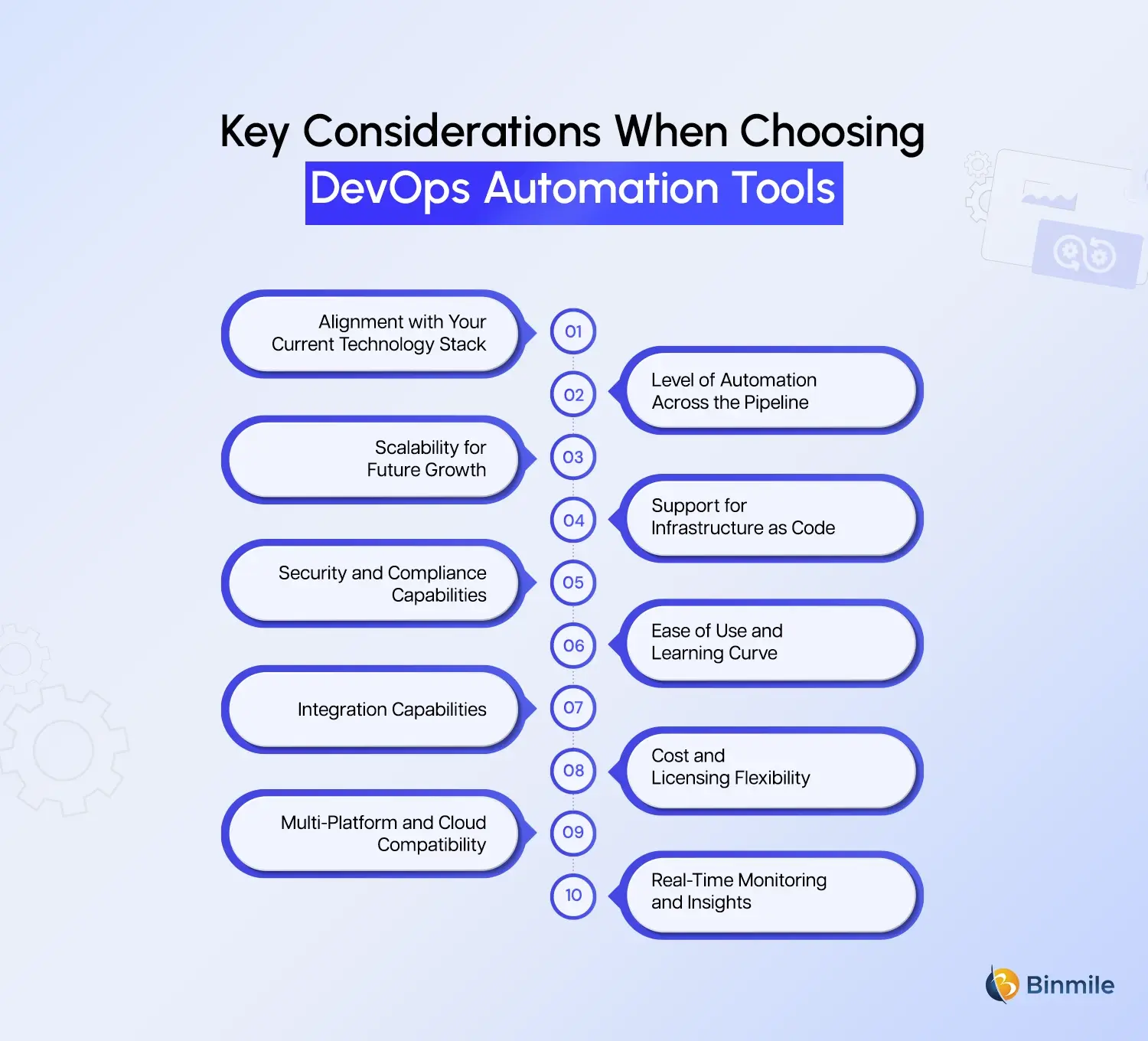
6. Ease of Use and Learning Curve
Your teams might be slowed down by tools that need complicated onboarding. Reduced training and onboarding time, as well as quicker adoption, can be achieved with a more simplified interface, robust documentation, and a proactive user community.
7. Integration Capabilities
DevOps relies on effortless integrations. Automation testing, configuration management, monitoring, and cloud services must be incorporated into CI/CD. A tool’s capacity to contribute to a unified ecosystem is a major consideration in decision-making.
8. Cost and Licensing Flexibility
While there can be no upfront cost with open source tools, paid ones usually have better features and enterprise support. Before making a decision, consider licensing, maintenance costs, training, support, and most importantly, the ROI.
9. Multi-Platform and Cloud Compatibility
Tools that function across platforms are essential for organizations employing hybrid or multi-cloud environments. For automation in multinational corporations, this is vital in DevOps.
10. Real-Time Monitoring and Insights
Effective monitoring lessens downtime and facilitates quicker resolutions of issues. Teams are provided with strong observability tools that provide comprehensive views of performance for this purpose.
Selecting tools based on these criteria ensures that businesses build a robust ecosystem that supports DevOps as a service and long-term digital maturity.
Why Choosing the Best DevOps Automation Tools Matters
In DevOps and automation, the software and applications used play a crucial role in determining the extent to which quality software can be delivered. When software and applications that are ill-suited or outdated are used, it can slow workflows considerably. There can be DevOps integration issues from the developers’ end, inoperable environments from the operations teams’ end, and slow work becomes the new normal.
On the other hand, the right automation tools in DevOps can:
- Improve deployment speed
- Reduce repetitive manual work
- Boost reliability and consistency
- Enhance collaboration between teams
- Strengthen cloud adoption efforts
- Lower long-term operational costs
DevOps and test automation also depend greatly on alignment. When a tool seamlessly integrates with the existing DevOps ecosystem, it complements and quickens the testing cycles while also minimizing the probability of defects entering production. The right automation accelerating environments for resource provisioning, monitoring, and scaling can be a huge plus for businesses adopting a hybrid and multi-cloud DevOps strategy.
As the use of tools becomes the basis for automation, digital transformation, and tool selection, the importance of tool selection becomes of utmost importance. If a company’s goal is to enjoy the many benefits of DevOps for automation with the goal of achieving continuous delivery, smooth operational flow, and minimal downtime, strategizing on tool selection must be the primary and foundational step.
Want to accelerate software delivery, reduce errors, and boost team productivity with the right DevOps tools?

How the Right DevOps Tools Boost ROI and Productivity
Good DevOps automation tools do more than streamline tasks. They also significantly impact business outcomes. When implemented correctly, these tools help reduce operational overhead, cut infrastructure costs, improve release quality, and enhance customer experience.
-
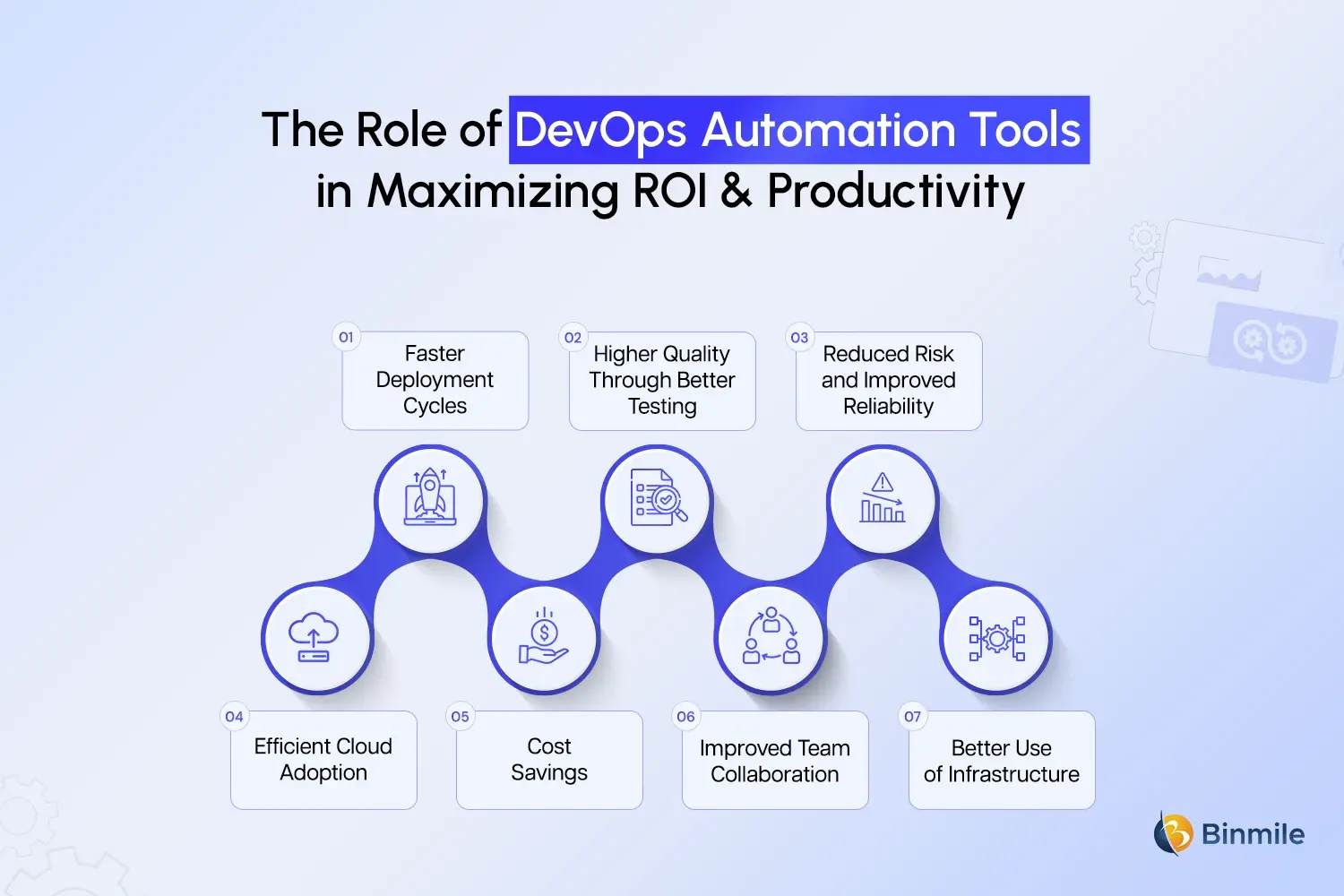
Faster Deployment Cycles
Automation enables the updating of system features without manual actions being performed by employees, thus enhancing the frequency of updates with incremental improvements. Additionally, this is a positive factor when considering the growing companies.
-
Higher Quality Through Better Testing
The improvement of the tests significantly reduces bugs. Additionally, provides higher quality and eventually increases ROI and productivity.
-
Reduced Risk and Improved Reliability
Automated pipelines ensure that each deployment is consistent with their process. In this way, they improve their human reliability and thus the predictability of errors during the demand.
-
Efficient Cloud Adoption
Automation provides configuration and scaling. With these, the transitions to the cloud and the management of the cloud are more efficient.
-
Cost Savings
Automation decreases the cost resulting from downtimes through repetitive work. Employees can thus fully concentrate on creating workflows that are more advanced.
-
Improved Team Collaboration
Automation provides better communication between the three, thus improving the time to solve a problem.
-
Better Use of Infrastructure
Tools that support IaC and containerization ensure that infrastructure is used efficiently. This reduces waste and ensures consistent environments across the pipeline.
Overall, businesses that invest in the right automation DevOps tools experience measurable improvements in both agility and operational efficiency.
Looking to streamline your DevOps processes and maximize ROI through automation?

How Expert Guidance Helps You Choose and Implement the Right Tools
Many businesses struggle with choosing the right DevOps automation tools because the ecosystem is vast, and every organization has unique requirements. This is where expert assistance becomes valuable. With the growing focus on DevOps consulting services, companies can get strategic guidance in evaluating tools based on workflows, scalability goals, team structure, and technology stack.
A knowledgeable implementation partner like Binmile can assess your current development and operational environment and help you plan and execute DevOps with clarity. Whether you need help in tool integration, infrastructure as code setup, CI/CD automation, or building pipelines for mobile DevOps, our experienced teams can build a tailored approach that aligns with your goals.
The team can also help businesses implement DevOps integration, enhance automation coverage, and select tools with the best long-term value. Additionally, build a strategy that fits cloud, hybrid, or on-premises environments. With the right support, companies can achieve strong DevOps performance and keep pace with emerging DevOps trends.
Organizations that partner with specialists gain the advantage of structured workflows, faster implementation cycles, and long-term operational maturity. This balanced combination of tools, strategy, and execution helps businesses unlock automation at scale and achieve continuous improvement across the software lifecycle.
Frequently Asked Questions
Any business aiming to improve the efficiency of delivering software, reduce the likelihood of manual errors, and improve cooperation between the development and operations teams should integrate DevOps automation tools to facilitate faster software releases, enhanced efficiency, and elevated quality of the product.
There is a wide spectrum of tools distributed in the DevOps automation space, which include but are not limited to CI/CD, version control, test automation, infrastructure automation, configuration management, monitoring, and container orchestration.
Because of the repetitive nature of certain tasks, automation tools are reducing the number of errors made in the process and providing standardized methods for deployment. Thus, the quality of software is improving, and the speed of delivery is accelerating, as code is getting tested and released.
These organizations should consider upgrading or substituting their tools if they experience any of the following scenarios: they have problems with integrations, there is a halt in the acceleration of their workflows, they lack in supporting cloud or hybrid environments, or they cannot scale with the growing demands of applications, all of which emphasize the importance of efficiency and optimization for the future.
These tools assist organizations with the adoption of a cloud system by automating the processes of allocating and managing infrastructure, maintaining uniform configurations, and deploying applications in different environments, thus allowing their teams to better control and scale the applications in a cloud or hybrid setting.
The primary beneficiaries of DevOps Automation tools are the sectors of finance, retail, healthcare, telecommunications, e-commerce, and information technology due to their demand for multi-functional applications that require rapid deployment and subsequent stable performance of the system, coupled with advanced security.