Augmented reality is no longer limited to gaming experiments or short-term marketing campaigns. It has evolved into a practical, business-driven technology that is actively reshaping how organizations operate and engage with users. According to Statista, the global augmented reality market is projected to surpass 1.19 billion by 2028, fueled by growing adoption across industries such as retail, education, healthcare, and manufacturing.
This expansion signifies a notable shift in how companies approach digital interaction. AR is currently influencing how businesses visualize complex data, how employees acquire skills, and how consumers explore products. This blog helps businesses understand how to create scalable AR-powered solutions in 2026 by delving deeply into augmented reality app development, covering everything from technologies and benefits to challenges, costs, and implementation strategies.
What is Augmented Reality App Development in 2026?
Augmented reality app development refers to the process of creating applications that overlay digital elements such as images, animations, text, or 3D models onto the real-world environment using a device camera. AR improves rather than replaces the real world, in contrast to virtual reality.
The development of AR applications has advanced considerably in 2026. These days, AR apps are not just visual overlays. They now incorporate real-time data synchronization, cloud-based processing, spatial computing, and artificial intelligence. However, this enables applications to recognize objects, comprehend physical environments, and react intelligently to user input.
Nowadays, companies that want to develop augmented reality apps prioritize performance, realism, scalability, and cross-platform compatibility. Additionally, AR apps need to provide consistent experiences across hardware ecosystems, whether they are used on smartphones, tablets, smart glasses, or business devices.
What are the Benefits of Investing in AR App Development?
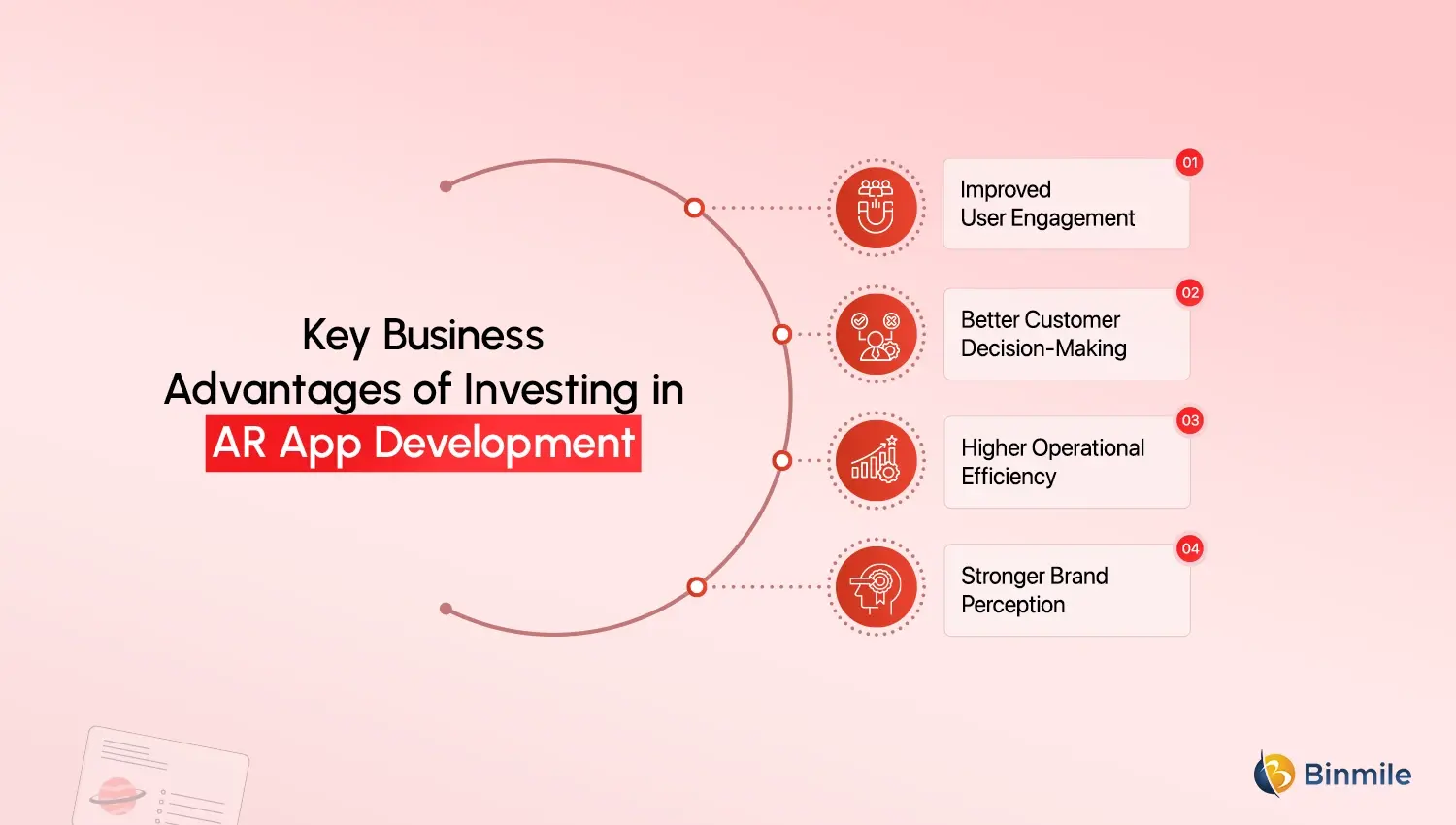
Investing in AR app development provides observable business benefits in a number of areas. Among the advantages are
-
Improved User Engagement
Developing AR applications helps to create immersive and interactive experiences. These apps offer real-time interactions and personalized visual stories that retain user attention longer than conventional apps.
-
Better Customer Decision-Making
With augmented reality applications, users can visualize products in their own environment. Augmented reality in retail and real estate helps reduce uncertainty and improve conversion rates.
-
Higher Operational Efficiency
Many businesses are using AR apps for remote assistance and training simulations. When employees are given contextual information in a hands-free manner, errors are reduced, and training cycles are completed more quickly.
-
Stronger Brand Perception
Investing in AR casts a business as innovative and ahead of the curve. Ensuring alignment between AR experiences and business goals can be achieved by partnering with expert AR app developers.
Which AR Technologies Shape the Future of App Development?
In 2026, a number of technologies are revolutionizing the development and implementation of augmented reality applications. These are a few of the technologies that will influence app development in the future.
-
Computer Vision as the Foundation
The computer vision of an AR app helps to identify surfaces, recognize objects, and monitor movements in real time. Further, computer vision safeguards the proper digital overlaying of the augmented objects.
-
Cloud-based AR Processing
Cloud-enabled AR removes the processor-demanding AR functions from the users’ devices, and these processor-demanding functions become the remote servers’ responsibility. This cloud feature broadens the accessibility of advanced AR devices to multiple users.
-
AR & Cloud Vision API Integration
These AR & Cloud Vision APIs provide the functionality of real-time object identification, text reading, understanding of the environment’s geolocation and spatial context, therefore providing the AR users with a more intelligent and situationally aware experience.
-
Artificial Intelligence for Personalization
The integration of Artificial Intelligence in AR application development helps to provide the personalization of content by adapting to users’ actions, geolocation, and preferences. Additionally, by adapting, it fosters a more focused and engaging experience in AR.
-
Metaverse-driven AR Experiences
The development of AR applications is influenced by the metaverse vision, which is the fusion of augmented reality with persistent digital layers, and augmented reality allows businesses to create a networked and immersive AR ecosystem.
Planning your next-gen digital experience with AR at its core to bring your vision to life?
How to Start an AR App Development Project in 2026?
From conception to post-launch support, developing an Augmented Reality (AR) app requires a methodical process. For a project in 2026, the essential steps to create an AR app are:
Step 1: Define Project Strategy and Goals
Define the aim of your app, the issues it addresses, and the audience it focuses on. Perform diligent market research and competitor analysis to develop unique selling points (USP) and possible monetization methods like in-app purchases, subscriptions, and ads. Establish distinct Key Performance Indicators (KPIs) to quantify success.
Step 2: Choose the Right Technology Stack and Platform
Choose the necessary AR development tools and SDKs relative to the app’s needs and targeted platforms (iOS, Android, or cross-platform). For native development, Apple’s ARKit iOS and Google’s ARCore Android can provide better performance and greater proximity to particular device features. For faster cross-platform development, AR Foundation with Unity and C# or the Unreal Engine can be used, but native builds often outperform others. In tandem with these, the use of AWS or Google Cloud to configure a strong backend and cloud infrastructure is vital for the management of data and 3D assets, as well as other scalability needs.
Step 3: Design the User Experience (UX) and User Interface (UI)
Strive for an intelligent and immersive experience that combines both the physical and digital environments. Use wireframes and prototypes to determine user journeys and depict various user actions through the use of voice and gesture. Additionally, smooth performance will depend on the use of quality 3D models and animations. Accessibility features such as adaptable interfaces and haptic feedback will guarantee that the use of the technology is inclusive.
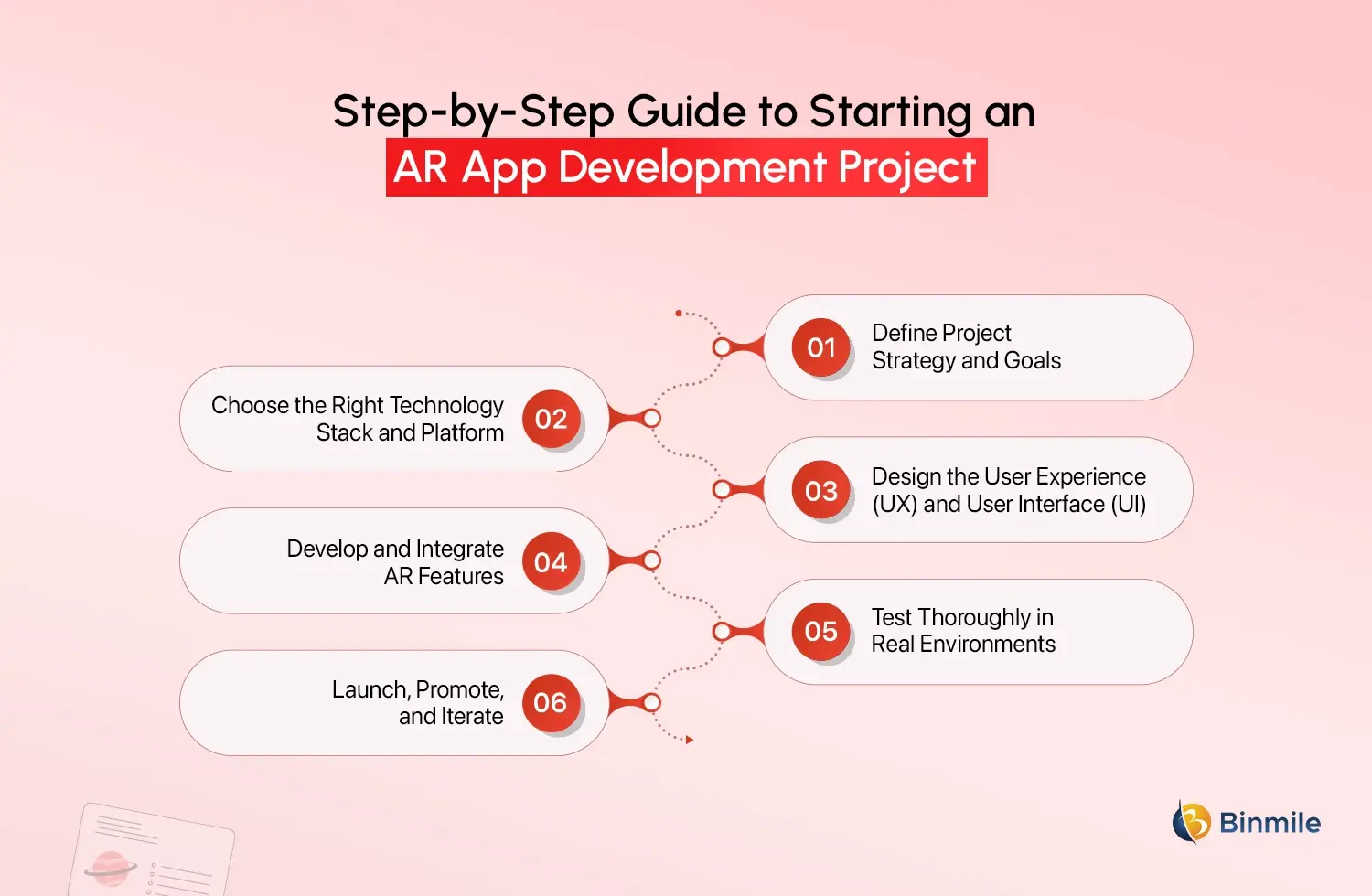
Step 4: Develop and Integrate AR Features
Writing the core AR code and incorporating features such as real-time 3D rendering, object tracking, and surface detection commences this step. Additionally, AI and personalization will be necessary to remain among the leaders by 2026, for improvements to be made in object recognition.
Step 5: Test Thoroughly in Real Environments
Standard app testing will not meet the bar when trying to evaluate the product. Real-world testing must be comprehensive to identify and correct bugs and performance issues. This is particularly around tracking and movements. Use the target audience for beta testing to gather insightful feedback about the experience and usability of the app.
Step 6: Launch, Promote, and Iterate
Prepare your app for submission to the Apple App Store and Google Play Store by optimizing your listing with compelling descriptions and demo videos. Post-launch, use analytics tools to monitor performance metrics (downloads, user engagement, retention) and gather user feedback to plan future updates and improvements. Continuous iteration is key to long-term success.
Challenges in Augmented Reality App Development
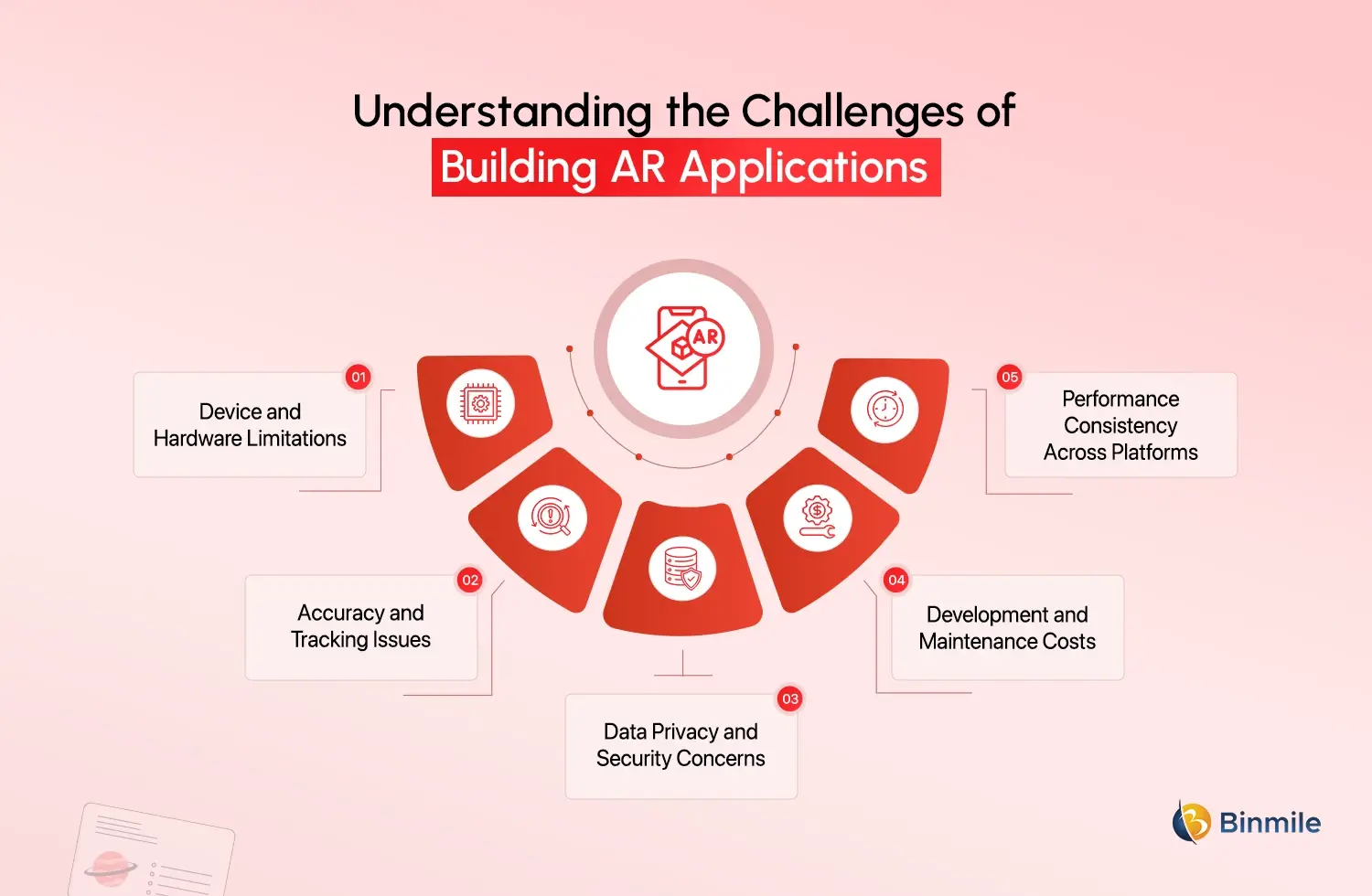
Despite its advantages, augmented reality app development comes with challenges. Some of the crucial challenges of how to build an AR app are mentioned below-
-
Device and Hardware Limitations
Device performance varies, and older smartphones or low-end hardware may have difficulty with rendering and tracking in real time, requiring more optimization.
-
Accuracy and Tracking Issues
Broken immersion from inaccurate object detection and tracking instabilities can be severe. Alignment of digital and real-world objects must be rigorously tested and calibrated.
-
Data Privacy and Security Concerns
Most AR apps involve the use of the camera, location data, and environmental scans, making it pivotal to secure and comply with data privacy laws.
-
Development and Maintenance Costs
App development in augmented reality can be complex and have a higher AR app development cost, depending on the features, integrations, and sustained support. Further, a lack of planning can escalate things quickly.
-
Performance Consistency Across Platforms
Achieving a consistent performance in AR across separate operating systems and devices is an additional complication and expense during the development and testing processes.
Looking to turn immersive AR ideas into real-world business impact to explore scalable AR app development solutions.

Moving Forward With the Right AR Development Approach
Success depends on more than just implementing new technology as augmented reality continues to transform how companies engage with clients and staff. It calls for careful execution, technical accuracy, and a thorough comprehension of user behavior.
Businesses that collaborate with seasoned engineering teams benefit from scalable delivery models, cross-industry insights, and organized augmented reality app development services. Binmile’s strategy supports businesses in app development, custom software development, and immersive digital solutions without interfering with current workflows by coordinating technical innovation with business objectives.
Businesses can confidently develop an augmented reality app that adapts to shifting market demands and technological breakthroughs by concentrating on usability, performance, and long-term value.
Frequently Asked Questions
The timeline depends on complexity, features, and platform requirements. A basic AR app may take three to four months, while enterprise-grade solutions with integrations and advanced interactions can take six months or more.
Businesses should consider AR when customer engagement plateaus, training costs rise, or product visualization becomes critical. AR-powered solutions are especially valuable when digital experiences need stronger real-world interaction.
Retail, education, healthcare, manufacturing, real estate, and marketing benefit significantly. AR improves visualization, training, customer interaction, and operational efficiency across these sectors.
Costs vary based on app complexity, platform, features, and integrations. Simple AR apps cost less, while enterprise solutions with cloud, AI, and analytics require a higher investment.
An experienced partner brings technical expertise, industry insight, and structured execution. They help define strategy, manage development challenges, optimize performance, and ensure long-term scalability.
AR app development enhances customer experience by making interactions more engaging and interactive. It allows users to visualize products, access real-time information, and interact with digital elements in real environments, leading to better understanding, higher confidence, and more satisfying user journeys.