Enterprise leaders are no longer asking whether artificial intelligence will reshape their industries. They are deciding how quickly they can adapt before competitors do. According to McKinsey’s global survey, companies that successfully embed AI into their core operations are already seeing a 12-to-14-percentage-point increase in EBITDA, while those delaying adoption struggle to keep pace.
The urgency around AI transformation is not driven by hype but by results. From faster decision-making to intelligent automation and personalized customer experiences, AI is redefining how modern enterprises operate. This blog explores what AI transformation really means, how it differs from traditional digital transformation, why it has become critical in 2026, the components that make it successful, the challenges enterprises face, and where real-world impact is already visible.
What is AI Transformation?
AI transformation refers to the strategic integration of artificial intelligence across enterprise systems, processes, and decision frameworks to drive measurable business outcomes. It goes beyond adopting isolated AI tools and focuses on reshaping how organizations think, operate, and scale.
At its core, artificial intelligence transformation enables enterprises to move from reactive operations to predictive and autonomous systems. Instead of relying solely on historical data and manual analysis, businesses leverage AI-driven digital transformation to uncover patterns, forecast outcomes, and automate complex workflows.
AI digital transformation services often include data engineering, machine learning models, intelligent automation, and AI-powered applications that evolve continuously as they learn from new data. This approach allows enterprises to stay adaptive rather than static in fast-changing markets.
Understanding AI Transformation vs Digital Transformation
Digital transformation laid the foundation for modern enterprises by digitizing processes and systems. AI transformation builds on that foundation and takes it further by adding intelligence to every layer of the organization.
| Aspect | Digital Transformation | AI Transformation |
|---|---|---|
| Primary Focus | Converts manual and legacy processes into digital workflows to improve efficiency and accessibility | Embeds intelligence into digital systems so they can learn, adapt, and improve outcomes over time |
| Decision Making | Based on predefined rules, dashboards, and human interpretation of data | Driven by machine learning models that analyze patterns, predict outcomes, and recommend or take actions |
| Automation | Automates repetitive tasks using fixed logic and workflows | Uses adaptive automation that evolves based on data, context, and changing conditions |
| Customer Experience | Delivers consistent experiences across channels | Creates personalized, contextual, and predictive experiences in real time |
| Scalability | Scales linearly with infrastructure and workforce | Scales exponentially as models improve with more data and usage |
Digital transformation with AI allows enterprises to go beyond operational efficiency. While digital tools help businesses move faster, AI transformations enable them to make better decisions, anticipate change, and continuously optimize performance.
Why AI Transformation Matters More in 2026
Several forces have converged to make 2026 a turning point for enterprise AI adoption. Market volatility, rising customer expectations, and data explosion have made traditional models insufficient.
AI business transformation matters now because enterprises are dealing with complexity at a scale humans alone cannot manage. AI strategy helps organizations extract value from vast data ecosystems, improve resilience, and unlock new revenue models.
Key reasons enterprises are investing now include competitive pressure from AI-native companies that operate with lower costs and higher agility, growing availability of enterprise-grade AI platforms and AI transformation apps, maturity of generative AI in digital product development, and rising demand for real-time personalization and predictive AI transformation services
Enterprises that delay artificial intelligence digital transformation risk being outperformed by faster, more adaptive competitors.
What are the Key Components of a Successful AI Transformation Strategy
AI transformation does not succeed through technology alone. It requires alignment between people, processes, and platforms.
1. Data as the Foundation
AI in enterprises relies on clean, structured, and accessible data. Most enterprises struggle not because of weak algorithms but because of fragmented data spread across systems. Successful AI transformation starts with unifying data, improving data quality, and defining governance models that ensure reliability and compliance.
2. Clear AI Strategy
An effective AI transformation strategy connects AI initiatives directly to business outcomes. Instead of running disconnected experiments, enterprises identify where AI can solve real problems, reduce costs, increase revenue, or improve customer experience. This clarity ensures faster adoption and measurable ROI.
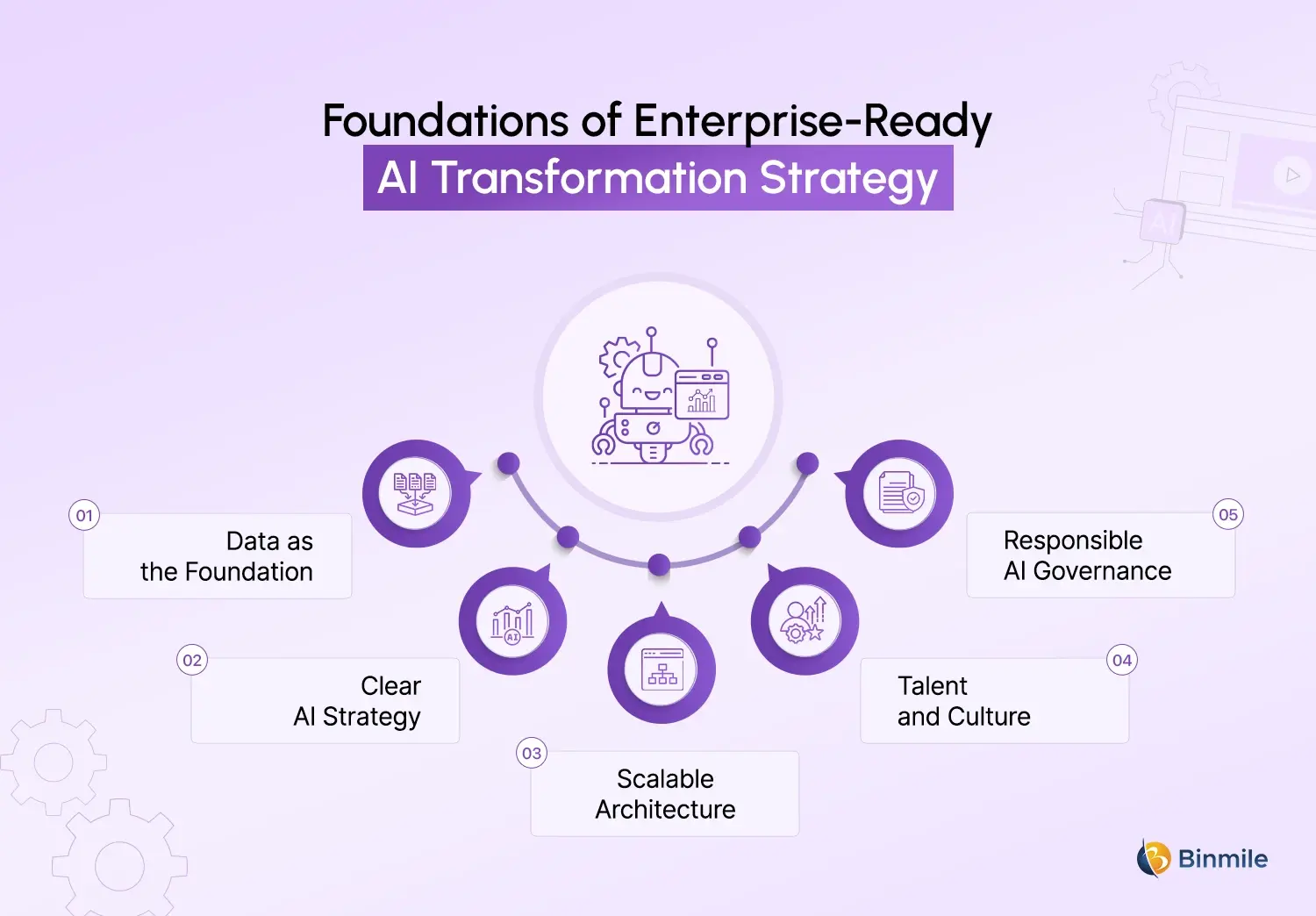
3. Scalable Architecture
Enterprise AI transformation requires flexible and scalable infrastructure. Cloud-native environments, modular architectures, and API-driven systems allow AI solutions to integrate with existing platforms and scale without disrupting ongoing operations.
4. Talent and Culture
AI transformation is as much about people as it is about technology. Data scientists, engineers, domain experts, and business leaders must collaborate closely. Equally important is fostering a culture that encourages experimentation, learning, and trust in AI-driven insights.
5. Responsible AI Governance
As AI systems influence critical decisions, enterprises must ensure transparency, security, and ethical usage. Responsible governance frameworks help manage bias, data privacy, and regulatory compliance, especially in industries such as finance, healthcare, and payments.
Need an AI-driven enterprise solution that scales with your business and delivers measurable outcomes?

What are the Challenges Enterprises Face During AI Transformation
Despite its potential, AI transformation is not always easy to scale across large enterprises. Many organizations begin with pilot projects that show promise but struggle to turn them into enterprise-wide initiatives. One of the primary reasons is fragmented data. When information is spread across multiple systems and departments, AI models lack the consistency and quality needed to deliver reliable insights.
Another common challenge is the absence of clear ROI and success metrics. Without well-defined objectives, it becomes difficult to measure the real impact of AI initiatives or justify continued investment. Integration with legacy enterprise systems further complicates progress, as older platforms are often not designed to support AI workloads or real-time data processing.
Skills gaps also slow adoption. Many enterprises lack experienced AI professionals or cross-functional teams that can effectively translate business needs into scalable AI solutions. In addition, security, privacy, and regulatory concerns create hesitation, especially when AI systems handle sensitive data.
Enterprises that address these challenges early tend to see better results. A structured approach that focuses on data readiness, clear business alignment, phased implementation, and strong governance helps reduce risk. With the right foundation in place, AI transformation becomes a sustainable driver of efficiency, innovation, and long-term competitive advantage.
How AI is Transforming Enterprise Functions
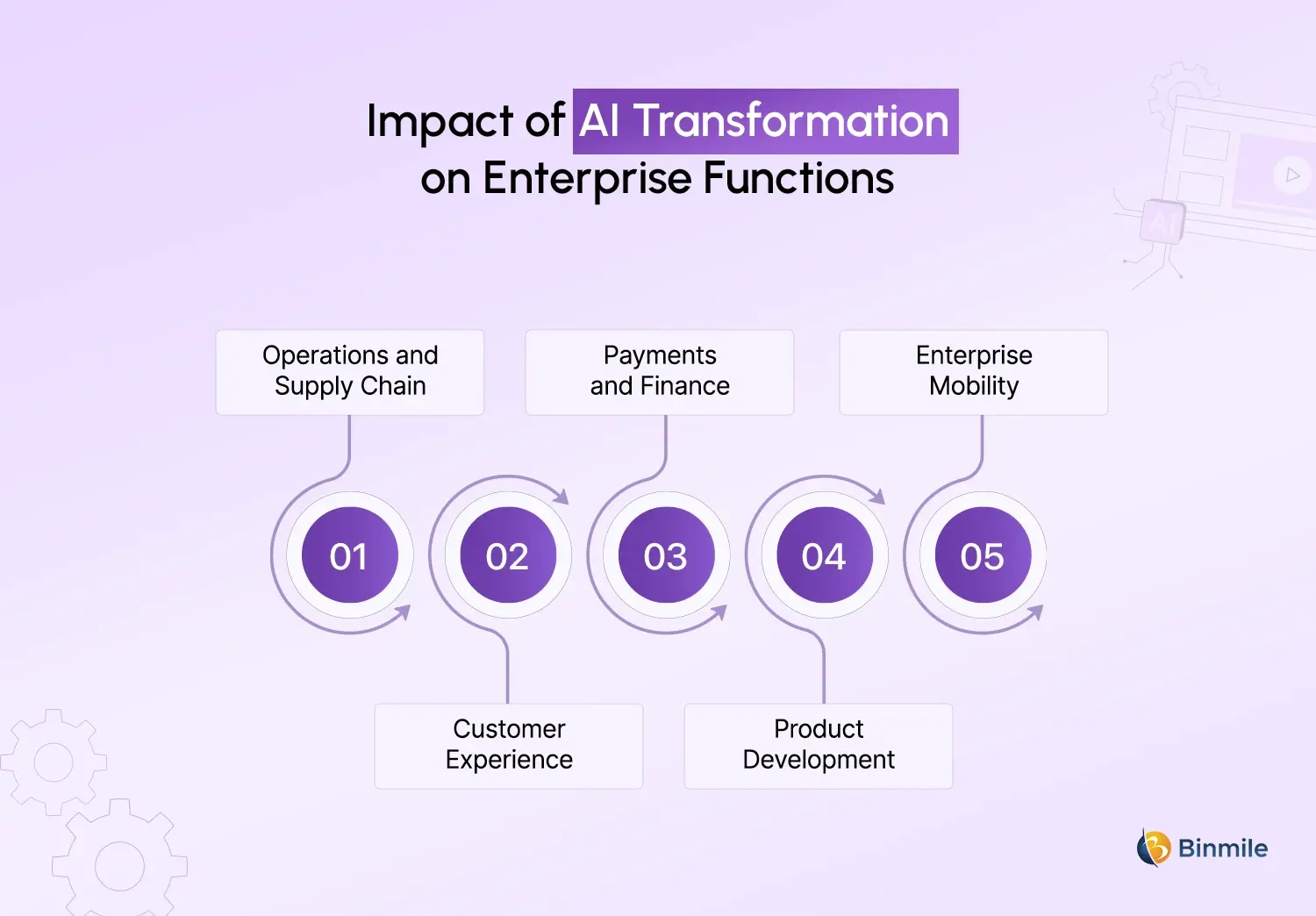
AI transforming industries is no longer theoretical. Enterprises across sectors are seeing tangible results.
-
Operations and Supply Chain
AI-driven digital transformation enables predictive maintenance by identifying equipment issues before failures occur. Demand forecasting models analyze market trends and historical data to optimize inventory levels, reduce waste, and improve supply chain resilience.
-
Customer Experience
AI customer experience solutions analyze customer behavior across touchpoints to deliver personalized interactions. Intelligent chatbots, recommendation engines, and sentiment analysis tools allow enterprises to respond faster and build stronger customer relationships.
-
Payments and Finance
AI transformation in payments improves fraud detection, credit scoring, and transaction monitoring. Machine learning models detect unusual patterns in real time, reducing financial risk while maintaining seamless customer experiences.
-
Product Development
Generative AI in digital product development accelerates idea validation, feature design, and testing. Enterprises can experiment faster, reduce development cycles, and launch smarter, data-informed products.
-
Enterprise Mobility
AI transformation apps integrated into enterprise mobile app development solutions provide employees with real-time insights, predictive alerts, and decision support, improving productivity and responsiveness across teams.
What are the Use Cases That Demonstrate Real Business Impact
AI transformation delivers value when applied to real-world problems.
-
Intelligent Document Processing
Enterprises in compliance-heavy industries use AI to automatically extract, classify, and validate documents, reducing manual effort and processing time significantly.
-
AI-powered CRM Systems
Machine learning models analyze customer behavior to predict churn, identify upsell opportunities, and recommend next-best actions for sales and support teams.

-
Advanced Analytics for Leadership
Smart analytics platforms aggregate enterprise data and provide predictive insights that help executives make faster, more informed strategic decisions.
-
Autonomous IT Operations
AI-driven IT systems monitor infrastructure, detect anomalies, and resolve issues proactively, minimizing downtime and improving system reliability.
These use cases show how artificial intelligence-as-a-service moves beyond efficiency to strategic advantage.
Looking to modernize your enterprise systems with intelligent automation and AI-powered insights?

Why Enterprises Are Choosing Strategic AI Partners
AI transformation is complex, especially for organizations with legacy systems and global operations. Enterprises increasingly rely on partners that understand both technology and business context.
This is where organizations like Binmile quietly support enterprise AI transformation by aligning AI initiatives with real operational needs. Through experience in enterprise software development company practices, AI development company expertise, and digital transformation in business, such partnerships help enterprises move from experimentation to execution without disruption.
Rather than pushing technology for its own sake, the focus remains on building AI capabilities that scale, integrate seamlessly, and deliver measurable outcomes across enterprise functions.
Frequently Asked Questions
Data is the backbone of AI transformation. Clean, unified, and well-governed data enables accurate models, reliable insights, and scalable AI solutions. Without strong data foundations, even advanced AI technologies fail to deliver value.
The right time is when data volume, operational complexity, and competitive pressure begin limiting growth. In 2026, most enterprises already meet these conditions, making AI transformation a strategic necessity rather than an optional upgrade.
AI transformation enhances customer experience through personalization, faster responses, and predictive support. AI systems analyze behavior in real time, enabling enterprises to deliver relevant, consistent, and proactive interactions across digital touchpoints.
Key risks include poor data quality, unclear business objectives, talent gaps, and weak governance. Enterprises must also address security and ethical considerations to maintain trust while scaling AI across critical operations.
AI transformation can deliver quick wins through automation and analytics, but its full value emerges over time. Enterprises benefit most when AI is treated as a long-term capability integrated into core business strategy.
The four types include reactive machines, limited memory AI, theory of mind AI, and self-aware AI. Most enterprise applications today rely on limited memory AI, which learns from historical data to make informed decisions.
Operations, customer service, finance, product development, and IT benefit significantly. AI in enterprises improves efficiency, decision-making, and scalability across these functions, creating organization-wide impact.