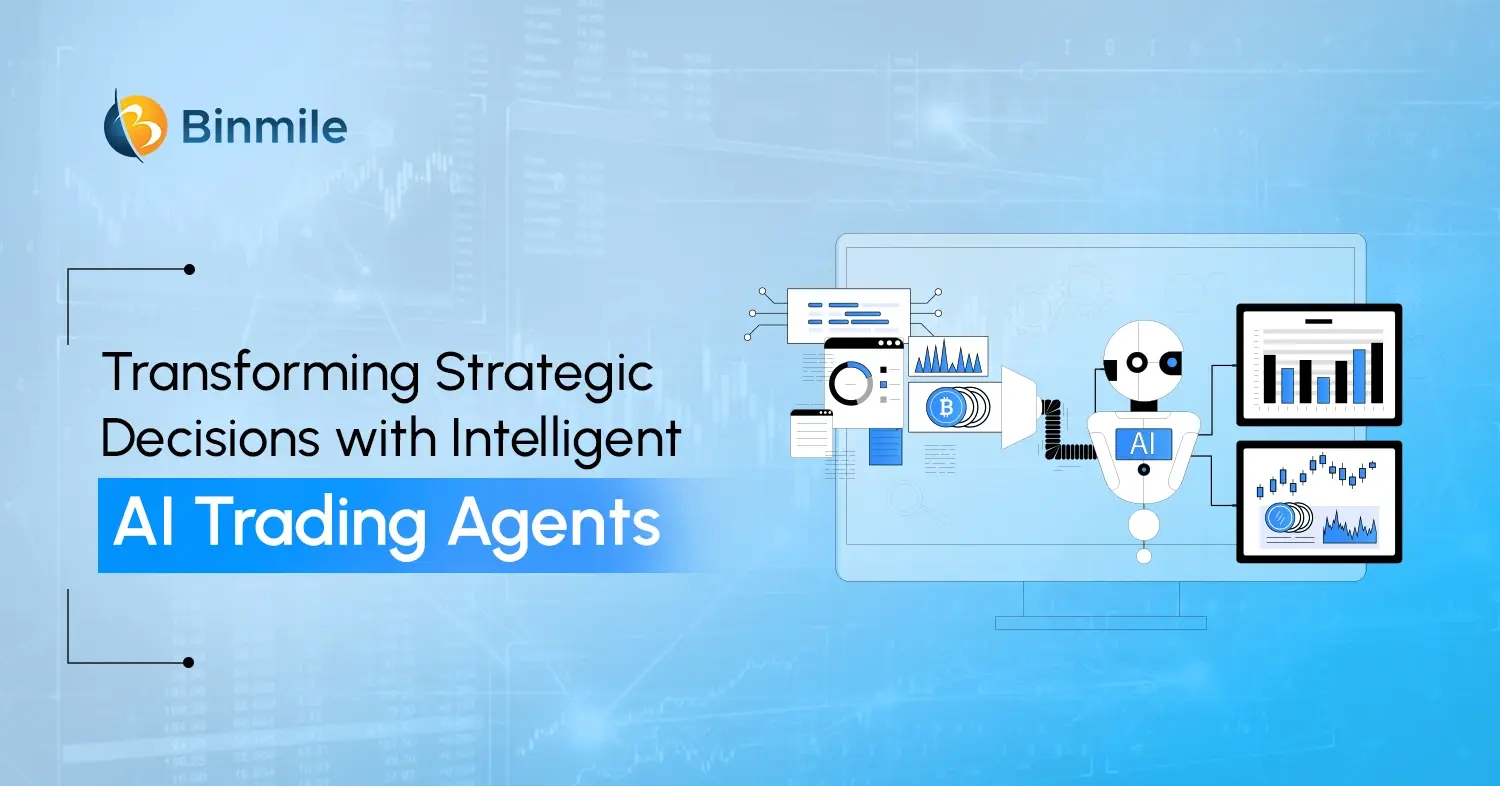
Analyzing data fast enough to make effective trades is extremely difficult. Social emotions, price changes, company earnings, news reports, and other global factors present complex challenges that must be understood and acted upon in seconds. According to a report by Grand View Research, the global artificial intelligence market size is projected to grow at a CAGR of 30.6% from 2026 to 2033. A large part of this growth is attributed to AI in finance, specifically trading and investment management. Because of this, AI trading agents are becoming more and more useful, changing how financial choices are made and how those financial choices are executed and fine-tuned.
In this blog, we define what AI trading agents are, their importance, and the challenges they alleviate for traders. We will discuss the various technological components that make these agents work. Additionally, we will examine the various use cases and benefits of AI trading as well as the challenges of implementing these agents. We will conclude this article by looking at how organizations can best implement AI trading technologies.
What are AI Trading Agents?
AI trading agents are a type of AI software program that analyzes market data for trading opportunities and makes trades automatically, semi-automatically, or inspires a human trader to make a trade. AI trading agents are different from traditional systems that are rule-based because they learn from both historical and real-time data and improve their trading strategies over time.
An intelligent agent in AI is defined as a system that observes and acts on an environment, processes the data in that environment, and acts in a way that furthers the attainment of some defined goal. Additionally, for trading, stock market prices, economic indicators, trading volumes, news, and even the mood of the market on social media are part of the environment.
AI trading agents can act as autonomous trading agents who are allowed to trade freely according to their defined objectives, as decision-support agents who provide information and trade forecasts to human traders, or as risk-tracking agents who monitor exposure and volatility to determine risk.
AI trading agents are widely accessible to retail investors because they can be used in AI trading apps and AI stock trading apps that provide sophisticated AI in algorithmic trading functionality.
What are the Common Trading Challenges Without AI Trading Agents
Before understanding how AI trading agents improve trading decisions, it is important to examine the limitations of traditional trading approaches.
1. Emotional Bias
Fear and greed affect the trading decisions. In fact, even veteran traders can panic in a bearish market and become extremely confident in a bullish market.
2. Limited Data Processing
Individual hand traders can only analyze a fraction of the available indicators at a given moment. In contrast, the influence of markets encompasses both structured data (e.g., price charts) and unstructured data (e.g., news articles and social media).
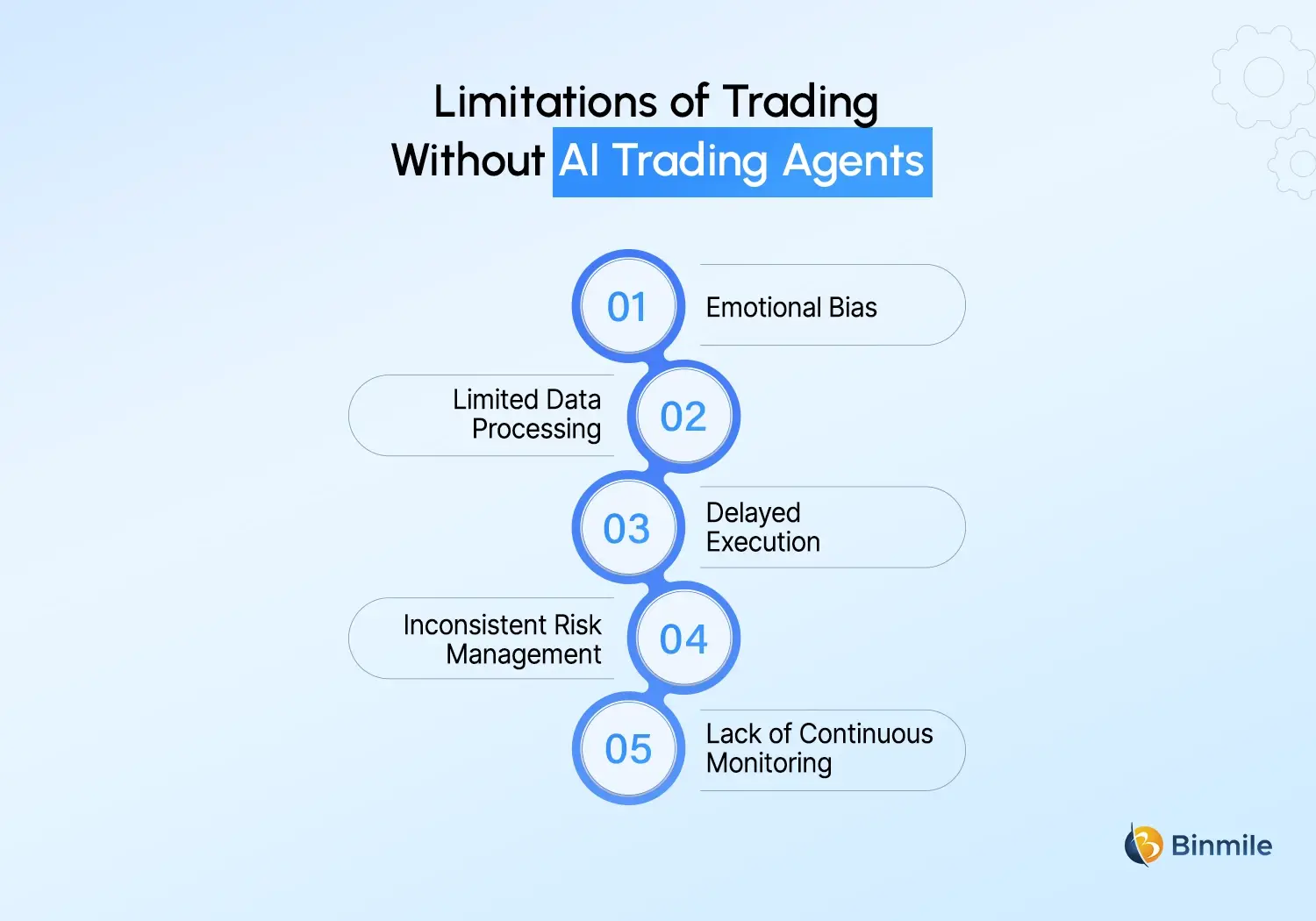
3. Delayed Execution
Order execution speed is negatively impacted by human manual trading. In high-frequency trading, even a handful of milliseconds can mean the difference between profit and loss.
4. Inconsistent Risk Management
Without the systems in place for AI trading, hands-off risk management systems can allow exposure levels to surpass the threshold anywhere in the extreme of volatile markets.
5. Lack of Continuous Monitoring
The trading market is geographically distributed and runs on separate time zones. Therefore, it is not practical to monitor cover markets on a dual basis.
Additionally, these challenges highlight why AI trading agents have become a priority for financial institutions and fintech startups.
How AI Trading Agents Improve Trading Decisions
AI trading agents transform trading by combining predictive analytics, automation, and adaptive learning. Here is how they make a measurable difference.
-
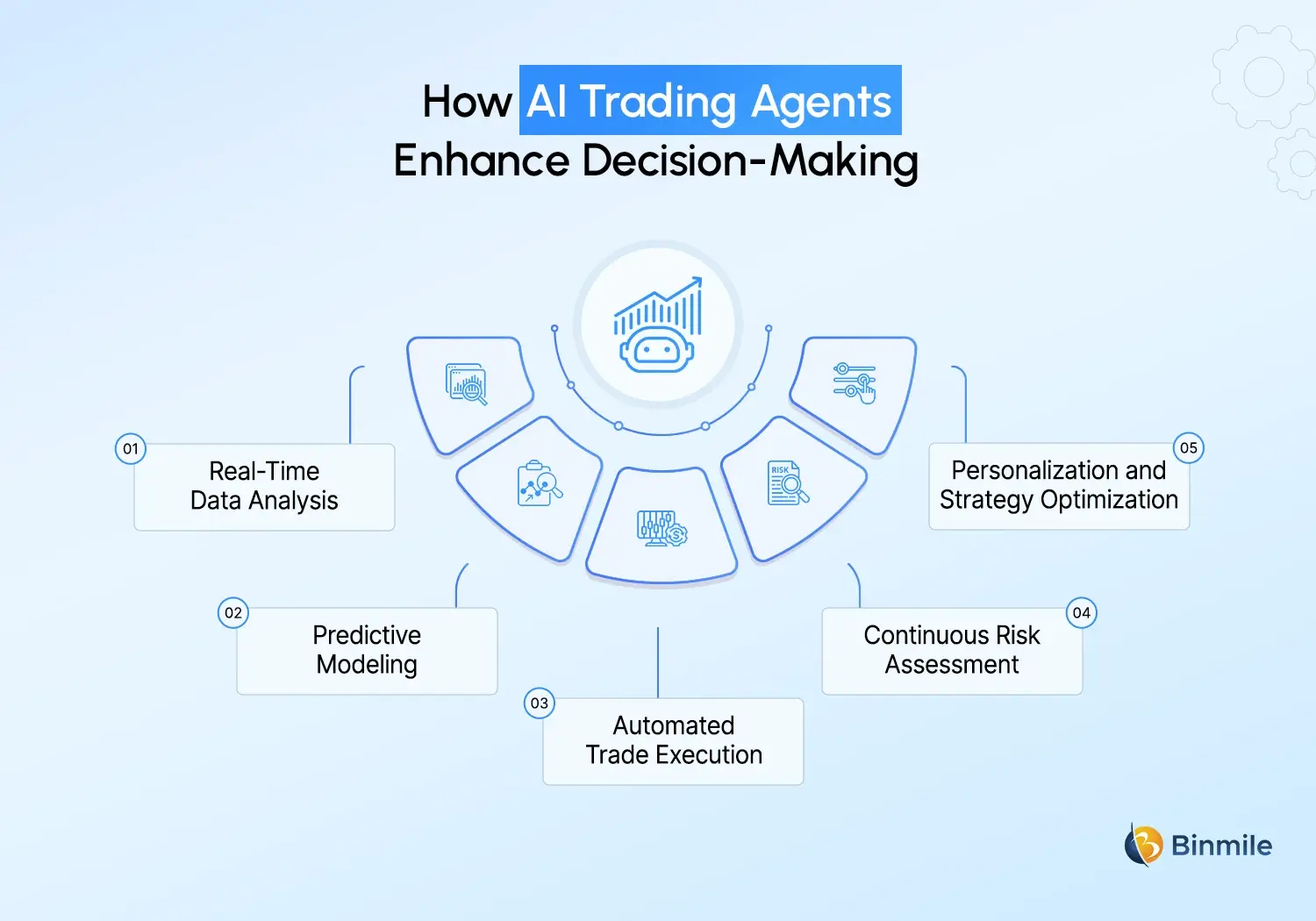
Real-Time Data Analysis
The AI-powered trading agents can analyze and process large amounts of data that can either be structured or unstructured in real-time. In addition to this, they can evaluate information from various historical price data, several indicators of the market, both fundamental and technical, economic, and even news sentiments. Additionally, by analyzing historical price data, news, and sentiment, they gain a comprehensive understanding of market conditions and a competitive edge in trading.
Additionally, the trading agents also use advanced algorithms to analyze data and recognize trends, correlations, and anomalies that can be useful in trade decision-making.
-
Predictive Modeling
Artificial intelligence agents for trading that use machine learning models predict price movements based on historical data and current market trends. Over time, these models improve and increase their ability to forecast accurately.
An example of this would be an AI stock trading application that uses a neural network to analyze data and forecast the price of a stock based on its historical volatility and short-term price movements.
-
Automated Trade Execution
Trading automation using AI, or the rise of agentic AI, means that no manual intervention whatsoever is required to execute a trade. Additionally, given an instance that a specific predefined condition is set, the system executes orders automatically by trade, allowing for minimal slippage and increasing the efficiency of the trading process.
Arbitrage trading and high-frequency trading are examples of advanced strategy trading where this feature comes in handy.
-
Continuous Risk Assessment
Risk management modules for AI trading assess exposure in portfolios, liquidity, and levels of volatility on an ongoing basis. Furthermore, when risk surpasses set limits, the system may automatically adjust the portfolio or implement stop losses.
-
Personalization and Strategy Optimization
Along with ongoing risk assessment, the management of individual accounts can be automated through AI. Additionally, this technology can adjust trading strategies depending on previously acquired returns. Furthermore, the individual trading agents created can be optimized to meet the needs of individual investors, be it capital preservation, aggressive growth, and/or income generation.
What are the Key Technologies Behind AI Trading Agents
The effectiveness of AI trading agents depends on several core technologies working together.
| Technology | Role in AI Trading Agent Development |
|---|---|
| Machine Learning | Learns patterns from historical data and improves prediction accuracy |
| Deep Learning | Identifies complex non-linear relationships in market data |
| Natural Language Processing | Analyzes financial news, earnings reports, and sentiment |
| Reinforcement Learning | Optimizes trading strategies based on reward mechanisms |
| Cloud Computing | Enables scalable, cloud-based AI trading platform deployment |
| Big Data Analytics | Processes high-volume market data in real time |
Additionally, these technologies power AI in stock trading agent development and allow organizations to build robust, adaptive systems.
Planning to launch a next-generation AI stock trading application or upgrade your algorithmic trading platform?
What are the Benefits of AI Trading Systems
The benefit of AI trading systems extends beyond automation. Additionally, they reshape the overall trading ecosystem.
-
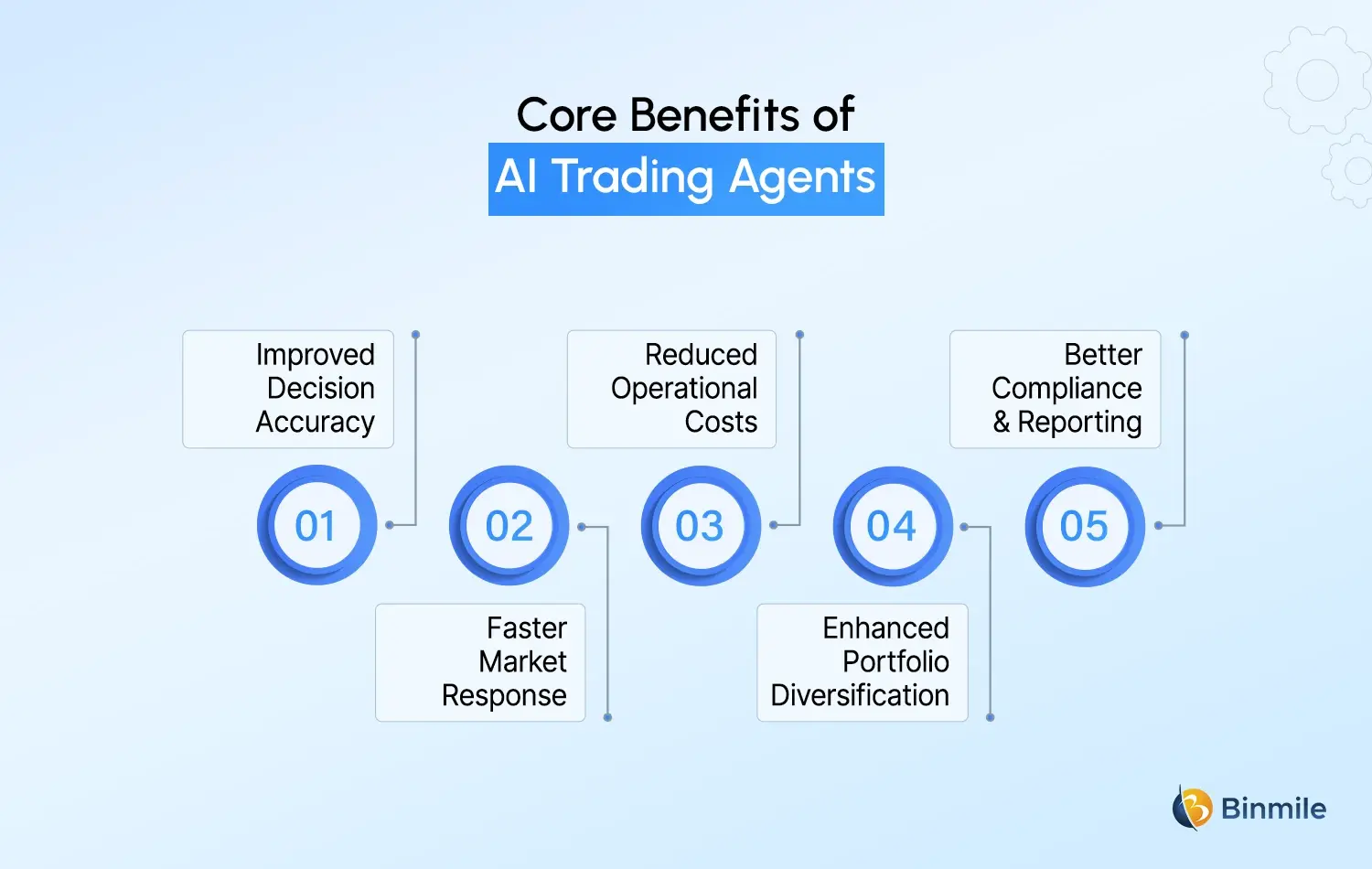
Improved Decision Accuracy
AI-powered trading solutions base their decisions on logic rather than sentiment analysis. Additionally, they identify key trading patterns using historical as well as current trading data and analyze them to make decisions. Furthermore, this leads to improvement in the predictions of the trading patterns and removes the chance for human error and sentiment bias.
-
Faster Market Response
AI trading applications react to market movements automatically and make decisions as the movements happen. They make trades on their own as instantaneously as the market movements. Additionally, this leads to the capture of trades at the best moment and the avoidance or controlled mitigation of losses due to market volatility.
-
Reduced Operational Costs
AI trading solutions require little human effort to monitor and execute the trades. They take over the manual trading and repetitive trading tasks. Additionally, this leads to the optimization of the organizational resources.
-
Enhanced Portfolio Diversification
AI agents analyze a greater number of asset classes and their interrelation. This leads to greater and more improved diversification of the investments. Furthermore, it provides the improved balancing of returns and the correspondingly associated risks.
-
Better Compliance and Reporting
Integrations for better reporting and compliance of the enterprise trading agents are available. This ensures regulatory alignment, improves transparency, and simplifies audit processes.
What are the Use Cases of AI Trading Agents
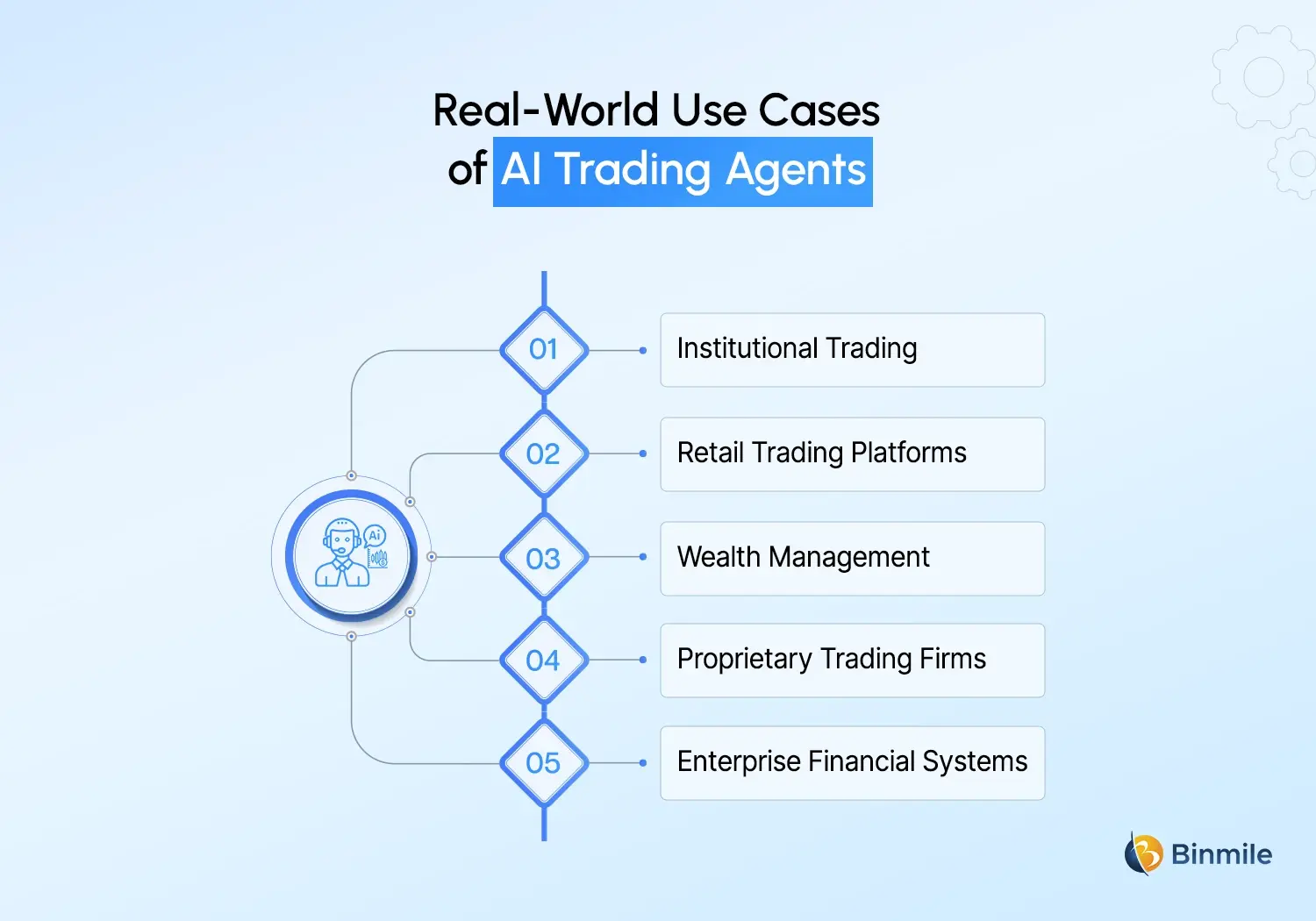
AI trading agents are not limited to hedge funds or investment banks. They are used across different segments.
-
Institutional Trading
Autonomous trading bots are used by large financial institutions to facilitate large-scale trading and liquidity management across various market regions.
-
Retail Trading Platforms
Through simplified dashboards, retail investors can trade using algorithms via generative AI in financial services trading applications.
-
Wealth Management
Advisory companies utilize AI agents in trading to maximize client portfolios and adjust funds in relation to risk.
-
Proprietary Trading Firms
The most sophisticated algorithmic trading companies employ AI to enhance algorithms used in algorithmic trading to gain an edge in turbulent markets.
-
Enterprise Financial Systems
Businesses with surplus capital incorporate AI trading agents to automate treasury and investment functions within protected enterprise financial systems.
Looking to build intelligent AI trading agents that enhance speed, accuracy, and risk management in your financial operations?
How the Right Technology Partner Makes the Difference
Building AI trading agents with top-tier performance demands not just knowledge in AI and financial software development, but also specific domain knowledge in applicable law. Thus, it is not only an issue of creating algorithms, but also engineering systems that are scalable, secure, and additionally, can be developed in a manner that meets regulatory compliance.
This is where the experience of AI development companies is essential. From the right partner, one can expect that AI trading automation can be developed in a manner that optimally fulfills the goals of the trading and financial institution.
Binmile, with its expertise in Artificial Intelligence as a Service, advanced analytics, and cloud-native development, helps businesses develop AI-powered trading solutions that are secure, intelligent, and scalable. Additionally, whether it is a stock-trading app, a custom AI-powered trading agent, or agentic AI in payments and financial ecosystems, the goal is to enhance performance and deliver value in the long run.
The combination of advanced technical skills and a deep understanding of the financial domain empowers businesses to implement AI trading agents. Additionally, this enhances trading performance and responsibly improves risk management.
Frequently Asked Questions
AI trading agents are intelligent software systems that analyze market data, predict price movements, and execute trades automatically or assist traders in decision-making using machine learning and advanced analytics.
They enhance efficiency by processing large datasets in real time, reducing emotional bias, executing trades instantly, and optimizing strategies through continuous learning and automated risk management mechanisms.
No, while institutions widely use them, AI trading apps and AI stock trading app platforms now allow retail investors and fintech startups to access AI-powered trading capabilities.
Yes, modern AI trading risk management modules continuously monitor portfolio exposure, volatility, and liquidity risks, enabling balanced decision-making focused on both risk control and profit optimization.
They do not completely replace human traders. Instead, they complement human expertise by automating repetitive tasks and providing data-driven insights for better strategic decisions.
Implementation timelines vary based on complexity, data availability, and integration needs. A basic solution may take a few months, while enterprise-grade systems can require longer development and testing cycles.
Financial markets use predictive agents, reinforcement learning-based autonomous trading agents, sentiment analysis agents, and hybrid decision-support agents tailored for specific trading strategies and risk profiles.