AI-powered mobile apps are no longer limited to innovation labs or experimental projects. According to Grand View Research, the global artificial intelligence market is projected to reach over USD 84.97 billion by 2030, with mobile applications playing a critical role in this expansion due to widespread smartphone adoption and real-time data availability.
This impressive acceleration illustrates a distinct change in the attitude companies have towards digital mobility. This blog discusses the phenomenon of AI-powered mobile apps, the business functions that gain the most advantages, the reasons why companies have a strong commitment to the development of AI mobile applications, and how these applications facilitate increased interaction and provide tangible returns on investments in various fields.
What Are AI-Powered Mobile Apps?
AI-powered mobile apps are applications that use artificial intelligence to learn from user behavior, analyze data, and make intelligent decisions without constant human input. Unlike traditional apps that follow fixed rules, these apps adapt over time and respond dynamically to user needs.
The incorporation of machine learning, computer vision, predictive analytics, and natural language processing empowers developers to personalize tasks, automate processes, and make real-time decisions with AI in mobile apps. Fraud detection, voice interaction, and product suggestion based on user history are all features of AI apps in Android. The intelligence works in the background, and users get an efficient and advanced experience.
Companies are going beyond the most obvious forms of automation as AI technology progresses. The more advanced, intelligent mobile experience offers them new opportunities to deliver value, and users are interacting with apps in ways that were previously unimaginable.
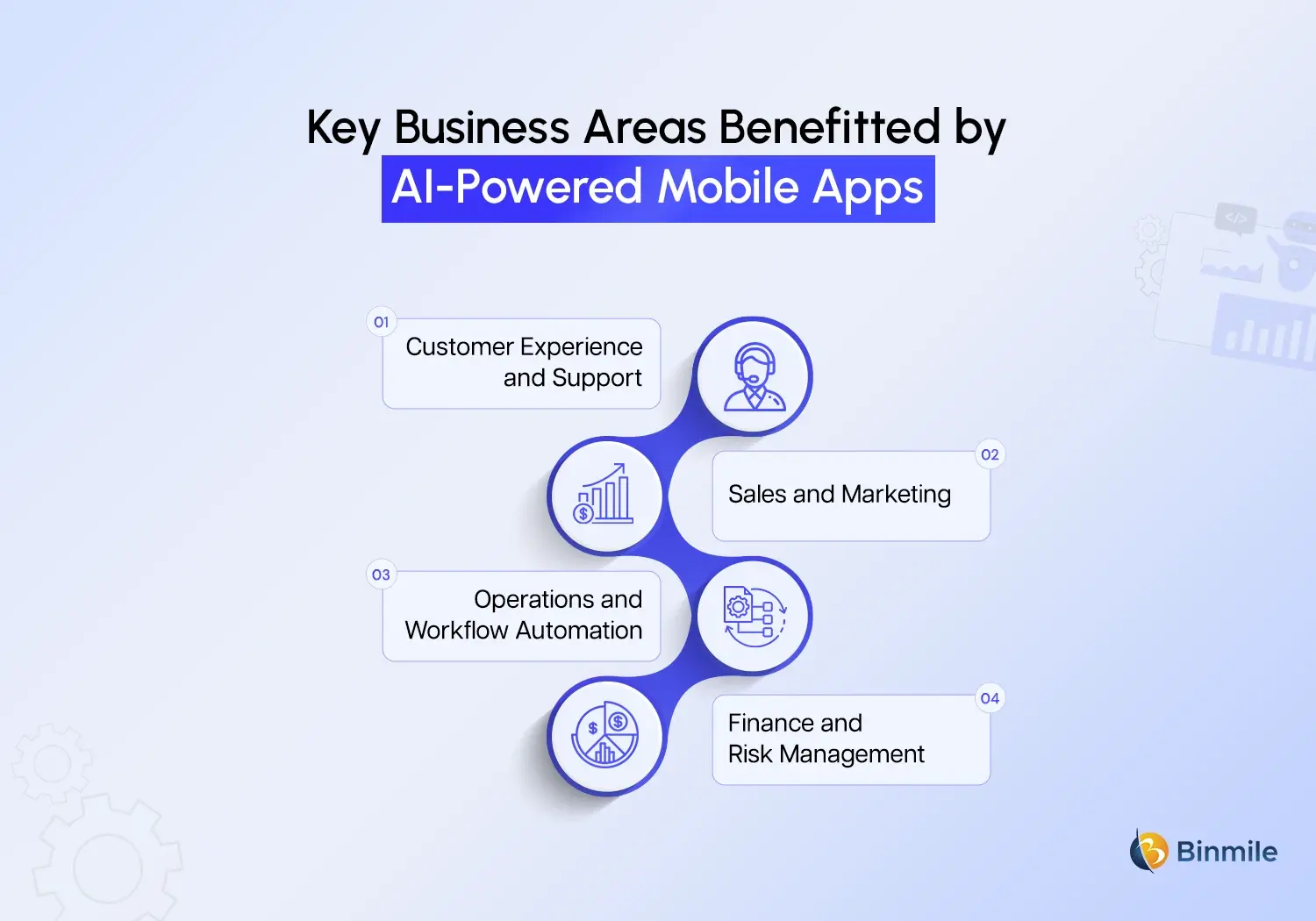
Which Business Functions Benefit Most from AI-Powered Mobile Apps?
AI-powered mobile apps create impact across multiple business functions, not just customer-facing areas. Their ability to process large volumes of data and act on insights makes them valuable across departments.
-
Customer Experience and Support
Businesses have been able to customize the app experience to fit the needs and user patterns based on behavior, preferences, and intent through AI user personalization. AI enables mobile app environments to supplement relevance while decreasing friction through personalized dashboards and intelligent recommendations.
Customer support has been automated through AI-powered virtual assistants and chatbots, which have now become a common feature of many mobile applications. They quickly respond to and resolve customer issues without the need for human intervention, which results in fast support and increased customer satisfaction.
-
Sales and Marketing
Sales and Marketing Teams have also been able to experience the benefits of AI-powered mobile applications. They can analyze user journeys and predict a possible future buying action. These AI applications have been able to recommend products in eCommerce and retail, offer personalized triggers, and even optimize pricing based on demand behavior.
The AI in mobile app development enables more intelligent target marketing for campaigns. Behavioral in-app analysis allows businesses to target messaging more effectively. This increases messaging effectiveness and conversion while decreasing customer acquisition costs.
-
Operations and Workflow Automation
AI mobile app development focusing on Automation and predictive insights also greatly enhances the internal operations. AI mobile app solutions can predict the future inventory needs of an organization, optimize logistics, and uncover process bottlenecks.
With scalable cloud infrastructure supporting AI workloads, enterprises can ensure their mobile applications remain responsive even during peak usage.
-
Finance and Risk Management
AI in finance apps enables real-time fraud detection, expense categorization, and predictive financial analysis. These AI-powered mobile apps help businesses identify anomalies early and make informed decisions faster.
For enterprises dealing with sensitive financial data, AI-based mobile apps add an extra layer of intelligence that improves accuracy and compliance.
Why are Enterprises Investing in AI-Powered Mobile Apps?
Enterprise investment in AI-powered mobile apps is driven by a combination of competitive pressure, evolving user expectations, and the need for operational efficiency.
-
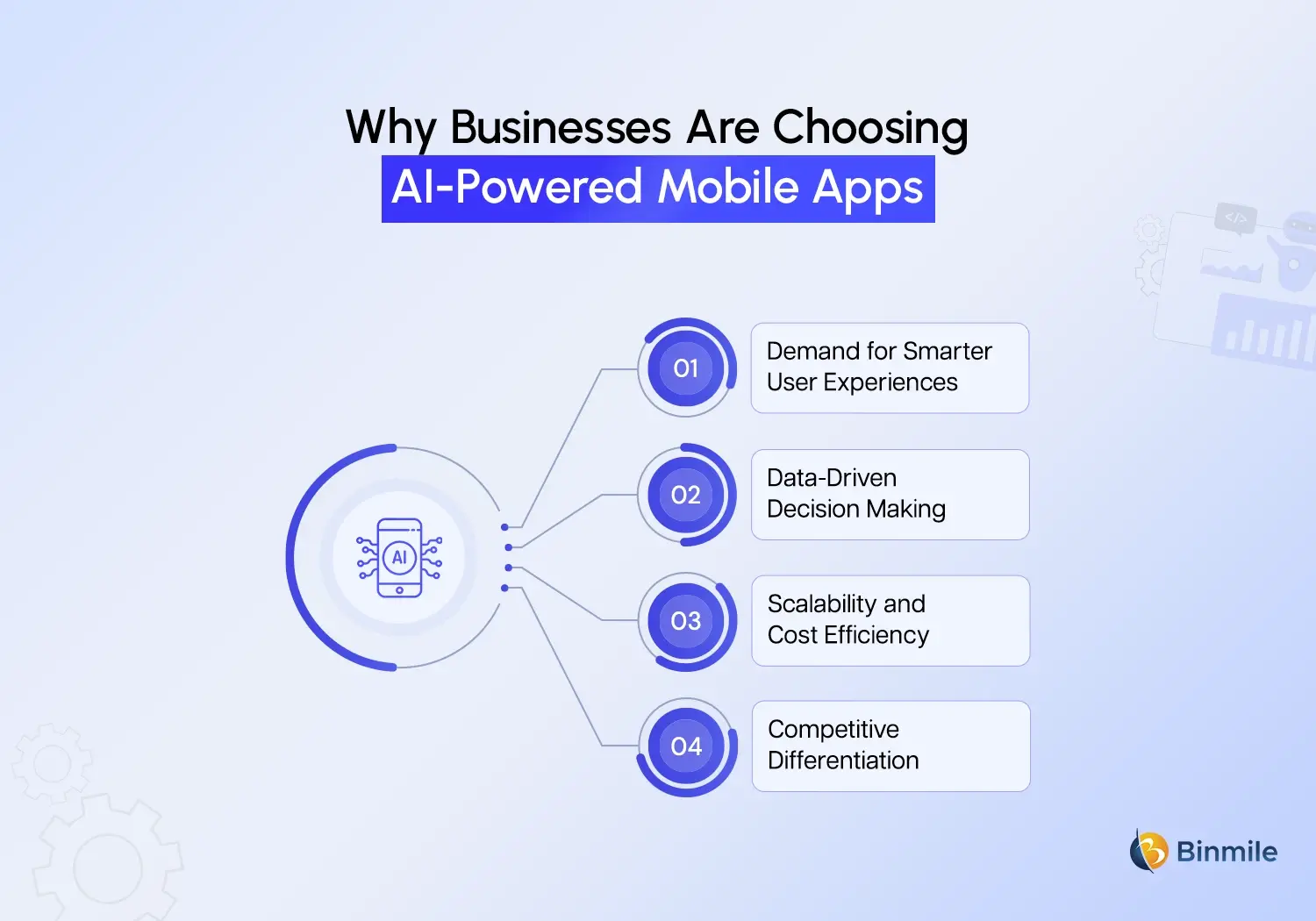
Demand for Smarter User Experiences
Consumers have gotten accustomed to mobile applications acting on their requests and preferences on demand and instantaneously. These users expect tailored experiences. Businesses should utilize AI Mobile App Development to provide users with the experiences they expect.
Artificial Intelligence has become the baseline expectation in many applications and services, such as tailored recommendations in the best Artificial Intelligence apps for Android, and the dynamic enterprise dashboard, for example.
-
Data-Driven Decision Making
Businesses today produce enormous quantities of information and data through their mobile and handheld devices. AI-powered Mobile Apps analyze and make sense of the data to provide businesses with insights that would have otherwise remained undiscovered. Businesses make quicker, better decisions by predicting the future and finding patterns.
AI-powered mobile apps constantly learn from their users, which is the primary differentiator from traditional apps.
-
Scalability and Cost Efficiency
The advancement of AI app development services for mobile makes it possible for businesses to automate previously manual processes. This results in much lower operating costs along with better enterprise flexibility and processes with the passage of time.
AI in Mobile app development and cloud-native architectures provides the enterprises with the ability to improve and change their apps more frequently without the need for major new infrastructure in order to improve and change their apps.
-
Competitive Differentiation
In crowded digital markets, differentiation is critical. AI-based mobile apps help businesses stand out by offering smarter features, proactive support, and seamless experiences.
Enterprises that adopt AI mobile technology early are better positioned to adapt to market changes and customer demands.
Looking to build an intelligent mobile experience to turn AI-driven ideas into enterprise-ready mobile apps?
How Do AI-Powered Mobile Apps Improve User Engagement and ROI?
User engagement and return on investment are closely linked, and AI-powered mobile apps directly influence both.
-
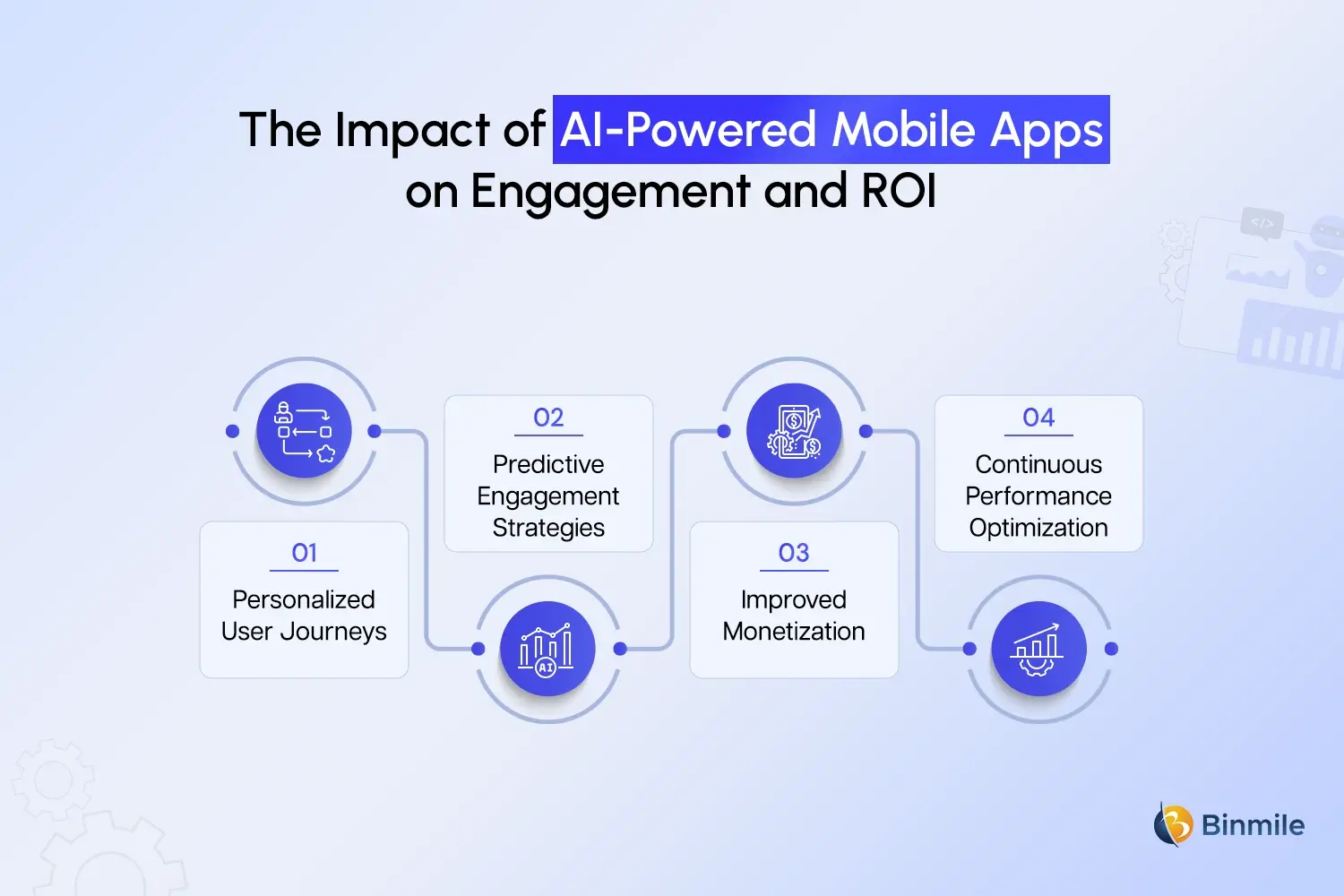
Personalized User Journeys
When artificial intelligence is utilized for personalization, users see relevant content, features, and recommendations. This ultimately extends their active session and minimizes the possibility of users dropping off.
AI applications in mobile environments examine user data and modify display screens in real time. Feelings of being understood by the system create a foundation of loyalty and trust.
-
Predictive Engagement Strategies
Artificial intelligence in mobile applications can foresee which users are at risk of dropping off and implement proactive measures in the form of customized alerts and offers. This prevents users from disengaging.
AI-powered applications create relevant business value by learning and anticipating user issues.
-
Improved Monetization
AI in mobile and web applications for retail and eCommerce enhances revenue generation by optimizing recommendations and pricing strategies based on data. This leads to a greater revenue per order value. Intelligent data-driven upselling and cross-selling instill focus rather than guesswork.
AI-driven mobile apps assist businesses in pinpointing users with a higher propensity for value, thus optimizing their resource allocation for maximum returns.
-
Continuous Performance Optimization
With the emergence of these applications, mobile artificial intelligence solutions can now improve with use. Machine learning models retrain at their own autonomy based on user data, optimizing without the need for continuous rebuilding.
This self-sustaining cycle, complete with user data, fuels long-term sustained growth and ROI.
Planning to integrate AI into your mobile strategy for better engagement and ROI?

How a Trusted Partner Can Help in Strategic AI Mobile App Development
The success of AI-powered mobile apps depends not just on the technology but on how well it aligns with business goals. A well-planned AI mobile app strategy considers scalability, security, and future readiness from the start.
Organizations that approach AI app development with a long-term vision benefit from better integration, smoother adoption, and stronger outcomes. This is where experienced development partners play a critical role. Teams that understand enterprise ecosystems, cloud scalability, and real-world AI implementation help translate ideas into reliable mobile solutions.
Through a combination of technical expertise and industry understanding, companies like Binmile, a leading mobile application development company, support enterprises in building AI-powered mobile apps that are secure, scalable, and aligned with business growth objectives. Rather than focusing on isolated features, the emphasis remains on creating intelligent mobile experiences that evolve with user needs and market demands.
Frequently Asked Questions
Yes. AI-powered mobile apps are highly suitable for enterprises as they support scalability, data-driven decisions, automation, and personalization. They integrate well with enterprise systems and help improve efficiency, user engagement, and long-term business performance.
An AI mobile app development company brings expertise in data science, cloud infrastructure, and security. This ensures faster development, reduced risks, and reliable AI integration aligned with business goals and compliance requirements.
AI-powered mobile apps commonly use machine learning, natural language processing, computer vision, predictive analytics, and cloud-based AI services. These technologies enable automation, personalization, real-time insights, and intelligent decision-making.
They collect user data, process it using AI models, and generate insights or actions in real time. Over time, these apps learn from user behavior and continuously improve accuracy, relevance, and performance.
Traditional apps follow fixed rules, while AI-powered mobile apps adapt based on data. They personalize experiences, predict user needs, and improve automatically, offering smarter and more responsive functionality.
Common types include machine learning for predictions, natural language processing for voice and chat features, computer vision for image recognition, and recommendation engines for personalization.
AI App Development Cost varies based on app complexity, AI features, data requirements, and integrations. Simple AI features cost less, while advanced enterprise-grade solutions require higher investment.
They deliver personalized experiences, proactive support, and relevant content. By understanding user behavior and addressing needs early, AI-powered mobile apps build loyalty and encourage long-term engagement.