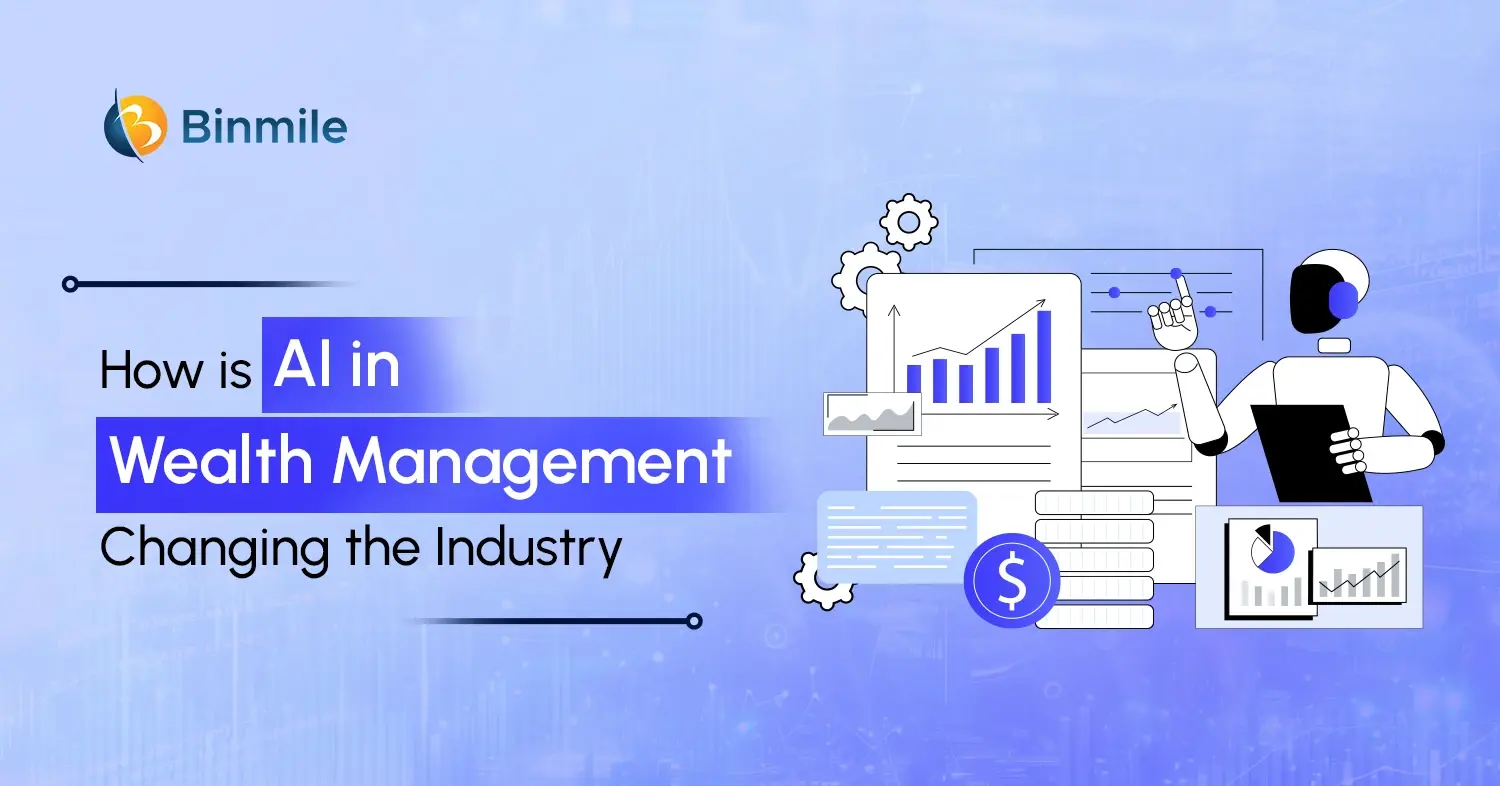
Artificial intelligence has moved from being an optional experiment to a strategic necessity for wealth management firms. According to a McKinsey report, AI-driven personalization can increase revenues for financial services firms by 10 to 15 percent by improving client engagement, advisory accuracy, and investment outcomes.
This shift is driven by changing client expectations, growing data volumes, and increasing regulatory complexity in the finance industry. In this blog, we explore the role of AI in wealth management, its benefits, how it compares with traditional models, the top AI use cases in wealth management, best practices for adoption, and how firms can move forward with confidence.
Understanding AI in Wealth Management
At its core, AI in wealth management refers to the use of intelligent systems that analyze vast volumes of financial data, identify patterns, and support decision-making across advisory, portfolio management, and operations.
Traditional wealth management relied heavily on manual research, static models, and advisor intuition. While experience still matters, AI-powered automation in wealth management platforms adds speed, scale, and accuracy to the process.
AI systems continuously learn from new data. They adapt to changing market conditions, client behavior, and risk signals without needing constant reprogramming. This ability makes AI-powered wealth management especially valuable in volatile markets.
What is the Role of AI in Wealth Management
The role of AI in wealth management goes beyond automation. It acts as an intelligence layer that supports advisors, strengthens decision-making, and improves operational efficiency across the wealth lifecycle.
-
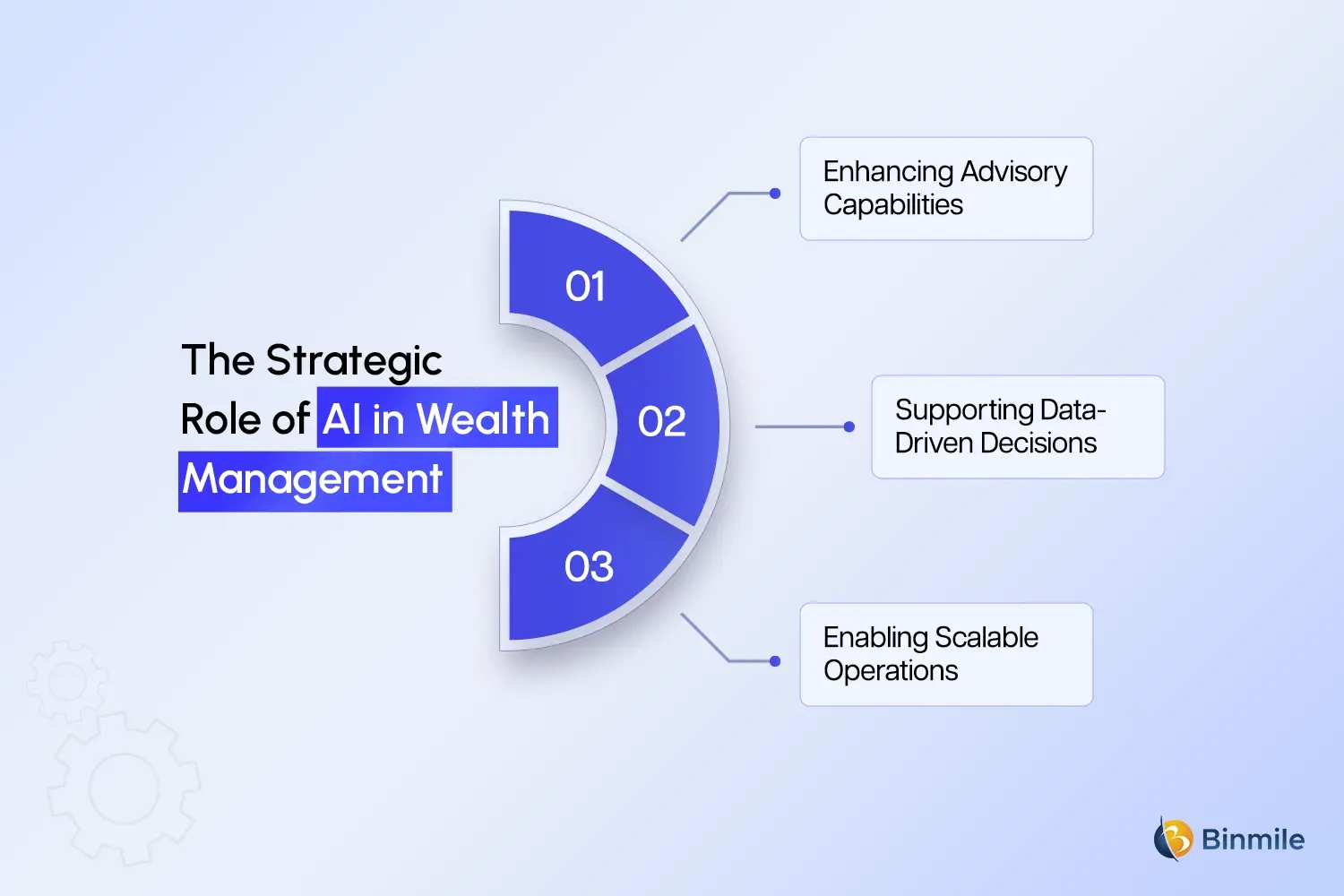
Enhancing Advisory Capabilities
AI for wealth management gives advisors the ability to evaluate and summarize large amounts of data with market conditions, customer details, and portfolio performance coinciding with the customer’s company. Instead of relying on past performance, advisors use insights that reflect market conditions, customer behaviors and give advice that is more precise and timely.
-
Supporting Data-Driven Decisions
Machine learning in wealth management is used to identify data patterns and correlations to support evidence-based decision-making. Predictive analytics support evidence-based decision-making by predicting potential risks associated with investing and movement within the portfolio. Predictive analytics and scenario modeling help advisors form and complete a strategy that is less biased and more consistent.
-
Enabling Scalable Operations
AI-based wealth management systems allow firms to utilize customer management on a large scale without the need to improve the relationship management process. Systems of AI-based wealth management systems allow the advisor to concentrate on the KYC process, relationship development, and the long-term operational management of the systems.
What are the Benefits of AI in Wealth Management
AI wealth management delivers measurable benefits across advisory, operational, and compliance functions.
-
Personalization at Scale
Using AI, firms can recommend personalized portfolios aligned with goals, risk appetite, and behavioral insights. More meaningful and personalized financial planning conversations can result from rebalancing portfolios as life events and market conditions change.
-
Operational Efficiency
In wealth management, time-consuming tasks such as reporting, onboarding, and data reconciliation can be automated with AI, resulting in fewer manual processes. Coupled with robotic process automation, firms experience shorter turnaround times, lower operational costs, and better accuracy in processes.
-
Improved Risk and Compliance Management
AI can strengthen compliance and risk management by monitoring portfolios, transactions, and communications in real time. This proactive approach helps identify and mitigate risk, keeping the finance industry’s shifting regulatory landscape in mind.
Traditional Wealth Management VS AI in Wealth Management
Understanding the difference between traditional and AI-driven models highlights why adoption is accelerating.
| Aspect | Traditional Wealth Management | AI in Wealth Management |
|---|---|---|
| Decision-making | Manual analysis and experience-driven | Data-driven and predictive |
| Personalization | Limited and segmented | Deep, real-time personalization |
| Risk monitoring | Periodic reviews | Continuous monitoring |
| Operational processes | Manual and time-intensive | Automated and scalable |
| Client engagement | Reactive | Proactive and insight-led |
While traditional models rely heavily on human expertise, AI applications in wealth management enhance that expertise with speed, accuracy, and scalability.
Ready to modernize your wealth operations with AI-powered automation and smarter decision systems?

What are the Top 10 AI Use Cases in Wealth Management
AI use cases in wealth management focus on solving real operational and advisory challenges.
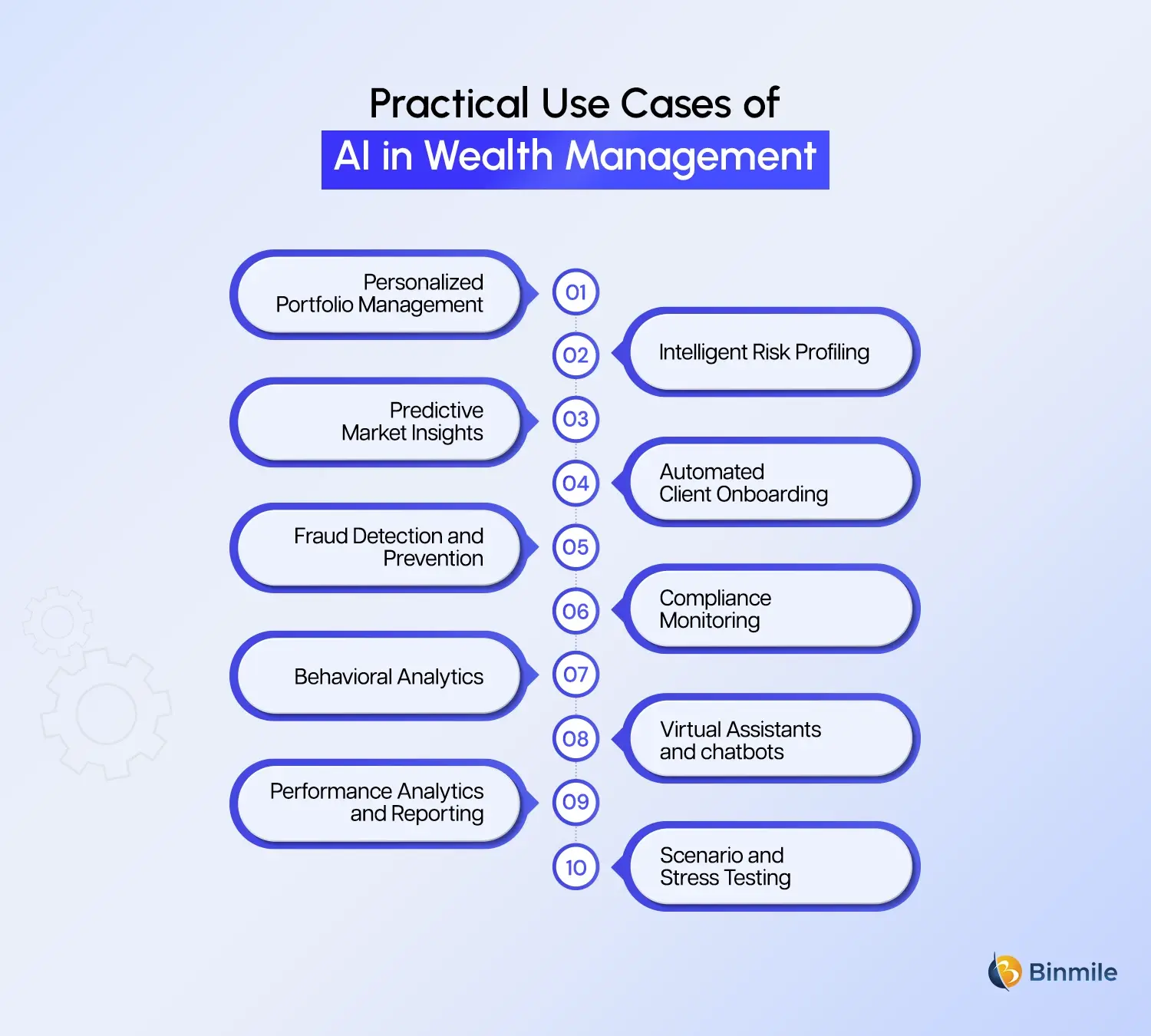
1. Personalized Portfolio Management
Artificial Intelligence reviews trends, correlations, and client preferences to customize and optimize portfolios. Strategies will be aligned to goals, and portfolios will be adjusted accordingly.
2. Intelligent Risk Profiling
Risk assessments are automated through machine learning, with consideration for client preferences, potential volatility, and the behavior of various assets to provide adaptive risk mitigation tactics.
3. Predictive Market Insights
Predictive models are one of the various ways AI in finance firms understand and anticipate shifts in the market by analyzing consistent patterns in data, history, and ongoing economic signals.
4. Automated Client Onboarding
The incorporation of AI and robotic process automation streamlines and accelerates the KYC and account creation processes, reducing the time in order to stay compliant.
5. Fraud Detection and Prevention
AI systems identify unusual patterns and anomalies in transactions, allowing firms to detect and prevent fraud in real time, protecting both assets and reputation.
6. Compliance Monitoring
AI aiding in automated regulatory check compliance to monitor and analyze reporting improves the overall governance and regulatory compliance for the firm.
7. Behavioral Analytics
AI detects when investors display certain behaviors, like panic selling or taking excessive risks. This allows advisors to provide better guidance to clients during difficult market situations.
8. Virtual Assistants and Chatbots
AI virtual assistants respond to clients’ common inquiries about their portfolio, performance, and account details, and provide better and faster service.
9. Performance Analytics and Reporting
AI-powered wealth management software provides better insight to advisors and clients regarding performance versus goals, in order to track progress.
10. Scenario and Stress Testing
AI helps firms focus on the unknown by analyzing different market situations and stress scenarios to test the strength of the investment strategies.
What are the Best Practices for AI in Wealth Management
Successful AI adoption requires a structured and responsible approach.
-
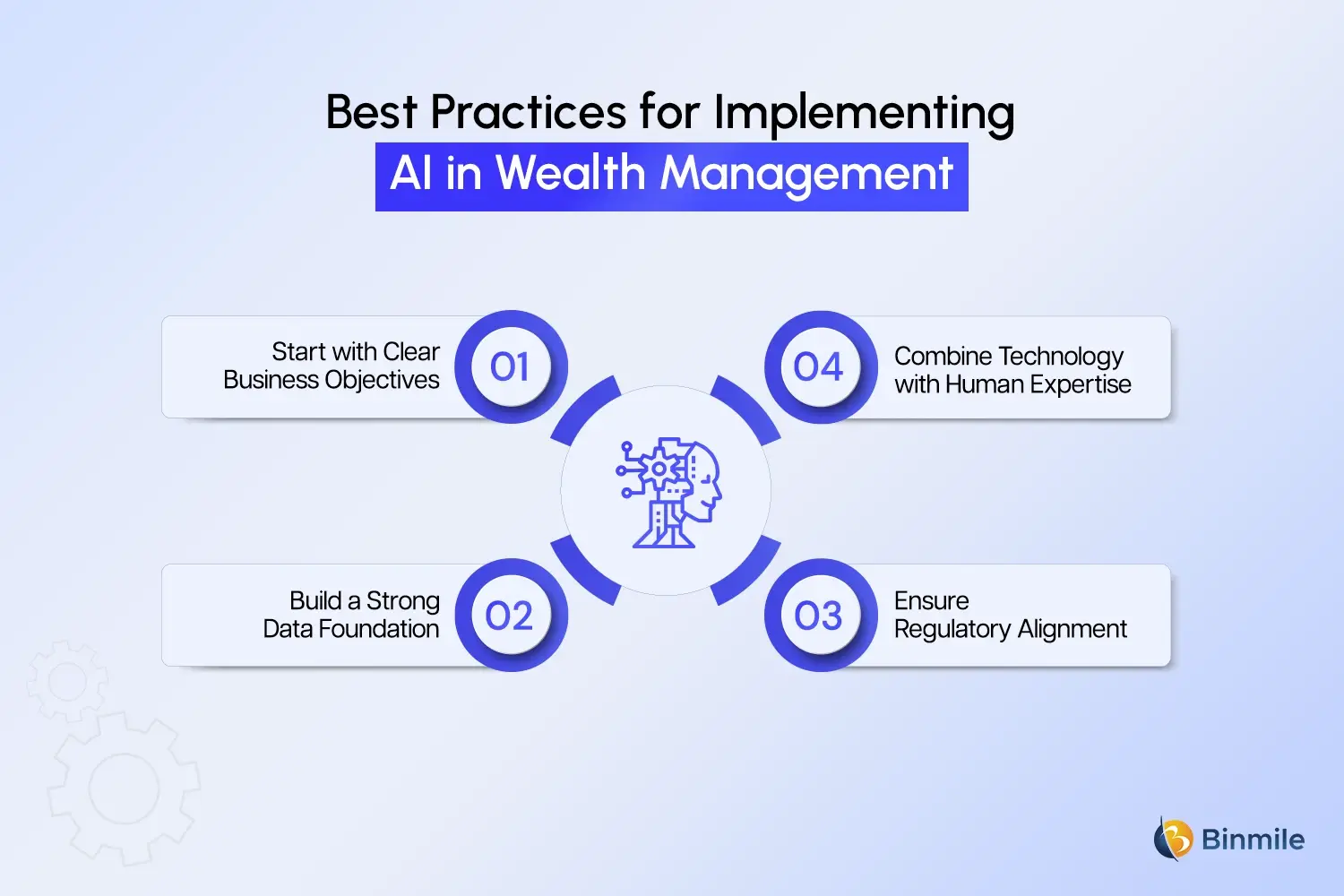
Start with Clear Business Objectives
Before firms implement any AI solutions, they need to narrow their focus to definable objectives, such as ensuring measurable outcomes, automation of compliance, or improving operational efficiency.
-
Build a Strong Data Foundation
For outcomes to be reliable, data needs to be secure, of high quality, and well governed. No matter how advanced, AI models provide limited value without a robust data foundation.
-
Ensure Regulatory Alignment
To prevent compliance and governance issues, the AI models in use must be explainable, transparent, and aligned with the models of regulation governing the institution.
-
Combine Technology with Human Expertise
AI must augment advisory functions as opposed to diminishing them. Automation of judgment skills is not desirable in areas of trust and ethics or to provide sophisticated financial advice.
Looking to build intelligent wealth management platforms that combine automation, compliance, and personalization?

How Binmile Supports AI Adoption in Wealth Management
AI is no longer an emerging trend in wealth management; it is becoming a core capability. From smarter portfolio decisions and personalized advisory services to risk management in software development and compliance automation, AI is reshaping how wealth managers operate, scale, and serve clients. Firms that adopt AI strategically can improve efficiency, deliver better client experiences, and stay competitive in an increasingly data-driven financial ecosystem.
Binmile supports wealth management firms in adopting AI in a practical, secure, and scalable way. With deep expertise in AI development, data engineering, and financial technology solutions, Binmile helps organizations identify high-impact AI use cases, integrate AI into existing wealth platforms, and ensure regulatory compliance throughout the process.
From building AI-powered advisory tools and portfolio analytics to automating operations and enhancing client engagement, Binmile works as a technology partner focused on long-term value creation. By aligning AI initiatives with business goals, Binmile enables wealth managers to move beyond experimentation and achieve measurable outcomes from their AI investments.
Frequently Asked Questions
AI is enabling personalized portfolios, real-time risk analysis, automated compliance, and data-driven advisory services. It helps firms scale services while improving decision accuracy and client experience.
Portfolio optimization, risk profiling, fraud detection, client onboarding, and compliance monitoring see the highest impact due to AI’s ability to process large datasets quickly and accurately.
AI supports advisors with insights, predictive analytics, and behavioral analysis, allowing them to focus on strategic guidance while reducing manual research and operational workload.
AI improves efficiency, enhances client trust, reduces risk exposure, and enables firms to stay competitive in a rapidly evolving finance industry.
AI continuously monitors transactions and behaviors, flags anomalies, and ensures consistent documentation, helping firms proactively manage regulatory and operational risks.
By analyzing vast data sets and simulating scenarios, AI reduces bias and enables faster, more informed investment and advisory decisions.
Firms managing complex portfolios, scaling advisory services, or seeking operational efficiency should consider AI-driven solutions to stay competitive.
AI consulting aligns technology with business goals, identifies high-impact use cases, ensures compliance readiness, and reduces implementation risks.